If you searched “Kumon Japanese”, there is a good chance you are looking at two completely different programmes without knowing it — and the one most parents abroad assume they are signing up for is not available where they live.
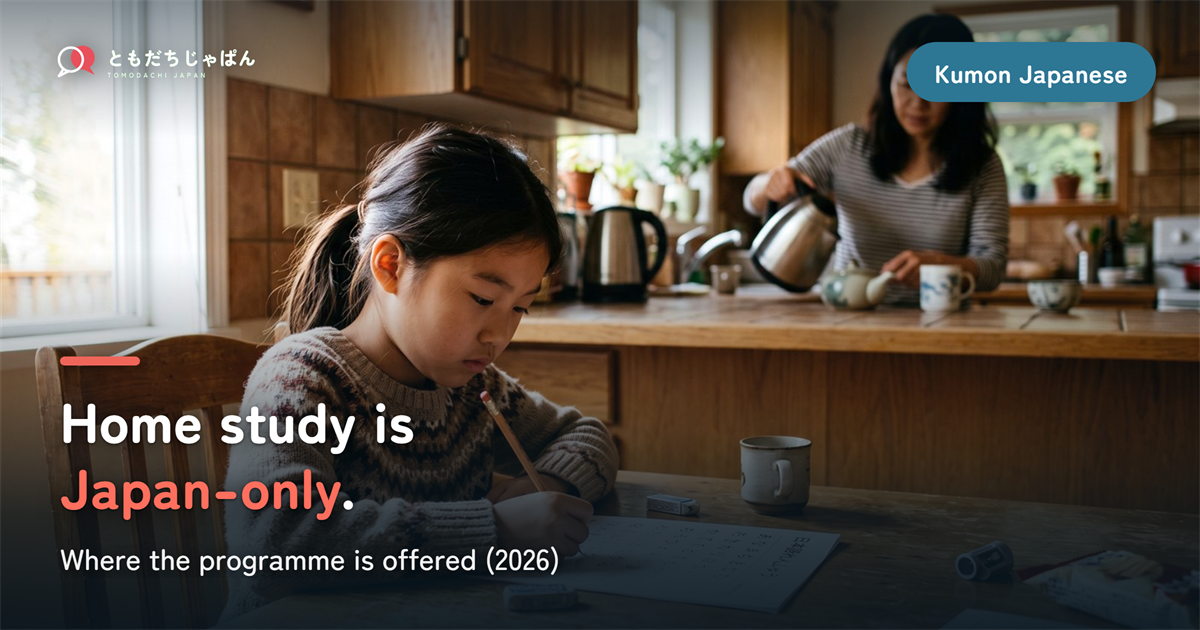
Here is the short version, taken from Kumon’s own pages. Kumon’s Japanese Language Program — the one built for non-native learners — is offered in Japan, Australia and Brazil. And its home-study version is, in Kumon’s words, “for Japanese residents only.” If you are raising a child in Singapore, London, Seattle or Dubai, that single sentence decides most of the question for you.
There are two Kumon Japanese programmes, and they are not the same

This is the part that causes the confusion, and it is worth getting straight before you contact anyone.
- The Japanese Language Program (JLP) — designed for non-native speakers. Worksheet instructions are printed in English, Portuguese or Chinese, with audio recorded by native speakers. This is the programme people mean when they say “Kumon Japanese.”
- The Kokugo programme (国語) — Kumon’s native-speaker Japanese, the same subject children study at school in Japan. Availability varies from centre to centre, so this one is a question for your local Kumon centre rather than a global answer.
Which one fits depends on something you already know: does your child speak Japanese at home? A child who chats with a Japanese parent every day but cannot read is a Kokugo question. A child starting from hiragana is a Japanese Language Program question.
Wondering what to add once the app runs out?
TOMODACHI JAPAN is an online Japanese school for children growing up outside Japan. They talk with peers their own age in Japan every day, taught by teachers working at Japanese schools, in small classes of 8.
🎁 Register and we’ll email you our School Guide (PDF, in English) straight away. You’ll also be first to hear about tuition, scholarships and opening dates.
Free · takes about 30 seconds
Where the Japanese Language Program is actually offered
Kumon’s own FAQ for the Japanese Language Program states that the programme “is also offered in Australia and Brazil” alongside Japan. It also draws a hard line around the home-study option: the correspondence course “is for Japanese residents only. You are not able to join the course in countries other than Japan.”
So for most families outside Japan, the honest position is this: you cannot simply order the Japanese Language Program worksheets to your address abroad and work through them at the kitchen table. If you are in Australia or Brazil, a local centre may be able to enrol you. Everywhere else, it is not on the menu.
Programmes and country coverage do change. Check Kumon’s own pages and ask your nearest centre before you plan around any of this — we would much rather you verify than take our word for it.
The entry requirement almost nobody mentions
This is the detail that changes the answer for parents of younger children. Kumon’s FAQ describes who the Japanese Language Program is for like this: “Anyone who has the grammatical ability equivalent to that of 5th and 6th graders in their native language is able to study with our program.”
Read that again with your own child in mind. The gate is not age — it is grammatical maturity in their first language, at roughly a 10-to-12-year-old’s level. The programme teaches Japanese by explaining it, in English or Portuguese or Chinese, on paper. A six-year-old who cannot yet parse a grammar explanation in any language is not the learner this material was written for.
That is not a flaw. It is a design decision, and a sound one — it is exactly why the programme works so well for the learners it was built for.
What Kumon Japanese is genuinely excellent at
We are not going to be coy about this. Kumon has been refining this method for decades and it does several things better than almost anyone:
- Genuinely small steps. The Japanese Language Program runs across 15 levels, from 4A to L, built out of around 3,000 worksheets. The gap between any two consecutive sheets is deliberately tiny, which is why children rarely hit a wall.
- It goes a long way. Levels C through L cover roughly JLPT N5 up to N2. That is not a dabbler’s syllabus — that is most of the way to functional literacy.
- Self-study that actually works. Instructions in the child’s own language plus native-speaker audio means a child can progress without an adult sitting beside them translating every line.
- Reading and writing. Kana, then kanji, then longer texts. This is the part that conversation practice tends to skip.
If your child is eleven, motivated, and you live somewhere the programme is offered — it is a strong choice and we will happily say so.
The one thing worksheets cannot do
Here is the pattern we hear most often from families raising children outside Japan. The child works through the sheets. The reading improves. The kanji count climbs. And then a Japanese grandparent calls, or a cousin visits, and the child goes quiet.
Nothing has gone wrong. Worksheets build knowledge about Japanese with great precision. What they cannot supply is someone on the other side of the sentence — a person their own age, waiting for a reply, who will laugh at the joke or not understand it and ask again. Children keep a language when the language has people attached to it.
Which is why we usually suggest treating these as two halves of one plan rather than rival choices: worksheets for the reading and writing, and somewhere real to use it.
How the options compare
| Kumon Japanese Language Program | Kumon Kokugo (国語) | TOMODACHI JAPAN | |
|---|---|---|---|
| Built for | Non-native learners | Native-speaker children | Children growing up outside Japan |
| Where | Japan, Australia, Brazil | Varies by centre — ask locally | Online, anywhere |
| Home study from abroad | Not available (Japan residents only) | Varies by centre | Yes — it is online by design |
| Typical entry point | Grammar maturity of a 10-to-12-year-old | Follows Japanese school Japanese | Placed by conversation level |
| Reading and writing | Excellent — 4A to L, kana to kanji | Excellent | Taught, but not the main event |
| Someone to talk to | No | No | Peers in Japan, live, every day |
| Format | Worksheets, self-paced | Worksheets, self-paced | Live classes of 8 |

What TOMODACHI JAPAN does
We are an online Japanese school for children growing up outside Japan. We are not a worksheet programme and we are not trying to replace one.
- Children talk with peers their own age in Japan — the thing no worksheet and no one-to-one lesson can manufacture.
- Taught by teachers working at Japanese schools, not by whoever happens to be available.
- Small classes of 8, so a quiet child cannot disappear and a talkative one cannot take over.
- Live, not recorded. Someone notices when your child does not speak.
If your child is already doing Kumon and it is going well, keep doing it. The combination we see working best is worksheets for the written language and a live class for the spoken one.
Frequently asked questions
Can I do Kumon Japanese from home if I live outside Japan?
Not through the Japanese Language Program’s correspondence course. Kumon’s FAQ states plainly that it is “for Japanese residents only.” If you are in Australia or Brazil, ask a local centre about the classroom course instead.
Is my six-year-old too young for Kumon Japanese?
For the Japanese Language Program, most likely yes — the stated entry point is the grammatical ability of a fifth or sixth grader in the child’s own language. The Kokugo programme is a different conversation, and worth raising with your local centre if Japanese is already spoken at home.
How far does Kumon Japanese go?
Levels C to L cover roughly JLPT N5 through N2. Kumon notes that learners aiming beyond that may continue into the Kokugo programme, which is written for native speakers.
What does it cost?
Fees are set locally and change, so any number we printed here would be wrong somewhere. Ask the centre nearest you.
In short
- “Kumon Japanese” is two programmes: the Japanese Language Program (non-native) and Kokugo (native speakers).
- The Japanese Language Program is offered in Japan, Australia and Brazil, and its home-study course is Japan-residents-only.
- The entry point is grammar maturity around age 10 to 12, not a starting age.
- It is outstanding for reading and writing. It does not give your child anyone to talk to.
- Worksheets and a live class are not rivals. Most families we meet need both.