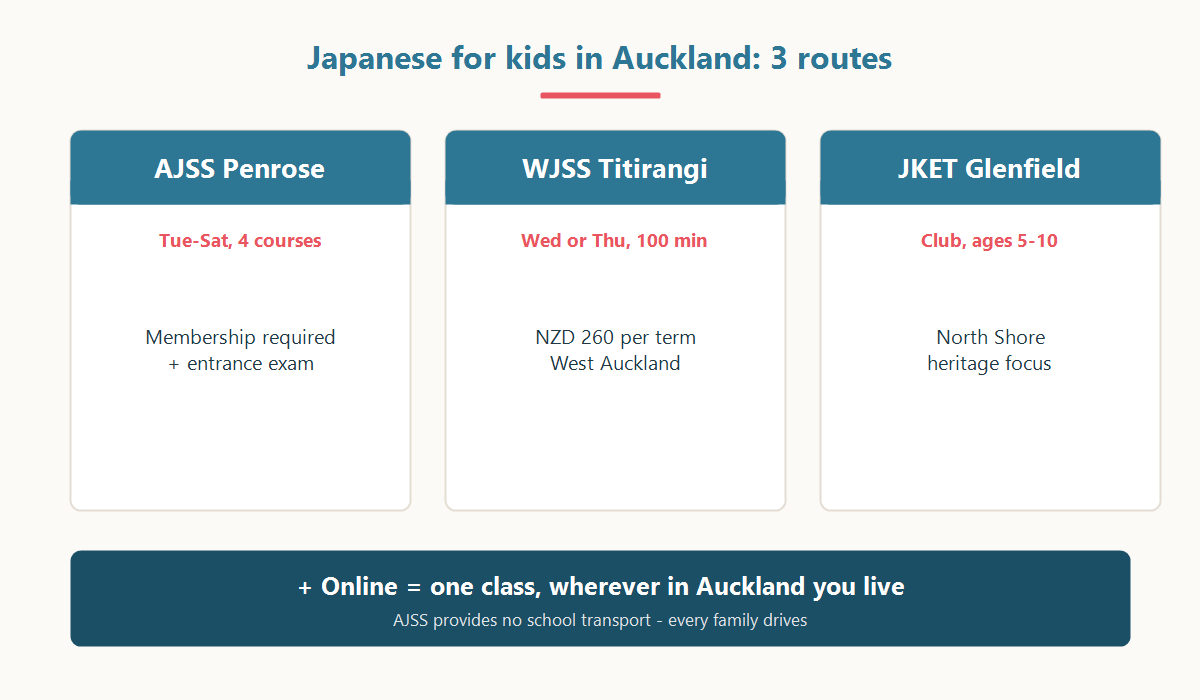
If you are raising a Japanese-New Zealander child in Auckland and you have searched “Japanese supplementary school Auckland”, you have probably found a consulate courtesy page, a couple of directory listings with a phone number and nothing else, and no straight comparison anywhere. Here is the short answer up front. Auckland has one MEXT-listed supplementary school — the Auckland Japanese Supplementary School (AJSS) in Penrose, running four different courses from NZD 110 to NZD 300 a month. It has one community after-school programme in the west, Waitakere Japanese Supplementary School in Titirangi, at NZD 260 a term. It has a beginner Japanese Club for ages 5–10 on the North Shore through Japan Kauri Education Trust. And for a credential there is NCEA Japanese, sometimes accessible through Te Kura by distance. Two things nobody tells you before you ring: AJSS requires membership of a Japanese association, and its main course requires an entrance exam. Here is the full comparison.
Japanese supplementary school in Auckland: the comparison
| School | Type | Day | Ages | Tuition | Area |
|---|---|---|---|---|---|
| Auckland Japanese Supplementary School (オークランド日本語補習学校) | MEXT-listed supplementary school, 4 courses | Tuesday–Saturday (1–3 days/wk by course) | Preschool – junior high | NZD 110–300/month + NZD 200–560 enrolment | Penrose |
| Waitakere Japanese Supplementary School (にじいろ) | Community after-school programme (not MEXT-listed) | Wednesday or Thursday, 16:00–17:40 | Kindergarten – junior secondary (by birth date) | NZD 260/term = NZD 1,040/yr + NZD 100 enrolment | Titirangi (West Auckland) |
| Japan Kauri Education Trust — Japanese Club | Beginner after-school club | After school | 5–10 | Contact the organisation | Glenfield (North Shore) |
| Te Aho o Te Kura Pounamu (Te Kura) | Distance/online: Curriculum Levels 1–5 + NCEA Levels 1–3 | Self-paced | Under 19 | Free for under-19s who meet enrolment/dual-tuition eligibility | Distance |
| Japanese Tutor NZ | Private tutor | Flexible | All ages | Contact the tutor | Online + in person |
| Fun Languages NZ | Community language classes (free trial) | Flexible | Children | Contact the provider | Auckland Central, Eastern Suburbs, North Shore, West Auckland |
| TOMODACHI JAPAN | Online, conversation & friendship | Any day (unlimited attendance) | 5–18 | One flat monthly fee — see the free guide | Your home |
Looking for a way to keep Japanese going from abroad?
TOMODACHI JAPAN is an online Japanese school for children growing up outside Japan. They talk with peers their own age in Japan every day, taught by teachers working at Japanese schools, in small classes of 8.
🎁 Register and we’ll email you our School Guide (PDF, in English) straight away. You’ll also be first to hear about tuition, scholarships and opening dates.
Free · takes about 30 seconds
Three routes to Japanese in Auckland — and why the difference matters
The names all sound the same — supplementary school, Japanese school, Japanese club, hoshuko — but they are doing three completely different jobs. One is trying to keep your child at Japanese national grade level, with an entrance exam to match. One is trying to keep Japanese alive and enjoyable in a community near where you live. One is trying to put a recognised credential on your child’s NCEA record. Most Auckland families need more than one, and they are usually not on the same side of the city.
Route 1: AJSS in Penrose — the MEXT-listed supplementary school
The Auckland Japanese Supplementary School has been running since 1972 and is on MEXT’s official list. It operates out of One Tree Hill College, 421–451 Great South Rd, Penrose, with two entrances and parking at both gates, and it teaches 幼稚部, 小学部 and 中学部 divisions at about ten students per class. It runs Tuesday to Saturday — weekday afternoons from 16:00 to 19:00 or 20:25 depending on the day, and Saturday 09:30–15:00 — and your child attends one to three days a week depending on which of the four courses they are in. It is a serious school doing a serious job, and if your child needs Japanese grade level, it is the best thing in the country.
The four courses are genuinely different products. Course A is for students returning to Japan or entering Japanese schools: elementary on Wednesday and Friday, junior high three days a week, covering 国語, 算数/数学, 理科 and 社会/生活 across 42 weeks a year. It has a real entrance exam — 国語, 作文 (essay) and 面接 (interview) — and the child must be able to follow age-appropriate instruction in Japanese. Course B is for mid-level Japanese, Tuesday and Thursday, 国語 plus 算数/数学, 40 weeks, assessed by interview. Course S is for children with a limited Japanese background, preschool through junior high, Saturday only, 国語 plus 算数/数学, 35 weeks, interview-based. Course S0 is the Saturday preschool class, also interview-based.
Fees, as officially published: enrolment (from April 2025) is NZD 560 for a first child in Course A and NZD 280 for siblings, and NZD 200 for Courses B and S and preschool. Monthly tuition (from April 2026) is Course A NZD 300/month (NZD 3,600/yr), Course B NZD 185 (NZD 2,220/yr), Course S NZD 170 (NZD 2,040/yr), preschool NZD 110 (NZD 1,320/yr). Suspension fees run NZD 5/month for preschool with a three-month minimum, and NZD 10–20/month for elementary and junior high. Entry is accepted year-round, though the school year begins in April. Tel +64 9 526 4471.
Auckland Japanese Supplementary School — official site
Route 2: community programmes near where you live — Titirangi and Glenfield
Auckland is long, and Penrose by 16:00 on a weekday is not realistic from every suburb. That is precisely why the Waitakere Japanese Supplementary School (ワイタケレ日本語補習校, “にじいろ”) exists in West Auckland. It runs at Glen Eden Intermediate School, 23 Kaurilands Rd, Titirangi, on Wednesday or Thursday, 16:00–17:40, once a week through the New Zealand school terms. Places are set by birth date: kindergarten for children born 2 April 2020–1 April 2022, primary 2 April 2014–1 April 2020, junior secondary 2 April 2011–1 April 2014. For 2026, enrolment is a one-off NZD 100, tuition NZD 260 a term (NZD 1,040 a year across four terms and 40 lessons), supplies NZD 100 a year, with a sibling discount of NZD 10 a term for a second child and NZD 20 for a third. Kindergarten entrants need to understand basic spoken Japanese; primary and secondary students need to follow lessons at an age-appropriate level, with some placement flexibility. Parents are expected to engage with Japanese-language communications and Board policies.
One factual difference to be clear about, stated neutrally: WJSS is not on the MEXT list. It is a community after-school programme rather than a MEXT-backed 補習授業校. That is not a criticism — it is a well-run answer to a real geographic problem — but it does mean it is a different category of institution from AJSS, and worth knowing before you compare the fees side by side.
On the North Shore, the Japan Kauri Education Trust at 225 Archers Rd, Glenfield, runs an after-school Japanese Club for children aged 5–10 at beginner level — greetings, numbers, seasons, animals, food, family, crafts, cooking and hiragana recognition. JKET also runs a Japanese children’s library, a Japanese Heritage Centre and four playgroups, serving more than 200 Japanese and Japanese-descendant families. Fees are on enquiry. Worth noting for completeness: the Japanese Society of Auckland does not itself run children’s classes — it runs community events like mochitsuki, Hinamatsuri and Tanabata — but its membership matters, as the next section explains.
Waitakere Japanese Supplementary School — admissions · Japanese Society of Auckland
Route 3: the credential — NCEA Japanese and Te Kura
NCEA Japanese is assessed at Levels 1, 2 and 3 plus New Zealand Scholarship — Level 1 in Year 11, Level 2 in Year 12, Level 3 in Year 13. At Level 1 the externals are AS 91958 (reading, 5 credits) and AS 91959 (listening, 5 credits), with internals AS 91956 (spoken interaction) and AS 91957 (communicate for a chosen purpose). NZQA publishes official vocabulary lists for each level.
If your child’s school does not offer Japanese, Te Aho o Te Kura Pounamu (Te Kura) teaches it by distance: Beginners’ Japanese at Curriculum Levels 1–5 and Japanese at NCEA Levels 1–3, free for under-19s who meet the enrolment and dual-tuition eligibility rules. Read that last clause carefully, because it is the part no competitor states. Te Kura is not open-access. A student at a state school reaches it through dual tuition, via government-funded “gateways” that their own school arranges, and each gateway is capped in the number of funded courses per student. Private-school students have no access to the government-funded gateways at all and must use the fee-paying gateway. Dual-registration applications open in November/December for the following year and close at the end of Term 3, and students must be re-registered every year. In practice this means the “free” route depends on your child’s school agreeing to arrange it, on time.
Five Auckland-specific things to plan around
- AJSS has a membership gate, and it is not on any comparison page. To enrol, your child must be the child of a member of either the Auckland Japanese Economic Discussion Group (二水会 / Nisuikai, a corporate body) or the Japanese Society of Auckland, must live in Auckland or its surrounds, and must currently be enrolled at a local New Zealand school. That is a real prerequisite, not a formality, and it is the first thing to sort out — the JSA membership fee is not published, so you will need to contact the association directly.
- Course A means sitting an entrance exam. The flagship course — the one aimed at children returning to Japan — requires 国語, a written 作文 essay and a 面接 interview, and the child must already be able to follow age-appropriate instruction in Japanese. Courses B, S and S0 are assessed by interview instead. If your child speaks Japanese at home but has never been drilled in writing, plan for Course S or B and build literacy first, rather than being surprised by the assessment.
- There is no school transport, and the three providers are on three sides of the city. AJSS says so plainly in its own FAQ — it is one of the standing parent concerns. Penrose, Titirangi and Glenfield are geographically separated, so your choice is often decided by your postcode rather than your preference. And the time cost is real either way: Course S is Saturday 09:30–15:00, a full day gone, while the weekday courses run straight into Auckland’s evening peak and can finish as late as 20:25.
- Te Kura’s “free” comes with a gate you do not control. Access runs through dual tuition arranged by your child’s school through a funded gateway, with caps on how many courses each student can take. Private-school students are outside the funded system entirely. Applications open November/December and close at the end of Term 3, and re-registration is annual — miss the window and you wait a year.
- NCEA has no separate heritage-speaker stream for Japanese. Unlike the Australian HSC model, NZQA runs one Japanese subject at each level and publishes no background-speaker restriction, so a heritage speaker can be entered for NCEA Japanese standards. But in practice entry is decided by the student’s school, which controls course placement and standard entries. Talk to the head of languages early rather than assuming your child will be slotted in at the right level.
The online option: turning once-a-week into every day
New Zealand’s Japanese community is not a posting-and-return community. Around 21,471 Japanese nationals were reported living in New Zealand as of 1 October 2025 in the MOFA survey — 13th globally, and the first time the country has crossed 20,000, up from 20,318 a year earlier — and that population is reported as exceptionally permanent-resident-heavy, at roughly 60–70%. The 2023 New Zealand Census recorded 19,488 residents identifying with the Japanese ethnic group, median age 28.9, with 11,985 women to 7,405 men. In other words: a lot of Japanese mothers in Japanese–New Zealand families, raising New Zealand-born children who are not going back. Those children need Japanese as a living heritage language, plus a credential at the end — which is a different problem from the one a supplementary school was originally built to solve. It is the same gap we cover in our guide to the online alternative to Japanese hoshuko.
- The time difference is close to ideal. Auckland is three hours ahead of Japan, so Japan’s late-afternoon class lands in the Auckland evening — after school, from home. No Great South Rd run at 16:00, no Saturday spent in Penrose, no drive back across the city at 20:25.
- The other children actually live in Japan. TOMODACHI JAPAN runs on NIJIN Academy, with 800+ students, so your child is not practising with other New Zealand children — they are making friends their own age in Japan. For a heritage child who will grow up as a New Zealander, that living connection to Japan and to their own identity is what keeps the language from quietly fading in the teenage years.
- Unlimited attendance, one flat fee, built for children. One flat monthly fee for as many sessions as your child wants — small groups organised by conversation level rather than school grade, taught by qualified, practising Japanese teachers. No term-by-term repurchase, no entrance exam, no membership requirement.
One Saturday in Penrose keeps Japanese ticking over. Five evenings of friends in Japan keep it growing.
FAQ from Auckland families
Do we have to join a Japanese association to enrol at AJSS?
Yes. This is the requirement no other page states, and it surprises people. Your child must be the child of a member of either the Auckland Japanese Economic Discussion Group (二水会 / Nisuikai, a corporate body) or the Japanese Society of Auckland, must live in Auckland or its surrounds, and must currently be enrolled at a local New Zealand school. Sort the membership out first, because it gates everything else. The JSA membership fee is not published anywhere we could find, so contact the association directly to ask.
Is there an entrance exam?
For Course A, yes — 国語, a written 作文 essay and a 面接 interview, and your child needs to be able to follow age-appropriate instruction in Japanese. Course A is designed for students returning to Japan or entering Japanese schools, so that bar makes sense for what it is trying to do. Courses B, S and the preschool class S0 are assessed by interview rather than a written exam, so a child with a lighter Japanese background is not shut out — they simply start in a course built for them. Entry is accepted year-round, although the school year begins in April.
We live in West Auckland and cannot get to Penrose by 16:00. What are our options?
This is exactly the problem Waitakere Japanese Supplementary School was created to solve — Wednesday or Thursday, 16:00–17:40, at Glen Eden Intermediate in Titirangi, at NZD 260 a term with a NZD 100 one-off enrolment fee. It is a community after-school programme rather than a MEXT-listed supplementary school, which is a difference in category, not in care. On the North Shore, Japan Kauri Education Trust in Glenfield runs a beginner Japanese Club for ages 5–10. And because AJSS provides no school transport — the school lists it among parents’ standing concerns in its own FAQ — geography really does decide this for a lot of families. An online class from home is the option that removes the drive entirely.
Can a heritage speaker sit NCEA Japanese?
NZQA sets no published background-speaker restriction and runs no separate heritage-speaker stream for Japanese — unlike the Australian HSC model, there is one Japanese subject at each level. So a heritage speaker can be entered for NCEA Japanese standards. The practical caveat is that entry is decided by the student’s school, which controls course placement and which standards a student is entered for. If your child speaks Japanese at home, raise it with the school’s languages department well before Year 11, and keep the reading and writing growing in the meantime — the externals at Level 1 (AS 91958 reading and AS 91959 listening) reward literacy, not just conversation.