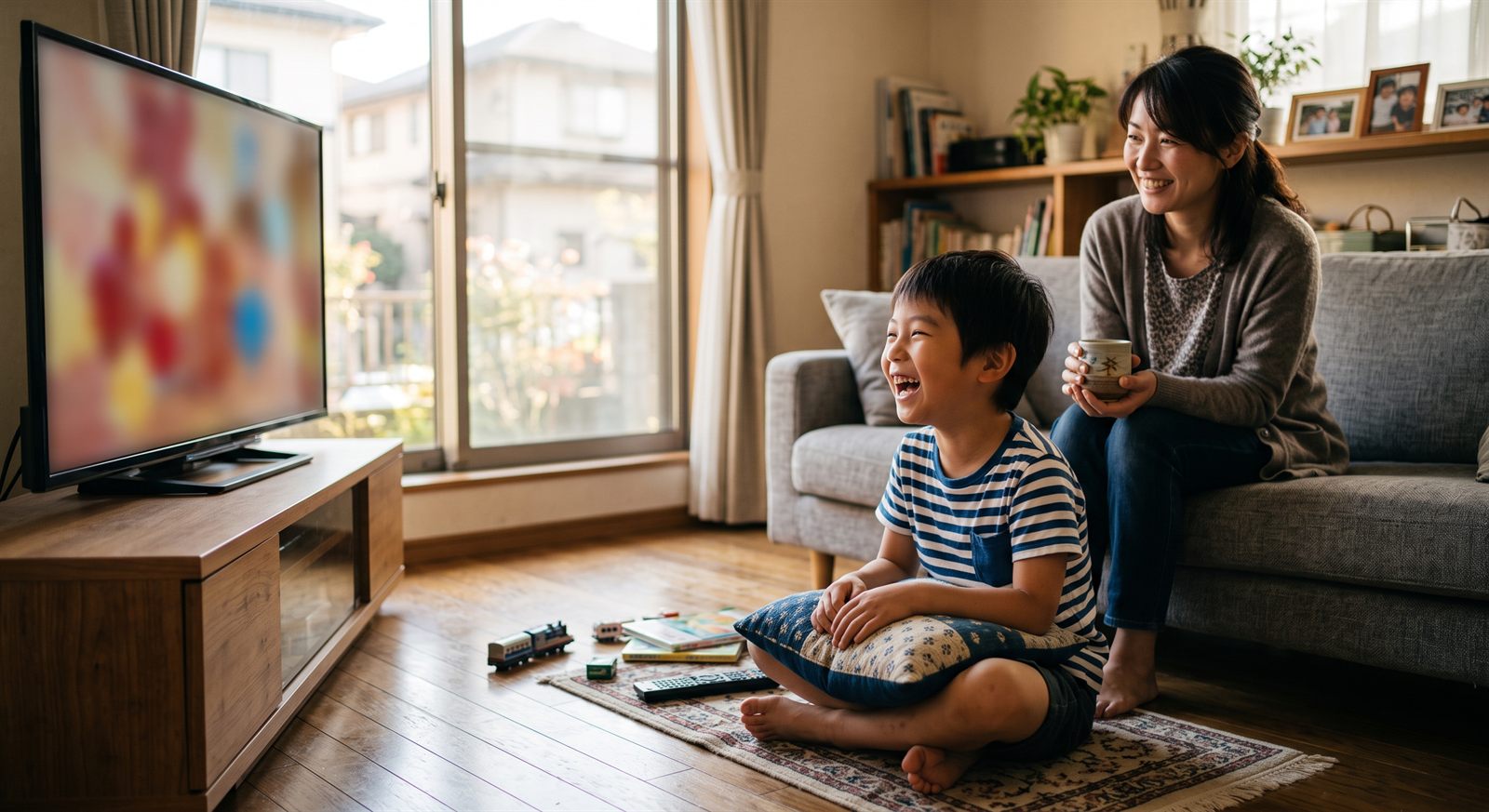
If you want one show to build a child’s Japanese, it is Doraemon. Japanese teachers say this so often it sounds like a cliché, but there’s a concrete reason: almost every episode happens in a house, a classroom, or an empty lot, and the characters talk about homework, dinner, being told off, and wanting something they can’t have. That is exactly the vocabulary a young learner needs, and it’s the vocabulary most anime never covers. I’m a Japanese teacher, and this is Doraemon in Japanese — the name, the characters, and the twelve words your child hears in almost every single episode.
Can-you-use-it legend: ◎ = safe, natural Japanese a child can say to anyone · △ = fine with friends, or only inside the show · ✗ = rude; don’t let it become the model.
How you write Doraemon in Japanese — and why it’s written oddly
Doraemon is ドラえもん, pronounced do-ra-e-mon — four beats, flat, with no stress on any of them. English speakers tend to say “dor-AY-mon”, which is two syllables short of the Japanese.
Look closely at how it’s written and you’ll see something genuinely unusual: ドラ is katakana and えもん is hiragana, inside a single name. Japanese almost never mixes the two scripts within one word, and this is a good early lesson for a child in why each script exists. The two halves come from different places:
- ドラ comes from doraneko (どら猫), an old word for a stray, good-for-nothing cat. Doraemon is a cat-type robot, so the joke is right there in his name. Katakana suits it because it reads as a modern, slightly comic label.
- えもん comes from -emon (衛門), a suffix on old-fashioned Japanese men’s names, the sort a grandfather’s grandfather might have had. Hiragana makes it look traditional and soft.
So the name is roughly “Stray-cat McOldname” — a futuristic robot with a comically antique name. The much-repeated claim that ドラ comes from dorayaki, his favourite red-bean pancake, is the wrong way round: the creator picked a food starting with ドラ because of the name.
Looking for a way to keep Japanese going from abroad?
TOMODACHI JAPAN is an online Japanese school for children growing up outside Japan. They talk with peers their own age in Japan every day, taught by teachers working at Japanese schools, in small classes of 8.
🎁 Register and we’ll email you our School Guide (PDF, in English) straight away. You’ll also be first to hear about tuition, scholarships and opening dates.
Free · takes about 30 seconds
The characters’ names, and what they secretly mean
Japanese children’s names in fiction are usually built to describe the character. Once a child sees this, kanji stops being arbitrary.
| Japanese | Romaji | English | What the name is doing |
|---|---|---|---|
| 野比のび太 | Nobi Nobita | Nobita | From 伸びる (nobiru, to grow, to stretch). His father named him hoping he’d grow up straight and strong — which is quietly funny given how he turns out. |
| 源静香 | Minamoto Shizuka | Shizuka | 静 (shizu) = quiet, calm; 香 = fragrance. A gentle, old-fashioned girl’s name. |
| 剛田武 | Gōda Takeshi | Gian (Giant) | 剛 = strong, 武 = warrior. Every kanji in his name means “tough”. His nickname ジャイアン is just English “giant” in katakana. |
| 骨川スネ夫 | Honekawa Suneo | Suneo | 骨川 = “bone river” (he’s skinny); スネ from 拗ねる (suneru, to sulk). A name that tells you his whole personality. |
| ドラミ | Dorami | Dorami | Doraemon’s younger sister. Same ドラ, with み — a very common ending for girls’ names. |
12 words your child hears in almost every episode
These are the recurring lines. Because Doraemon repeats its situations — Nobita fails a test, gets told off, asks for help, misuses the gadget, regrets it — a child hears each of these hundreds of times. That repetition is the whole reason the show teaches so well.
| Japanese | Romaji | English | Literally / when it’s used |
|---|---|---|---|
| 助けて! | tasukete! | Help me! | “Save (me)” — Nobita’s opening move in most episodes. |
| どうしよう | dō shiyō | What am I going to do? | “How shall I do (it)” — said to oneself, in a panic. |
| 宿題 | shukudai | homework | “Assigned task” — 宿 (home) + 題 (topic). |
| テスト | tesuto | test | English loanword in katakana. Usually followed by 0点 (zero-ten, zero marks). |
| 0点 | zero-ten | zero out of a hundred | 点 is the counter for marks/points. |
| だめ | dame | No / not allowed / useless | One of the most useful words in the language. Tone does the work. |
| のび太のくせに | Nobita no kuse ni | And you’re only Nobita! | くせに = “despite being” — a genuinely sharp construction. Gian’s catchphrase. |
| ずるい | zurui | That’s not fair / sly | Playground word number one in Japan. |
| ごめん | gomen | Sorry | Casual. ごめんなさい (gomen nasai) to an adult. |
| もう! | mō! | Oh, honestly! | “Already” used as pure exasperation. Shizuka and Nobita’s mother, constantly. |
| やったー! | yattā! | Yes! / I did it! | Past tense of やる (to do), stretched out in delight. |
| のび太さん | Nobita-san | Nobita | Shizuka calls him -san, not -kun — a small, deliberate mark of her politeness. |
The one worth stopping on is のび太のくせに. くせに attaches to a noun or verb and means “despite being” — it always carries a sting, so it’s not a neutral “even though”. A child who understands why that line is rude has grasped something about Japanese that a vocabulary list can’t teach.
The gadget names are a katakana lesson in disguise
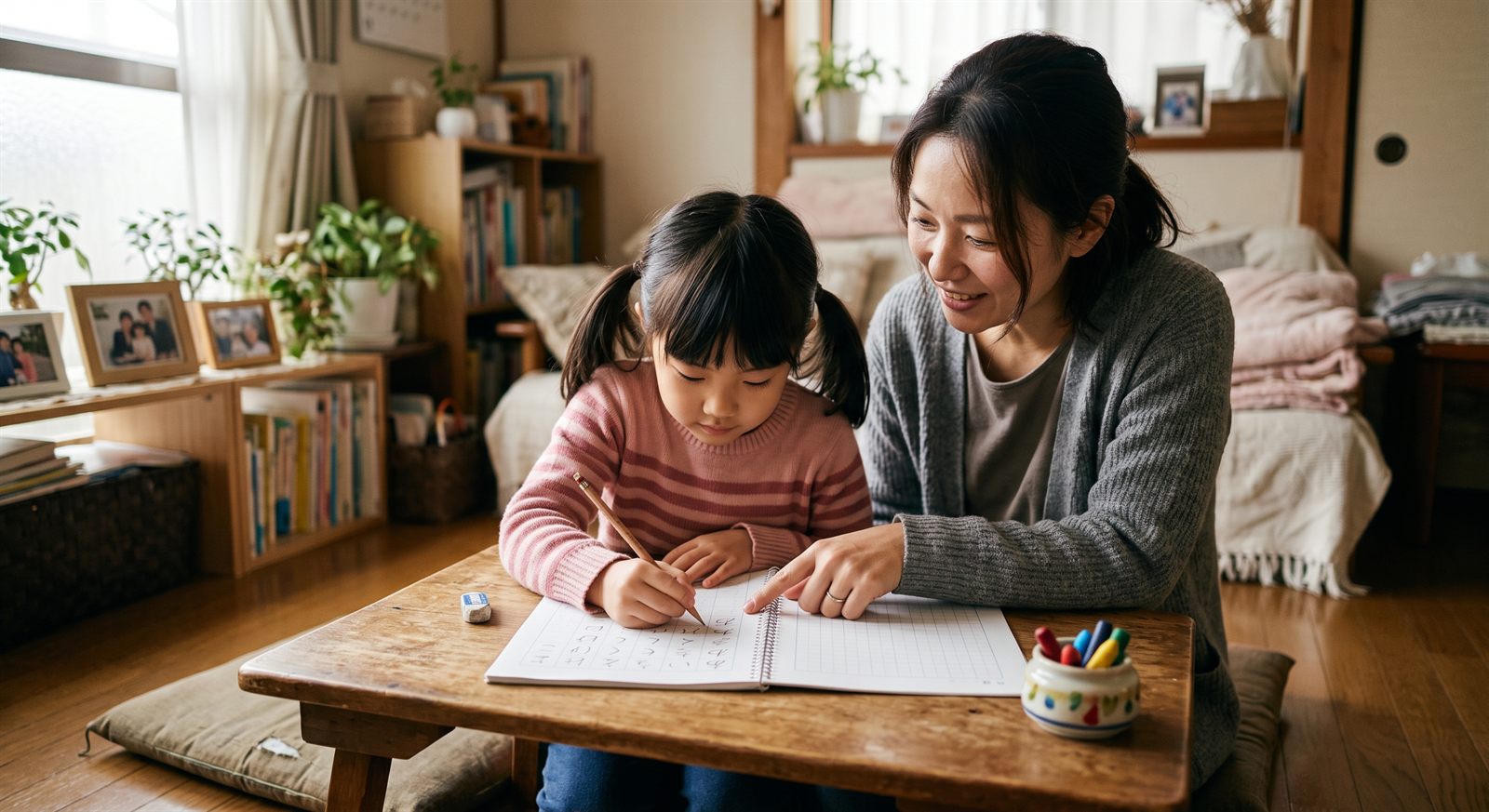
Doraemon’s gadgets are named in plain, descriptive Japanese, which makes them unusually good reading practice for a child who has just learned katakana.
| Japanese | Romaji | English | Literally |
|---|---|---|---|
| どこでもドア | Dokodemo Doa | Anywhere Door | どこでも (“anywhere at all”) + ドア (door, from English) |
| タケコプター | Takekoputā | Bamboo-copter | 竹 (take, bamboo) + コプター (from “copter”) |
| タイムマシン | Taimu Mashin | Time machine | Straight English, straight katakana |
| 四次元ポケット | Yojigen Poketto | Four-dimensional pocket | 四 (four) + 次元 (dimension) + ポケット |
| ほんやくコンニャク | Hon’yaku Konnyaku | Translation Konjac jelly | 翻訳 (translation) rhymed with こんにゃく, a real Japanese jelly food — a pun, not a word |
Notice the pattern: the Japanese part is written in kanji or hiragana, the borrowed part in katakana, inside the same word. Pointing that out once while your child is already interested does more than a worksheet.
Can you actually use it?
| Japanese | Romaji | Can your child say it? |
|---|---|---|
| 助けて / どうしよう / ずるい / だめ | tasukete / dō shiyō / zurui / dame | ◎ Real, everyday, age-appropriate Japanese. |
| ごめん | gomen | ◎ With friends. Use ごめんなさい with a teacher or any adult. |
| やったー! / もう! | yattā / mō | ◎ Natural and expressive. Very much how Japanese children actually sound. |
| のび太のくせに | Nobita no kuse ni | △ Grammatically excellent to understand. Saying it to a classmate is an insult. |
| お前 (Gian’s word for everyone) | omae | ✗ Confrontational. Your child should use the person’s name + さん or くん. |
| ぶっとばすぞ! | buttobasu zo! | ✗ “I’ll knock you flying.” It’s a bully’s line, and it reads as one. |
A note on politeness — the reason Doraemon beats most anime
Most anime gives a child one register: casual speech between equals. Doraemon is unusual because adults are constantly present. Nobita’s mother tells him off, the teacher speaks to the class, neighbours greet each other at the door. So a child hears the plain form and the polite -masu form used by the right people in the right situations, which is the part overseas learners are usually missing. When Shizuka says Nobita-san while Gian says omae, your child is watching the Japanese politeness system operate — long before anyone explains it to them.
Frequently asked questions
How do you write Doraemon in Japanese?
ドラえもん. The first two characters are katakana (ドラ) and the last three hiragana (えもん) — an unusual mix that reflects the two halves of the name: doraneko, a stray cat, and -emon, an archaic ending for men’s names.
Is Doraemon good for learning Japanese?
It is the single best starting point for children roughly aged 4 to 10. The speech is slow and clearly articulated, the situations are domestic and repetitive, and — unlike most anime — the Japanese is safe to copy. Episodes run about eleven minutes, which matches a young child’s attention span almost exactly.
What age is Doraemon best for?
Four to ten for language learning. Under four, Anpanman is slower and simpler. Over ten, children usually want something with a longer story, though Doraemon stays useful because the vocabulary is everyday rather than fantastical.
Should we watch with Japanese or English subtitles?
English subtitles while your child is still learning to read; Japanese subtitles once hiragana and katakana are comfortable. Avoid the English dub if the goal is language — there’s no Japanese input in it at all. We go through the options in detail in anime with Japanese subtitles.
My child watches constantly but still won’t speak Japanese. Why?
Because watching builds comprehension, and only speaking builds speaking. This is the most common thing parents describe to us: a child who understands a great deal and produces almost nothing. The fix isn’t more screen time — it’s giving those words a person to say them to. At TOMODACHI JAPAN, children join small-group classes with qualified Japanese teachers and peers their own age living in Japan, so the words from last night’s episode get used out loud this week. See our plans and pricing.