
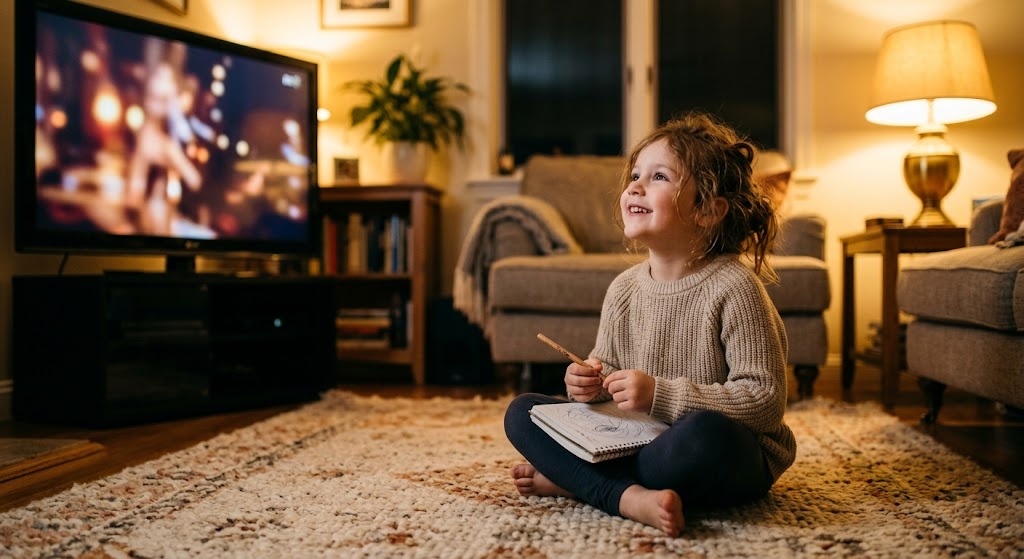
If your child is already asking to watch anime, you have something most language teachers would pay for: a child who wants to hear Japanese. The question is which shows actually help. Not every anime is useful for a young learner — a lot of the most popular titles are full of rough, masculine, shouted Japanese that will make a seven-year-old sound strange. I’m a Japanese teacher, and this is my honest list of the best anime for kids to learn Japanese, what each one teaches, and how to watch so it becomes real language instead of background noise.
Can-you-use-it legend: ◎ = the Japanese in this show is safe and natural for a child to copy · △ = mixed; some dialogue is fine, some isn’t · ✗ = enjoyable, but don’t let it become their speaking model.
The best anime for kids to learn Japanese, ranked by how usable the language is
| Show | Japanese title | Best for | Language quality |
|---|---|---|---|
| Doraemon | ドラえもん | Ages 4–10. Everyday home and school life. | ◎ The gold standard |
| Anpanman | それいけ!アンパンマン | Ages 2–5. First words, very slow speech. | ◎ Ideal for absolute beginners |
| My Neighbour Totoro | となりのトトロ | Ages 4–9. Family speech, countryside life. | ◎ Gentle and clear |
| Kiki’s Delivery Service | 魔女の宅急便 | Ages 6–11. Polite Japanese with adults. | ◎ Excellent keigo model |
| Chi’s Sweet Home | チーズスイートホーム | Ages 3–7. Tiny episodes, simple sentences. | ◎ Very low pressure |
| Pokémon | ポケットモンスター | Ages 5–11. Katakana, counting, reactions. | ◎ Motivating and clean |
| Sailor Moon | 美少女戦士セーラームーン | Ages 7–12. Natural girls’ speech. | ◎ Great female speech model |
| Cardcaptor Sakura | カードキャプターさくら | Ages 7–12. Polite, warm, school life. | ◎ Very well-mannered |
| Detective Conan | 名探偵コナン | Ages 9+. Longer sentences, reasoning. | △ Crime themes; language is fine |
| Spirited Away | 千と千尋の神隠し | Ages 8+. Formal and humble speech. | △ Fast in places |
| Crayon Shin-chan | クレヨンしんちゃん | Ages 8+ with a parent. | ✗ Deliberately rude — see below |
| Demon Slayer / Naruto | 鬼滅の刃/ナルト | Ages 11+. | ✗ Great fun, bad speech model |
Want to go from quoting anime to actually talking with friends in Japan?
TOMODACHI JAPAN is an online Japanese school for children growing up outside Japan. They talk with peers their own age in Japan every day, taught by teachers working at Japanese schools, in small classes of 8.
🎁 Register and we’ll email you our School Guide (PDF, in English) straight away. You’ll also be first to hear about tuition, scholarships and opening dates.
Free · takes about 30 seconds
Why Doraemon beats every “learn Japanese” app I’ve seen
Teacher’s note: If I could pick one show for a child learning Japanese, it’s Doraemon — and the reason is structural, not sentimental. Nobita is a normal elementary-school boy, so the entire vocabulary of the series is the vocabulary of a child’s actual life: homework, snacks, being late, his mother telling him off, the park, the test he didn’t study for. Compare that with a battle anime, where the most-repeated words are “power,” “die,” and “I’ll protect you.” One of those word lists is useful on a Tuesday afternoon.
Doraemon also gives you clean examples of the three speech levels children actually need, in the same scene: Nobita speaks casually to friends, more carefully to his mother, and politely to teachers and shopkeepers. That contrast is the single most valuable thing a young learner can absorb, and it’s exactly what shonen anime flattens into one shouting register.
| Japanese | Rōmaji | English | Use it? |
|---|---|---|---|
| どうしよう。 | Dō shiyō. | What should I do? / Oh no. | ◎ Constantly useful |
| しかたないなあ。 | Shikata nai nā. | Well, nothing to be done. | ◎ Very natural |
| いってきます。 | Ittekimasu. | I’m off! (leaving home) | ◎ Daily ritual phrase |
| ただいま。 | Tadaima. | I’m home. | ◎ Daily ritual phrase |
| 手伝って。 | Tetsudatte. | Help me. | ◎ Casual, to friends |
| 宿題やった? | Shukudai yatta? | Did you do your homework? | ◎ Pure everyday speech |
Ghibli: the politeness training you didn’t know you were getting
Studio Ghibli films are unusually good for language learning, and Kiki’s Delivery Service is the standout. Kiki is thirteen and has just moved to a strange city, so almost every conversation is a young person speaking politely to adults she doesn’t know — customers, a baker, a landlady. That means an entire film of natural keigo at a speed a child can follow, which is genuinely hard to find.
Totoro works differently: it’s family Japanese, warm and simple, with a lot of repeated calling-out (おかあさん!, まって!) that small children pick up without trying. Spirited Away is a step up — Chihiro has to use humble forms in a workplace — so I’d save it until a child is comfortable with the first two.

The honest warnings: Shin-chan, and the shonen problem
Teacher’s note — Crayon Shin-chan: Japanese parents have a running joke about this one, and it’s not really a joke. Shin-chan’s entire comedic engine is a five-year-old using language he shouldn’t: talking back to adults, using rough forms, being cheeky to his mother. Japanese children genuinely copy it, and Japanese parents genuinely tell them to stop. It’s a wonderful show. It is a terrible speech model. Watch it for fun, not for imitation.
The bigger issue is the shonen hits — Naruto, Demon Slayer, Jujutsu Kaisen, Dragon Ball. Children love them, and I’d never tell a family to switch them off. But be clear about what they are: the dialogue is written to sound dramatic, so it leans hard on commands, rough male pronouns and insults that a real child should never aim at a real person.
| Heard in anime | Rōmaji | What it does | Use it? |
|---|---|---|---|
| お前 | omae | Rough “you.” | ✗ Rude to most people |
| てめえ/貴様 | temē / kisama | Hostile “you.” | ✗ Genuinely aggressive |
| 死ね | shine | “Drop dead.” | ✗ Never say this |
| やめろ! | Yamero! | Stop it! (command form) | △ Harsh — use やめて |
| すごい! | Sugoi! | Amazing! | ◎ Perfectly safe |
| ありがとう | Arigatō | Thank you. | ◎ Always right |
The fix isn’t censorship — it’s labelling. A child who knows 「お前 is what Bakugo says, not what I say」 can enjoy the show and speak properly. Children are very good at this once an adult explains it once. Our guide to learning Japanese with anime goes through the safe-versus-risky split in more detail.
How to actually watch: subtitles, repeats and the five-word rule
Parents ask me about subtitles constantly, so here’s my straight answer. Japanese audio with English subtitles is fine and is where most children start — they’re still soaking in rhythm and intonation. English audio with English subtitles teaches nothing. Japanese audio with Japanese subtitles is excellent, but only once a child can read kana comfortably; before that it’s just visual noise.
The technique that actually moves the needle is smaller than most parents expect. Re-watch one short episode your child already loves, and pull out five words. That’s it. Five words they choose, written down, said out loud, and used that week. A child who does that with one Doraemon episode learns more usable Japanese than a child who passively streams forty hours.
And the part no show can do: those five words have to be said to someone. Watching is input, and input alone produces children who understand a lot and freeze when asked to speak — the single most common pattern I see in families abroad. The words stick the moment a real person answers back.
Frequently asked questions
What is the best anime for a child to start learning Japanese?
Doraemon for ages 4–10, and Anpanman for under-fives. Both use slow, clear, everyday Japanese about ordinary childhood life, which is exactly the vocabulary a young learner needs. My Neighbour Totoro is the best film-length starting point.
Can a child really learn Japanese from anime alone?
No — but it’s a powerful half. Anime builds listening, vocabulary and motivation extremely well. What it cannot build is speaking, because nothing on screen responds to your child. Children who only watch typically end up understanding far more than they can say.
Should we use Japanese or English subtitles?
Japanese audio with English subtitles to begin with. Switch to Japanese subtitles once your child reads hiragana and katakana comfortably. Avoid English dubs if the goal is language learning — there’s no Japanese input at all.
Is Crayon Shin-chan bad for learning Japanese?
As entertainment it’s fine; as a model it’s risky. The humour comes from a small child using rude, cheeky language with adults, and children who copy it sound impolite. Japanese parents warn about this too. Watch it, but pair it with a show like Doraemon for the language your child should actually reproduce.
How do we turn anime into real Japanese ability?
Give the words somewhere to go. At TOMODACHI JAPAN, children join small-group classes with qualified Japanese teachers and peers living in Japan, so the phrases they picked up from a favourite show get used in real conversation — and gently corrected when they’re the anime-only kind. See our plans and pricing.