NCEA Japanese is assessed through four or five achievement standards at each level, roughly half internal and half external. In 2026, Level 1 Japanese has four standards worth 5 credits each (20 credits: two internals and two digital external exams), while Level 2 and Level 3 Japanese each have five standards worth 24 credits in total. The external exams for 2026 fall on 10 November (Level 2), 18 November (Level 3) and 23 November (Level 1), with Scholarship Japanese on 2 December.
This guide puts everything a Year 11–13 student or parent usually has to piece together from a dozen NZQA pages in one place: every Japanese standard by number, what changed with the new Level 1, what the planned replacement of NCEA means for current students, exactly where to find past papers, audio files and assessment schedules, how to use the official vocabulary and kanji lists, and a realistic study plan for the final weeks. Every number below comes from NZQA or the Ministry of Education, with the year noted. We’ve also added a few notes from our side as Japanese teachers, because the interaction standards reward some very Japanese habits that textbooks rarely spell out.

NCEA Japanese at a glance (2026)
Japanese is offered at NCEA Level 1, Level 2 and Level 3, plus New Zealand Scholarship. Each level tests the same four skills, listening, reading, speaking and writing, but splits them differently:
- Externals (end-of-year exams): one listening standard and one reading standard at every level, 5 credits each. Questions are written in English.
- Internals (assessed at school during the year): spoken interaction at every level, plus writing and a spoken presentation at Levels 2 and 3. At Level 1, presentation and writing have merged into one flexible standard, Communicate in Japanese for a chosen purpose.
- Grades: Achieved, Merit or Excellence for each standard, as with every NCEA achievement standard.
If you started Japanese in Year 9 or 10, you are exactly who Level 1 is designed for. The Level 1 interaction standard states that it is designed to be accessible to students who only begin formal study of the language in junior secondary school (AS91956, version 3).
Looking for a way to keep Japanese going from abroad?
TOMODACHI JAPAN is an online Japanese school for children growing up outside Japan. They talk with peers their own age in Japan every day, taught by teachers working at Japanese schools, in small classes of 8.
🎁 Register and we’ll email you our School Guide (PDF, in English) straight away. You’ll also be first to hear about tuition, scholarships and opening dates.
Free · takes about 30 seconds
Every NCEA Japanese achievement standard, by level
This is the full list of standards that are current in 2026, checked against the NZQA standards search for each level. The numbers in brackets (1.1, 2.3 and so on) are the short codes most teachers and course outlines use.
| Level | Standard | Title | Assessment | Credits |
|---|---|---|---|---|
| 1 | 91956 (1.1) | Interact in spoken Japanese to share and respond to information, ideas, and opinions | Internal | 5 |
| 1 | 91957 (1.2) | Communicate in Japanese for a chosen purpose | Internal | 5 |
| 1 | 91958 (1.3) | Demonstrate understanding of written Japanese related to everyday contexts | External (reading) | 5 |
| 1 | 91959 (1.4) | Demonstrate understanding of spoken Japanese related to everyday contexts | External (listening) | 5 |
| Level 1 total | 20 | |||
| 2 | 91133 (2.1) | Demonstrate understanding of a variety of spoken Japanese texts on familiar matters | External (listening) | 5 |
| 2 | 91135 (2.2) | Give a spoken presentation in Japanese that communicates information, ideas and opinions | Internal | 4 |
| 2 | 91134 (2.3) | Interact using spoken Japanese to share information and justify ideas and opinions in different situations | Internal | 5 |
| 2 | 91136 (2.4) | Demonstrate understanding of a variety of written and/or visual Japanese text(s) on familiar matters | External (reading) | 5 |
| 2 | 91137 (2.5) | Write a variety of text types in Japanese to convey information, ideas, and opinions in genuine contexts | Internal | 5 |
| Level 2 total | 24 | |||
| 3 | 91553 (3.1) | Demonstrate understanding of a variety of extended spoken Japanese texts | External (listening) | 5 |
| 3 | 91554 (3.2) | Give a clear spoken presentation in Japanese that communicates a critical response to stimulus material | Internal | 3 |
| 3 | 91555 (3.3) | Interact clearly using spoken Japanese to explore and justify varied ideas and perspectives in different situations | Internal | 6 |
| 3 | 91556 (3.4) | Demonstrate understanding of a variety of extended written and/or visual Japanese texts | External (reading) | 5 |
| 3 | 91557 (3.5) | Write a variety of text types in clear Japanese to explore and justify varied ideas and perspectives | Internal | 5 |
| Level 3 total | 24 | |||
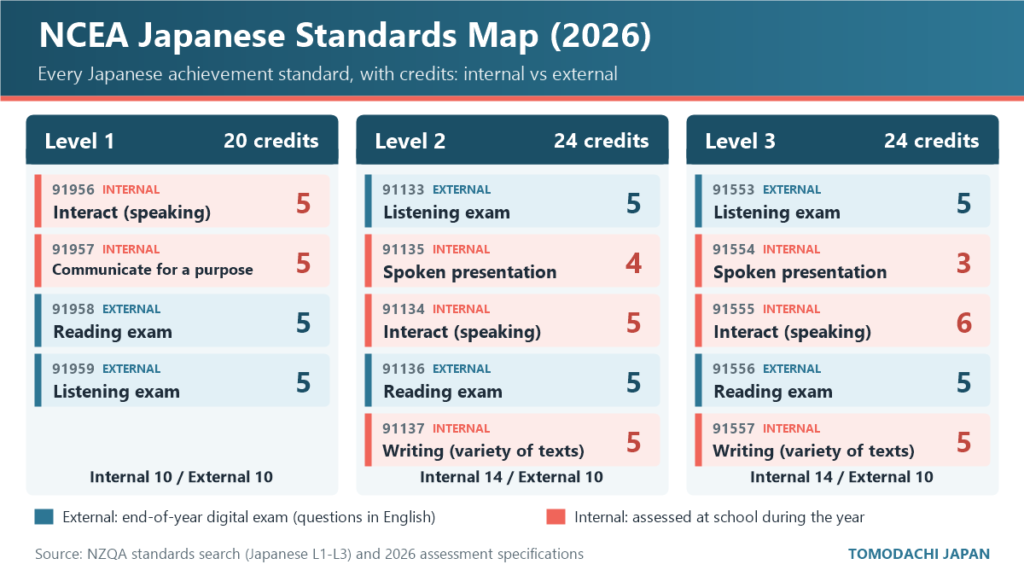
A few things worth noticing in that table:
- Interaction is the biggest internal at Level 3. 91555 is worth 6 credits, double the 3-credit presentation. If you have limited time, conversation practice gives you the most credits per hour.
- Level 2 and Level 3 are 14 internal credits and 10 external credits. Level 1 is an even 10 and 10.
- All the externals are now digital. NZQA’s 2026 specifications list all six Japanese external standards as online digital examinations. At Levels 2 and 3 a paper-based version is also described, and the reading texts are printed on paper for every candidate.
What the external exams look like
According to the 2026 assessment specifications, each listening and reading exam has three questions written in English, based on the texts provided. At Level 1 you answer in English or te reo Māori. At Levels 2 and 3 you can answer in Japanese, English or te reo Māori. In the Level 1 listening, you hear each whole passage once and then three times in sections; at Levels 2 and 3 you hear three spoken texts as a whole and twice in sections, and you can choose when to start each play but cannot pause inside it. Bring headphones. The Level 2 reading has three texts totalling approximately 1,400 kana, and the Level 3 reading approximately 1,600 kana.
What changed, and what is changing next
There are two separate changes that often get mixed up, so here they are one at a time.
1. The new Level 1 Japanese (from 2024)
Level 1 Japanese moved to four new standards, 91956 to 91959. The standard documents state that these replaced the old five Level 1 standards, AS90893 to AS90897 (NZQA, AS91956 version 3, published December 2023, with a planned review date of December 2028). If you’re using an older Level 1 workbook, check the standard numbers before trusting the practice tasks.
2. Levels 2 and 3 in 2026, and the replacement of NCEA
Level 2 and Level 3 Japanese still use the standards in the table above in 2026, and NZQA has already published 2026 assessment specifications for both levels. Separately, the Government has confirmed that NCEA will be replaced by new national qualifications rolled out progressively from 2028: a Foundational Award focused on literacy and numeracy, the New Zealand Certificate of Education (NZCE) for Year 12, and the New Zealand Advanced Certificate of Education (NZACE) for Year 13 (Ministry of Education, school leaders bulletin, 26 May 2026; Tāhūrangi, May 2026). The Ministry describes the new qualifications as subject-based and aligned with the secondary curriculum being finalised in 2026, and operational details such as transitional arrangements were still being worked out at the time of the announcement.
What this means in practice: if you are sitting Japanese this year, nothing about your exams changes. Watch your school’s notices and the NZQA Japanese subject page for subject-level details as they are released.
NCEA Japanese past papers, audio and assessment schedules
NZQA publishes almost everything you need, free. The trick is knowing which page holds what.
- Start at the Japanese subject page (NZQA: Japanese). It links to the standards for each level, the 2026 assessment specifications, the vocabulary lists and the exam timetable.
- Open the past exams page (NZQA: Japanese past exams and exemplars). For each level it has internal exemplars, a link called Level 1 (or 2, or 3) Japanese exams and exemplars, and a link called Level 1 (or 2, or 3) Japanese assessment reports and schedules.
- Click into a standard. Each external standard’s page lists, by year, the Examination paper, the Examination audio, the Examination audio or video transcript, and Exemplar answer scripts at Achievement, Merit and Excellence. For example, the 91553 page has all of these for 2025 and 2024. The same page lists the assessment schedule (the marking guide) and the assessment report (the examiners’ comments) for each year.
- For digital exams, NZQA also keeps a Find past digital exams page, where you can try past exams in the same online format you’ll use on the day.
Don’t skip the assessment reports. They’re short and blunt. The 2025 Level 1 reading report noted that candidates made use of adjectives, adverbs and position words to give more detailed answers, and the 2023 report listed one- or two-word answers and answers based on their own experiences rather than the cues in the texts as common features of Not Achieved scripts. That is useful for a student who keeps landing just below Merit.
If you also have friends sitting UK or Australian exams, the logic is the same everywhere: past papers plus the marking guide beat any summary. Our guides to GCSE Japanese past papers and to HSC and VCE Japanese course levels cover the equivalents across the Tasman and in England.
NCEA Japanese vocab lists and kanji lists
The official vocabulary lists live on the NZQA Japanese subject page as Excel files. In October 2026 the page lists a 2026 Level 1 list and 2025 lists for Level 2 and Level 3 (the Level 2 and 3 files are dated December 2024). Each workbook has tabs for Japanese to English, a Kanji List, English to Japanese, categories and grammar and structures, and the Level 1 and Level 3 files add expressions and sample sentences.
Key rules from the lists and the 2026 specifications:
- The lists guide the external exams. Words outside the approved list will be glossed if their meaning is not evident from the text.
- Kanji appear only in listed words. Each Kanji List tab states that kanji are only used in the words listed in the Kanji List in external assessments.
- Furigana disappears after Level 1. Level 1 exams provide furigana for kanji; the Level 2 and Level 3 lists state that furigana will not be provided. This is the biggest reading jump between levels.
- Lists build on each other. Level 2 students are expected to recognise Level 1 items, and Level 3 students the Level 1 and Level 2 items. At Level 3 you may also need to make informed guesses about unfamiliar words from context.
Here’s a starter set by topic. Every word below appears in the official list for that level, so it’s a safe place to begin your flashcards.
| Level (list) | Topic | Starter words from the official list |
|---|---|---|
| Level 1 (2026) | Me, family, friends | かぞく (family), ともだち (friend), すんでいます (live) |
| Level 1 (2026) | School life | がっこう, こうこう, せいふく (uniform), しゅくだい (homework), ぶかつ (club activities) |
| Level 1 (2026) | Free time and travel | しゅみ (hobby), アルバイト (part-time job), りょこう (trip), おまつり (festival), おみやげ (souvenir) |
| Level 1 (2026) | Weather and seasons | てんき (weather), きせつ (season) |
| Level 1 (2026) | Conversation glue | そうですね, えっと, あのう, どうして (why), でも (but) |
| Level 2 (2025) | Exchange and school trips | こうりゅう (exchange), しゅうがくりょこう (school trip), あいさつ (greeting) |
| Level 2 (2025) | Community and opinions | ボランティア, リサイクル, あんぜん (safety), きょうみ (interest), あきらめる (give up) |
| Level 3 (2025) | Society and big ideas | しゃかい (society), かんきょう (environment), へいわ (peace), じゆう (freedom), ぶんか (culture) |
| Level 3 (2025) | Identity and future | アイデンティティ, ジェンダー, えいきょう (influence), ゆめ (dream), けいけん (experience) |
| Level 3 (2025) | Places and nature | かんこう (tourism), しぜん (nature) |
As Japanese teachers: what the interaction standards really reward
The interaction standards are where we see the widest gap between students who know a lot of Japanese and students who sound Japanese. Read the explanatory notes for 91956 and you’ll see why. For Merit, NZQA asks you to use interactive strategies to support conversation, giving examples such as asking and responding to questions, reacting to the speaker to show understanding, self-correcting and seeking clarification. For Excellence, the examples include prompting, engaging with and extending on specific detail in a partner’s responses, and anticipating conversational cues. The conversation must be unrehearsed and unscripted.
In Japanese, those strategies have a name: aizuchi (相づち), the small sounds and phrases listeners use to show they are following. A conversation without them feels cold to a Japanese ear, even when every sentence is grammatically perfect.
From a Japanese teacher: そうですね is on the Level 1 list, and it’s more useful than it looks. Said with a falling tone, it means I agree. Said slowly, with a slight stretch, it means let me think, which buys you two seconds without dropping into English. えっと and あのう (also on the Level 1 list) do the same job before a longer answer. Then add one reaction that shows you heard the detail, not just the topic: へえ、そうなんですか, or repeat a key word back with a question, like 北海道?いいですね! The step up to Excellence is turning it around: ○○さんは? or どうしてですか? That is prompting, and it is exactly what the explanatory notes describe. One warning: don’t stack aizuchi on every sentence. Two or three natural reactions per minute sounds fluent; one every five seconds sounds like a script.
Plain form or polite form?
The second habit that separates Merit from Excellence is register. Japanese changes its verb endings depending on who you’re talking to: です/ます with teachers, host families and people you’ve just met, and plain form (行く, 食べた, おもしろいね) with friends your own age.
From a Japanese teacher: If your interaction partner is a classmate playing a friend, plain form is natural, and a student who switches to it confidently sounds much more like a real teenager. If you’re talking to your teacher, stay in です/ます. What costs you is drifting: starting polite, slipping into 行くよ halfway, then jumping back. Choose at the start and hold it. The same logic applies to 91957 and the writing standards. A message to a Japanese friend can be in plain form; a letter to a host family or a speech to a visiting school group should be in です/ます from greeting to sign-off. Showing that you chose the register for the audience is a quiet signal of control, and control is what the Merit and Excellence descriptors keep coming back to.
Our Japanese oral exam guide has more speaking drills, conversation starters and phrase banks that work for interaction and presentation standards across different exam systems.
NCEA Japanese exam dates 2026
| Exam | Date | Session | Standards |
|---|---|---|---|
| Level 2 Japanese | Tuesday 10 November 2026 | 2:00pm | 91133 listening, 91136 reading |
| Level 3 Japanese | Wednesday 18 November 2026 | 9:30am | 91553 listening, 91556 reading |
| Level 1 Japanese | Monday 23 November 2026 | 9:30am | 91958 reading, 91959 listening |
| Scholarship Japanese | Wednesday 2 December 2026 | 9:30am | 93002 |
The 2026 exam period on the NZQA timetable runs from Tuesday 10 November to Friday 4 December. Internal deadlines are set by each school, so check your own Japanese department’s calendar for interaction and writing due dates.
Scholarship Japanese
Scholarship Japanese (performance standard 93002) is aimed at top Level 3 students, and it is a different kind of exam. According to the 2026 assessment specifications, it runs in a three-hour slot with two parts:
- Writing, two hours, two questions. Question One is a written response in Japanese to spoken passages (about 30 minutes of listening, no more than three passages on a common theme, played three times). Question Two is a written response in English or te reo Māori to up to three Japanese texts on a common theme.
- Speaking, an individual session. You get a question in Japanese, 10 minutes to make notes, then speak for 3–4 minutes (up to a maximum of 5) in response. Your response is recorded.
The vocabulary is not limited to the NCEA Level 1–3 lists, though unusual or topic-specific words are still glossed. Past Scholarship Japanese exam material for 2023, 2024 and 2025 can be downloaded as zip files from the NZQA Scholarship Japanese page, along with the performance standard.
A study plan that works for NCEA Japanese
Internals and externals reward different habits, so the plan splits the year in two: build speaking and writing evidence during the year, then switch to exam technique once internals are done.
| When | Focus | What to do |
|---|---|---|
| Terms 1–3, every week | Vocab and kanji | Ten words a day from your level’s list, grouped by topic. At Levels 2 and 3, practise reading kanji words without furigana from the start. |
| Terms 1–3, every week | Interaction | Two short unscripted conversations a week, on the themes your teacher is using. Record one and listen for aizuchi, questions back and register. |
| Before each internal | Writing and presentation | Read the internal exemplars for your standard on the NZQA past exams page and compare your draft with the Merit and Excellence scripts. |
| 4 weeks out | Diagnose | Do one full past listening paper and one reading paper under time. Mark with the assessment schedule, then read that year’s assessment report. |
| 3 weeks out | Listening | One past listening paper every second day with the official audio. Afterwards, read the transcript and highlight what you missed. |
| 2 weeks out | Reading | Timed reading papers. Practise answering in full sentences that point to the text, with detail such as time, place, reasons and feelings. |
| Final week | Digital rehearsal | Try a past paper in the digital format, check your headphones, and review your weakest vocab topic. |
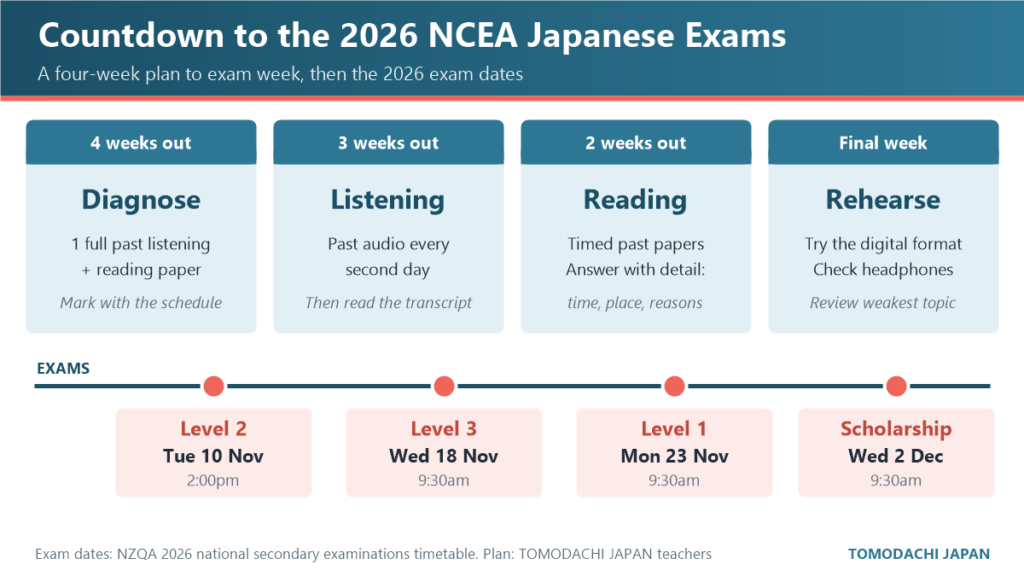
If you’re reading this in late October 2026, you’re about three weeks from the Level 2 exam (10 November) and about five weeks from Level 1 (23 November). That’s still enough time for the countdown rows above, as long as you start with a diagnostic paper this week rather than more vocab lists.
Good free resources, and where a class fits
Honestly, the best NCEA Japanese resources are free and official:
- NZQA past papers, audio, transcripts, assessment schedules and reports for every external standard, plus internal exemplars.
- The official vocabulary lists, which double as a kanji list and a grammar checklist.
- The Ministry of Education’s NCEA site (NCEA Education: Japanese), with the Level 1 learning matrix, conditions of assessment and assessment matrix.
- Your school’s online platform. If your school subscribes to Education Perfect for language homework, its listening and vocab tasks are useful daily practice.
- The Japan Foundation’s free Marugoto site, for extra listening on everyday topics.
What those resources can’t give you is a real conversation partner. That’s the gap TOMODACHI JAPAN fills: small online group classes taught by teachers from Japan, where students also make friends with peers in Japan, which is the most natural way to practise the unscripted interaction that 91956, 91134 and 91555 ask for. If you’re in Auckland, our guide to Japanese supplementary schools in Auckland covers local, in-person options too, and our Japanese classes for kids in Australia and New Zealand page compares formats across the region.
To be clear about who we don’t suit: we are not an NCEA tutoring service. We don’t mark work against NZQA assessment schedules, and internal credits can only be assessed by your school. If you need targeted help with a specific internal draft in the next fortnight, your Japanese teacher or an NCEA-specialist tutor is the better choice. If you want Japanese that keeps growing through Years 11 to 13 and beyond, you can find details in our school guide.
NCEA Japanese FAQ
How many credits is NCEA Japanese worth?
In 2026, Level 1 Japanese offers 20 credits (four standards of 5 credits), Level 2 offers 24 credits and Level 3 offers 24 credits. At Levels 2 and 3, 14 credits are internal and 10 are external.
Where can I find NCEA Japanese past exam papers?
On the NZQA Japanese past exams and exemplars page. Click through to each external standard to find the examination paper, audio, transcript, exemplar answers, assessment schedule and assessment report by year.
Is there an official NCEA Level 3 Japanese kanji list?
Yes. It is a tab inside the Level 3 Japanese vocabulary list (Excel) on the NZQA Japanese subject page. Kanji in external exams are only used in listed words, and at Levels 2 and 3 no furigana is provided.
Is NCEA Japanese being replaced?
NCEA as a qualification is being replaced from 2028 by a Foundational Award, the NZCE (Year 12) and the NZACE (Year 13), according to the Government’s May 2026 announcement. For 2026, the Japanese standards and exams in this guide apply as normal.
Is Scholarship Japanese only a written exam?
No. It has a two-hour writing section based on listening and reading, followed by a short recorded speaking task: 10 minutes to prepare, then 3–4 minutes of speaking in Japanese.
Sources
- NZQA, Japanese subject page (standards, specifications, vocabulary lists), accessed October 2026: www2.nzqa.govt.nz/ncea/subjects/select-subject/japanese/
- NZQA, Japanese past exams and exemplars: www2.nzqa.govt.nz/ncea/subjects/past-exams-and-exemplars/japanese/
- NZQA, Assessment Specifications, Level 1, Level 2 and Level 3 Japanese 2026 (published October 2025)
- NZQA, Assessment Specifications, Scholarship Japanese 2026 (published October 2025)
- NZQA, Achievement Standard AS91956 version 3 (December 2023)
- NZQA, Japanese vocabulary lists: Level 1 (2026), Level 2 and Level 3 (2025)
- NZQA, 2026 national secondary examinations timetable
- NZQA, 91958 assessment reports (2023, 2025)
- Ministry of Education, NCEA Education: Japanese (Level 1 learning matrix and assessment)
- Ministry of Education, school leaders bulletin, 26 May 2026; Tāhūrangi, Further details confirmed for new senior secondary qualifications replacing NCEA (May 2026)