
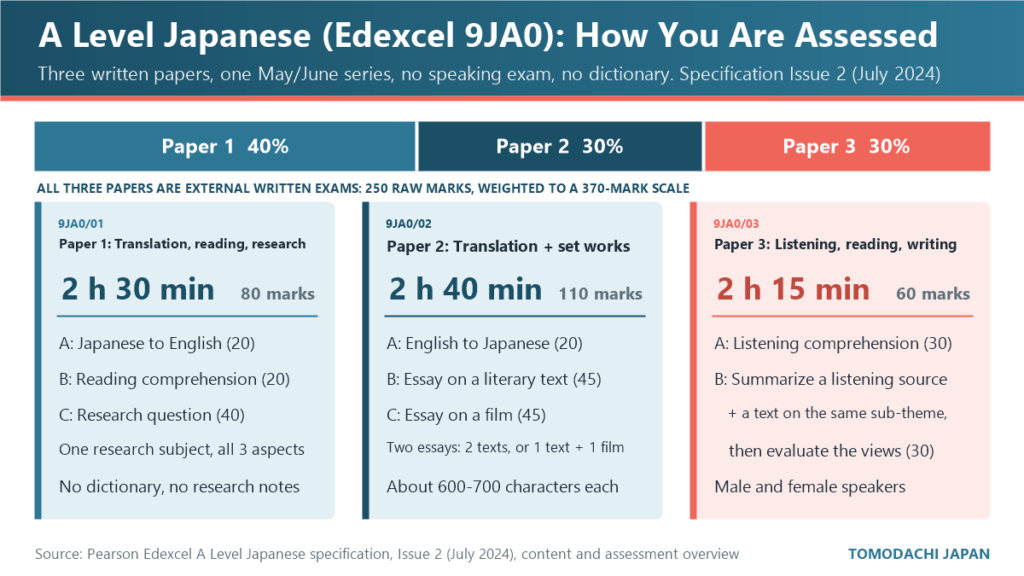
A Level Japanese is offered by one exam board in the UK, Pearson Edexcel, under the code 9JA0. It is assessed by three written papers sat in May/June of the same year: Paper 1 (translation into English, reading and a research question, 40%), Paper 2 (translation into Japanese and essays on set works, 30%) and Paper 3 (listening, reading and writing, 30%). There is no speaking exam, no coursework and no dictionary in any paper.
This guide is checked against the current Pearson specification (Issue 2, July 2024, first assessment 2020) and the grade boundaries Pearson published for the 2022 to 2025 exam series. You will find the exact marks for each section, the boundary for every grade, the four themes with their sub-themes in Japanese, what the set-works rule actually says, how the kanji list works, and the honest way to use the past papers that exist. Where a detail sits only inside a document we could not open, we say so rather than guess.

A Level Japanese at a glance: three papers, 250 raw marks
The specification describes the qualification as three externally-examined papers that assess listening, reading and writing. Every section below is taken from the assessment overview on pages 4 to 6 of the specification.
| Paper | What is in it | Time | Marks | Weight |
|---|---|---|---|---|
| Paper 1 (9JA0/01) Translation into English, reading comprehension and writing (research question) | Section A: translation of an unseen passage from Japanese into English (20 marks) Section B: reading comprehension on a variety of text types (20 marks) Section C: a reading-and-writing question on your chosen research subject, using an unseen text plus your own research findings (40 marks) | 2 h 30 min | 80 | 40% |
| Paper 2 (9JA0/02) Translation into Japanese and written response to works | Section A: translation of an unseen passage from English into Japanese (20 marks) Section B: essay on a literary text (45 marks) Section C: essay on a film (45 marks) You answer two essays: two literary texts, or one text and one film. Two films is not allowed. | 2 h 40 min | 110 | 30% |
| Paper 3 (9JA0/03) Listening, reading and writing | Section A: listening comprehension on a recording with male and female Japanese speakers (30 marks) Section B: summarize one listening source and one written text on the same sub-theme, then evaluate the points of view and say which you agree with and why (30 marks) | 2 h 15 min | 60 | 30% |
Three rules in the specification shape how you should prepare:
- Everything is sat in one series. The specification says students must complete all assessments in May/June in any single year. You cannot bank Paper 1 in Year 12.
- No dictionary, and no research notes. In Paper 1 you are not permitted a dictionary or any documentation related to your research. The research for Section C has to be in your head.
- Speaking is not assessed. The specification states that although speaking skills are not directly assessed in the qualification, students should be encouraged to develop their speaking skills during the course. We come back to why that line matters further down.
Looking for a way to keep Japanese going from abroad?
TOMODACHI JAPAN is an online Japanese school for children growing up outside Japan. They talk with peers their own age in Japan every day, taught by teachers working at Japanese schools, in small classes of 8.
🎁 Register and we’ll email you our School Guide (PDF, in English) straight away. You’ll also be first to hear about tuition, scholarships and opening dates.
Free · takes about 30 seconds
A Level Japanese grade boundaries, 2022 to 2025
Pearson publishes grade boundaries after every series. For A Level Japanese the overall boundary is set on a 370-mark scale, not on the 250 raw marks above. That is because the three papers are weighted 40/30/30: 40% of 370 is 148 (Paper 1), and 30% of 370 is 111 (Papers 2 and 3). Your raw marks are converted to that scale before the grade is decided, so a raw mark on Paper 1 is worth proportionally more than a raw mark on Paper 2.
| Series | Max | A* | A | B | C | D | E |
|---|---|---|---|---|---|---|---|
| June 2022 | 370 | 290 | 246 | 202 | 158 | 114 | 71 |
| June 2023 | 370 | 292 | 253 | 214 | 175 | 137 | 99 |
| June 2024 | 370 | 292 | 253 | 214 | 175 | 137 | 99 |
| June 2025 | 370 | 292 | 253 | 214 | 175 | 137 | 99 |
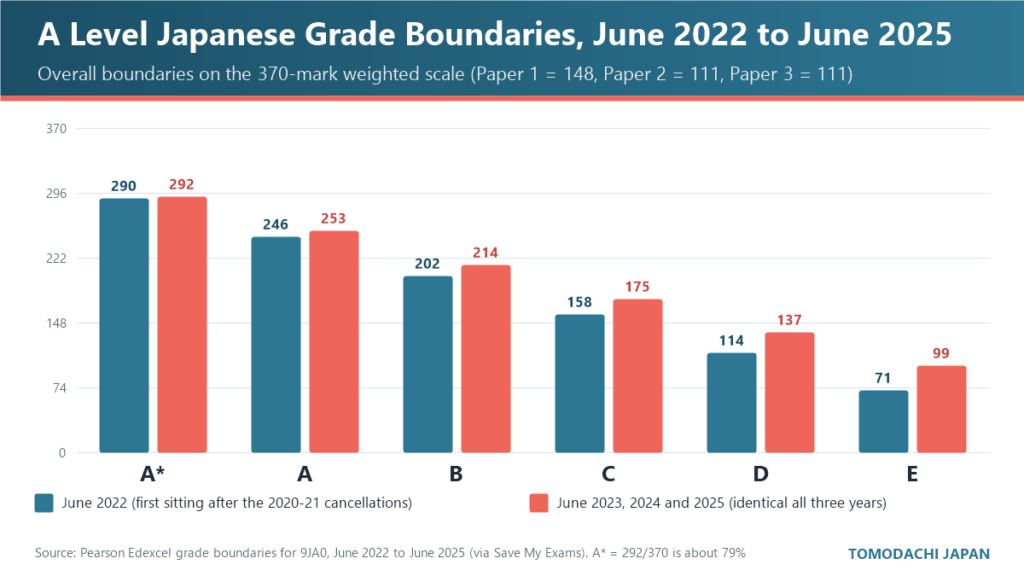
Two things stand out. First, the boundaries have been identical for three years running: an A* needs 292 of 370 (about 79%), an A needs 253 (about 68%) and a C needs 175 (about 47%). Second, 2022 was the first time these papers were actually sat, because the 2020 and 2021 exam series were cancelled in England, and the 2022 boundaries were noticeably lower, especially at E (71 against 99). If you are using 2022 to judge how hard the paper is, you are looking at an unusual year.
The four themes, with the sub-themes in Japanese
Papers 1, 2 and 3 are all set within four themes, and the specification is explicit that they are set in the context of Japan only. Each theme has two sub-themes and one research subject. For Paper 1 Section C you choose one research subject and must cover all three of its aspects. The Japanese headings below are the ones printed in the specification; the English is our translation.
| Theme | Sub-themes | Research subject (Paper 1 Section C) |
|---|---|---|
| Theme 1: 変わっていく若者の生活 Changing lives of young people (society past and present) | 教育 (education: the system and its reforms since ゆとり教育, exams and juku, the ministry’s control of the curriculum) 若者の健康 (young people’s physical and mental health: pressure, diet, bullying) | 家族関係や人間関係 (family and human relationships: traditional family structure, the nuclear family, relationships at home) |
| Theme 2: 変わっていく文化 Changing culture (artistic and intellectual culture) | 変わるポピュラー・カルチャー (changing popular culture: anime and manga, music, martial arts) テクノロジーの影響 (the influence of technology: progress, robots, automation) | 変わっていく行事 (changing events: traditional festivals and modern events, tourism, the arrival of Western occasions) |
| Theme 3: 変わっていく人生観 Changing outlooks on life (society past and present) | 変化する労働 (changing work: the end of lifetime employment, attitudes to work, moving for work) 長引く不景気 (the long recession: daily life, government response, globalization, foreign workers) | 高齢化社会 (the ageing society: isolation of the elderly, family support, social support) |
| Theme 4: 東日本大震災後の日本 Japan after the Great East Japan Earthquake (political culture) | 3月11日とその直後 (11 March and its immediate aftermath: the earthquake and tsunami, evacuation, rescue and aid, overseas reaction) 復興への政策 (policies for recovery: rebuilding, volunteers and national unity, resilience, mental health care) | 福島原発事故後の省エネ生活 (energy-saving life after the Fukushima accident: daily saving, the energy debate, old wisdom about saving energy) |
A note from a Japanese classroom teacher. Theme 4 is a popular research choice, and it is also where borrowed phrasing shows most clearly. Japanese sources on 3.11 use a small set of fixed expressions: 被災地 (the affected area), 避難所 (evacuation shelter), 復興 (recovery), 絆 (bonds between people). Learn them, but build your argument around one concrete example you can describe in your own Japanese, such as a specific town’s rebuilding plan or a specific volunteer scheme. A paragraph that strings together four fixed phrases reads as summary; a paragraph that explains one example with cause and effect reads as analysis, and the Section C mark scheme is weighted toward the second.
Paper 2: the set works and the two-essay rule
Appendix 1 of the specification lists the prescribed works. The current list contains three literary texts (a short-story collection first published in 1991, a novel from 1998 of which only part 1 is studied, and an autobiography from 1991) and three feature films (released in 2001, 2004 and 2009). Schools choose two works for their students. The rules in the specification are:
- You write two essays: either two literary texts (both from Section B) or one literary text and one film (one from Section B, one from Section C).
- Students must not answer questions on two films.
- For each work there is a choice of two questions.
- The June 2025 paper asked for approximately 600 to 700 characters per essay. Each essay carries 45 marks, so the two essays together are worth more than Paper 3 in its entirety.
The titles themselves are printed in Japanese in the specification PDF; ask your teacher which two your school has chosen, and read the specification’s Appendix 1 directly rather than a third-party list, because Pearson can revise it between issues.
What a 45-mark essay in Japanese actually rewards. The marking grid for extended writing rewards a wide variety of kanji and a range of expression, and penalizes repetitive structures. In practice the students who score well do two things British literature classes do not teach: they use the plain form (だ・である体) consistently for an essay about a work, rather than slipping between です・ます and plain forms, and they use connectives that signal analysis (〜一方で, 〜にもかかわらず, 〜ことから) instead of the narrative それで, そして that come naturally after GCSE. An essay that retells the plot in polite form will stay in the middle band however accurate it is.
The kanji list: what the specification promises
Appendix 3 of the specification is the kanji list, grouped by stroke count from 2 strokes upward. The specification makes three promises about it:
- These are the kanji students are expected to recognise. The word is recognise, not write.
- Any kanji not on the list will be glossed in the question papers so that students can understand them.
- Knowledge of the GCSE kanji is assumed. The A Level list is built on top of the GCSE list, so if your GCSE kanji are shaky, start there. Our GCSE Japanese kanji list covers that base.
Recognition is the floor, not the target. In Paper 2 you are translating into Japanese and writing 1,200 to 1,400 characters of essay, and the mark scheme explicitly rewards students for using a wide variety of kanji. A student who can read the whole list but writes essays in hiragana is giving away marks in two sections. A practical split that works: aim to write every kanji that appears in your two set works and your research subject, and to recognise the rest.
Past papers and mark schemes: what exists and how to use them
Pearson publishes the question papers, mark schemes and examiner reports on its qualifications website under A Level Japanese (2018), exam materials. Because the 2020 and 2021 series were cancelled, the full set of real papers runs from June 2022, and the 2018 sample assessment materials (SAMs) are the only earlier set written for this specification. Papers from the previous specification (last examined in 2019) exist, but their structure and themes are different, so use them for reading practice only.
That is a small bank: four real series plus the SAMs. It is not enough to practice by volume, so each paper has to be used carefully.
- Sit one SAM paper cold in the autumn of Year 13, timed, with no dictionary, before you have seen any real paper. The point is to find out where time runs out, which for most students is Paper 1 Section C.
- Mark it against the mark scheme yourself, then read the examiner report for the same section of the nearest real series. The reports say, in plain English, what the top band did and the middle band did not.
- Keep the real papers for timed practice in the spring, one series every two to three weeks, and never look at a paper’s translation passage before you sit it. A translation you have already seen teaches you nothing about speed.
- Re-do the translations (Paper 1 Section A and Paper 2 Section A) a month later. Translation is the section where accuracy improves fastest with repetition, and the passages are short enough to redo.
- Build your own Paper 3 Section B bank. The exam gives you a listening source and a text on the same sub-theme and asks you to summarize both and then say which views you agree with. Take any NHK News Web Easy story on one of the sub-themes, pair it with a short written article on the same topic, and write the summary-plus-opinion in 30 minutes. Four of those are worth more than one extra past paper.
If you also sit, or are choosing between, other Japanese qualifications, we have the same kind of guide for GCSE Japanese past papers, IB Japanese B, IB Japanese ab initio and the US AP Japanese exam.
Speaking is not examined, and that is the trap
Because there is no oral, some sixth forms treat A Level Japanese as a reading-and-writing course and speaking practice quietly disappears in Year 13. The specification itself warns against that, and the papers punish it in two places. Paper 3 Section A is a listening comprehension with male and female speakers at natural speed; students who have not been speaking Japanese regularly lose the thread on the second listening and never recover. Paper 1 Section C requires research using authentic Japanese sources, and students who can hold a conversation read those sources two or three times faster, because they already know the spoken patterns that written Japanese compresses.
There is also a longer-term point. Most students who take A Level Japanese want to use it: a year abroad, a degree with Japanese, a job. An A grade with no speaking is a strange thing to have in your hands at 18. The students we see who keep speaking through Year 13, even twice a week, arrive at university able to use the grade.
Where the extra help comes from: an honest comparison
A Level Japanese classes in school are often tiny, sometimes a single student with a teacher who also runs the GCSE group, and some students take it off-timetable with a tutor. Here is how the usual options compare for the three things the papers actually test.
| Option | Best for | Weak spot | Watch out for |
|---|---|---|---|
| School sixth-form class | Set works, research subject guidance, exam technique, entry and admin | Listening at natural speed, if the teacher is the only Japanese voice in the room | Very small groups can mean a thin timetable; ask how many hours per week are actually taught |
| Private tutor (one-to-one) | Translation marking, essay correction, targeted grammar | Expensive per hour; one voice again | Check the tutor has marked this specification, not the pre-2018 one |
| Self-study with past papers and examiner reports | Reading and translation into English | Nobody corrects your Japanese output; essays drift | The bank is four real series; do not burn it in Year 12 |
| Online group school with teachers in Japan (what we run) | Listening, speaking, output correction every week, peers to speak with | Not an exam-prep service: we do not teach the set works or the research subject | Time difference; classes are scheduled from Japan, so check the UK evening slots fit your week |
TOMODACHI JAPAN is an online school where children and teenagers growing up outside Japan talk with peers in Japan every week, taught by teachers who work in Japanese schools, in groups of eight. We charge a flat monthly rate for unlimited classes; the figures and the UK time slots are in our school guide, which you can get from the registration page, and the pricing model is explained on our tuition page. If what you need is essay marking against the Pearson grid, a tutor who knows 9JA0 is the better buy. If what you need is a Japanese-speaking environment to keep the listening and speaking alive through Year 13, that is what we are for.
Frequently asked questions
Which exam board offers A Level Japanese?
Only Pearson Edexcel, code 9JA0, first assessed in 2020. AQA and OCR do not offer Japanese at A Level. The current specification is Issue 2, dated July 2024.
Is there an A Level Japanese speaking exam?
No. All three papers are written. The specification says speaking is not directly assessed but should still be developed during the course, and Paper 3 includes a listening comprehension.
What grade boundary is an A* in A Level Japanese?
292 out of 370 on the weighted scale in June 2023, 2024 and 2025 (about 79%), and 290 in June 2022. An A was 253 and a C was 175 in each of the last three series.
Do I need GCSE Japanese first?
The specification assumes knowledge of the grammar and kanji specified for GCSE, and entry requirements are set by each school. Students without the GCSE do take it, usually heritage speakers or students who studied in Japan, but the kanji and grammar lists are the honest test of readiness, not the certificate.
Can a native or heritage speaker sit A Level Japanese?
Yes, there is no restriction in the specification. Heritage speakers usually find Paper 3 easy and Paper 2 hard, because essay writing in plain-form academic Japanese and translation from English are skills that living in a Japanese-speaking home does not teach. Many universities also treat a native-language A Level differently in offers, so check the course you want.
How many past papers are there?
Four real series (June 2022, 2023, 2024 and 2025) plus the 2018 sample assessment materials, all with mark schemes and examiner reports on the Pearson site. The 2020 and 2021 series were cancelled.
Sources
- Pearson Edexcel Level 3 Advanced GCE in Japanese (9JA0) specification, Issue 2, July 2024: content and assessment overview (pages 4 to 6), themes (pages 8 to 9), assessment information, Appendix 1 (prescribed literary texts and films), Appendix 3 (kanji list).
- Pearson Edexcel A Level Japanese getting started guide (2018).
- Pearson Edexcel A Level Japanese Paper 2 question paper, June 2025 (9JA0/02): essay length and section rules.
- Pearson Edexcel grade boundaries for A Level Japanese, June 2022 to June 2025, as collated by Save My Exams.