
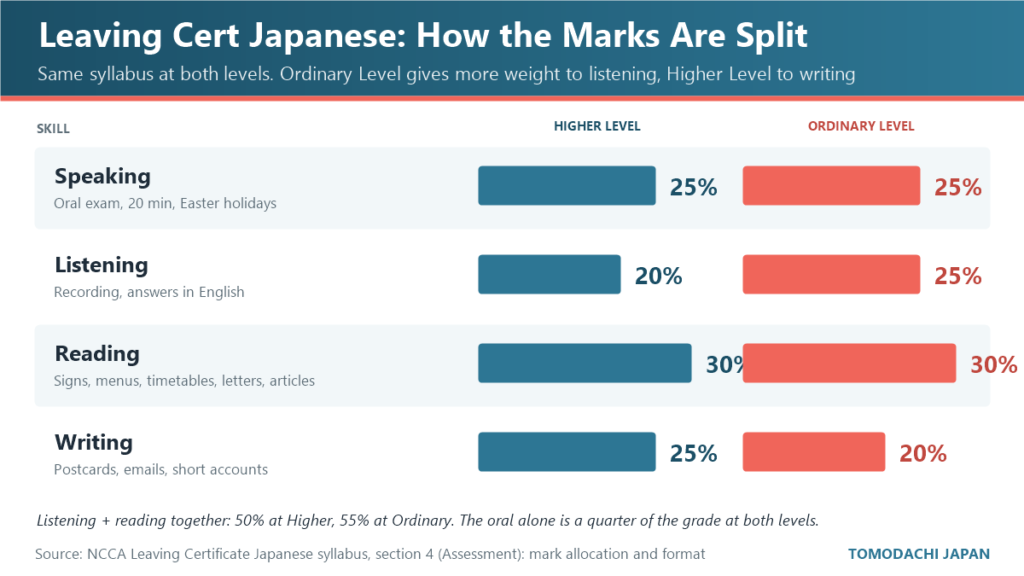
Leaving Cert Japanese is examined at Higher and Ordinary Level on the same syllabus, and it tests all four skills: a 20-minute oral held by a visiting examiner in the Easter holidays, and a written paper in June that covers listening, reading and writing. At Higher Level the marks are split speaking 25%, listening 20%, reading 30% and writing 25%; at Ordinary Level the listening carries more (25%) and the writing less (20%). Listening questions are answered in English.
This guide is checked against the NCCA Leaving Certificate Japanese syllabus (section 4, Assessment), the State Examinations Commission circulars on the 2025 and 2026 oral examinations, and the published 2026 written timetable. You will find the exact mark allocation at both levels, what the four parts of the oral are, how the listening and reading papers are built, where the past papers and marking schemes live, the 2026 dates, and a teacher’s view on where candidates lose marks. Where a number is not in a public document, we say so instead of inventing one.

Leaving Cert Japanese mark allocation: Higher vs Ordinary
The syllabus is the same at both levels. What changes is the complexity of the language in the tasks and the weighting of the skills. The NCCA explains the logic: receptive skills (listening and reading) develop earlier than productive skills (speaking and writing), so at Ordinary Level the receptive skills are given a greater share of the marks.
| Skill | How it is examined | Higher Level | Ordinary Level |
|---|---|---|---|
| Speaking | Oral examination, 20 minutes per candidate, in the Easter holidays | 25% | 25% |
| Listening comprehension | Recorded material; questions answered in English | 20% | 25% |
| Reading comprehension | Signs, menus, timetables, brochures, letters, simplified articles | 30% | 30% |
| Writing | Responding to written or visual stimuli, giving information, describing, explaining | 25% | 20% |
Three practical consequences follow from that table:
- Reading is the biggest single block at both levels (30%). It is also the skill most candidates under-practise, because the texts in the exam (menus, timetables, notices, short letters) feel easy until you meet them with a clock running.
- The oral is a quarter of the grade and happens two months before the written paper. If your speaking is not ready by March, no amount of June revision gets those marks back.
- Higher Level rewards writing. The five percentage points that move from listening to writing at Higher are exactly where a well-drilled student pulls ahead of a nervous one.
Looking for a way to keep Japanese going from abroad?
TOMODACHI JAPAN is an online Japanese school for children growing up outside Japan. They talk with peers their own age in Japan every day, taught by teachers working at Japanese schools, in small classes of 8.
🎁 Register and we’ll email you our School Guide (PDF, in English) straight away. You’ll also be first to hear about tuition, scholarships and opening dates.
Free · takes about 30 seconds
The oral: four parts in 20 minutes
The syllabus sets out the oral in four parts, and it allots twenty minutes per candidate:
- General conversation based on the syllabus content: yourself, family, school, free time, daily routine, your town, plans.
- Role-play: a situation card (shopping, directions, ordering, making arrangements) acted out with the examiner.
- Development of the theme of the role-play through discussion: the examiner follows the role-play with open questions on the same topic.
- Description of a picture and discussion of the themes it raises.
A note from a Japanese classroom teacher. Part 4 separates the grades. Most candidates can say what is in the picture (男の人が電車に乗っています). Far fewer can move from description to the themes the picture is there to raise, and that is where the discussion marks sit. Practice a three-step pattern for every picture: what you see (〜ています), what you think is happening and why (〜と思います。〜からです), and a link to your own experience (私も〜たことがあります). The third step is what turns a description into a conversation, and it is the same move the examiner is waiting for in Part 3.
One more thing that is easy to get wrong in a classroom in Ireland: the oral is a conversation with an adult you have not met, so the polite form (です・ます) is the register for all four parts. Students who learned Japanese from anime slip into plain form under pressure (行く instead of 行きます), which examiners hear as abrupt rather than friendly. Keep the plain form for quoting what a friend said, and for nothing else.
The written paper: listening, reading and writing
The written examination lasts 2 hours 30 minutes and starts at 9:30 on the day of the exam. The syllabus describes the three skills it covers:
- Listening comprehension. You listen to a recording and answer questions in English. The syllabus lists overheard conversations, public announcements and extracts from radio among the sources, and asks for both general understanding and specific details. Because the answers are in English, the test is purely whether you understood; there are no marks for the Japanese you write here.
- Reading comprehension. Public signs, menus, timetables, brochures, guides, letters and simplified newspaper or magazine articles. At Higher Level the syllabus says material places greater demands on candidates and asks them to explore various levels of meaning within a text, so expect inference questions, not just information-finding.
- Written production. Responding to written or visual stimuli, giving and obtaining information, describing, relating, explaining and summarizing. In practice this means short functional texts: a postcard, an email to a host family, a reply to an invitation, a short account of your weekend.
The kanji list. The syllabus ends with an appendix titled List of required Kanji. Your teacher works from that list, and so should you: the exam is written for candidates who know those characters, and kanji outside the list are not the point of the paper. Our advice is to learn every kanji on the list for reading, and to be able to write the ones that appear in the writing tasks you practice most (days, numbers, time, family, school, places, verbs of movement). If you want to see how a bigger list is organized for a different exam, our GCSE Japanese kanji list shows the UK equivalent.
Leaving Cert Japanese 2026: the dates
| What | When | Source |
|---|---|---|
| Oral examinations (Irish and modern foreign languages, including Japanese) | Saturday 28 March to Thursday 2 April 2026, in schools, by SEC-appointed examiners (the first week of the Easter holidays) | SEC circular on Leaving Certificate 2026 oral examinations; the SEC has said the Easter arrangement applies for 2025, 2026 and 2027 |
| Written paper: Japanese | Tuesday 23 June 2026, 9:30, 2 hours 30 minutes | Leaving Certificate 2026 written timetable (the last day of the written exams, which run from 3 June) |
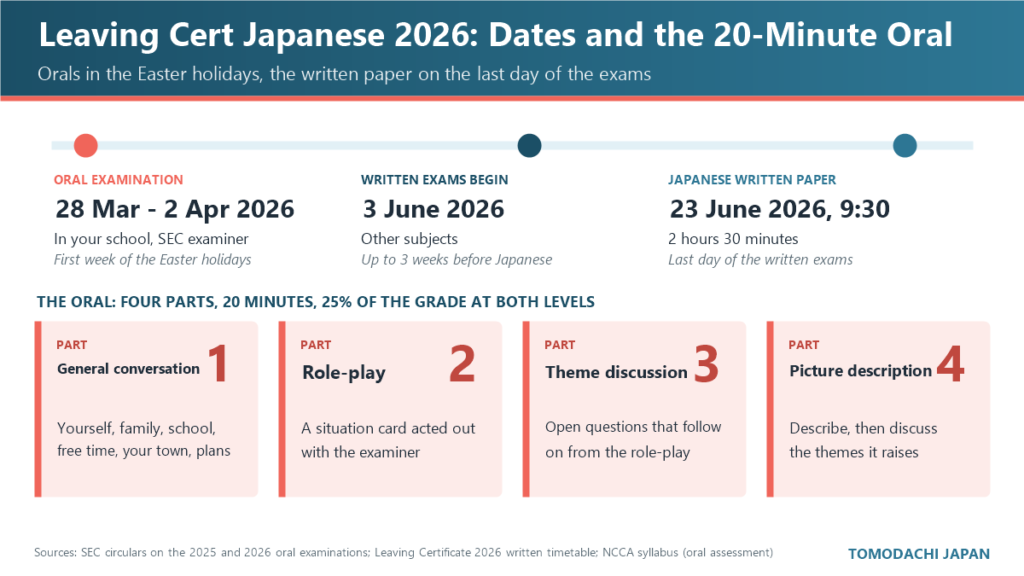
The gap matters. Japanese is the last written paper of the whole Leaving Cert in 2026, so you will sit it after every other subject is finished, with up to three weeks between your second-last exam and this one. That is a gift for reading and writing revision, and a risk for the listening, which decays fastest when you stop hearing Japanese. Keep one short listening habit going through June.
Past papers and marking schemes
The State Examinations Commission publishes every Leaving Certificate Japanese paper and marking scheme in its exam material archive on examinations.ie, at both Higher and Ordinary Level, with the listening audio files alongside recent papers. Third-party sites mirror the papers, but the marking scheme on the SEC site is the one your examiner uses, so read that version.
How to use them, in the order that pays off:
- Start with the reading sections of three different years, untimed, and build a list of the text types that recur (menus, timetables, notices, letters). The vocabulary in those text types repeats far more than the vocabulary in the general conversation does.
- Do every listening section you can find, twice. The first time, answer in English as the exam asks. The second time, a week later, write down the Japanese you heard for each answer. That second pass is what moves the listening into your speaking.
- Time the writing tasks and mark them against the scheme’s criteria: the syllabus says marks reflect the ability to transfer meaning and the accuracy and appropriateness of language, including the range of vocabulary and structures. Range is a criterion. A safe answer with five sentence patterns scores lower than a slightly riskier one with ten.
- Turn old role-play cards into oral practice with anyone who can read the examiner’s lines, and record yourself. The Part 3 discussion that follows the role-play is the part you cannot rehearse from a card, so practice open questions on the same topics.

Where to get speaking practice: an honest comparison
Japanese is taught in a limited number of Irish schools, and in many of them the Leaving Cert group is small and the teacher is the only Japanese voice the students hear. The oral is 25% of the grade and the listening is another 20 to 25%, so the question most families end up asking is where the extra listening and speaking comes from.
| Option | Best for | Weak spot | Watch out for |
|---|---|---|---|
| School class | The syllabus, the kanji list, exam format, oral mock with the format | Hours per week; one voice | Ask how the Part 3 and Part 4 discussions are practised, not just the role-play |
| Grinds (one-to-one tutor) | Correcting writing, drilling the role-play cards | Cost; the same voice every week | Check the tutor knows the Leaving Cert format rather than the JLPT |
| Self-study with SEC past papers | Reading and listening comprehension, at no cost | Nobody hears your speaking | Record yourself or the oral stays unpractised |
| Online group school with teachers in Japan (what we run) | Hearing and speaking Japanese every week with people your age in Japan; polite-form conversation becomes automatic | Not an exam-prep service; we do not teach the Leaving Cert role-play cards | Time difference: classes run from Japan, so the Irish slots are early afternoon and evening |
TOMODACHI JAPAN is an online school where children and teenagers growing up outside Japan talk with peers in Japan every week, taught by teachers who work in Japanese schools, in groups of eight. We charge a flat monthly rate for unlimited classes; the figures and the Irish time slots are in our school guide, which you can get from the registration page, and the pricing model is explained on our tuition page. If what you need is a grind for the role-play cards, a Leaving Cert tutor is the better buy. If what you need is to hear and speak Japanese with real people every week so that the oral and the listening stop being frightening, that is what we are for.
If you are comparing qualifications, we have the same kind of guide for GCSE Japanese past papers, IB Japanese B and IB Japanese ab initio, and for the HSC Japanese past papers in Australia.
Frequently asked questions
Is Leaving Cert Japanese hard?
It is a beginner-to-elementary course: the syllabus is built around everyday situations (family, school, shopping, travel, directions) and a fixed kanji list, and listening questions are answered in English. The difficulty is not the content but the oral, which is 25% of the grade and is sat in March with an examiner you have not met.
Is there an oral exam for Leaving Cert Japanese?
Yes. It is 25% at both Higher and Ordinary Level, lasts twenty minutes, and has four parts: general conversation, role-play, discussion of the role-play theme, and picture description with discussion. In 2026 the orals run from 28 March to 2 April.
When is the Leaving Cert Japanese exam in 2026?
The written paper is on Tuesday 23 June 2026 at 9:30 and lasts 2 hours 30 minutes. It is the last day of the written examinations.
Are listening answers in Japanese or English?
In English. The syllabus states that candidates listen to a recording and answer questions in English on what they have heard.
Can I take Leaving Cert Japanese if my school does not teach it?
Entry is through a school, so you would need your school to enter you and to host the oral examiner; some students study with a tutor and sit the exam through their school. Ask your principal early in fifth year, because the arrangement has to be in place before the February entry deadlines.
How many kanji do I need for Leaving Cert Japanese?
The syllabus has an appendix titled List of required Kanji, and that list is the scope of the exam. The syllabus PDF on curriculumonline.ie prints the characters; it does not state a count in the text, so work from the list itself rather than from a number.
Sources
- NCCA, Leaving Certificate Japanese Syllabus (Ordinary Level and Higher Level), section 4 Assessment: mark allocation, format, oral assessment, listening, reading, written production; Appendix, List of required Kanji.
- State Examinations Commission circular on Leaving Certificate 2026 oral examinations (orals delivered in schools from Saturday 28 March to Thursday 2 April 2026, in the first week of the Easter holidays for 2025, 2026 and 2027).
- State Examinations Commission circular S11/25 on Leaving Certificate 2025 oral examinations (Japanese listed among the oral languages).
- Leaving Certificate 2026 written examination timetable (Japanese: 23 June 2026, 9:30, 2 h 30 min).
- State Examinations Commission exam material archive (past papers and marking schemes).