The GCSE Japanese kanji list is Appendix 4 of the Pearson Edexcel GCSE (9-1) Japanese specification (1JA0). It contains exactly 200 kanji: 76 for Foundation tier and a further 124 for Higher tier, so a Higher candidate is expected to know all 200. Below you’ll find every one of them, sorted into themes you can actually revise, with a meaning, the common readings and an example word for each, plus a clear answer to the question every Year 10 asks: do I have to write these, or just read them?
We checked every character against the current specification (Issue 5, October 2022), so the list below matches Pearson’s exactly, kanji for kanji. Pearson prints the list by stroke count, which is handy for typesetting and not much use for learning. We’ve regrouped it by topic and added the readings and example words ourselves, as Japanese teachers. If you are looking for where the past papers live and how the four papers are weighted, our guide to GCSE Japanese past papers covers that. This article is about the list itself.
The GCSE Japanese kanji list at a glance
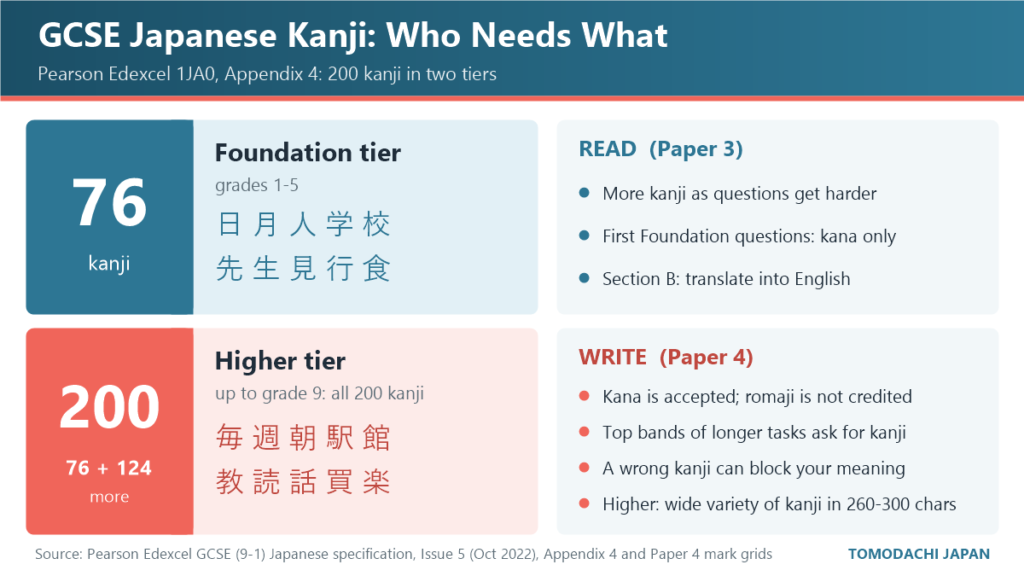
Here’s the whole picture before the detail. Tier, grades and counts come straight from the specification.
| Tier | Kanji you are expected to know | Grades available | Smallest stroke count / largest |
|---|---|---|---|
| Foundation | 76 | 1–5 | 1 stroke (一) to 10 strokes (家, 校, 高, 時) |
| Higher | 200 (the 76 plus 124 more) | 4–9 (a grade 3 may be allowed) | 4 strokes (父, 心, 文…) to 18 strokes (曜) |
Three details in the specification change how you should revise:
- The 200 kanji are the only kanji you are expected to know. The vocabulary list in the specification gives every word in hiragana or katakana. Where it also shows a kanji version, Pearson says that column is there for teachers’ reference and that candidates aren’t expected to know those kanji. So 図書館 is worth learning in kanji (all three characters are on the Higher list), while a word like 運転 can stay in kana.
- Kanji density rises with difficulty. The first questions on the Foundation reading paper use only hiragana and katakana. Kanji increase as the questions get harder, which is why Higher papers feel so much denser.
- No dictionaries, anywhere. That includes the speaking preparation time. Whatever you can’t read on the day, you work out from context.
Looking for a way to keep Japanese going from abroad?
TOMODACHI JAPAN is an online Japanese school for children growing up outside Japan. They talk with peers their own age in Japan every day, taught by teachers working at Japanese schools, in small classes of 8.
🎁 Register and we’ll email you our School Guide (PDF, in English) straight away. You’ll also be first to hear about tuition, scholarships and opening dates.
Free · takes about 30 seconds
Do you have to write the kanji, or only read them?
Short answer: you must be able to read them, and you are rewarded for writing them, but you are never forced to. The specification doesn’t split the list into kanji to recognize and kanji to produce. Instead, the mark grids for Paper 4 (Writing) tell you how kanji affect your score, and they are surprisingly generous to kana.
| Paper 4 task | Suggested length | What the top band says about script |
|---|---|---|
| Foundation Q1 (12 marks) | 25–50 characters | Hiragana is enough for the top band |
| Foundation Q2 (16 marks, formal) | 50–80 characters | Hiragana and katakana with minimal kanji |
| Foundation Q3 / Higher Q1 (20 marks, informal) | 160–180 characters | A variety of kanji alongside varied vocabulary |
| Higher Q2 (28 marks, formal) | 260–300 characters | A wide variety of kanji |
| Translation into Japanese | 5 sentences (F) / short passage (H) | Meaning and accuracy are marked; romaji earns nothing |
Two rules from the same mark grids are worth taping above your desk. First, anything written in romaji is not credited, on every writing task. Second, a wrong kanji counts as a serious error. The specification gives 工園 written for 公園 as an example of an error that stops the meaning getting through, while a slightly wobbly but recognizable character is only a minor slip. In other words, kana you are sure of beats a kanji you are guessing.
The writing paper is answered on squared manuscript paper (原稿用紙, genkō yōshi). In the Summer 2025 examiner report for Paper 4H, the principal examiner noted that candidates were placing small kana and punctuation correctly and using simple, everyday kanji better than in previous years. That is exactly the kind of kanji use that pays: common characters, written correctly, in sentences.
Our practical advice: aim to read all the kanji for your tier, and to write about 40 to 60 of them with total confidence, the ones that turn up in almost every answer. A good starting set:
- Time: 今日, 毎日, 時, 年, 月, 週末 (末 is not on the list, so しゅうまつ is fine), 午前, 午後
- People: 私, 友だち, 先生, 家族, 父, 母
- Places: 学校, 家, 日本, 駅, 店, 町
- Verbs: 行きます, 来ます, 見ます, 食べます, 飲みます, 思います, 買います
- Opinions: 好き, 楽しい, 大きい, 小さい, 高い, 新しい
Speaking (Paper 2) involves no kanji at all, but the same words come up there. If you are preparing for that paper too, our guide to the Japanese oral exam walks through role plays and conversation questions.
Foundation kanji list: all 76, grouped by theme
Everyone needs these, at both tiers. Nearly all of them are taught in the first two years of primary school in Japan, which is good news: they are simple in shape and appear constantly. Learn them inside the example word rather than on their own, and say the word out loud as you go.
| Kanji | Meaning | Common readings | Example word |
|---|---|---|---|
| Numbers and money (14) | |||
| 一 | one | いち, ひと(つ) | 一つ (ひとつ) one thing |
| 二 | two | に, ふた(つ) | 二人 (ふたり) two people |
| 三 | three | さん, みっ(つ) | 三月 (さんがつ) March |
| 四 | four | よん, し, よっ(つ) | 四時 (よじ) four o’clock |
| 五 | five | ご, いつ(つ) | 五分 (ごふん) five minutes |
| 六 | six | ろく, むっ(つ) | 六月 (ろくがつ) June |
| 七 | seven | なな, しち | 七時 (しちじ) seven o’clock |
| 八 | eight | はち, やっ(つ) | 八百 (はっぴゃく) eight hundred |
| 九 | nine | きゅう, く | 九月 (くがつ) September |
| 十 | ten | じゅう, とお | 十日 (とおか) the 10th of the month |
| 百 | hundred | ひゃく | 三百 (さんびゃく) three hundred |
| 千 | thousand | せん | 千円 (せんえん) 1,000 yen |
| 万 | ten thousand | まん | 一万円 (いちまんえん) 10,000 yen |
| 円 | yen; circle | えん | 百円 (ひゃくえん) 100 yen |
| Days and time (10) | |||
| 日 | day; sun | にち, ひ, か | 日曜日 (にちようび) Sunday |
| 月 | month; moon | がつ, げつ, つき | 月曜日 (げつようび) Monday |
| 火 | fire | か, ひ | 火曜日 (かようび) Tuesday |
| 水 | water | すい, みず | 水曜日 (すいようび) Wednesday |
| 木 | tree | もく, き | 木曜日 (もくようび) Thursday |
| 金 | gold; money | きん, かね | お金 (おかね) money |
| 土 | earth, soil | ど, つち | 土曜日 (どようび) Saturday |
| 年 | year | ねん, とし | 今年 (ことし) this year |
| 時 | time; o’clock | じ, とき | 時間 (じかん) time, hours |
| 今 | now | いま, こん | 今日 (きょう) today |
| People and me (10) | |||
| 人 | person | じん, にん, ひと | 日本人 (にほんじん) Japanese person |
| 子 | child | こ, し | 女の子 (おんなのこ) girl |
| 女 | woman | おんな, じょ | 女子 (じょし) girls |
| 男 | man | おとこ, だん | 男の子 (おとこのこ) boy |
| 友 | friend | とも, ゆう | 友だち (ともだち) friend |
| 先 | ahead; previous | せん, さき | 先生 (せんせい) teacher |
| 生 | life; be born | せい, い(きる), う(まれる) | 学生 (がくせい) student |
| 私 | I, me | わたし, し | 私 (わたし) I, me |
| 自 | self | じ | 自分 (じぶん) oneself |
| 才 | years old | さい | 十五才 (じゅうごさい) 15 years old |
| Body and actions (11) | |||
| 口 | mouth | くち, こう | 入口 (いりぐち) entrance |
| 目 | eye | め, もく | 目 (め) eye |
| 耳 | ear | みみ | 耳 (みみ) ear |
| 手 | hand | て, しゅ | 上手 (じょうず) good at |
| 見 | see, watch | み(る) | 見ます (みます) to see, to watch |
| 言 | say | い(う), げん | 言います (いいます) to say |
| 行 | go | い(く), こう | 行きます (いきます) to go |
| 来 | come | く(る), き(ます), らい | 来年 (らいねん) next year |
| 出 | go out; exit | で(る), だ(す), しゅつ | 出口 (でぐち) exit |
| 入 | enter | はい(る), い(れる), にゅう | 入ります (はいります) to go in |
| 食 | eat; food | た(べる), しょく | 食べます (たべます) to eat |
| Places and school (9) | |||
| 国 | country | くに, こく | 外国 (がいこく) foreign country |
| 県 | prefecture | けん | 山口県 (やまぐちけん) Yamaguchi Prefecture |
| 市 | city | し | 市内 (しない) in the city |
| 町 | town | まち, ちょう | 町 (まち) town |
| 村 | village | むら, そん | 村 (むら) village |
| 田 | rice field | た, だ | 田中さん (たなかさん) Mr or Ms Tanaka |
| 家 | house; family | いえ, うち, か | 家族 (かぞく) family |
| 学 | study, learning | がく | 大学 (だいがく) university |
| 校 | school | こう | 学校 (がっこう) school |
| Position and size (8) | |||
| 上 | up, above | うえ, じょう | 上 (うえ) on top of |
| 下 | down, below | した, か | 下手 (へた) bad at |
| 中 | middle, inside | なか, ちゅう | 中学校 (ちゅうがっこう) lower secondary school |
| 外 | outside | そと, がい | 外国人 (がいこくじん) foreigner |
| 右 | right | みぎ | 右 (みぎ) right |
| 左 | left | ひだり | 左 (ひだり) left |
| 大 | big | おお(きい), だい | 大きい (おおきい) big |
| 小 | small | ちい(さい), しょう | 小学校 (しょうがっこう) primary school |
| Nature, food and everyday words (14) | |||
| 山 | mountain | やま, さん | 富士山 (ふじさん) Mount Fuji |
| 川 | river | かわ | 川 (かわ) river |
| 天 | sky; heaven | てん | 天気 (てんき) weather |
| 気 | spirit; energy | き | 気分 (きぶん) mood |
| 元 | origin; source | げん, もと | 元気 (げんき) well, lively |
| 白 | white | しろ, はく | 白い (しろい) white |
| 犬 | dog | いぬ, けん | 子犬 (こいぬ) puppy |
| 牛 | cow | うし, ぎゅう | 牛肉 (ぎゅうにく) beef |
| 肉 | meat | にく | 肉 (にく) meat |
| 本 | book; origin | ほん, もと | 日本 (にほん) Japan |
| 字 | written character | じ | 漢字 (かんじ) kanji |
| 何 | what | なに, なん | 何時 (なんじ) what time |
| 分 | minute; part | ふん, ぶん, わ(かる) | 分かります (わかります) to understand |
| 高 | tall; expensive | たか(い), こう | 高校 (こうこう) upper secondary school |
Two notes on this list. 才 is the simplified way of writing the age counter (the full form is 歳); for GCSE, 才 is the one you need. And 分 does triple duty: minutes (五分), a part (半分) and understanding (分かります). It is one of the most useful single characters on the whole list.
Higher kanji list: the extra 124
If you are sitting Higher, add these to the 76 above. Many of them complete words you already half know: 朝ご飯, 毎週, 図書館, 勉強, 映画. That is why learning the Higher list feels faster than its length suggests. Once you know 間, 時間 and 一時間 read themselves.
| Kanji | Meaning | Common readings | Example word |
|---|---|---|---|
| Family and people (10) | |||
| 父 | father | ちち, ふ | お父さん (おとうさん) father |
| 母 | mother | はは, ぼ | お母さん (おかあさん) mother |
| 兄 | older brother | あに, きょう | お兄さん (おにいさん) older brother |
| 弟 | younger brother | おとうと, だい | 兄弟 (きょうだい) siblings |
| 姉 | older sister | あね | お姉さん (おねえさん) older sister |
| 妹 | younger sister | いもうと | 妹 (いもうと) younger sister |
| 族 | family, group | ぞく | 家族 (かぞく) family |
| 体 | body | からだ, たい | 体育 (たいいく) PE |
| 心 | heart, mind | こころ, しん | 心配 (しんぱい) worry |
| 名 | name | な, めい | 名前 (なまえ) name |
| Time, seasons and weather (19) | |||
| 午 | noon | ご | 午後 (ごご) afternoon, p.m. |
| 半 | half | はん | 三時半 (さんじはん) half past three |
| 前 | before; in front | まえ, ぜん | 午前 (ごぜん) morning, a.m. |
| 後 | after; behind | あと, うし(ろ), ご | 後で (あとで) later |
| 毎 | every | まい | 毎日 (まいにち) every day |
| 週 | week | しゅう | 来週 (らいしゅう) next week |
| 曜 | day of the week | よう | 何曜日 (なんようび) what day |
| 朝 | morning | あさ, ちょう | 朝ご飯 (あさごはん) breakfast |
| 昼 | midday, daytime | ひる | 昼休み (ひるやすみ) lunch break |
| 晩 | evening | ばん | 晩ご飯 (ばんごはん) dinner |
| 夜 | night | よる, や | 今夜 (こんや) tonight |
| 間 | interval, between | あいだ, かん, ま | 一時間 (いちじかん) one hour |
| 春 | spring | はる | 春休み (はるやすみ) spring holidays |
| 夏 | summer | なつ | 夏休み (なつやすみ) summer holidays |
| 秋 | autumn | あき | 秋 (あき) autumn |
| 冬 | winter | ふゆ | 冬休み (ふゆやすみ) winter holidays |
| 雨 | rain | あめ | 雨 (あめ) rain |
| 雪 | snow | ゆき | 大雪 (おおゆき) heavy snow |
| 風 | wind; style | かぜ, ふう | 台風 (たいふう) typhoon |
| Places, town and travel (28) | |||
| 東 | east | ひがし, とう | 東京 (とうきょう) Tokyo |
| 西 | west | にし, せい | 西 (にし) west |
| 南 | south | みなみ, なん | 南 (みなみ) south |
| 北 | north | きた, ほく | 北海道 (ほっかいどう) Hokkaido |
| 京 | capital | きょう | 京都 (きょうと) Kyoto |
| 都 | capital, metropolis | と, みやこ | 都会 (とかい) big city |
| 州 | state; province | しゅう | 九州 (きゅうしゅう) Kyushu |
| 地 | ground, land | ち, じ | 地図 (ちず) map |
| 所 | place | ところ, しょ | 台所 (だいどころ) kitchen |
| 場 | place, location | ば, じょう | 場所 (ばしょ) place |
| 店 | shop | みせ, てん | 店員 (てんいん) shop assistant |
| 屋 | shop; roof | や, おく | 本屋 (ほんや) bookshop |
| 駅 | station | えき | 駅 (えき) station |
| 館 | large building | かん | 図書館 (としょかん) library |
| 院 | institution | いん | 病院 (びょういん) hospital |
| 園 | garden, park | えん | 動物園 (どうぶつえん) zoo |
| 庭 | garden, yard | にわ | 庭 (にわ) garden |
| 寺 | temple | てら, じ | お寺 (おてら) temple |
| 神 | god, spirit | かみ, じん | 神社 (じんじゃ) shrine |
| 社 | company; shrine | しゃ | 会社 (かいしゃ) company |
| 室 | room | しつ | 教室 (きょうしつ) classroom |
| 道 | road, way | みち, どう | 道 (みち) road |
| 車 | car, vehicle | くるま, しゃ | 電車 (でんしゃ) train |
| 鉄 | iron | てつ | 地下鉄 (ちかてつ) underground railway |
| 旅 | journey | たび, りょ | 旅行 (りょこう) trip |
| 近 | near | ちか(い), きん | 近く (ちかく) nearby |
| 海 | sea | うみ, かい | 海外 (かいがい) overseas |
| 空 | sky; empty | そら, くう | 空港 (くうこう) airport |
| School and study (17) | |||
| 教 | teach | おし(える), きょう | 教えます (おしえます) to teach |
| 勉 | effort | べん | 勉強 (べんきょう) study |
| 強 | strong | つよ(い), きょう | 強い (つよい) strong |
| 書 | write | か(く), しょ | 書きます (かきます) to write |
| 読 | read | よ(む), どく | 読書 (どくしょ) reading for pleasure |
| 話 | speak, talk | はな(す), わ | 電話 (でんわ) telephone |
| 語 | language, word | ご | 日本語 (にほんご) Japanese |
| 漢 | China (as in kanji) | かん | 漢字 (かんじ) kanji |
| 英 | England; English | えい | 英語 (えいご) English |
| 文 | writing, sentence | ぶん | 作文 (さくぶん) essay |
| 図 | drawing, plan | ず, と | 図書館 (としょかん) library |
| 紙 | paper | かみ | 手紙 (てがみ) letter |
| 部 | part; club | ぶ | 部活 (ぶかつ) school club |
| 理 | reason, logic | り | 理科 (りか) science |
| 写 | copy | うつ(す), しゃ | 写真 (しゃしん) photo |
| 画 | picture | が, かく | 画家 (がか) painter |
| 映 | reflect, project | えい | 映画 (えいが) film |
| Everyday verbs (19) | |||
| 会 | meet | あ(う), かい | 会います (あいます) to meet |
| 休 | rest | やす(む), きゅう | 休みます (やすみます) to rest, to be off |
| 住 | live (somewhere) | す(む), じゅう | 住んでいます (すんでいます) to live in |
| 作 | make | つく(る), さく | 作ります (つくります) to make |
| 使 | use | つか(う), し | 使います (つかいます) to use |
| 泳 | swim | およ(ぐ) | 泳ぎます (およぎます) to swim |
| 思 | think | おも(う), し | 思います (おもいます) to think |
| 持 | hold, have | も(つ), じ | 持っています (もっています) to have with you |
| 待 | wait | ま(つ), たい | 待ちます (まちます) to wait |
| 帰 | return home | かえ(る), き | 帰ります (かえります) to go home |
| 動 | move | うご(く), どう | 運動 (うんどう) exercise |
| 働 | work | はたら(く), どう | 働きます (はたらきます) to work |
| 飲 | drink | の(む), いん | 飲み物 (のみもの) a drink |
| 買 | buy | か(う), ばい | 買い物 (かいもの) shopping |
| 売 | sell | う(る), ばい | 売店 (ばいてん) kiosk |
| 知 | know | し(る), ち | 知っています (しっています) to know |
| 聞 | listen; ask | き(く), ぶん | 新聞 (しんぶん) newspaper |
| 終 | end, finish | お(わる), しゅう | 終わります (おわります) to finish |
| 有 | have, exist | ゆう | 有名 (ゆうめい) famous |
| Food, money and things (6) | |||
| 魚 | fish | さかな, ぎょ | 魚 (さかな) fish |
| 茶 | tea | ちゃ, さ | お茶 (おちゃ) green tea |
| 飯 | cooked rice, meal | はん, めし | ご飯 (ごはん) rice, a meal |
| 料 | fee; ingredients | りょう | 料理 (りょうり) cooking |
| 物 | thing | もの, ぶつ | 動物 (どうぶつ) animal |
| 銀 | silver | ぎん | 銀行 (ぎんこう) bank |
| Describing words, colors and culture (25) | |||
| 赤 | red | あか | 赤い (あかい) red |
| 青 | blue | あお | 青い (あおい) blue |
| 黒 | black | くろ | 黒い (くろい) black |
| 古 | old | ふる(い), こ | 古い (ふるい) old |
| 新 | new | あたら(しい), しん | 新しい (あたらしい) new |
| 安 | cheap; safe | やす(い), あん | 安い (やすい) cheap |
| 長 | long; chief | なが(い), ちょう | 長い (ながい) long |
| 多 | many | おお(い), た | 多い (おおい) many, a lot |
| 少 | few, a little | すく(ない), すこ(し), しょう | 少し (すこし) a little |
| 好 | like | す(き), こう | 好きな (すきな) favorite |
| 楽 | fun; music | たの(しい), がく, らく | 楽しい (たのしい) fun |
| 真 | true, real | ま, しん | 真ん中 (まんなか) the middle |
| 同 | same | おな(じ), どう | 同じ (おなじ) the same |
| 切 | cut | き(る), せつ | 大切な (たいせつな) important |
| 公 | public | こう | 公園 (こうえん) park |
| 化 | change | か | 文化 (ぶんか) culture |
| 式 | ceremony; style | しき | 入学式 (にゅうがくしき) school entrance ceremony |
| 和 | harmony; Japanese style | わ | 和食 (わしょく) Japanese food |
| 祭 | festival | まつ(り), さい | お祭り (おまつり) festival |
| 花 | flower | はな, か | 花火 (はなび) fireworks |
| 音 | sound | おと, おん | 音楽 (おんがく) music |
| 電 | electricity | でん | 電気 (でんき) electricity, lights |
| 病 | illness | びょう | 病気 (びょうき) illness |
| 事 | thing, matter | こと, じ | 仕事 (しごと) job |
| 番 | number; turn | ばん | 一番 (いちばん) number one, the most |
Notice how many Higher kanji are built from Foundation ones: 休 is 人 plus 木, 好 is 女 plus 子, 間 is a gate (門) with 日 inside, and 聞 is the same gate with 耳. More on that in the teachers’ note below.
Kana, furigana and the kanji you don’t need
Students often ask what happens when a word on the vocabulary list uses a kanji that isn’t one of the 200. The specification’s answer is indirect but clear: you are only expected to know the 200, and the vocabulary list itself is written in kana. So for a word such as 運動 (うんどう, exercise), where 動 is on the list but 運 is not, writing it in kana is perfectly safe. By contrast, 料理 (cooking) is worth learning in kanji, because both 料 and 理 are on the Higher list.
The specification does not publish a furigana rule for the question papers, so we won’t invent one. The safest way to see how Pearson prints words outside the list is to open two or three recent reading papers and look. You will quickly get a feel for which words appear in kanji and which stay in kana. When you write, you are free to use kana for anything you aren’t sure of.
If you are curious how other exam boards handle this, Australian senior Japanese courses publish their own lists too. Our articles on the VCE Japanese kanji list and the HSC Japanese Continuers kanji list show how differently each one approaches it, which is useful if you’re planning to continue Japanese after GCSE.
A 10-week plan to learn all 200
This plan assumes about 15 minutes a day, five or six days a week, and works for both tiers. Foundation students stop adding new kanji after week 3 and use weeks 4 to 8 to deepen the 76 through reading and writing. The groups match the tables above, so you can work straight from this page.
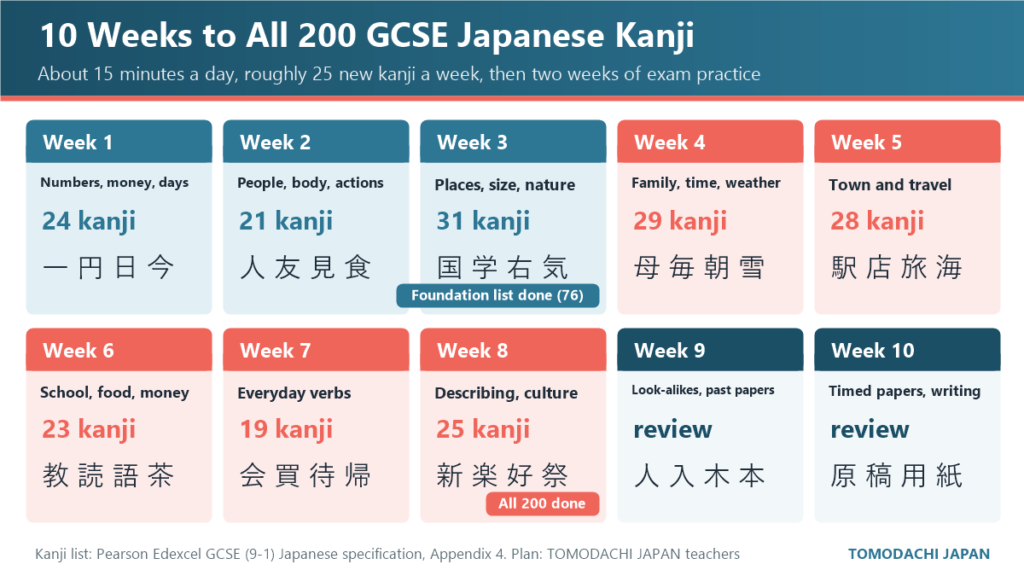
| Week | Groups from the tables | New kanji | End-of-week check |
|---|---|---|---|
| 1 | Numbers and money; Days and time | 24 | Write today’s date and a price in kanji |
| 2 | People and me; Body and actions | 21 | Five sentences about a friend |
| 3 | Places and school; Position and size; Nature, food and everyday words | 31 | Foundation list complete: one Foundation reading paper, untimed |
| 4 | Family and people; Time, seasons and weather | 29 | Describe your week and the weather |
| 5 | Places, town and travel | 28 | Directions from a station to a shop |
| 6 | School and study; Food, money and things | 23 | A short paragraph about school |
| 7 | Everyday verbs | 19 | Rewrite week 2 sentences in the past tense |
| 8 | Describing words, colors and culture | 25 | All 200 learned: one Higher reading paper, untimed |
| 9 | Review: look-alike pairs and every kanji you missed | 0 | Highlight all kanji in two past papers; re-learn the ones you hesitated on |
| 10 | Timed reading paper and a full writing paper on squared paper | 0 | Count the kanji you used correctly in your longest answer |
A daily 15 minutes that works:
- 5 minutes: review. Flashcards for everything you’ve learned so far, with the example word on the front, not the single kanji.
- 5 minutes: new kanji. Four or five new characters. Read the example word aloud, write it three times, then cover it and write it once from memory.
- 5 minutes: use it. Write one sentence that uses today’s kanji and something from last week. 毎朝、駅まで歩きます is better practice than a page of 駅.
Leave weekends for catching up. Most students fall behind in week 5, the biggest Higher group, so it is fine to split it over ten days.
Teachers’ note: how kanji actually stick
As teachers trained in Japan, we teach children kanji every week, and the pattern is always the same. Students who copy a kanji twenty times in a row tend to forget it by Friday. Students who notice what it’s made of, and meet it inside words, keep it. Here is what we do in class.
Learn kanji by their parts
Most kanji on the Higher list are built from simpler pieces, many of them Foundation kanji. Once you see the pieces, a 14-stroke character becomes three familiar shapes:
- 言 on the left means speech: 語 (language), 読 (read), 話 (talk). 読 is 言 plus 売, so if you know 売 you nearly know 読.
- The roof 宀 on top: 字, 安, 家, 室. Things under one roof.
- 女 for family words: 姉, 妹, 好.
- The water strokes 氵: 海 (sea), 泳 (swim).
- 雨 on top for weather: 雪 (snow), 電 (electricity, originally lightning).
- 寺 as a sound family: 時, 持, 待 all contain 寺, and 時 and 持 both share its じ sound.
Learn them through vocabulary
Exams test words, not lone characters. 生 has several readings, but you’ll never need to recite them: you need to recognize 先生, 学生 and 生まれました. Learning the word fixes the reading automatically, and it is exactly what you’ll write in Paper 4. That’s why every row in our tables has an example word.
Watch the look-alikes
These are the pairs we correct most often in GCSE-level writing. Put them side by side on one flashcard so your eye learns the difference:
| Pair | How to tell them apart |
|---|---|
| 人 / 入 | In 人 (person) the long left stroke is on top and the right stroke leans against it; in 入 (enter) it is the other way round, with the right stroke on top. Think of 入口, the entrance. |
| 木 / 本 | 本 is a tree with a line marking the root, the origin. 本 means book in 本屋 and origin in 日本. |
| 右 / 石 | 石 (stone) isn’t on the list, but it turns up in names. In 右 the slanting stroke rises above a short horizontal; in 石 a long horizontal sits on top and the slanting stroke hangs below it. Also note stroke order: 右 starts with the slanting stroke, 左 with the horizontal. |
| 午 / 牛 | 牛 (cow) has a centre stroke that pokes through the top; 午 (noon) doesn’t. 午後 vs 牛肉. |
| 大 / 犬 / 天 | Add a dot and big becomes dog (犬); add a line on top and it becomes sky (天). |
| 日 / 目 / 白 / 百 | Count the inside lines: 日 one, 目 two. 白 is 日 with a tick; 百 is 白 with a line on top. |
| 待 / 持 | Same right side (寺). 待 (wait) has the going strokes 彳; 持 (hold) has the hand 扌. |
| 公 / 工 | The specification’s own example: 工園 instead of 公園 counts as a meaning error. |
One last point about handwriting. Stroke order matters because it makes your characters balanced and readable, but GCSE examiners care about whether the kanji is recognizable and correct. Spend your time on the right shape inside the right word, not on perfect calligraphy.
Free resources worth using, and who we don’t suit
You don’t need to pay for anything to learn this list. These are the resources we would point our own students to:
- Pearson’s own materials. The specification (for the kanji and vocabulary lists), the sample assessment materials, past papers and the examiner reports are all on the Pearson Qualifications site. The examiner reports are the most underrated: they tell you which words and kanji tripped candidates up.
- The Japan Foundation. Its free JF Japanese e-Learning Minato platform and Marugoto materials give you graded reading and listening that reuse the same everyday kanji.
- Anki. Free on desktop and Android. Copy our tables into a spreadsheet, import them, and put the example word on the front of each card. If you download a shared GCSE deck instead, check it against the 200: some decks include extra kanji you don’t need.
- A good free dictionary. Jisho.org shows readings, example words and stroke order animations, which is all you need to check your writing.
- Kanji apps. Many let you build a custom list. Pick one that shows kanji inside words, and load only the 76 or 200 you need, so the app doesn’t pull you into hundreds of extra characters.
Where a school like ours helps is in using these kanji with real people. At TOMODACHI JAPAN, students learn online in small groups with teachers from Japan, and make friends with children their own age in Japan. Reading a message from a friend in Japan that contains 今日, 学校 and 楽しかった does more for your kanji than another flashcard session. If you’re in the capital, our guide to Japanese schools for kids in London compares local options too.
To be honest about fit: we are not a GCSE cramming service. If your exams are a few weeks away and you want someone to drill past papers with you one to one, a specialist GCSE tutor is a better choice. Where we fit is the longer run, when a student wants Japanese to become a language they use with friends rather than a subject they revise. Details are in our school guide at /en/apply/.
The bottom line
The GCSE Japanese kanji list is short and fixed: 76 kanji for Foundation, 200 for Higher, all printed in Appendix 4 of the Pearson Edexcel specification. You need to read your tier’s kanji, and you earn more marks in the longer writing tasks by using a variety of them correctly. Kana is always acceptable, romaji never is, and a wrong kanji costs more than a right hiragana word. Learn the list by theme, by parts and inside words, about 25 a week, and you’ll have all 200 with two weeks to spare for past papers.
GCSE Japanese kanji FAQ
How many kanji do you need for GCSE Japanese?
200 for Higher tier and 76 for Foundation tier. The Higher list is the 76 Foundation kanji plus a further 124, as set out in Appendix 4 of the Pearson Edexcel GCSE (9-1) Japanese specification.
Do I lose marks if I write in hiragana instead of kanji?
Not on the short Foundation tasks, where hiragana is enough for the top band. In the longer tasks (160–180 and 260–300 characters), the top bands expect a variety of kanji, so writing everything in kana limits how high you can go. Writing in romaji earns no credit at all.
Is there an official GCSE Japanese vocabulary list?
Yes. The specification includes a vocabulary list organized by high-frequency language and by theme, split into Foundation and Higher. Words are given in hiragana or katakana; the kanji shown next to some of them are for teachers’ reference only.
Are the GCSE kanji the same as JLPT N5?
No. They overlap heavily, but they aren’t the same list. The JLPT has not published official kanji lists since 2010, and the unofficial lists people use put N5 at around 100 kanji, so the GCSE Higher list of 200 sits somewhere between unofficial N5 and N4 lists.
Which kanji should I learn first?
Numbers, days of the week and the kanji in 学校, 先生, 友だち, 私 and 毎日. They appear in nearly every reading text and are useful in every writing answer, whatever the topic.
Will the GCSE Japanese kanji list change soon?
Not at present. The reformed GCSE language content with first exams in 2026 applies to French, German and Spanish only, and Japanese continues on the 2017 specification. Check the specification’s issue number on the Pearson site each September to be sure.
Sources
- Pearson Edexcel Level 1/Level 2 GCSE (9-1) in Japanese (1JA0) specification, Issue 5, October 2022: qualifications.pearson.com (PDF)
- Pearson Edexcel GCSE Japanese (2017) qualification page: qualifications.pearson.com
- Pearson, Examiners’ Report, Summer 2025, Paper 4H Writing in Japanese: qualifications.pearson.com (PDF)
- Pearson, Past papers, mark schemes and examiner reports: qualifications.pearson.com