If you have been looking into Japan Preschool Exchange, you have probably typed the same follow-up questions most parents do: how does it work, is it legit, what does it cost, and would my child actually cope?
This is a straight guide from a Japanese school that works with children growing up outside Japan. We are not affiliated with the programme and we do not earn anything from it. We think it is a genuinely lovely idea — and we also think families should know exactly where it ends, so the Japanese a child picks up in Japan does not quietly disappear on the flight home.
What Japan Preschool Exchange is
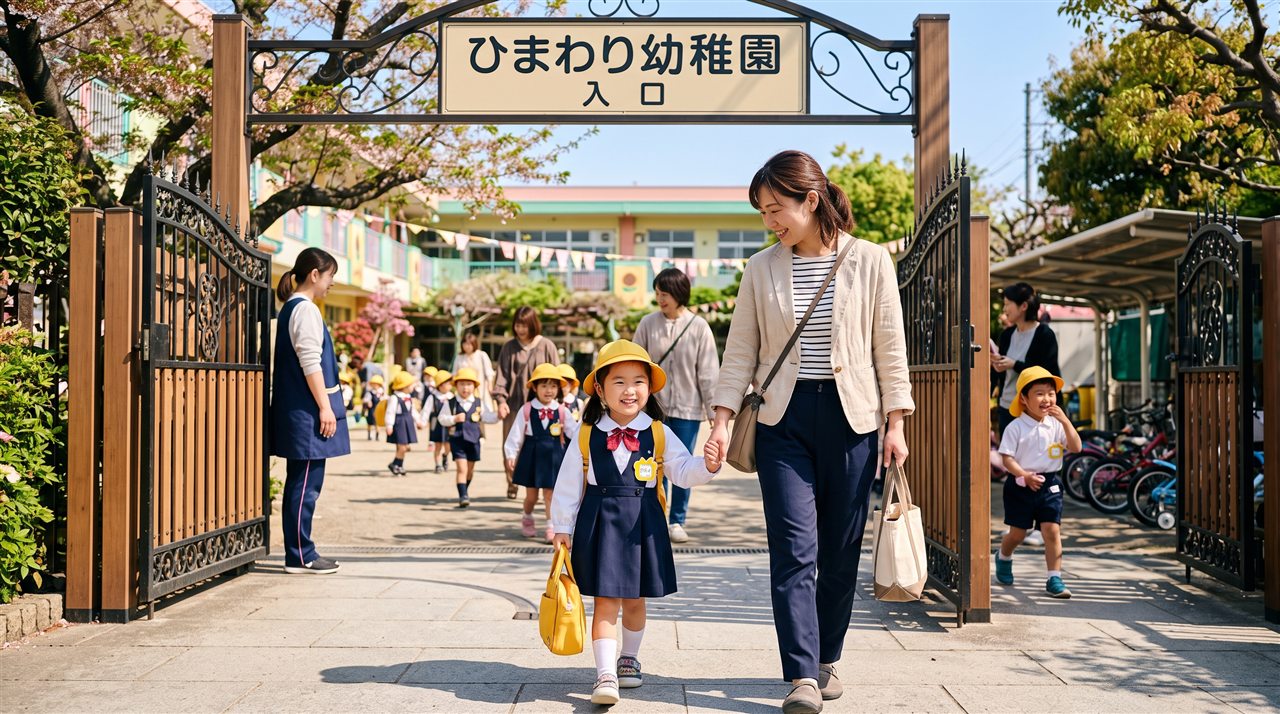
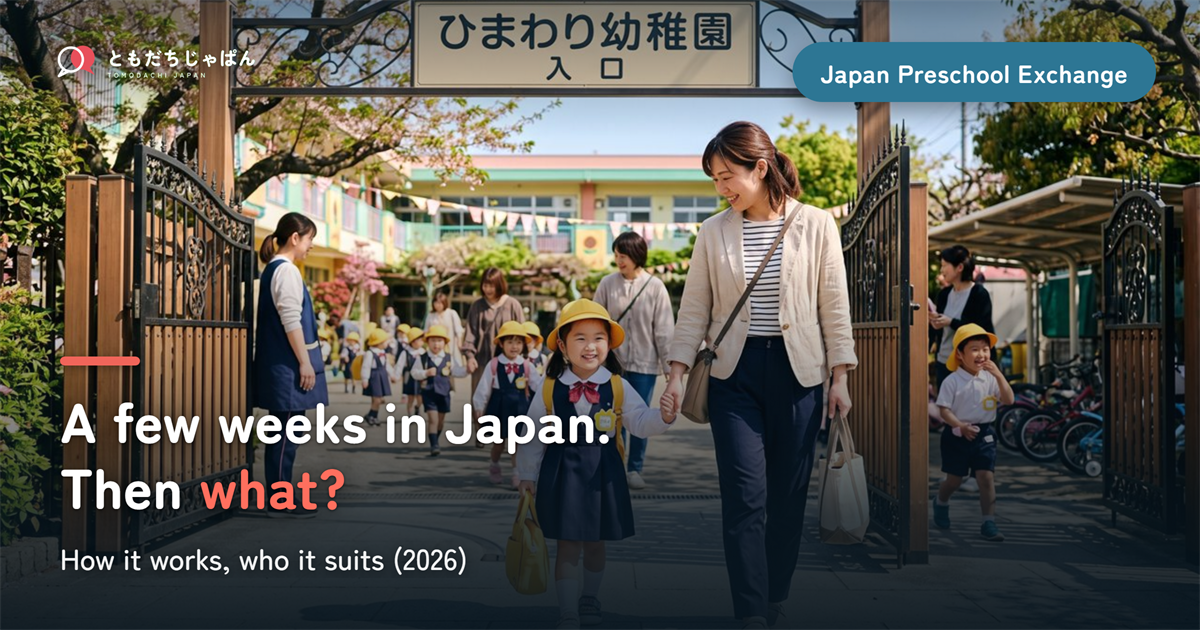
Japan Preschool Exchange is the English-language version of 保育園留学 (hoikuen ryugaku), a service run by Kitchhike, Inc., a Japanese company headquartered in Assabu, Hokkaido, with offices in Tokyo and Fukuoka. The idea started in 2021, after the company’s CEO stayed with his own daughter in a small town in Hokkaido and she attended the local preschool.
What they sell is a package: a place at a Japanese preschool for your child, plus a furnished home for your family, for a set number of weeks. You cannot book the preschool on its own, and you are asked not to contact the schools directly — Kitchhike arranges both sides for you.
Want the Japanese to keep going once you are home?
TOMODACHI JAPAN is an online Japanese school for children growing up outside Japan. They talk with peers their own age in Japan every day, taught by teachers working at Japanese schools, in small classes of 8.
🎁 Register and we’ll email you our School Guide (PDF, in English) straight away. You’ll also be first to hear about tuition, scholarships and opening dates.
Free · takes about 30 seconds
Is Japan Preschool Exchange legit?
This is the most searched question about it, so here is the most useful answer we found: the operator publishes its travel agency registration (a domestic travel agency registered with the Tokyo Metropolitan Government) along with its terms of transaction on the official site. That is a regulated status in Japan, not a marketing badge. The programme has also been covered by international media, including a CNN travel feature in 2025.
That tells you it is a real, accountable business. It does not tell you whether it suits your child — which is the more important question, and the rest of this article.
How it works, step by step
- Choose a destination and dates. Standard stays run one, two or three weeks, Sunday to Saturday. Longer stays of one to three months are offered only in a few towns (Assabu, Takehara and Shirahama at the time of writing).
- Apply. Kitchhike contacts the preschool and the accommodation, and both have to accept your family. They say this takes one to two weeks.
- Meet the teacher online. There is a video call with the preschool one to two months before you arrive.
- Arrive and attend. Your child joins an ordinary class of Japanese children on weekdays, during the school’s normal hours.
Most destinations are rural or small-town, which is the point for many families. There are also city options, including Tokyo (Setagaya), Yokohama, Kyoto, Osaka and Fukuoka. The schools are a mix of types — nursery schools, kindergartens and combined kodomo-en.
Ages, language and who it suits
- Age: the programme covers children from 0 to 6, but each preschool sets its own limits, and children are placed by the Japanese school-year system.
- Japanese: neither your child nor you needs to speak Japanese. The day runs in Japanese, with Japanese staff and Japanese classmates. Some schools have English-speaking teachers.
- Your time: care is weekday-only, so the model suits a parent who can work remotely or explore during school hours.
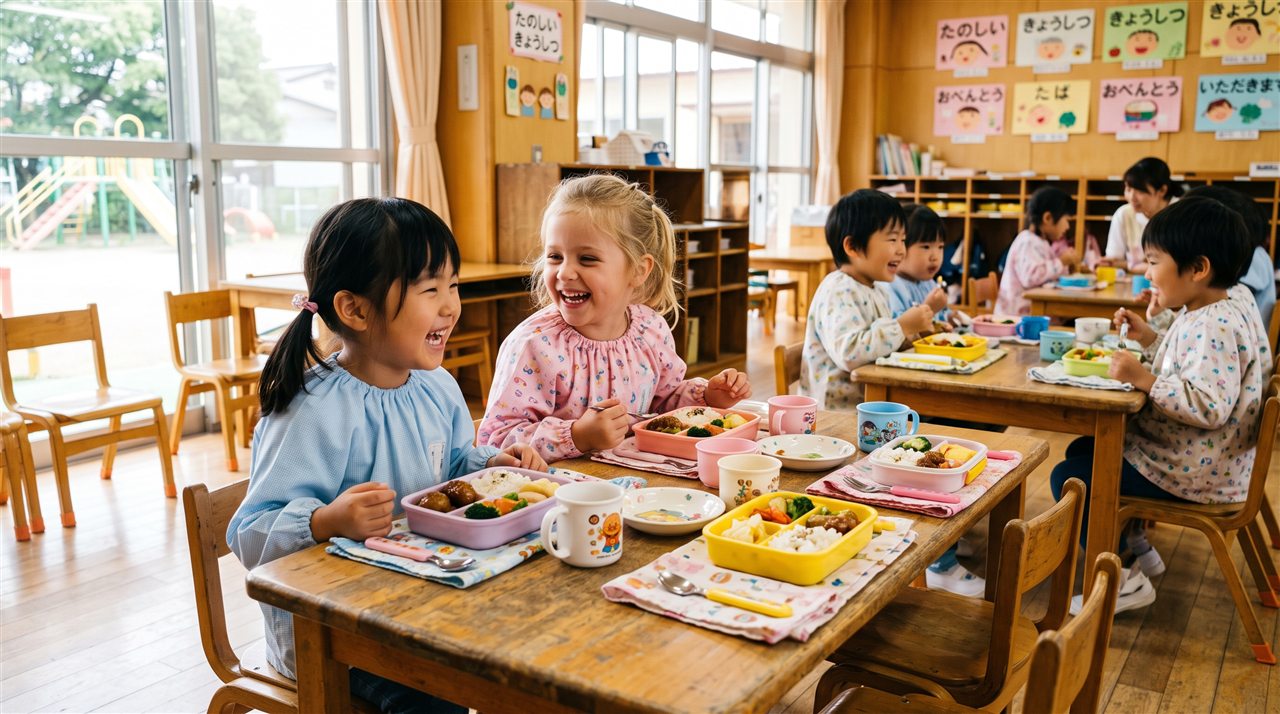
It suits families who want their young child to live Japanese for a few weeks — lunch, songs, outdoor play, the rhythms of a Japanese classroom — rather than study it. For a child with a Japanese parent, it is an unusually good way to make the language feel like something real children use.
How much does Japan Preschool Exchange cost?
We do not quote prices, because they change by destination, season and length of stay, and an out-of-date number helps nobody. What is useful is how the price is built, because that is where families get surprised:
- One package price covers childcare, the accommodation, household items and Wi-Fi.
- Not included: flights, local transport, meals and accommodation tax. In some rural towns a car is strongly recommended, which is its own cost.
- Payment timing: nothing is charged when you apply; payment is taken around check-in.
- No refund for Japanese public holidays or if you shorten the stay, and cancellation fees apply.
Check the current package price for your exact dates on the official site before you plan anything else.
What parents arrange themselves
- Flights and getting around.
- Food, including a packed lunch on some days at some schools.
- Entry to Japan and travel insurance. The programme’s pages do not cover these. As a general rule, short stays of under 90 days fall under Temporary Visitor status for many nationalities, but check the Japanese embassy guidance for your own passport.
The honest limits
Nothing here is a criticism of the programme. These are simply the edges of what a short stay can do.
- Availability. Places depend on open slots at each school, and there is no cancellation waitlist.
- The first days are hard. The operator itself says children often cry on day one. A three-week stay can end just as a shy child has settled in.
- It ends. We found no follow-up or language-maintenance element after the stay. Your child’s classmates stay in Japan; your child flies home.
That last point matters more than it sounds. A young child absorbs Japanese fast in an environment like this — and loses it just as fast once nobody around them speaks it. The weeks in Japan are the spark. What keeps it alight is what happens in the months after.
How it compares with other ways to give a child Japanese
| Japan Preschool Exchange | Local Japanese playgroup | TOMODACHI JAPAN | |
|---|---|---|---|
| Where | In Japan | Where you live | Online, from home |
| Ages | 0 to 6 | Usually under 5 | School-age children |
| Length | 1 to 3 weeks (longer in a few towns) | Term by term | Ongoing, all year |
| Classmates | Japanese children in Japan | Other local families | Peers in Japan, in a class of 8 |
| Family travel needed | Yes | No | No |
| After it ends | Nothing built in | Stops at school age | Designed to continue |
Where TOMODACHI JAPAN fits
We are an online Japanese school for children growing up outside Japan. We are not an alternative to a trip to Japan — nothing replaces three weeks of real Japanese preschool life. We are what can come after it.
- Live classes of 8, where children talk with peers their own age in Japan.
- Teachers working at Japanese schools, who know how Japanese children actually speak and play.
- Every day, from home, so there is no flight involved in keeping friends.
The combination we would suggest: use a preschool stay in Japan to make Japanese feel alive, then give your child a reason to keep using it once you are home. The trip starts the friendships. Something ongoing has to keep them.
Frequently asked questions
Does my child need to speak Japanese before joining?
No. The operator states that no Japanese is required for the child or the parent. The day runs in Japanese, so expect a period of adjustment.
Can I book just the preschool without the accommodation?
No. It is sold as a package of preschool place plus furnished home, and families are asked not to approach schools directly.
Is it only in the countryside?
Mostly, but not only. The destination list includes city options such as Tokyo, Yokohama, Kyoto, Osaka and Fukuoka. The longer one-to-three-month stays are limited to a few towns.
Does the same company run programmes outside Japan?
Yes. It lists a separate programme that sends families to schools in countries such as Spain, Italy and Costa Rica, with a different structure. That is why searches for Italy or Spain appear next to the name.
How do we keep the Japanese going afterwards?
Regular contact with other children who speak it. Books and videos help with input; what holds a young language in place is having someone to reply to. That can be a local playgroup while your child is small, and live classes with peers in Japan once they reach school age.
In short
- Japan Preschool Exchange is run by Kitchhike, Inc. and sells a preschool place plus furnished home as one package.
- It publishes a Japanese travel agency registration, which answers most of the legit question.
- Children 0 to 6, stays of 1 to 3 weeks (longer in a few towns), no Japanese required.
- Flights, meals, transport and entry arrangements are on you; check the current package price for your dates.
- It is a wonderful spark with no built-in follow-up — plan what keeps the Japanese going once you are home.