

HSC Japanese Continuers listening is worth 25 of the 80 marks on the written paper — more than the writing section, more than the oral examination. It is also the section students most often decide they simply “aren’t good at”, as though listening were a fixed trait. It is not. Almost all lost listening marks come from four repeatable habits, and every one of them can be trained.
Where listening sits in the exam
Section I — Listening and responding — opens the written paper. The paper as a whole runs 3 hours, including 10 minutes of reading time, for 80 marks, with the oral examination adding a separate 20 marks for a total of 100.
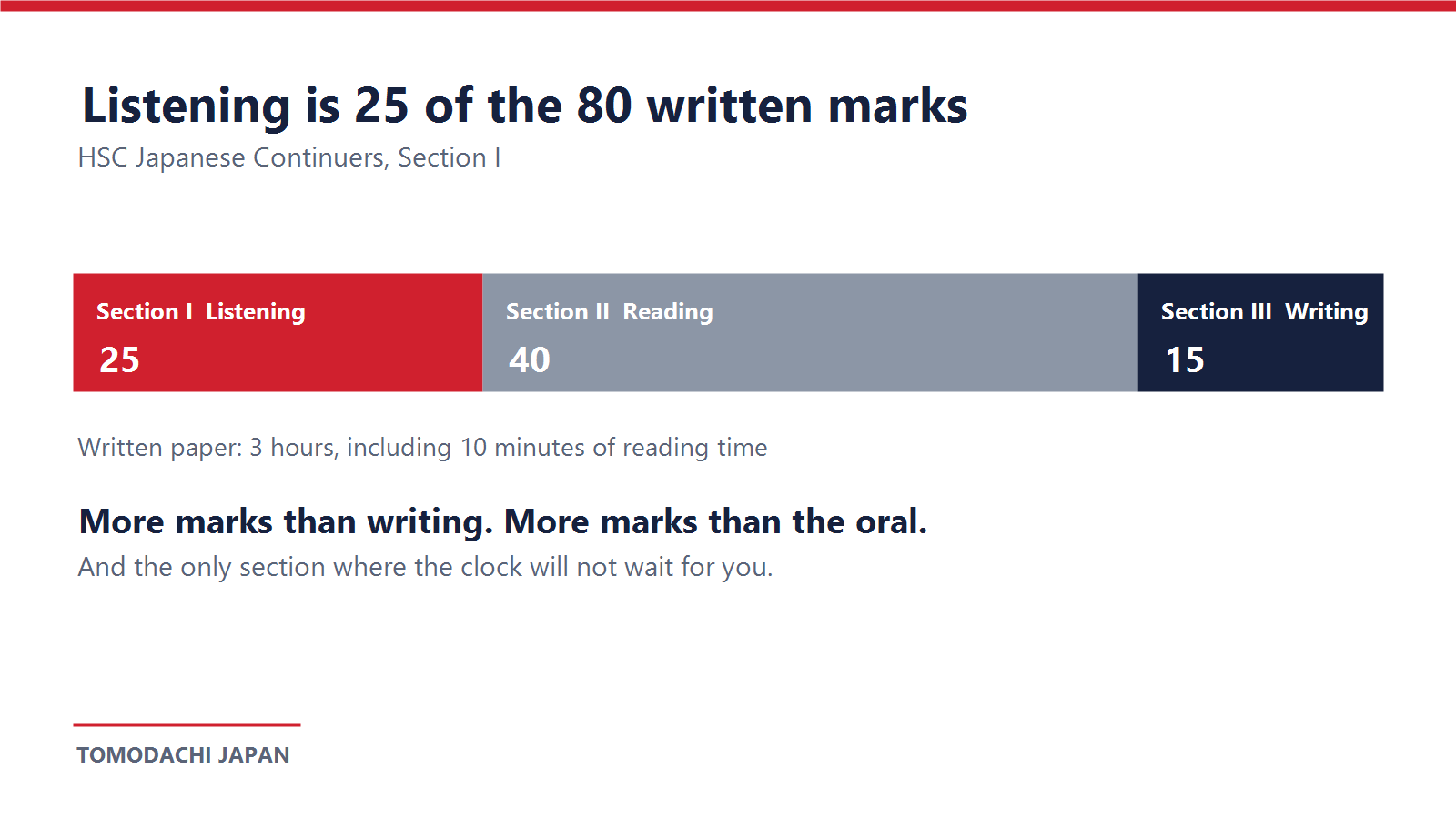
Note the mismatch with school. Internally, your listening assessment carries a mandatory weighting of 30%, while in the HSC it is 25 marks out of 100. Listening therefore feels more important in your school ranking than in the examination — yet it is the section where a single bad ten minutes is hardest to recover from, because the audio does not wait.
Looking for a way to keep Japanese going from abroad?
TOMODACHI JAPAN is an online Japanese school for children growing up outside Japan. They talk with peers their own age in Japan every day, taught by teachers working at Japanese schools, in small classes of 8.
🎁 Register and we’ll email you our School Guide (PDF, in English) straight away. You’ll also be first to hear about tuition, scholarships and opening dates.
Free · takes about 30 seconds
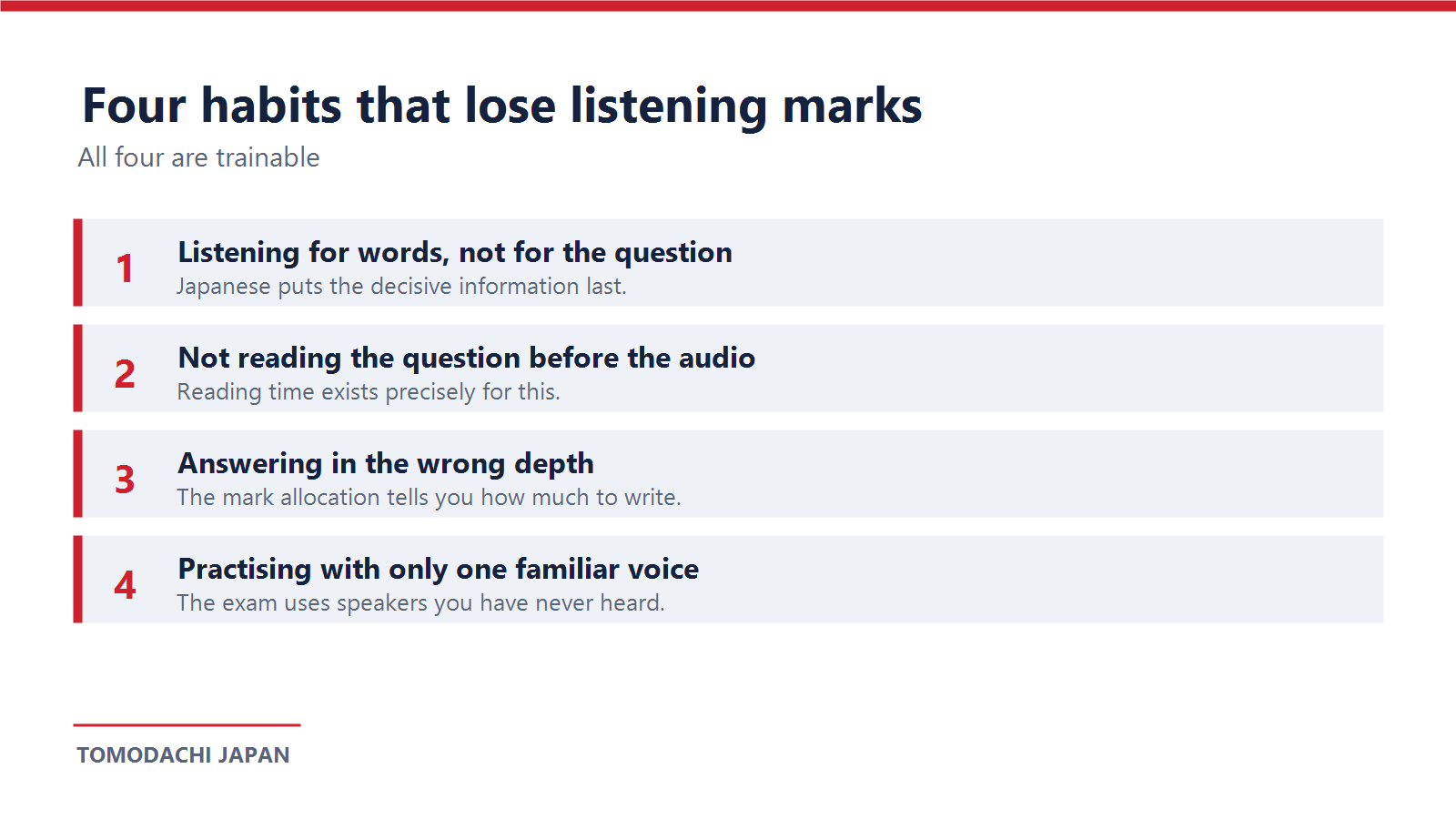
The four habits that lose marks
1. Listening for words instead of for the question
Students hear a word they recognise, latch onto it, then miss the clause that actually answers the question. Japanese puts the decisive information late — the verb, its negation, the modality — so a candidate who stops processing after the noun will confidently write the opposite of the right answer. Train yourself to hold the whole sentence until the ending arrives.
2. Not reading the question before the audio
Reading time exists for this. Knowing whether you need a reason, a number, a feeling, or a comparison changes what you listen for entirely. Going in cold means listening to everything, which means retaining nothing.
3. Answering in the wrong depth
A question worth several marks is not satisfied by one fact. When a question asks why, examiners want the reason plus its support. Match the length of your response to the marks on offer — the mark allocation is printed for a reason.
4. Practising only with one familiar voice
This is the big one. Most classroom listening comes from a single teacher, sometimes a single textbook narrator, speaking clearly at a considerate pace. Exam audio features different speakers, different ages, natural speed, plus the ordinary hesitations of real conversation. A student trained on one voice is not trained for that.

How to build listening you can rely on
- Use the real audio, not transcripts. NESA publishes past HSC papers with their audio. Do the listening section as audio, once through, under time — then, only afterwards, study the transcript.
- Do a second pass for language, not for marks. Replay the same audio a week later and write down every structure you now recognise. The gain is in the second pass.
- Add voices deliberately. Podcasts, interviews, ordinary conversation between two Japanese people — anything that is not your teacher.
- Talk with people, not at recordings. Comprehension improves fastest under the pressure of having to reply. Listening you must respond to is worth several times the same minutes spent listening passively.
That final point links the two halves of the exam. The habits that fix Section I — holding a sentence to its end, catching a reason on first hearing, coping with an unfamiliar accent — are the same habits that carry the oral examination. Train them together, not separately.
| Practice type | Voices heard | Must you respond? | Transfers to the oral |
|---|---|---|---|
| Textbook audio | One or two | No | Weakly |
| Past paper audio | Several per paper | No, written answers | Partly |
| Anime or drama | Many, stylised | No | Partly — register can mislead |
| Live group conversation with Japanese peers | Many, natural | Yes, immediately | Directly |
On the anime row, one caution worth stating: it builds ear speed while teaching register that costs marks. We separate the useful from the risky in from anime Japanese to exam Japanese.
TOMODACHI JAPAN occupies the bottom row. Small-group classes are led by teachers currently working in Japanese schools, with students in Japan of the same age in the room — so a Continuers candidate spends ordinary weekday time listening to unfamiliar voices at natural speed, then having to answer. Attendance is unlimited on one monthly fee, so the run-up to the exam costs nothing extra.

Frequently asked questions
How many times is the audio played?
Check the current examination advice from NESA for your year rather than relying on what an older sibling remembers — then rehearse under whatever conditions apply, because a student who has only ever practised with unlimited replays has not practised the exam.
Do I answer in English or Japanese?
Follow the instruction printed on each question, which varies by section. Writing in Japanese is examined separately in Section III, worth 15 marks.
Where do I find past listening audio?
NESA publishes HSC examination papers with accompanying audio, marking guidelines, plus feedback. Our guide on using HSC Japanese past papers sets out the order to work through them.
What else is in the syllabus?
The full mark map, the three prescribed themes, plus the indicative hours are set out in the HSC Japanese Continuers syllabus explained.
Listening and reading draw on the same prescribed vocabulary, and the characters behind it are set out in the HSC Japanese Continuers kanji list.
Train your ear on real voices
TOMODACHI JAPAN opens in December 2026. Tell us your exam year — we’ll send opening news, class times for your state, plus trial-session details first.