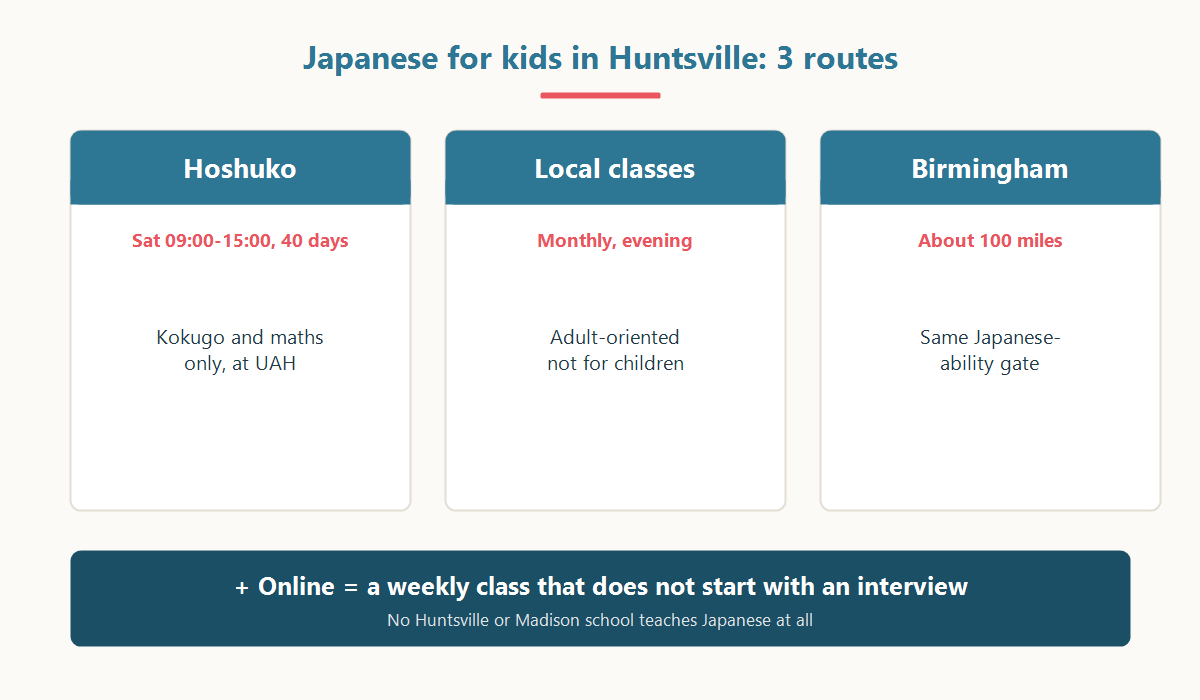
If you have searched “Japanese supplementary school Huntsville AL” — whether you came for Mazda Toyota Manufacturing, the Toyota engine plant or a supplier, or your family has been in north Alabama for years — you have probably found a 2019 press release and a school site that throws a certificate warning. Short answer: there is a real, active school. ハンツビル日本語補習校, founded 1983, meets on the UAH campus every Saturday 09:00–15:00, about 40 days a year, grades 1–9, teaching two subjects only: 国語 and 算数/数学. The thing no page tells you is that it is a Japanese school taught in Japanese, not a place to learn Japanese from scratch: a child who is not 邦人子女 is admitted only after a parent-and-child interview checking their Japanese is at grade level. Tuition is not published anywhere public, so we will not guess. Here is who can get in, and what the family signs up for.
Japanese for children in Huntsville: the comparison
| Option | Type | Day | Ages | Cost | Area |
|---|---|---|---|---|---|
| ハンツビル日本語補習校 | 補習授業校 designated by Japan’s Foreign Minister; 国語 + maths only | Saturdays 09:00–15:00 (~40 days/yr) | 6–15 (grades 1–9) | Not published — contact the school | UAH campus |
| JASA Japanese Language Club | Conversation club, all levels — adult-oriented | One Thursday evening a month, 18:30 | Adults | No fee stated | “A library or cafe”; JASA is Birmingham-based |
| Yuwenbon Language Learning Center | Commercial language centre, 7 languages | Not published | Not published | Not published — contact the centre | 2600 Newby Rd SW |
| バーミングハム日本語補習校 | 補習授業校; Japanese, maths, social studies | Saturdays 08:50–14:20 | Grades 1–9 | Not published — contact the school | Birmingham — about a 100-mile drive |
| TOMODACHI JAPAN | Online, classes of 8 with a homeroom teacher | Any day (unlimited) | 5–18 | One flat monthly fee — see the free guide | Your home |
One warning before you click. The school’s HTTPS certificate has expired, so https:// gives a full-screen security warning. The site is fine and current — it simply serves on plain http://. Use http://huntsvillejapaneseschool.com/ and it loads normally. Parents hit that warning and assume the school has folded. It has not.
Looking for a way to keep Japanese going from abroad?
TOMODACHI JAPAN is an online Japanese school for children growing up outside Japan. They talk with peers their own age in Japan every day, taught by teachers working at Japanese schools, in small classes of 8.
🎁 Register and we’ll email you our School Guide (PDF, in English) straight away. You’ll also be first to hear about tuition, scholarships and opening dates.
Free · takes about 30 seconds
What each option actually is
The Huntsville school has run since 1 September 1983 and has been on the UAH campus since 2010. It is officially designated — and the wording matters, because the internet gets it wrong. 補習授業校 are designated by Japan’s Minister for Foreign Affairs; MEXT certifies full-time 日本人学校 and private overseas schools. Huntsville’s designation date is 29 March 2023 and its jurisdiction is the Consulate-General of Japan in Atlanta — not Nashville, which covers Tennessee, Arkansas, Kentucky, Louisiana and Mississippi but not Alabama. The list published 13 July 2026 runs to 246 schools worldwide. Designation is why the school teaches from Japanese-government textbooks ordered through the consulate, on a April–March year. It is run entirely by parents: no office, no published phone or email, just a web form and a P.O. box.
Now the part that decides whether this is about you. The bylaws define the purpose as supplementary education in Japanese, using Japanese textbooks, for children who will return to Japan, and eligibility is written for 邦人子女 aged 6–15 near Huntsville. Any other child may be admitted only “to the extent it does not impede the school’s purpose”, and only if the board chair and homeroom teacher confirm in a 親子面談 that the child’s Japanese suits their school year — textbooks may be used as test material. Birmingham states it plainly in English: students are welcome regardless of race or national origin, as long as they can already speak and understand basic Japanese. Textbooks are the family’s expense in principle, and the consulate order closes six months before the semester.
About the school · Contact form · Bylaws 規約 (PDF) · Birmingham Japanese School (BSSAL) — official site
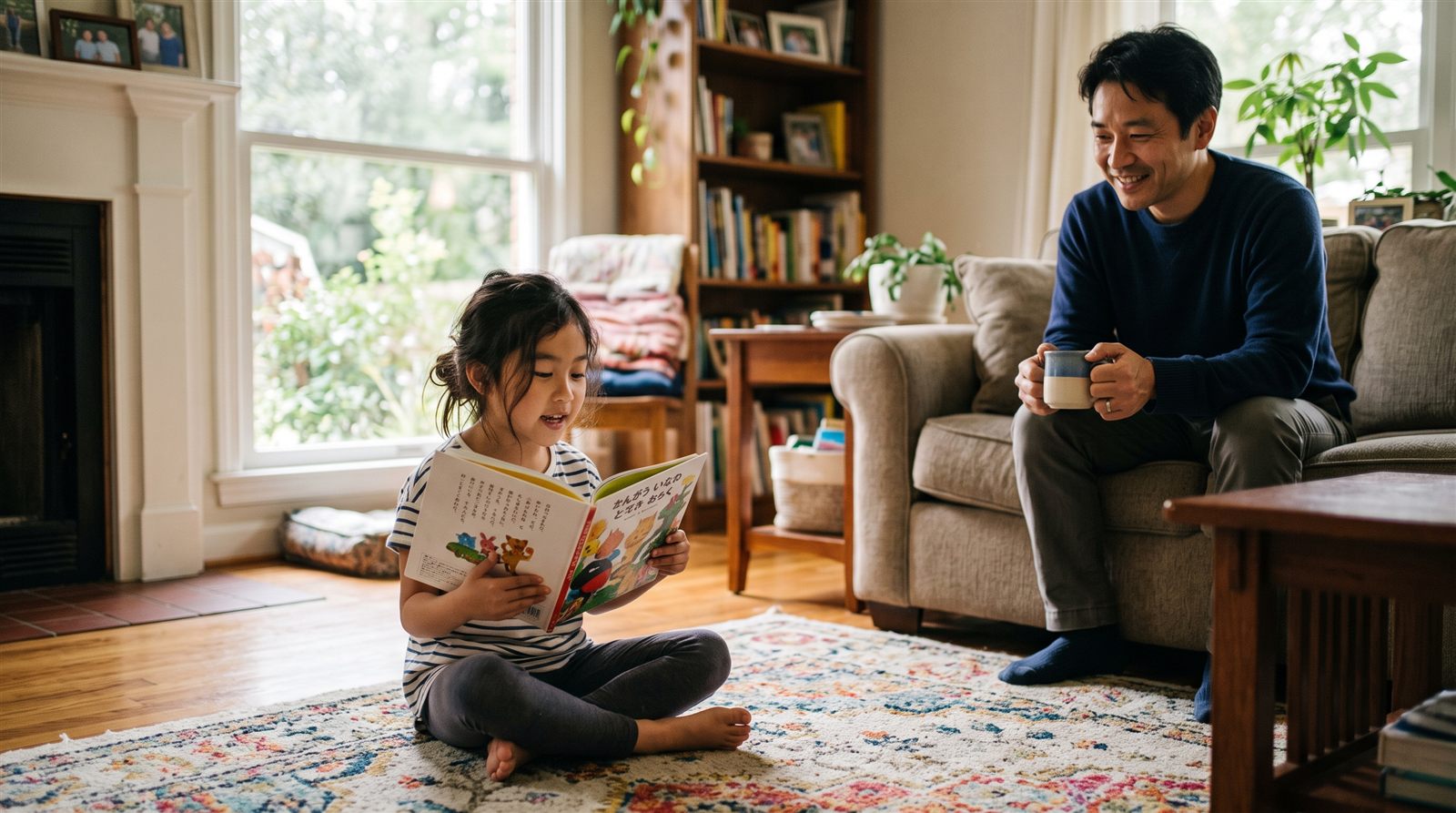
The JASA Japanese Language Club ranks well, but read the details: one Thursday evening a month at 18:30, at “usually a local library or cafe near you”, announced through a Facebook group, all-levels and adult-oriented, run from Birmingham. Good for a Japanese-speaking adult; not a children’s programme. Yuwenbon Language Learning Center on Newby Rd genuinely offers Japanese, but its public presence is a Facebook page with no ages, levels or fees. Worth a call for conversation tuition; not a heritage or 国語 programme.
What is not here matters just as much, because stale pages imply otherwise. No Huntsville or Madison public or major private school teaches Japanese at all. There is no full-time 日本人学校 in the South — only four exist in North America, nearest Chicago. Seigakuin Atlanta International School, the Southeast’s only full-time Japanese-curriculum school, has closed, yet it is still listed as operating on the Atlanta consulate’s directory page from January 2020, which also points at a dead URL for Huntsville. Do not plan around that page. And the region’s one free Japanese immersion school, International Charter Academy of Georgia, is a state charter legally restricted to Georgia residents.
The three things you are actually signing up for
None of this is hidden — it is written openly in the bylaws and the duty roster on the school’s own site. But it is in Japanese, and it is the difference between a family that thrives and one that quietly drops out in November. A school this size has no administrative staff. The parents are the staff.
- 1. The Japanese-ability interview. If your child is not 邦人子女, the chair and homeroom teacher confirm at the 親子面談 that they can work at their year’s level in Japanese, and the board judges the fit. A real gate — and a fair one from the school’s side, because one Saturday must cover a week of Japanese 国語 and maths.
- 2. Mandatory 当番 duty, from 08:30. Every enrolled family serves duty on a per-family basis. The published roster sets out six stations over two floors: setup, front desk and key handover, photocopying, classroom patrols, library lending, lunchroom setup and cleaning, playground supervision and the 11:30 call on whether outdoor play happens, sick-child response, and end-of-day tidying. In practice a full unpaid Saturday — arriving before the children, leaving after them.
- 3. Automatic 保護者会 membership. Parents of enrolled children are members, one per family, with a February AGM for budget, accounts and elections. Officers are elected from the parent body, serve one unpaid year and are barred from consecutive years — which is exactly why your turn comes round. 第8条 further provides that if the school cannot hire enough teachers, parents can be asked to serve as 理事教員 and teach, also unpaid. Transport is the family’s job, and marking largely comes home.
How to choose: three questions, in this order
- What are you actually trying to buy? If you are on a posting and your child re-enters a Japanese classroom in two or three years, holding 国語 and maths at Japanese grade level is the whole job, and a 補習授業校 on government textbooks is the purpose-built tool. If your child is growing up American with a Japanese parent or grandparent, you want heritage maintenance — the language alive and still worth having at fifteen. A returnee curriculum can serve that, but it was not built for it, and the interview is calibrated for the first case.
- Can your family do the Saturday? Nine to three, every Saturday, roughly 40 weeks, plus the drive from Madison, Decatur or Athens, plus duty shifts from 08:30, plus a board year at some point, plus marking midweek. For two parents with a free weekend it is entirely doable. For a single parent, a shift worker on the plant schedule, or a family with Saturday sport, it is the thing that breaks — better known in August than in February.
- Will the child keep going — and who are the friends? A child sticks with Japanese when Japanese is attached to people they like. For many families here the Saturday school is the only place their child meets other Japanese-speaking children at all, which is a real argument for it. The flip side: if the class is small, or your child is the weakest reader in it, or they are turned down, there is no second Japanese-speaking peer group inside a hundred miles.
The online option: friends in Japan on a Friday evening
Huntsville’s Japanese community exists because of employers — Mazda Toyota Manufacturing, which reached its 4,000-employee goal on a $2.3bn plant; the Toyota engine plant with roughly 2,400 team members and a $282m expansion; YKTA; Daikin in Decatur. That means families spread over three counties, most of whom will never put their children back into a Japanese classroom, and one Saturday school with a language gate at the door. TOMODACHI JAPAN is built for that middle: the child whose Japanese is real but below grade level, the child of a mixed household, the family in Decatur for whom an 08:30 duty start is not survivable, and the child who was told no. See also our guide to the online alternative to Japanese hoshuko.
- The other children live in Japan. Classes are groups of eight with a homeroom teacher who knows your child, and the friends they make are children their own age in Japan — not other Alabama children practising on each other.
- It keeps the connection, not just the grammar. For a child growing up in Madison or Huntsville, Japanese is identity before it is a subject. Regular contact with Japanese peers, taught by qualified practising Japanese teachers, is what stops the language fading between ten and fifteen.
- Built for children, at the level your child is actually at. Around 100 sessions a month across three time bands, grouped by level rather than school grade, so a child does not need to be at Japanese grade level to walk in. One flat monthly fee, unlimited classes. No entrance exam, no duty roster, no board year.
The timezone, honestly. Huntsville is on US Central time, 14 hours behind Japan in summer. That is beautiful in one direction: Japan’s Saturday morning is Friday evening in Alabama, so a 09:00 Saturday class in Japan lands at 19:00 Friday at your kitchen table, and Japan’s Sunday sessions land on Saturday evening. It is bad in the other: Japan’s weekday-evening classes fall in the small hours here, so those are not realistic on a school night.
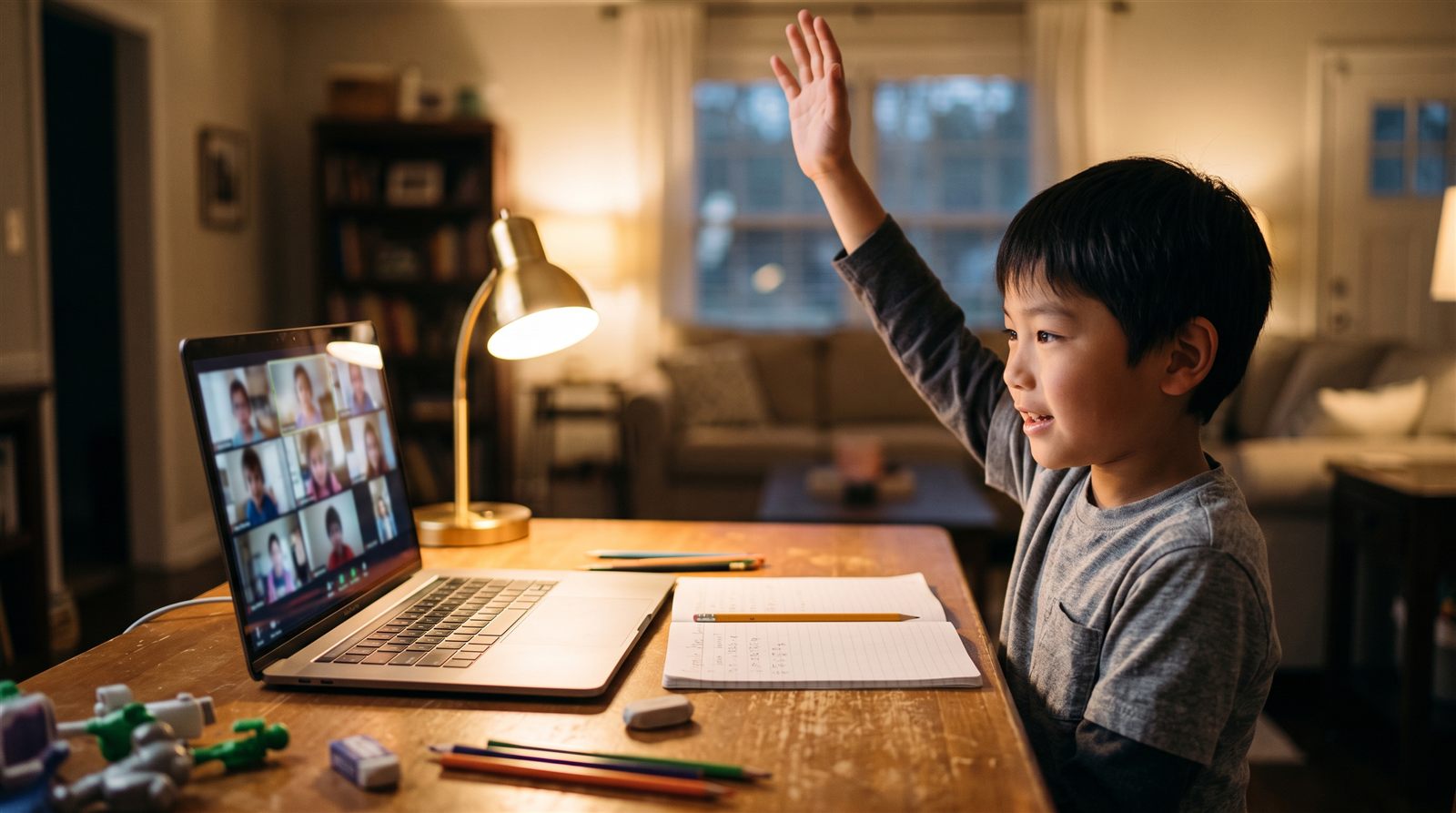
One Saturday on the UAH campus keeps 国語 and maths at grade level. Friday evenings with friends in Japan keep the language worth having.
FAQ from north Alabama families
Can my child join if they can’t read Japanese yet?
Probably not, and better to hear it now. Eligibility is written for 邦人子女 aged 6–15; any other child is admitted only after the 親子面談 interview confirming their Japanese suits their school year, with textbooks usable as test material. Birmingham says the same in English: the school is not intended to teach Japanese to students who do not already speak it. That is not gatekeeping for its own sake — one six-hour Saturday covers a week of 国語 and maths, with no capacity to start from zero. Build literacy elsewhere first, then apply again.
What does it cost?
Honestly, nobody outside the school can tell you — be sceptical of any page that gives a number. No fee schedule appears on any public page, and the bylaws say tuition is governed by a separate 授業料徴収規定 behind the password-protected parent portal. Birmingham does not publish its tuition either. Ask through the school’s contact form (remember, http://), and ask about textbooks too — those are the family’s responsibility in principle.
Do both parents have to work at the school?
Duty is assigned per family, not per parent, so one adult can cover a shift — but it starts at 08:30 and runs to the end of the day. On top of that, every enrolled family is automatically a 保護者会 member, officers are elected from the parents for unpaid one-year terms and cannot serve consecutive years, and the bylaws allow parents to be asked to teach if recruitment falls short. If one parent works Saturdays — common on plant schedules — agree with the school in advance how your family will cover it.
Is there anything for a child who is turned down?
Locally, very little — this is north Alabama’s honest weak point. No Huntsville or Madison school teaches Japanese, Yuwenbon publishes no ages or levels, the JASA club is monthly and adult-oriented, and Birmingham is about a 100-mile drive each way with the same language requirement. The realistic routes are a private tutor or an online school that groups children by actual level rather than school grade. Whichever you pick, protect the thing that matters: regular contact with other children who speak Japanese. A child who only ever speaks Japanese to their own parent tends to stop.
Is there a full-time Japanese school in the South?
No. Only four full-time 日本人学校 exist in all of North America, the nearest being Chicago, roughly 600 miles away. Seigakuin Atlanta International School closed years ago, though the Atlanta consulate’s January 2020 directory page still lists it as operating. International Charter Academy of Georgia runs free Japanese–English immersion, but as a Georgia state charter it is open only to Georgia residents. For a family in north Alabama, the Saturday school plus something online is the whole realistic menu.