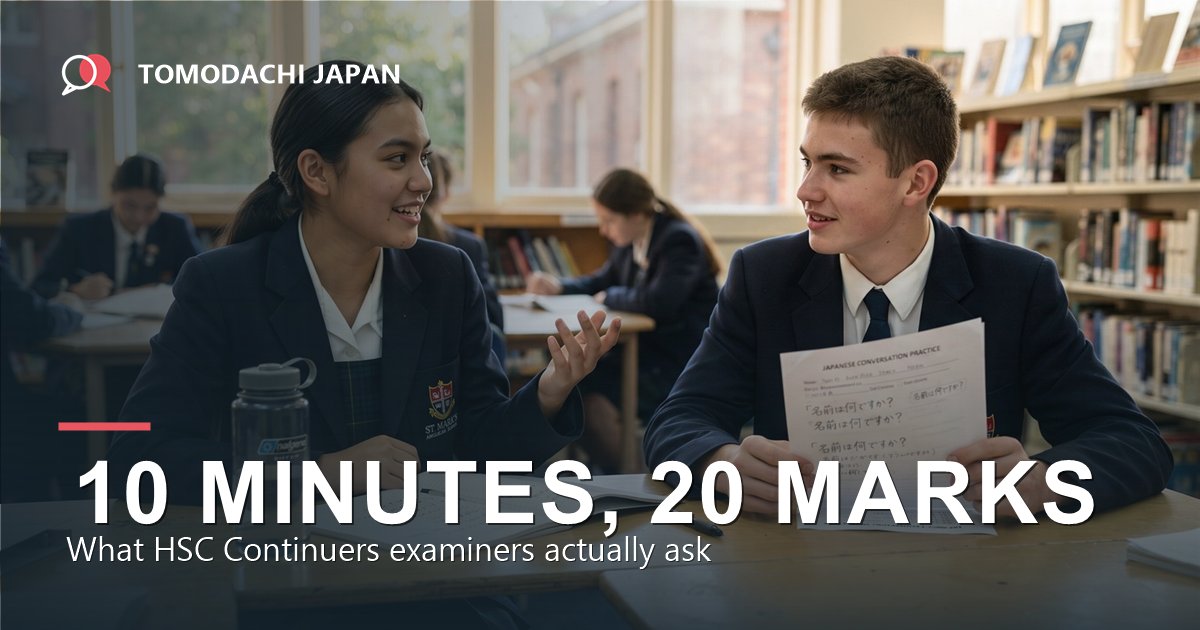
The Continuers oral is the part of the HSC that students prepare least and worry about most. It is worth 20 of your 100 marks, it happens before the written papers, and it is the only section where a marker can interrupt you mid-sentence and change the direction of the whole conversation.
This guide sets out what actually happens in the room, the question areas you can predict, and the specific behaviours NESA’s own advice rewards. If you are in Year 12 now, your oral sits in the August–September window, so the useful work is the kind you can do in the next few weeks — not a new grammar syllabus.
What the oral actually is
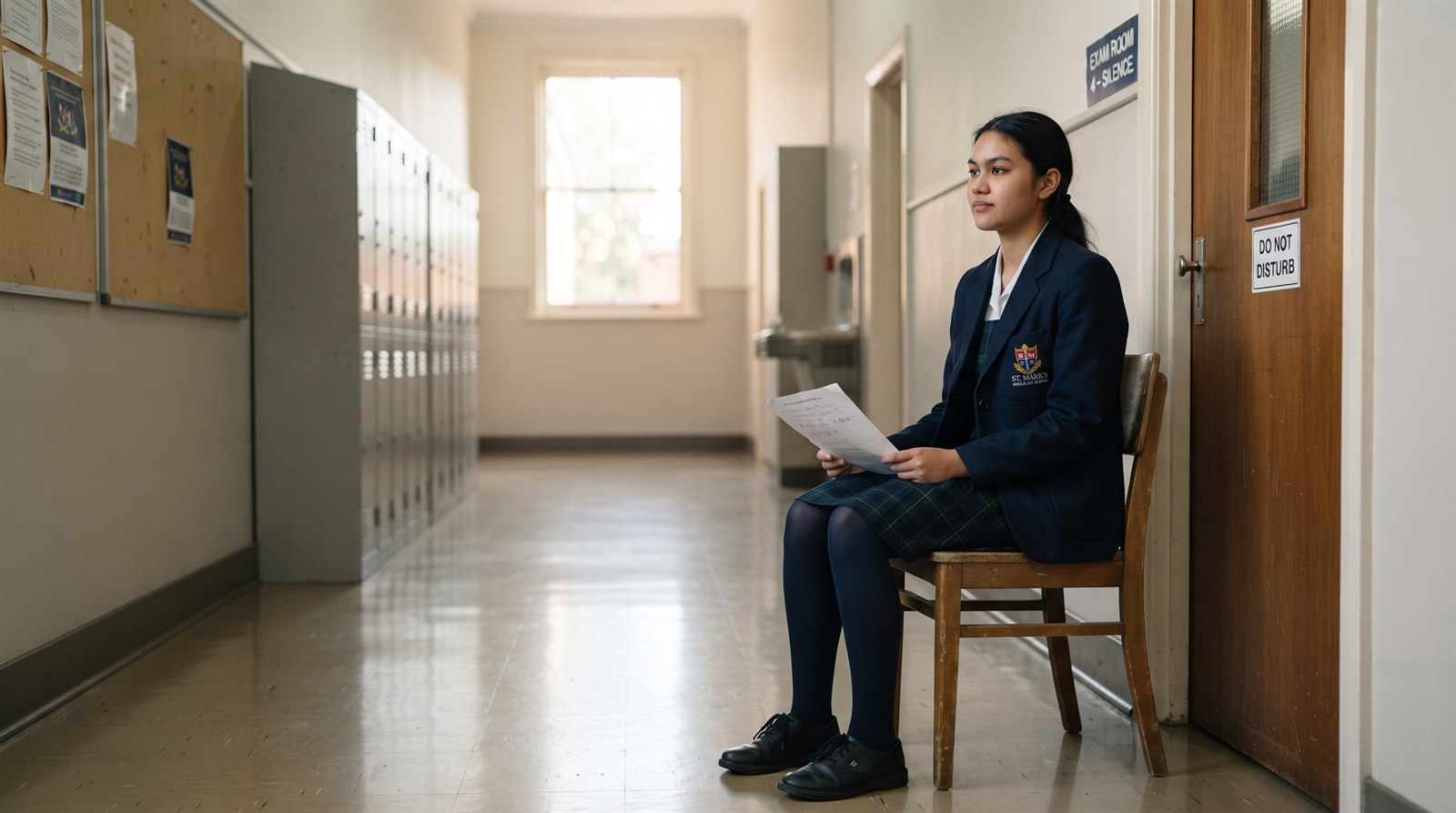
It is a conversation of roughly ten minutes with an examiner you have never met, at a designated examination centre rather than your own school. Your school confirms the scheduling around the middle of the year. There is no prepared speech, no cue card, and no topic you nominate in advance.
That last point is where most preparation goes wrong. Students rehearse a monologue about their family, the examiner asks a follow-up question two turns in, and the rehearsed material stops being usable. The conversation is the assessment — not the content you brought with you.
Looking for a way to keep Japanese going from abroad?
TOMODACHI JAPAN is an online Japanese school for children growing up outside Japan. They talk with peers their own age in Japan every day, taught by teachers working at Japanese schools, in small classes of 8.
🎁 Register and we’ll email you our School Guide (PDF, in English) straight away. You’ll also be first to hear about tuition, scholarships and opening dates.
Free · takes about 30 seconds
Where the oral sits in the 100 marks
Two different weightings apply to your Japanese, and confusing them is common:
| Skill | School internal weighting | Share of the HSC marks |
|---|---|---|
| Listening | 30% | 25 of 100 |
| Reading | 30% | 40 of 100 |
| Speaking | 20% | 20 of 100 |
| Writing | 20% | 15 of 100 |
The written paper runs three hours, including ten minutes of reading time, and carries the remaining 80 marks. So the oral is one fifth of the subject, earned in ten minutes, on a day when nothing else is being examined. Per minute of examination time, it is by far the densest mark opportunity in the course.
The question areas you can predict
Continuers is built on three prescribed themes — the individual, the Japanese-speaking communities, and the changing world — and the oral approaches them through your personal world. In practice the examiner’s questions cluster into a small number of predictable areas:
- School life — your subjects, why you chose them, what you find difficult, your timetable, teachers, school events.
- Home and family — who is in your family, what they do, chores, what your household is like on a weekend.
- Free time — clubs, sport, music, part-time work, what you did last weekend, what you plan to do next holidays.
- Friends and social life — how you met, what you do together, what makes a good friend.
- After school — university plans, career ideas, whether you will keep studying Japanese, whether you want to visit or work in Japan.
- Japan and Japanese — why you started, what is hard about it, what you know about Japanese life, any contact you have with Japanese people.
None of that is exotic. The difficulty is not the topic — it is that you must handle any of it in any tense, at conversational speed, while someone redirects you.
What the marking advice actually rewards
NESA’s guidance for the conversation is unusually concrete, and it describes behaviours rather than knowledge. The strongest responses:
- Elaborate. A question is an invitation, not a form field. One-clause answers cap your mark no matter how correct they are.
- Engage the examiner. The conversation should feel like a conversation — you are expected to actually address the person asking.
- Range, not repetition. Reusing the same vocabulary and the same two or three structures is explicitly marked down. Variety is the criterion.
- Move across time. Expect to be pushed between past, present and future, and to be asked for different perspectives on the same topic.
- Give opinions with reasons. Information alone is a weaker answer than information plus a stated view and a justification.
- Manipulate the language to fit the question. Bending what you know to answer what was actually asked scores better than steering back to what you rehearsed.
Two pieces of that advice deserve to be pulled out, because students are rarely told them:
You should expect to be interrupted
Being cut off is not a sign you are doing badly. Examiners interrupt to move the conversation on, to probe, or to sample another tense. Students who have only ever practised uninterrupted monologues read this as failure, lose composure, and spend the next thirty seconds recovering. Practise being interrupted on purpose.
You may ask for repetition — in Japanese
Asking the examiner to repeat or clarify is a legitimate, credited communication strategy, provided you do it in Japanese. すみません、もう一度おねがいします is a better move than a guess that answers the wrong question, and far better than silence. Have two or three of these phrases genuinely automatic, not merely known.
The four answers that separate bands
Take one ordinary question — どんな科目を勉強していますか — and look at how the same student can answer it four ways.
| Answer | What it does | Why it caps or lifts the mark |
|---|---|---|
| Lists three subjects and stops. | Answers correctly. | No elaboration, no opinion, one tense. Correct but capped. |
| Lists subjects, adds which is hardest. | Adds detail. | Better, but still information only — no reason, no time shift. |
| Lists subjects, names the hardest, says why, compares it to last year. | Opinion + reason + past tense. | Now demonstrating range and perspective. |
| All of the above, then connects it to what they want to study next year. | Adds future, invites a follow-up. | Gives the examiner somewhere to go — a conversation, not an answer. |
The fourth answer uses no vocabulary the first one lacked. The difference is entirely in the habits — and habits are trainable in weeks, which is why the oral is the most improvable part of the course this late in the year.
How to practise in the weeks before
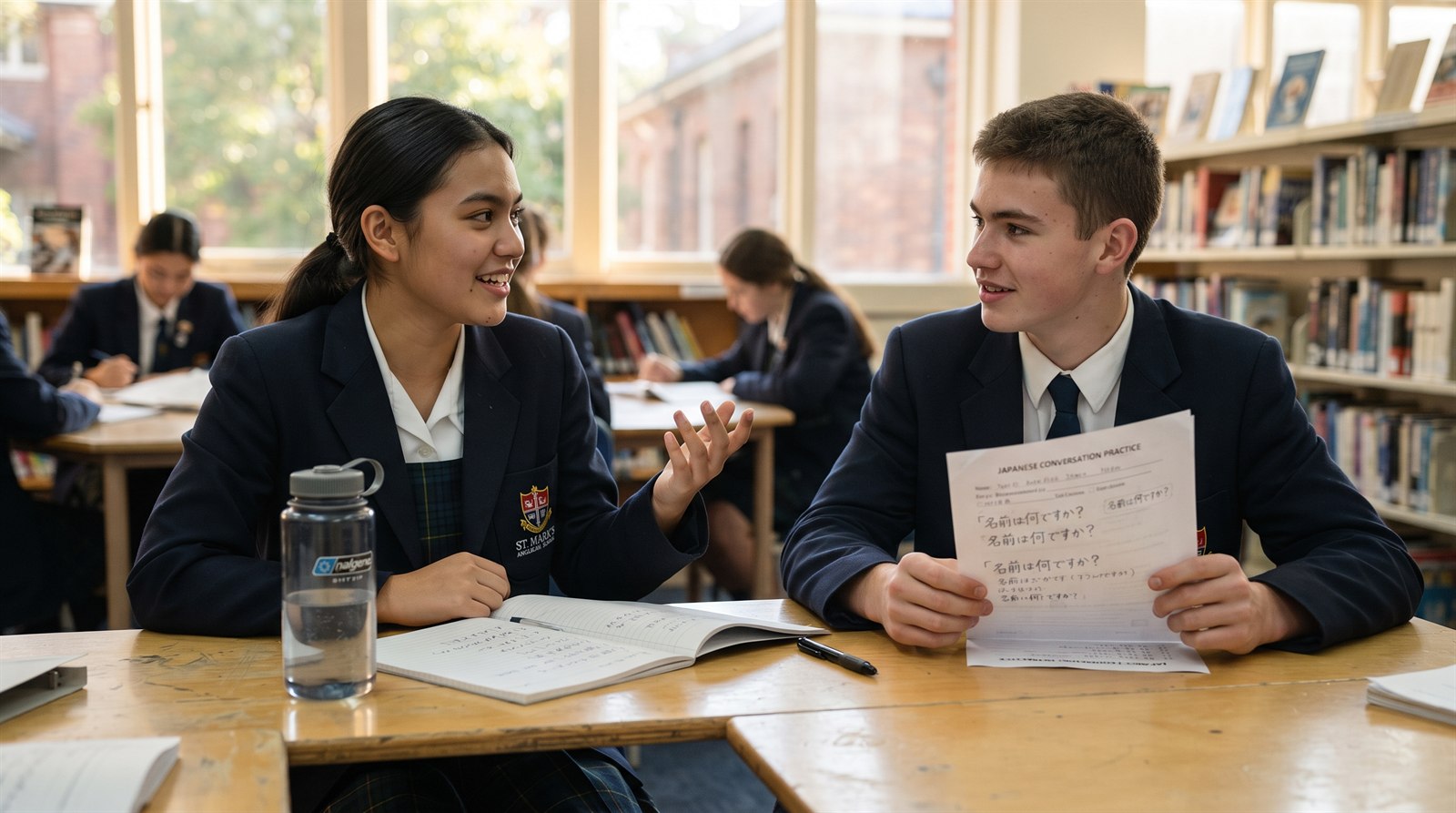
- Practise with people, not scripts. The examinable skill is responding to a question you did not choose. A script cannot generate that.
- Vary the interlocutor. If every practice conversation is with the same teacher, you adapt to one voice, one speed and one set of habits. The examiner will be none of those.
- Record yourself and count. Count how many times you reuse the same connective, and how many answers stay in one tense. Those two counts predict your band better than your vocabulary size.
- Rehearse recovery, not just fluency. Deliberately have someone interrupt you, ask something you cannot answer, or speak too fast — then practise the clarification phrases until they are reflexive.
- Use the NSW Department of Education mock-conversation resource. It publishes a video of a mock oral with discussion questions, designed for exactly this purpose.
Note what is absent from that list: past papers. The written sections have past papers; the oral does not. There is no bank of previous oral questions to work through, which is precisely why unstructured conversation practice carries so much weight here.
Where students actually lose the marks
In our experience of the same handful of failure modes, the marks go missing in ordinary places:
- Textbook register. Answers assembled from a Year 11 textbook sound like a textbook. Examiners hear the difference between language a student uses and language a student recites.
- One-speed listening. Students who have only heard their own teacher’s Japanese struggle with an unfamiliar voice at ordinary speed.
- Politeness drift. Slipping between plain and polite forms mid-conversation — common in students who learned casual Japanese from anime and formal Japanese at school.
- Silence as a strategy. Every second of silence is a second not being assessed. A clarification question is always worth more.
Why conversation volume is the constraint
Speaking is 20% of your internal assessment and 20 marks of the HSC, but in most school programs it is the skill that gets the least classroom time — a large class, a limited number of minutes, and one adult to talk to. The syllabus asks for a conversational range that a weekly turn in a group of twenty cannot realistically build.
That is the gap TOMODACHI JAPAN was built to close. Our teachers are currently working teachers from Japanese schools — not tutors who once studied the language — so students practise against the register, speed and follow-up questions of an ordinary Japanese adult, alongside peers their own age in Japan. Small-group classes run every weekday, so speaking stops being a weekly event and starts being a habit. For a student six weeks out from an oral, frequency is the whole game.
Frequently asked questions
When is the Continuers oral held?
In the August–September window, before the written HSC papers, at a designated examination centre rather than your own school. Your school handles the scheduling, generally confirming times around the middle of the year. See our full guide to the Continuers oral for the logistics.
Are there past papers for the speaking exam?
No. NESA publishes past written papers with marking guidelines, but the oral has no equivalent question bank. Use the published marking advice and the department’s mock-conversation resource instead. How to use past papers without burning them covers the written side.
How long should my answers be?
Long enough to state something, justify it, and leave the examiner an opening — typically several connected sentences rather than one. But do not filibuster: refusing to yield the turn works against the conversational criteria just as much as one-word answers do.
Am I even eligible for Continuers?
Eligibility is decided by your schooling and residence history, not by how strong your Japanese is. We set out the rules in Continuers, Beginners or Background Speakers. Victorian students should read our VCE Japanese oral exam guide instead, and can compare states via the Australia & NZ hub.
I have six weeks. What is the single highest-value change?
Talk to more than one Japanese person, more than once a week. If you only change one thing, change the number of different voices you have to respond to. Our six-week oral preparation plan sequences the rest.
Dictionaries are permitted in the written paper but not in the oral, so the characters worth knowing cold are a smaller set than students fear. They are collected in the HSC Japanese Continuers kanji list.
Practise the oral with teachers from Japan
TOMODACHI JAPAN opens in December 2026. Get the free school guide by email — class times for your time zone, how the small-group classes work, plus tuition and scholarship details.