

Every year, HSC Japanese Continuers students lose marks on kanji they had technically “studied”. Not because the list is long — by JLPT standards it is short — but because almost nobody works out the one distinction that decides how you should study it. Some characters on the NESA prescribed list you must be able to write from memory. Others you only need to recognise. Studying both groups the same way wastes weeks and still leaves gaps in the writing section. This guide explains where the official list actually lives, what the asterisk means, how kanji is tested in each part of the exam, and a study method built around the way the HSC actually assesses you.

Where the official HSC kanji list actually is
There is one authoritative source, and it is not a flashcard app. The prescribed kanji for Japanese Continuers are published by NESA as part of the prescribed vocabulary list for the Japanese Continuers Stage 6 syllabus. The kanji list sits at the end of that vocabulary document, which is why so many students never find it — they open the syllabus PDF, see no kanji, and give up.
Two things follow from this that are worth taking seriously. First, the vocabulary list and the kanji list are one document for a reason: the characters are prescribed in the service of the prescribed words, organised by the syllabus themes and topics rather than by grade or stroke count. Studying kanji divorced from that vocabulary is studying the wrong thing. Second, counts you find online disagree with each other, because different people include or exclude the recognition-only characters. Do not trust a number from a study-notes site, including this one — download the current NESA document and work from it directly.
Looking for a way to keep Japanese going from abroad?
TOMODACHI JAPAN is an online Japanese school for children growing up outside Japan. They talk with peers their own age in Japan every day, taught by teachers working at Japanese schools, in small classes of 8.
🎁 Register and we’ll email you our School Guide (PDF, in English) straight away. You’ll also be first to hear about tuition, scholarships and opening dates.
Free · takes about 30 seconds
The asterisk: the single most useful thing on the list
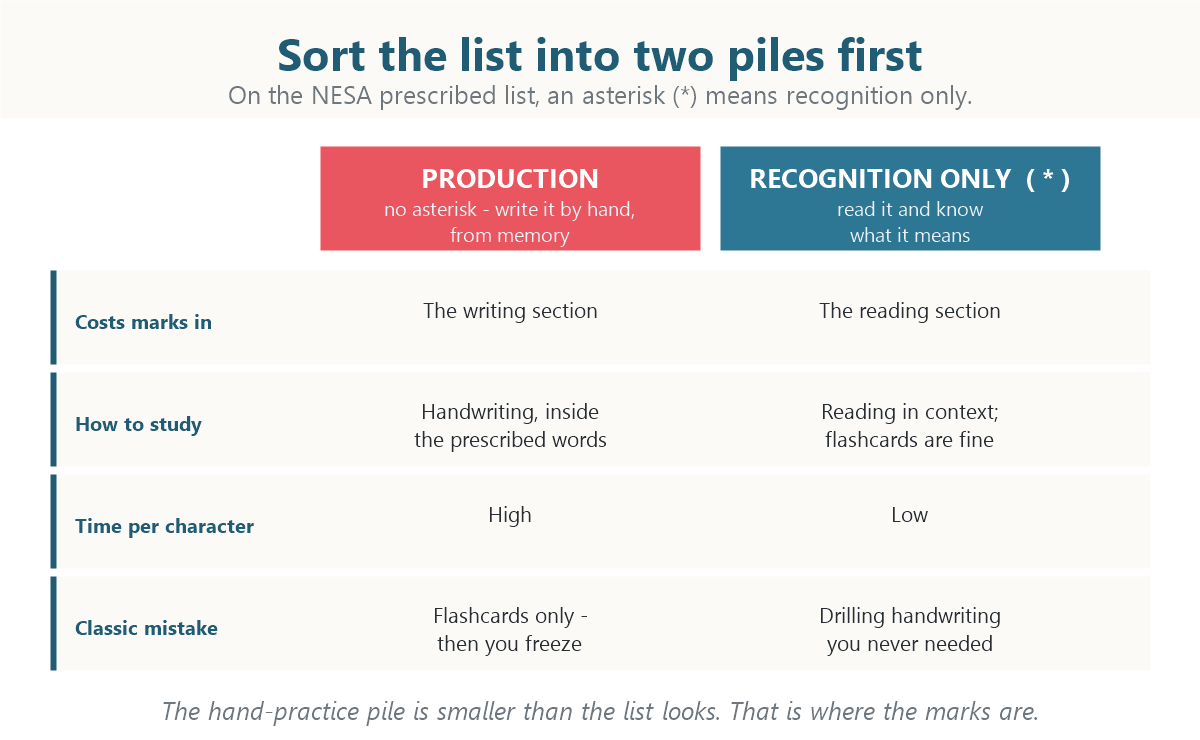
On the prescribed list, characters marked with an asterisk (*) are for recognition only. Everything else, you are expected to be able to write. This is the distinction that should drive your entire study plan, and most students never act on it.
| Production kanji (no asterisk) | Recognition-only kanji (*) | |
|---|---|---|
| What you must do | Write it correctly, by hand, from memory | Read it and know what it means in context |
| Where it costs you | The writing section | The reading section |
| How to study it | Handwriting, from English or from the reading, repeatedly | Reading in context; passive review; flashcards are fine |
| Time per character | High | Low |
| Common mistake | Studying it with flashcards only, then freezing in the exam | Drilling handwriting for it and wasting hours |
Split your list into these two piles in week one. It typically means the genuinely expensive pile — the characters that need hand practice — is meaningfully smaller than the list looks at first glance, and your study time immediately concentrates where the marks are.
How kanji is actually tested in each section
Listening
No kanji appears, but the prescribed vocabulary underneath it does. If you have learned a word only as a shape on a card and never as a sound, it will not register when it goes past you at speed. Say every character’s words aloud while you study them — this is why kanji study and listening practice are not separate tasks.
Reading
This is where the asterisked characters earn their keep. You are reading real text types — letters, emails, articles, notices — and you need to recognise characters inside words, not in isolation. Practise by reading, not by testing individual characters. Past papers are the best source of text at the right level; we set out how to use them properly in HSC Japanese Continuers past papers: how to use them.
Writing
This is where kanji marks are actually won and lost. Under time pressure, with no dictionary and no keyboard, you have to produce characters by hand. Two rules matter here. Use the kanji you know — writing a word in kana when the prescribed kanji exists reads as weaker control of the language. And do not reach beyond the list: an ambitious character written wrong is worse than a correct simpler alternative, because a garbled shape can make the word unreadable.
Speaking
No kanji at all — but the same prescribed vocabulary, which is why students who study kanji as vocabulary rather than as decoration tend to sound more precise in the oral. If the oral is your weak point, that is a separate skill with its own preparation; see our guide to the HSC Japanese Continuers oral exam and the six-week speaking plan.
Why students lose kanji marks
- Recognition masquerading as knowledge. You can pick 見 out of a line-up and still not produce it under pressure. If you have only ever studied by tapping “I knew that”, you have trained recognition and will be tested on production.
- Sloppy shape and stroke order. Stroke order is not aesthetic pedantry — it is what keeps proportions right when you write fast. Characters that collapse under time pressure are the ones learned by copying an image rather than by writing a sequence.
- Wrong reading for the context. Most characters carry more than one reading, and the prescribed vocabulary tells you which ones you need. Learn readings inside words, never as a naked list of on’yomi and kun’yomi.
- Over-reaching. Students who study extra kanji for ambition, then use them imprecisely in the writing section, routinely score below students who used the prescribed set accurately.
- Confusing the HSC list with a JLPT list. They overlap but are not the same, and they are organised on completely different principles. JLPT N4 or N3 decks are a reasonable warm-up and a poor substitute.
An eight-week plan that matches how you are tested
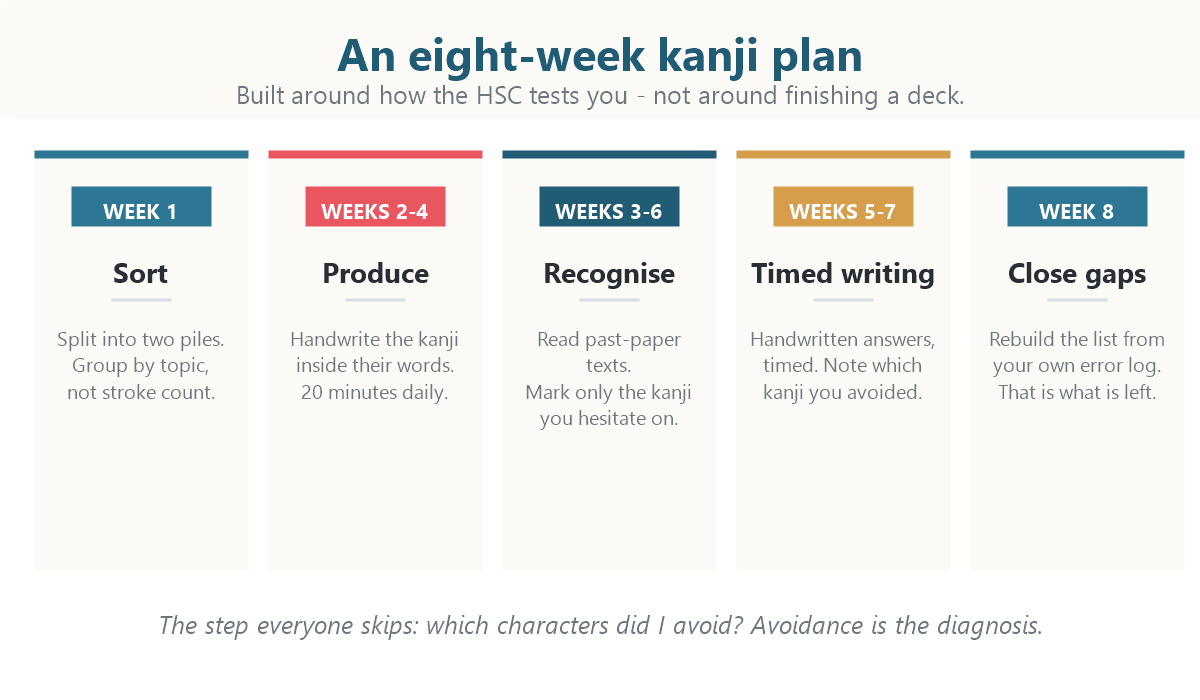
| Weeks | Focus | What you actually do |
|---|---|---|
| 1 | Sort | Split the prescribed list into production and recognition-only. Group by syllabus topic, not stroke count. |
| 2–4 | Production | Handwrite the no-asterisk characters inside their prescribed words. Twenty minutes daily beats two hours on Sunday. |
| 3–6 | Recognition, in context | Read past-paper texts and mark every character you hesitate on. Those, and only those, go into review. |
| 5–7 | Write for real | Write full responses by hand, timed, using only prescribed kanji. Mark yourself on which characters you avoided. |
| 8 | Close the gaps | Rebuild the list from your own error log — the characters you dodged in timed writing are the entire remaining syllabus. |
The step almost everyone skips is the last column of week 5–7: which characters did I avoid? Avoidance is invisible in flashcard scores and obvious in handwritten responses. It is the most reliable diagnostic you have.

Frequently asked questions
How many kanji are on the HSC Japanese Continuers list?
Figures circulating online differ, mainly because some counts include the recognition-only characters and some do not. The list is modest compared with JLPT N3 or N2, and it is organised by the syllabus themes rather than by grade. Rather than trusting any third-party count, take the number from the current NESA prescribed vocabulary list — that document is the only version that governs your exam.
Do I have to write every kanji on the list from memory?
No. Characters marked with an asterisk are for recognition only; the rest you are expected to be able to write. Sorting the list on this basis is the first thing you should do, because it usually shrinks the hand-practice workload substantially.
Can I use kanji that is not on the prescribed list?
You are not penalised for knowing more Japanese, but there is no reward for decoration and there is real risk in writing an unfamiliar character incorrectly under time pressure. The safe strategy is to use the prescribed set accurately and completely, and to reach beyond it only for characters you write confidently and correctly every time.
Is JLPT study useful for HSC Japanese?
As supplementary reading practice, yes. As your kanji programme, no. The JLPT tests recognition through multiple choice and never asks you to handwrite a character, so a student who prepares only with JLPT materials arrives at the HSC writing section without the one skill it examines.
I’m in Continuers but I have Japanese at home. Am I in the right course?
Course eligibility rules are strict and worth checking early rather than in Year 12 — we cover the differences between Continuers, Beginners and Background Speakers in choosing the right HSC or VCE Japanese course. If you are in the right course but your literacy lags your speaking, that is the standard heritage-speaker profile and the kanji plan above is exactly the fix.
Practising with teachers from Japan
Kanji is one of the few parts of Japanese you genuinely can drill alone. What you cannot do alone is find out which characters you are quietly avoiding, or hear whether the vocabulary underneath them sounds natural when you use it. Tomodachi Japan is an online Japanese school for students aged 5–18 abroad, taught in small groups of eight by qualified teachers from Japan, with unlimited attendance for one flat monthly fee. For Year 11 and 12 students in Australia and New Zealand the time difference with Japan is only an hour or two, so regular practice fits around school — see our guide for families in Australia and New Zealand, or our honest take on whether you need an HSC or VCE Japanese tutor.