There is no full-time Japanese school in Brisbane. When parents search for a Japanese school here, the school most of them mean is the Japanese School of Queensland, Brisbane — クイーンズランド補習授業校ブリスベン校, often called the Brisbane Japanese Supplementary School — a Saturday-morning school (hoshuko) that rents classrooms at St Aidan’s Anglican Girls’ School in Corinda. For the school year that began in April 2026 it charges $1,508 a year in tuition for every division, plus a $50 entrance fee, and every family must also join the Japanese Club of Brisbane, the community association that runs it. It teaches Japan’s national curriculum in Japanese language and maths, from a single kindergarten year to the end of junior high, about 40 Saturdays a year. The fact most English pages miss is who gets in: the school says in writing that it is not a Japanese-language school, every new pupil sits an interview, and there is no beginner class.
This page is the single-city deep dive: what the Brisbane Saturday school costs, who can enrol, how a Saturday in Corinda works, and the other places a Brisbane child can learn Japanese — including the only state primary school in Queensland with a Japanese bilingual pathway. Everything comes from the Japanese Club of Brisbane’s Japanese-language pages, the school’s own overview and newsletters, the Gold Coast campus’s 2026 documents and the Queensland Department of Education, read on 16 November 2026. Where something is not published, we say not published. If you are comparing cities, our page on the Japanese Saturday school in Sydney shows how the same model works further south.
The short answer
| What it is | A Saturday hoshuko recognised by the Japanese government, teaching Japan’s curriculum in Japanese language (kokugo) and maths. One school with two campuses: Brisbane, run by the Japanese Club of Brisbane, and the Gold Coast, run by the Japanese Society of the Gold Coast |
| Where | Lessons at St Aidan’s Anglican Girls’ School, 11 Ruthven Street, Corinda, on Saturday mornings. Office at Suite 17, Taringa Professional Centre, 180 Moggill Road, Taringa, open a few weekday mornings |
| Cost, 2026–27 | Tuition $1,508 a year (kindergarten, primary and junior high alike), entrance fee $50, materials and accident insurance included. Club membership on top: $111 for a family joining before October |
| Who it takes | Children with basic Japanese and daily habits in place, of school age by Japan’s 2 April cut-off, whose parents understand what a hoshuko is for and are club members. Every new pupil, April or mid-year, has an interview |
| Grades | One kindergarten year (the year before Grade 1), primary Grades 1–6 and junior high 1–3. No high school |
| Size | About 250 pupils on each campus, most of them in primary, according to the school’s 2023 overview |
| The real catch | It is a school for children who can already learn in Japanese, on a Japanese April-to-March year, with compulsory parent drop-off and parent volunteering. It is not a class for learners |
Looking for a way to keep Japanese going from abroad?
TOMODACHI JAPAN is an online Japanese school for children growing up outside Japan. They talk with peers their own age in Japan every day, taught by teachers working at Japanese schools, in small classes of 8.
🎁 Register and we’ll email you our School Guide (PDF, in English) straight away. You’ll also be first to hear about tuition, scholarships and opening dates.
Free · takes about 30 seconds
First, which school do you actually mean?
“Japanese school Brisbane” covers four quite different things, and the search suggestions mix them: language school, immersion school, primary school, bilingual school. Here is the map before we go deep on the Saturday school.
| Name you will see | What it actually is | Language and ages | Where |
|---|---|---|---|
| Japanese School of Queensland, Brisbane (Brisbane Japanese Supplementary School, クイーンズランド補習授業校) | The Saturday hoshuko this page is mostly about. Japan’s curriculum, taught in Japanese, one morning a week. Annual tuition | Japanese; kindergarten year to junior high 3 | Corinda (lessons), Taringa (office) |
| Wellers Hill State School, Australian Curriculum Japanese pathway | A Queensland state primary school where children in one pathway learn part of the Australian Curriculum in Japanese. The school calls it unique within Queensland | Japanese and English; pathway from Year 1 to Year 6 | Tarragindi |
| Japanese language schools (BJLC, Japanese Brisbane, the University of Queensland’s Institute of Modern Languages and others) | Private classes that teach Japanese as a foreign language, mostly to adults; some run kids’ and junior classes | English-speaking learners | Alderley, Brisbane City, St Lucia |
| A full-time Japanese school | None in Queensland. The full-time schools teaching Japan’s curriculum in Australia are in Sydney, Melbourne and Perth | — | — |
The practical difference is direction. Wellers Hill and the language schools take children who are learning Japanese and build it up. The Saturday school takes children who already have Japanese and keeps them level with classmates in Japan. A child from an English-speaking home with no Japanese belongs at the first two; a child who chats in Japanese at home but has never opened a Japanese textbook may struggle at the Saturday school’s interview. If you are moving with a job and want a five-day Japanese school, Brisbane does not have one: see our guides to Sydney Japanese International School fees and the Japanese school options in Melbourne.
What it costs in 2026–27: $1,508 a year, plus $50 and a club membership
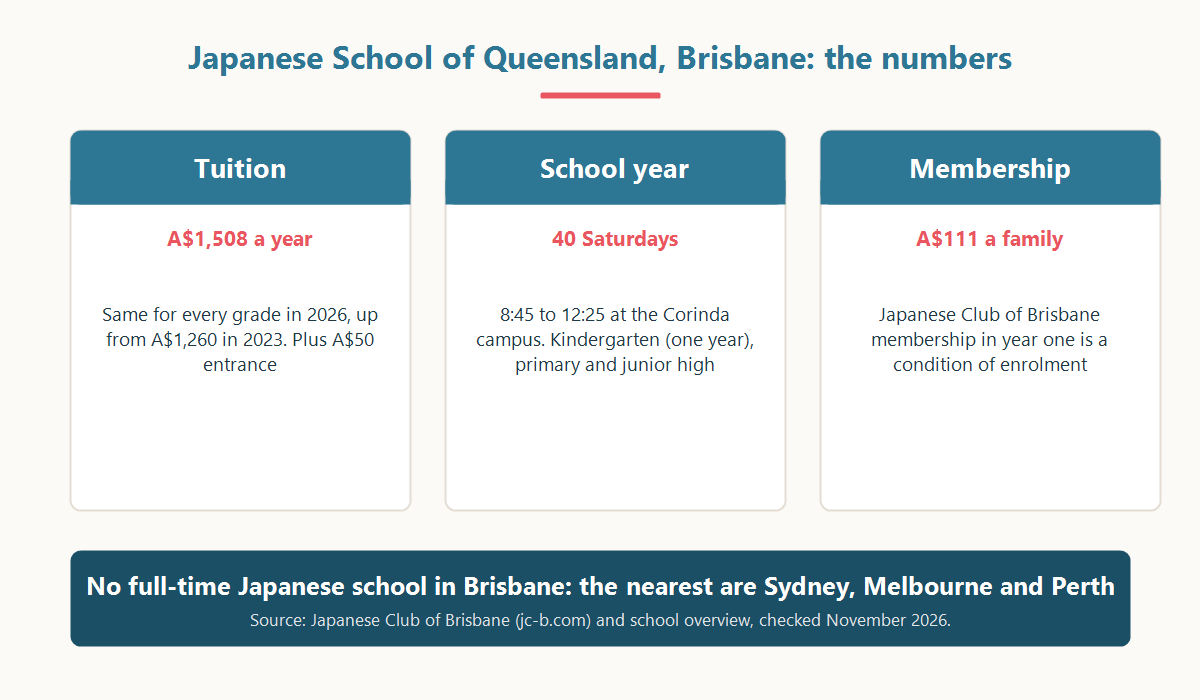
The school follows Japan’s school year, so its “2026” year runs from April 2026 to March 2027. The Japanese Club of Brisbane publishes one fee table for the Brisbane campus, and it is the same for all three divisions.
| Brisbane campus, 2026 | Kindergarten | Primary | Junior high |
|---|---|---|---|
| Entrance fee (once) | $50 | $50 | $50 |
| Annual tuition | $1,508 | $1,508 | $1,508 |
| Total, first year | $1,558 | $1,558 | $1,558 |
Three things sit around that headline number:
- You have to join the club. Entry to the Saturday school requires membership of the Japanese Club of Brisbane. A family membership is $23 to join plus $88 a year, so $111 in the first year and $88 to renew; joining between 1 October and 31 March costs $23 plus $44. Paying by credit card adds 2%. With membership, a first year for one child comes to about $1,669 (our arithmetic).
- Paying in instalments costs extra. Tuition can be paid at once, in two halves or in four terms. Since 2024 the club charges a $50 handling fee per instalment, per family, from the first one. Four instalments therefore add about $200 a year; two add $100.
- It has gone up. The school’s 2023 overview listed Brisbane tuition at $1,260. The 2026 figure is $248 higher, a rise of about 20% in three years. Any English page still quoting the old figure is out of date. The fee is also set on the assumption that Japanese government funding continues at the same level.
Per Saturday, $1,508 over about 40 lesson days is roughly $38 a morning for four 40-minute lessons. Two children cost $3,016 in tuition plus $100 in entrance fees: the Brisbane page publishes no sibling discount. The Gold Coast campus, which is the same school under a different operator, does: its 2026 fee is $1,390 for a first child and $1,180 for each further child, with $130 for new Gold Coast Japanese Society membership. A family living between the two cities may find the Gold Coast cheaper for siblings.
Not published for Brisbane: any refund rule for leaving mid-year (the Gold Coast says there is none), and whether an employer can be invoiced directly. Children arriving from Japan should collect free overseas-edition textbooks from the Japan Overseas Educational Services (JOES) in Tokyo before they fly; for children already here, textbooks come through the Consulate-General of Japan in Brisbane, and families who join after the school’s annual textbook count must apply to the consulate themselves.
Who can enrol: an interview, four written conditions and a club membership
This is the section that matters most, and the one no English page covers. The school’s overview lists four entry conditions. Translated closely, a child may enrol if the child:
- has basic Japanese ability and basic daily habits in place;
- has parents who understand the purpose and role of a supplementary school;
- is the child of a Japanese Club of Brisbane member (for the Gold Coast campus, a Gold Coast Japanese Society member);
- is of Japanese compulsory-school age: six by 2 April for Grade 1, twelve by 2 April for junior high, and five by 2 April for the kindergarten year.
On top of that, every applicant, in April or mid-year, has an interview before a place is confirmed. The overview quotes Japan’s education ministry on what a hoshuko is for — helping children who attend local schools fit back into school in Japan — and draws the conclusion in plain words: the school is “not an educational facility that provides Japanese-language teaching”. The number of places in each grade is set every year in the admissions notice, which is handed out rather than posted online.
Do you need a Japanese passport? The Brisbane conditions say nothing about nationality or a return to Japan. The Gold Coast campus, under the same school rules, puts it in writing in its 2026 enrolment confirmation: permanent residents with no plan to return and children of foreign nationality are admitted, as long as they understand what the school teaches, can follow lessons in Japanese and keep the rules. The same document says the school may refuse entry to a child whose Japanese is not up to the lessons, and that a child normally joins the grade matching their age in Japan.
Starting in April 2027. The 2026 calendar is not on the club’s site, so here is the pattern from last year. On the 2025–26 calendar, the Brisbane campus held its information session and opened applications on Saturday 8 November 2025, ran kindergarten entrance tests and Grade 1 interviews on Saturday 6 December, with a backup date of 24 January 2026, and started the new year in April. If the timing repeats, this year’s session has just passed: e-mail the office at hoshuko@jc-b.com now rather than in February.
Note what Japan’s April year does to a Queensland child. Japan’s Grade 1 for April 2027 takes children born between 2 April 2020 and 1 April 2021. In Queensland most of them are in Year 1 in 2027, and those born in April, May or June 2020 are in Year 2. Your child may be a grade “behind” on Saturdays compared with weekdays, and that is by design.
How it works: four lessons, one Saturday morning, about 40 times a year
The Brisbane campus is run by a management committee under the Japanese Club of Brisbane: the committee chair and deputy, the club president, the principal, a parents’ association representative and a consul from the Consulate-General as observer. A joint committee oversees both campuses, and the overview says this two-operator set-up is unique among Japan’s supplementary schools worldwide. The principal is sent by the Japanese government; teachers are hired locally.
| What | What the school publishes |
|---|---|
| The day | Arrive 8:45 a.m.; assembly or class time 8:50–9:10; four 40-minute lessons from 9:15 to 12:25 with a 20-minute break. Twice a year a science day and occasional extra lessons add periods to 2:25 p.m. |
| Subjects | Primary: Japanese language and maths, with social studies and science on set days. Junior high: Japanese and maths, likewise. Kindergarten: songs, number games and read-alouds to prepare for Grade 1 |
| Pace | Japanese-government textbooks at almost the same pace as schools in Japan. The published lesson plan for Grade 1 runs from hiragana in April to katakana and first kanji by December |
| Homework | The principal’s message says children do a week’s worth of the learning their peers in Japan do on weekdays at home, supported by parents |
| Getting there | Parents must drop off and collect. Cars are not allowed into the Brisbane campus grounds |
| Food | No food on normal mornings; water or tea in a bottle. Packed lunch on the long science days |
| Library | More than 3,200 Japanese books on each campus; three books for two weeks, six before the long holidays in Brisbane |
| Calendar | Four terms: April–June, July–September, October–December, January–March. About 40 Saturdays. On the 2025–26 calendar the year opened on 12 April, sports day was 23 August, the school festival 22 November and graduation 7 March |
Two features deserve a closer look. The first is the calendar. Japan’s year and Queensland’s year do not line up: the Saturday school’s long break falls in the Australian summer, but its new year starts in April, in the middle of a Queensland school year, and it teaches through the July school holidays. Families who travel to Japan in the Japanese summer will miss Saturdays.
The second is the parents. The principal’s message is frank: teachers have other jobs during the week, and parents and committee members work “like full-time staff” on safety duty, study support, the library and events, all as volunteers. It adds that if the partnership of pupils, teachers and parents breaks down, a hoshuko stops functioning as a school. A two-income family should count those hours alongside the $1,508.
The honest review: what the English pages leave out
We found no verifiable parent reviews of the Brisbane Saturday school in English or Japanese, and it has no website of its own: everything sits inside the Japanese Club of Brisbane’s Japanese-only site. We will not invent a consensus. What we can do is show where the English pages that rank diverge from what the school publishes.
1. The name has changed, and so has the Gold Coast office
The English Wikipedia list calls the school the Japanese Language Supplementary School of Queensland, クイーンズランド日本語補習授業校, from documents dated 2013 and 2014, and puts the Gold Coast office in Surfers Paradise. The school dropped “Japanese Language” from its Japanese name in 2015 and now signs its documents “Japanese School of Queensland”; the Gold Coast office is in the Robina Community Centre. The Brisbane details on Wikipedia — classes in Corinda, office in Taringa — are still right.
2. “Japanese school” does not mean a language school
An English-speaking parent who reads “Japanese school” can easily picture a class for learners. The school’s overview rules that out: it provides Japan’s school education under the national Course of Study, and it is not a place for Japanese-language teaching. The Gold Coast’s 2026 document repeats it: the school assumes Japanese at the level of the child’s grade in Japan.
3. Tuition is not the whole bill
No English page we read mentions that enrolment requires joining the Japanese Club of Brisbane, or that paying tuition in instalments costs $50 each time. Together they can add $200 to $300 to a first year.
4. “For Japanese nationals” is not quite the rule
Wikipedia describes the school as serving “Japanese nationals and Japanese Australians”. The founding purpose was children of families posted here temporarily, and the school’s overview still says so. But the written entry conditions are about Japanese ability, age and club membership, not passports, and the Gold Coast campus explicitly admits permanent residents and foreign nationals who can follow lessons in Japanese.
5. The bilingual primary school is not open to everyone on equal terms
Guides that list Wellers Hill State School’s Japanese programme rarely mention two filters. It is a state school with an equidistant catchment and a maximum enrolment of 941, gazetted in August 2025, so out-of-catchment places are restricted. And according to the school’s enrolment page, updated on 8 October 2026, children applying for the Japanese pathway sit a brief Japanese proficiency screening at interview; Prep families choose a pathway through a survey in Term 4. A child who arrives in Year 4 with no Japanese will most likely go into the English pathway.
6. What to ask, since the reviews won’t tell you
- When is the information session and interview for April 2027? Last year it was November and December.
- Is my child’s grade full, and what happens if it is? Places per grade are set in the admissions notice.
- What does the interview check? Ask what level of reading and writing is expected for your child’s grade.
- Is there a refund if we leave mid-year? Not published for Brisbane.
- How many volunteer duties does a family take on?
- Can our employer pay directly? Not published.
Other options in Brisbane
The Saturday school is the only place in Brisbane teaching Japan’s school curriculum. The alternatives teach Japanese as a language, or teach Australian subjects in Japanese.
| Option | Who it takes | What to know |
|---|---|---|
| Wellers Hill State School, Australian Curriculum Japanese (ACJ) pathway | Children enrolled at the school, in catchment first; Japanese screening for ACJ applicants | A state primary in Tarragindi, Prep to Year 6. From Year 1, ACJ children have an English teacher and a Japanese teacher in two classrooms and swap after first break; the school brochure lists maths, technologies, health and HASS as taught in Japanese. Both pathways follow the Australian Curriculum. The school itself says the pathway is not suited to every child |
| Japanese as a school subject | Any child at a school that offers it | Many Brisbane state and Catholic schools teach Japanese as a language subject, and it continues as a Queensland Certificate of Education subject in Years 11 and 12 at schools that offer it. No Brisbane state high school listed a Japanese immersion programme when we checked |
| The Brisbane Japanese Language and Culture School (BJLC) | Learners, including a kids and junior stream | Private language school in Alderley with native-speaker teachers. Fees on application |
| Little Japan Brisbane | Year 1 to Year 12 tutoring; workshops for schools | Based in Tarragindi; runs an after-school homework club with Wellers Hill State School on Mondays and Wednesdays, 3:00–4:15 p.m., in term time |
| Japanese Brisbane, LaPont, UQ Institute of Modern Languages | Mainly adults and teens | Language courses in the city and at St Lucia; Japanese Brisbane runs groups of three to nine |
| Japanese School of Queensland, Gold Coast | Same conditions as Brisbane, through the Gold Coast Japanese Society | Saturday mornings at All Saints Anglican School, Merrimac. 2026 fee $1,390 for a first child, $1,180 for siblings |
The gap is the same one we see in every Australian city. Wellers Hill and the language schools serve children building Japanese from little or none; the Saturday school serves children already at Japanese grade level. The child of a Japanese parent who speaks Japanese at home but reads two years behind, or who lives on the north side or in Ipswich, for whom Corinda by 8:45 every Saturday is a stretch, can fall between them. Our page on the Japanese Saturday school options in Perth shows the same pattern on the other side of the country.
How to choose, in four questions
- Can your child follow a lesson taught in Japanese, at their grade in Japan? That is what the Saturday school’s interview checks. If the honest answer is “not yet”, reading at home, a language class or a bilingual pathway will help more than an interview your child is unlikely to pass.
- Is your child likely to go back into Japanese schooling? If so, the Saturday school is built for it: same textbooks, same April year. If you are settled in Queensland, weigh 40 Saturday mornings plus weekly homework against what your child wants from Japanese.
- Do you live near Tarragindi, and is your child starting school? Wellers Hill’s Japanese pathway is the one weekday option, and the catchment decides more than the programme does.
- Can a parent carry the Japanese side? Drop-off, homework support in Japanese and volunteer duties are part of the deal, not extras.
Where TOMODACHI JAPAN fits
We are not a substitute for the Saturday school in Corinda, and if your child is at grade level in Japanese and heading back to a school in Japan, we would point you there first. We exist for the families the four questions leave stuck — the child whose Japanese is not yet at the level of the interview, the family on the north side or the Sunshine Coast for whom Corinda every Saturday is too far, the child in Wellers Hill’s English pathway who still wants Japanese, and the child who has never had Japanese friends of their own age.
- Japanese friends of the same age, every day. Classes with children the same age in Japan — not only other learners in Queensland. The reason children keep going is usually the other children.
- Teachers working at Japan’s current classroom standard — about 2% of applicants are hired. Not a syllabus written abroad and not a tutoring marketplace.
- Small classes of eight children. Enough to be a class, few enough that every child speaks every lesson.
- Brisbane is one hour ahead of Japan all year. Queensland has no daylight saving, so the gap never moves. An after-school class in Japan at 5 p.m. would land at 6 p.m. here, after dinner prep rather than before breakfast; a 7 p.m. class in Japan would be 8 p.m. in Brisbane. Children here can talk with children in Japan on a weekday evening without either side staying up late. No interview, no 8:45 drop-off, no volunteer rota.
- Unlimited classes for a flat monthly fee. Tuition, scholarships and opening dates are in our free school guide, which we email to everyone who registers, with no obligation. Our pilot classes are planned to open in December 2026.
If a Saturday school is what you are weighing us against, our guide to online alternatives to a Japanese hoshuko sets out what an online class can and cannot replace.
Frequently asked questions
How much does the Japanese school in Brisbane cost?
For the 2026 school year (April 2026 to March 2027), the Japanese School of Queensland’s Brisbane campus charges $1,508 a year in tuition for kindergarten, primary and junior high alike, plus a one-time $50 entrance fee. Materials and accident insurance are included. Families must also join the Japanese Club of Brisbane: $111 for a family in the first year. Paying in two or four instalments adds $50 per instalment.
Is there a full-time Japanese school in Brisbane?
No. There is no full-time school teaching Japan’s curriculum anywhere in Queensland. The full-time Japanese schools in Australia are in Sydney, Melbourne and Perth. Brisbane has the Saturday school in Corinda and, for weekday schooling partly in Japanese, the Japanese pathway at Wellers Hill State School.
Can a child who doesn’t speak Japanese go to the Saturday school?
No. The first entry condition is basic Japanese ability, every new pupil has an interview, and the school states that it is not a Japanese-language school. Lessons follow Japan’s textbooks at almost the same pace as schools in Japan. For children starting from scratch, look at a language school or a school that teaches Japanese as a subject.
Does my child need a Japanese passport?
The Brisbane entry conditions do not mention nationality. They ask for basic Japanese, Japanese school age, parents who understand the school’s purpose and Japanese Club of Brisbane membership. The Gold Coast campus, under the same school rules, says in writing that permanent residents and children of foreign nationality are admitted if they can follow lessons in Japanese.
When is the next intake?
The school year starts in April. For the April 2026 intake, the Brisbane campus held its information session and opened applications on 8 November 2025, with kindergarten tests and Grade 1 interviews on 6 December. The dates for April 2027 are not on the website, so e-mail hoshuko@jc-b.com. Mid-year transfers are possible, also after an interview.
Is Wellers Hill State School a Japanese school?
It is a Queensland state primary school in Tarragindi with two pathways. In the Australian Curriculum Japanese pathway, from Year 1, children learn part of the Australian Curriculum in Japanese with a Japanese teacher. It follows the Australian Curriculum, not Japan’s, and entry depends on catchment and, for the Japanese pathway, a brief proficiency screening.
Sources
- Japanese Club of Brisbane (Japanese-language pages): Supplementary school, 2026 enrolment fees and club membership, Principal’s message, Annual lesson plans, 2025–26 Brisbane calendar (PDF), Newsletter, 9 December 2025 (PDF), Club newsletter, September 2026 (PDF)
- Japanese School of Queensland: School overview 2023 (PDF, Japanese); Gold Coast campus 2026 fees (PDF), 2026 enrolment confirmation (PDF), information for families
- Japan Overseas Educational Services: Overseas Japanese schools and supplementary schools
- Wellers Hill State School: Enrolling at our school, Principal’s welcome, Learning pathways brochure (PDF); Queensland Department of Education, Wellers Hill enrolment management plan and languages and specialist programs
- Other options: Japan Foundation, Sydney, Japanese language schools outside NSW (August 2026, PDF); BJLC; Little Japan Brisbane; Japanese Brisbane FAQ
- Third-party page checked: Wikipedia, Supplementary Japanese Schools in Australia. All checked 16 November 2026.