The Japanese School in Perth — パース日本人学校, known locally as JSP — charges A$525 a month in tuition for Grades 1 to 4 and A$580 a month from Grade 5 to the end of junior high in its 2026 school year, plus a one-time A$550 entrance fee. Those are the rates for families on a permanent or long-stay visa; a family on a student visa (subclass 500) pays A$1,650 to A$1,700 a month, because the school gets no Australian government subsidy for that child. It is a small school — 35 pupils across nine grades on 1 May 2026 — and it sits at 30 Marapana Road, City Beach, on the same grounds as a local public school, City Beach Primary. Two things most English listings miss: entry depends on the parents’ visa, not on a Japanese passport, and the directory figures for fees and pupil numbers are a year or more out of date.
This page is the single-school deep dive: what the Japanese School in Perth costs, who can enrol, how a day there works, and what English-language listings leave out. Everything comes from the school’s own Japanese-language website, its English-language 2025 Annual Report, and the Australian Business Register, read on 31 October 2026. Where something is not published, we say not published. If what you actually want is Saturday Japanese alongside an Australian school, that is a different decision, and our comparison of the Japanese Saturday school options in Perth covers it; this page is about the full-time school.
The short answer
| What it is | Western Australia’s only full-time Japanese school (nihonjin gakko), teaching Japan’s national curriculum in Japanese, Grades 1 to 9. Recognised by Japan’s education ministry (MEXT) and registered as an independent school in WA. Began as a Saturday school in 1968; full-time since 1978 |
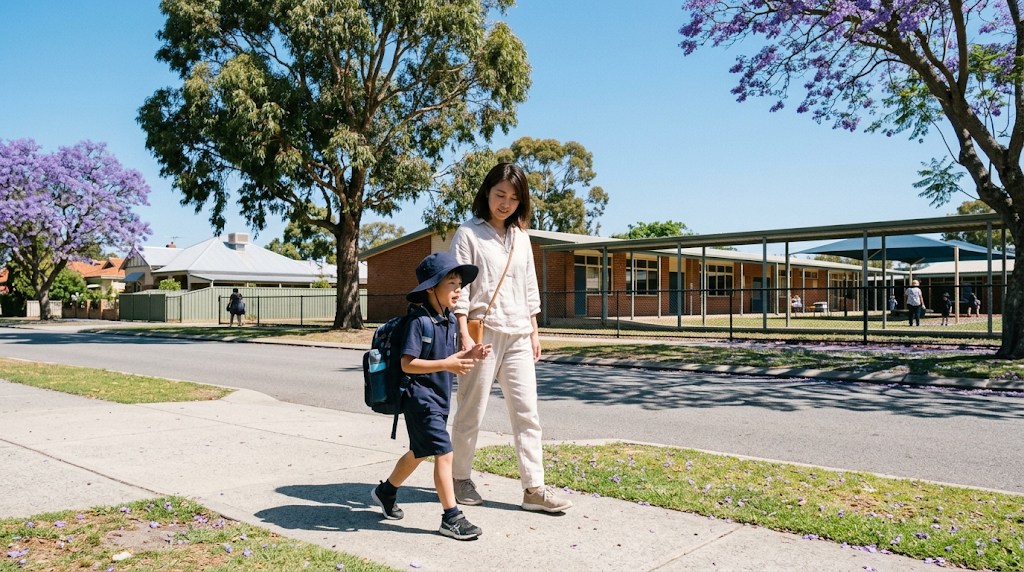
| Where | 30 Marapana Road, City Beach WA 6015, about 10 km north-west of the CBD. Since 2018 it has shared its campus with City Beach Primary School |
| Cost, 2026 | Tuition A$525 a month (Grades 1–4) or A$580 a month (Grade 5 to junior high). Entrance fee A$550, once. Second child A$30 a month less, third and later A$50 less. Student-visa families: A$1,650 / A$1,700 a month |
| Who it takes | Children of Japanese school age whose parents hold a permanent or long-stay visa (or who are dual Japanese–Australian citizens). No tourist visas; stays of at least three months; an interview with the child. No nationality requirement is published |
| Size | 35 pupils on 1 May 2026 (27 primary, 8 junior high), down from 42 in January. Grades of 1 to 6 children; capacity about 15 per grade |
| Run by | The Japanese School Council in Perth Limited, a not-for-profit company and registered charity, under the Japanese Society of WA’s school committee. Nine teachers seconded from Japan, nine hired locally (2025) |
| The real catch | No school bus and no school lunch, and the school ends at Grade 9 — children heading for an Australian high school leave in February |
Looking for a way to keep Japanese going from abroad?
TOMODACHI JAPAN is an online Japanese school for children growing up outside Japan. They talk with peers their own age in Japan every day, taught by teachers working at Japanese schools, in small classes of 8.
🎁 Register and we’ll email you our School Guide (PDF, in English) straight away. You’ll also be first to hear about tuition, scholarships and opening dates.
Free · takes about 30 seconds
First, which school do you actually mean?
Search for a Japanese school in Perth and you will meet one address with three schools on it, two Japanese schools with almost the same name, and searches for a “Japanese international school” that does not exist. Here is the map.
| Name you will see | What it actually is | Language and ages | Where |
|---|---|---|---|
| The Japanese School in Perth / JSP / “Perth Japanese School”, パース日本人学校, jsp.wa.edu.au | The full-time school this page is about. Japan’s curriculum and textbooks, Monday to Friday, plus English and Australian studies taught in English | Japanese; Grades 1–9 (Japanese school ages 6–15) | 30 Marapana Road, City Beach |
| The Weekend Japanese School in Perth / WJSP, パース補習授業校, wjsperth.org | A separate company running the Saturday hoshuko for children at Australian schools, overseen by the same Japanese Society school committee. Japanese language (kokugo) and, for older students, ATAR Japanese | Japanese; kindergarten to Year 12 | Same address, on weekends |
| City Beach Primary School | A WA government primary school. JSP occupies part of its grounds; the two share the oval, playtimes, weekly sport and carnivals | English; Kindergarten–Year 6 | Same campus |
| “Japanese international school Perth” | No such school. Australia’s other full-time Japanese schools are in Sydney and Melbourne; in Perth, JSP is the only one | — | — |
Two practical consequences. When a directory quotes “A$550” or a yearly figure, it is pricing the weekday school; the Saturday school’s fees are per term and about a quarter of the price. And if your child goes to an Australian school during the week and you want Japanese on Saturdays, you want WJSP — on the same oval, but with its own enrolment, board and fees. If you want a full Japanese school week, read on.
What it costs in 2026–27: A$525 a month, A$550 to start
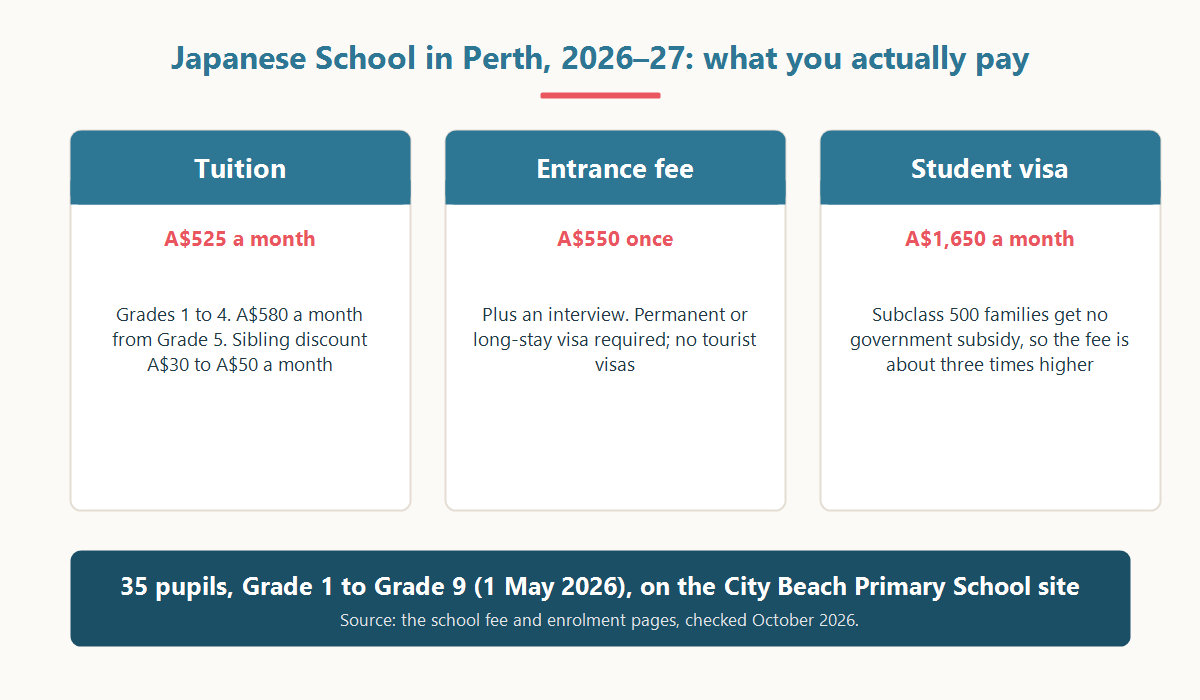
JSP runs on Japan’s school year — the 2026 year began on 17 April 2026 and ends in March 2027 — split into four terms aligned with WA’s school holidays. The admissions page lists one table for 2026. Fees are in Australian dollars, per child, and tuition is quoted per month. The school does not say how many months a year are billed; the yearly figures below assume twelve, so treat them as a ceiling and ask.
| Item | Permanent or long-stay visa | Student visa (subclass 500 etc.) |
|---|---|---|
| Entrance fee (once, new or transfer) | A$550 | A$550 |
| Tuition, Grades 1–4 | A$525 a month | A$1,650 a month |
| Tuition, Grade 5 to junior high (Grade 9) | A$580 a month | A$1,700 a month |
| Second child | A$30 a month off | A$30 a month off |
| Third and later children | A$50 a month off | A$50 a month off |
| Per year if billed for 12 months, Grades 1–4 | A$6,300 | A$19,800 |
| Per year if billed for 12 months, Grades 5–9 | A$6,960 | A$20,400 |
| First year, one child in Grades 1–4 | A$6,850 | A$20,350 |
| School bus | None — parents drive | None — parents drive |
| School lunch | None — packed lunch; the neighbouring school’s canteen on some days | None — packed lunch |
Two children in Grades 2 and 6 would pay A$1,075 a month between them after the sibling discount — about A$12,900 a year on the twelve-month assumption. Uniform (polo shirt, shorts or skort, jumper and hat; blazer in junior high), camp and excursion costs are not published. Children arriving from Japan collect free overseas-edition textbooks from JOES in Tokyo before they leave; after that, textbooks are distributed through the school.
Three things about these numbers that a one-line fee on a directory does not tell you:
- The visa sets the price. The school is funded by fees, a Japanese government subsidy, Australian and WA government subsidies and donations. A child on a student visa brings no Australian subsidy, so the fee roughly triples — A$1,650 instead of A$525 a month. If one parent is coming to Perth to study, this is the number to plan around.
- Compare it with what a WA public school charges you. Dependants of temporary skilled (subclass 482) visa holders can enrol at their local government school for a flat A$4,000 a year per family, however many children they have; permanent residents pay no tuition. So one child at JSP costs about 1.6 times the 482 family fee, and two children about 3.2 times. Full-fee overseas students in WA public primary schools pay A$14,575 for 2027 — there, JSP’s student-visa rate is the higher one.
- Fees went up this year. The widely copied A$500 / A$550 a month are the 2025 rates. The 2026 table is A$525 / A$580, a rise of about 5%.
Is it expensive? By Japanese-school standards in Australia, no: Sydney’s full-time Japanese school charges more, and our page on Sydney Japanese International School fees shows the east-coast comparison. The real cost question in Perth is the one above: what the same child would cost you at the government school down the road on your particular visa.
Who can enrol: a long-stay visa, not a passport, and an interview
Admission is decided by the principal after an interview, and reported to the school board. The rules on the admissions page and FAQ are about residence, not nationality:
- Visa. “Unless the child holds both Japanese and Australian citizenship,” the FAQ says, a parent must hold a permanent or long-stay visa. Tourist visas are not accepted, and the school cannot sponsor a visa.
- Length of stay. Short-term entry is possible for three months or more.
- One school at a time. Dual enrolment is not allowed; a child must leave their current school before JSP processes the transfer.
- Japanese. There is no published language test, but the application form asks for every passport the child holds, and families who are unsure about their child’s Japanese are asked to talk to the school before applying.
The application form itself has tick boxes for nationality — Japan, Australia or “Other Country” — and for temporary or permanent visa subclass. In other words, the school expects mixed and non-Japanese families to apply, and screens on visa and readiness, not on passport.
- Send the enrolment request (入学希望届, a one-page PDF on the admissions page) to toiawase@jsp.wa.edu.au, and fix an interview date.
- Interview with your child — in person in principle, sometimes online.
- After acceptance, submit the forms: application, family-background form (家庭環境調査書), passport photo pages, a copy of the visa and a certificate of enrolment from the current school.
- Pay the A$550 entrance fee before the first day.
For April 2027, the school is taking applications for new Grade 1 and new junior-high Grade 1 (Year 7) from 12 October to 17 November 2026, with the aptitude interview on 27 November 2026. Transfers into other grades are accepted through the year. There is no waiting list at present: the school sets a ceiling of about 15 children per grade, and no grade is near it. In past years JSP has also run a paid “auditing” week (聴講) in January — A$150 a day in 2019, credited against the entrance fee — but whether it runs now is not published.
How it works: a Japanese school week on an Australian playground
The principal, Toshiaki Ito, is seconded from Japan; the 2026 year is the school’s 49th. In 2025 the school had nine teachers dispatched by Japan’s education ministry and nine locally hired staff for about forty pupils, which is why every parent testimonial mentions small classes. Junior-high core subjects are taught by subject specialists.
| What | How it works at JSP |
|---|---|
| Curriculum | Japan’s national course of study and Japanese government-approved textbooks; graduates are recognised as completing Japanese primary and junior high. The school also meets WA registration standards |
| English | Grades 1–2: 3 hours a week. Grades 3–6: 4 hours plus 1 hour of Australian studies (history, geography, civics) taught in English. Junior high: 4 hours of Japanese-curriculum English, 3 hours with native-speaker teachers and 1 hour of Australian studies. Three ability groups per pair of grades |
| The local school | Shared oval and playtimes with City Beach Primary; joint PE once a week; joint cross-country, athletics carnival, music assembly and book parade |
| Australian pathway | NAPLAN preparation for volunteers in Grades 2, 4, 6 and 8; NAPLAN is sat by permanent-resident pupils. Children moving to an Australian high school leave in February and still receive their graduation certificate |
| Lunch and transport | Packed lunch; the neighbouring school’s canteen on some days. No school bus — parents drive; some junior-high pupils take the public bus. After-school care at City Beach Primary is available |
| Calendar | Japanese April start, four WA-aligned terms; report cards in September and March; parent conferences in May, September and February |
| Events | Learning presentation in November, a two-night camp in December for Grades 3–9, a visit to the Antarctic icebreaker Shirase at Fremantle, mochi-pounding, Bon dance, Eiken once a year |
Two features deserve a closer look. The first is how much English a JSP pupil gets compared with a Japanese school abroad. A Grade 4 child has five hours a week in English — against one hour in Japan — and plays every lunchtime on an Australian playground. The school is open that this is a bridge, not immersion: in 2025, eight pupils passed Eiken grades 2 to 4, and the annual report notes that writing and spelling lag numeracy in NAPLAN because children have little practice typing in English.
The second is who the pupils are. The school’s own pathway page says that “many” children are from permanent-resident families who stay until upper primary or high school and then move into the Australian system. Perth’s Japanese school is not only for two-year corporate postings; for a long-settled family it can be a deliberate choice for the primary years.
The honest review: what the English pages leave out
People search for “Japanese School in Perth reviews” and “photos” to find out what the school is like from the inside. We want to be straight: the only review figure we found is an aggregator’s 4.6 out of 5 from five Google reviews, which is too few to mean much, and the main school directory says the school “has not added photos”. The school’s own blog posts photos almost every week — judo, a new playground, craft lessons — but in Japanese. We will not invent a consensus. What we can do is show where the English pages that rank diverge from what the school publishes.
1. “A$500 a month, 2026/27.” Those are last year’s fees
The Doris profile, which it labels AI-compiled and “not yet claimed by the school”, headlines fees of “A$550 – 6,600” for 2026/27, but its breakdown uses the 2025 monthly rates of A$500 and A$550. The school’s 2026 table says A$525 and A$580. Other aggregators quote an “approximate annual tuition” of A$7,437 with no source. The only fee that counts is the table on the school’s admissions page — and it is per month, not per year.
2. “Opened 1968” or “opened 1977”? Full-time since 1978
Doris gives 1968; the English Wikipedia article says 1977 in its text and 1978 in its infobox. The school’s own history settles it: a Saturday supplementary school opened in 1968, and the full-time Japanese School in Perth opened with ministry approval in 1978. It moved to Scarborough in 1990, to City Beach in 2009, and onto the City Beach Primary School grounds in 2018. The distinction matters because the Saturday school today is a separate company, founded in 2005.
3. Pupil numbers that move every term — and a table that doesn’t add up
Directories say 34 pupils, undated. The school’s own figures are 33 in June 2024, 42 at the end of January 2026, and 35 on 1 May 2026; the federal ACARA profile for 2025 gives 39. Numbers swing because families arrive and leave mid-year and because children heading for Australian high schools leave in February. One more wrinkle: on the school’s May 2026 table, the grade rows add up to 28 primary pupils and 36 in total, while the totals line says 27 and 35. Either way, expect a grade of one to six children — Grade 9 had one pupil.
4. The fee nobody prints: the student-visa rate
None of the English pages we checked explains why the school has two fee tables. If a parent comes to Perth on a student visa, the child’s tuition is A$1,650 or A$1,700 a month — about A$20,000 a year — because Australian subsidies do not cover that child. A university researcher’s family reading “A$525” could be out by more than A$13,000 a year.
5. “A school for Japanese children.” Many families are staying
English summaries describe JSP as a school for children of Japanese expatriates. The school’s annual report says it “primarily serves Japanese children”, but its own pages describe many permanent-resident families, a NAPLAN programme, and a February exit route into Australian high schools. The governing company, The Japanese School Council in Perth Limited, is a registered Australian charity, and the school is WA-registered — renewed for five years in November 2025. It is a Japanese school built to hand children back to either system.
6. What to ask, since the reviews won’t tell you
- How many months a year is tuition billed, and when? Only the monthly rate is published.
- How many children are in my child’s grade this term, and how many are leaving in February? In a grade of three, one departure changes the class.
- Which of our visas counts? Bring the subclass number; the student-visa rate is three times the standard one.
- What do uniform, camp and excursions cost? Not published.
- Is there an auditing or trial week this year? It has run in January before.
- Where did last year’s Grade 6 and Grade 9 leavers go? The website does not say.
Other options in Perth
JSP is the only full-time Japanese school in Western Australia, so the Japanese choices in Perth narrow to one weekday school, one Saturday school on the same grounds, and community classes.
| Option | Who it takes | What to know |
|---|---|---|
| The Weekend Japanese School in Perth (WJSP) | Japanese-speaking children at Australian schools, kindergarten to Year 12; long-stay and permanent residents | Saturdays in WA term (9:00–12:00 or 1:00–4:00), junior high and ATAR Japanese on Sundays, at 30 Marapana Road. 2026 fees A$365 a term for primary (A$375 junior high), plus A$90 enrolment and A$20 selection fee — about a quarter of JSP’s tuition. Our guide to Saturday Japanese in Perth compares it with community classes |
| Community Japanese classes | Children learning Japanese as a language | Conversation and language classes rather than Japan’s school curriculum; covered in the same Saturday-school guide |
| WA government schools | Local residents; 482-visa dependants | English-medium. Free for permanent residents; A$4,000 a year per family for subclass 482 visa holders; full-fee overseas students A$14,575 (primary, 2027) |
| Japanese schools in other states | Families relocating within Australia | Sydney Japanese International School and the Japanese School of Melbourne are the other full-time options; see our Melbourne options page |
The gap is the one we see in every city. A full-time Japanese school serves children who can spend a whole week in Japanese; a Saturday school serves Japanese children at other schools, three hours a week. The Japanese-Australian child at a local school whose kanji has started to slip — exactly the story one JSP parent tells about why their daughter switched — or the family in Rockingham or Ellenbrook for whom City Beach is a long drive each way, falls between them.
How to choose, in four questions
- Can your child follow a full day of lessons in Japanese? Every core subject is taught in Japanese with Japanese textbooks. One parent describes a child who arrived from a local school more than a year behind and caught up in about six months with extra help — possible in a class of five, but it takes work.
- Which system is your child heading for? If it is back to Japan, JSP is built for it. If your family is staying, the school is designed to hand children over to an Australian high school in February — but weigh three to five hours of English a week against a local school, and plan for NAPLAN writing.
- Which visa are you on? Permanent resident: JSP costs A$525–A$580 a month against a free local school. Subclass 482: against A$4,000 a year for the whole family. Student visa: A$1,650 a month or more.
- Can you do the school run? No bus, no lunch service. City Beach is close to the western suburbs and a drive from everywhere else.
Where TOMODACHI JAPAN fits
We are not a substitute for the Japanese School in Perth, and if your child can follow a Japanese school day and the drive to City Beach works, we would point you to Marapana Road. We exist for the families the four questions above leave stuck — the child at a local school whose Japanese reading slips between Saturdays, the family too far from City Beach for a daily run, and the child who has never had Japanese friends of their own age.
- Japanese friends of the same age, every day. Classes with children the same age in Japan — not only other learners in Perth. The reason children keep going is usually the other children.
- Teachers working at Japan’s current classroom standard — not a syllabus written abroad and not a tutoring marketplace.
- Small classes of eight children. Enough to be a class, few enough that every child speaks every lesson.
- Perth is only one hour behind Japan, all year round. Western Australia has no daylight saving, so the gap never changes: an evening class in Japan at 8 p.m. would land at 7 p.m. in Perth, after school and dinner, and a Japanese afternoon is a Perth afternoon. Of all the cities where Japanese families live abroad, Perth has one of the easiest clocks. No school run, no visa table.
- Unlimited classes for a flat monthly fee. Tuition, scholarships and opening dates are in our free school guide, which we email to everyone who registers, with no obligation.
If a Saturday school is what you are weighing us against, our guide to online alternatives to a Japanese hoshuko sets out what an online class can and cannot replace.
Frequently asked questions
How much does the Japanese School in Perth cost?
For the 2026 school year, tuition is A$525 a month for Grades 1 to 4 and A$580 a month from Grade 5 to Grade 9, plus a one-time entrance fee of A$550. A second child pays A$30 a month less and a third or later child A$50 less. Families on a student visa (subclass 500) pay A$1,650 or A$1,700 a month. If billed for twelve months, a first year for one child in Grades 1 to 4 comes to about A$6,850; the school does not publish how many months it bills.
Where is the Japanese School in Perth?
At 30 Marapana Road, City Beach WA 6015, about 10 km north-west of the CBD, on the grounds of City Beach Primary School, where it has been since 2018. There is no school bus; families drive, and the school says the CBD is about 30 minutes away by public bus.
Does my child need a Japanese passport?
No nationality requirement is published. The condition is the visa: unless the child is a dual Japanese–Australian citizen, a parent must hold a permanent or long-stay visa, tourist visas are not accepted, and the stay must be at least three months. Every child is interviewed, and families unsure about their child’s Japanese are asked to consult the school first.
Is there a waiting list?
Not at present. The school caps grades at about 15 children and, with 35 pupils across nine grades in May 2026, none is close. Applications for new Grade 1 and new junior-high entrants in April 2027 close on 17 November 2026, with interviews on 27 November.
Is the Weekend Japanese School in Perth the same school?
No. The Weekend Japanese School in Perth is a separate company that uses the same City Beach address on Saturdays and Sundays, for children who attend Australian schools during the week. It teaches Japanese language from kindergarten to Year 12 and charges A$365 a term for primary pupils in 2026.
Is there a high school?
No. JSP runs from Grade 1 to Grade 9 (ages 6 to 15). Children either return to Japan or move into an Australian high school; those going local leave in February, at the start of the Australian school year, and still receive their graduation certificate.
Sources
- The Japanese School in Perth (Japanese-language pages): Home and April 2027 intake notice, Admissions and 2026 tuition, School visits and FAQ, School profile, history and enrolment (1 May 2026), Principal’s message, Programmes and events, English education, Pathway to local schools, Exchange with City Beach Primary School, Graduate and parent testimonials
- JSP annual reports (English): Annual Report 2025 (PDF), Annual Report 2024 (PDF)
- Australian Business Register: The Japanese School Council in Perth Limited, ABN 81 008 864 391
- The Weekend Japanese School in Perth: Home, School information, timetable and 2026 fees
- Comparison: TAFE International WA, fees for dependants of visa holders and 2027 school fees and charges; ACARA 2025 school profile data (via GDP.com.au)
- Third-party pages checked: Wikipedia (English); Doris profile; Cluey Learning school page; SchoolRank. The ACNC register and the Consulate-General of Japan in Perth page did not load for our fetch. All checked 31 October 2026.