If you want your child to keep Japanese growing outside Japan, books do something nothing else in the house can. Research on Japanese heritage-language children backs this up. A 2025 study of 427 children in Child Development found that their Japanese vocabulary began falling behind children in Japan at around age five and a half — and that reading and writing in Japanese, along with time spent in Japan, predicted how well they kept up, while general community exposure did little.
So which Japanese books for kids are worth having, and how do you get them when the nearest Japanese bookshop is a flight away? This guide lists the picture books Japanese children actually grow up with, the bilingual editions that exist (and the ones that are harder to find than you would think), where to buy or borrow in the US, Australia, the UK and Singapore, and free options you can use tonight.
Why Japanese picture books are ideal for learners
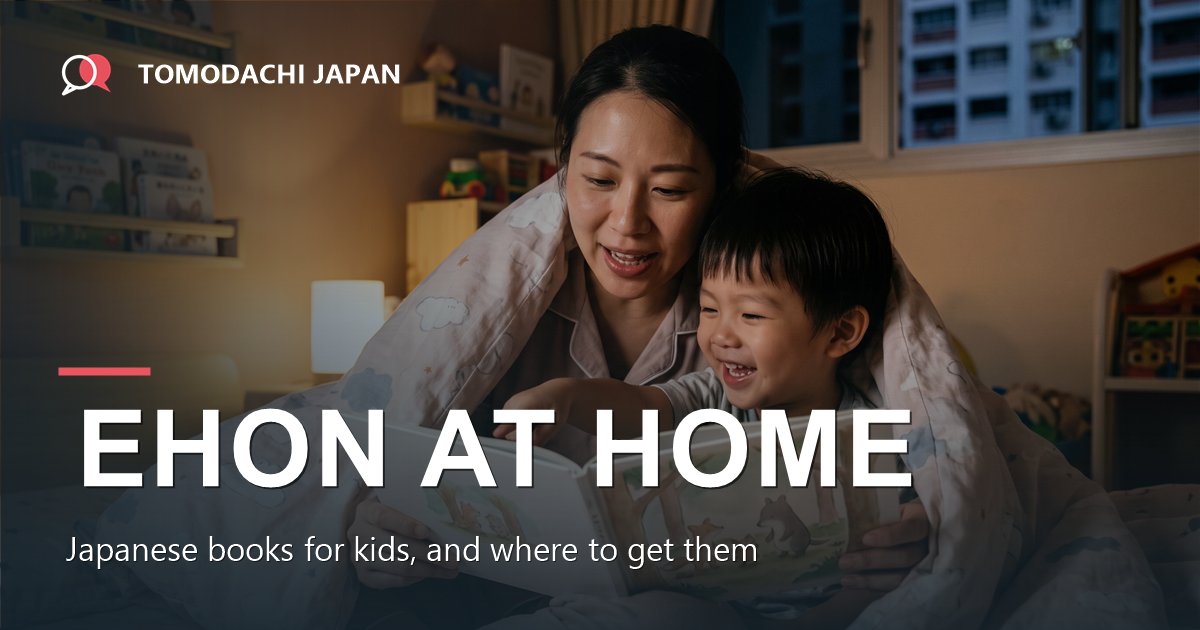
Japanese picture books, ehon, are mostly written in hiragana, often with spaces between phrases so small children can follow. That makes them readable for a child who knows hiragana long before they can manage a chapter book, and approachable for a parent who is still learning. Many rely on repetition and sound words, which is exactly how young children pick up language in the first place.
They also carry something a textbook cannot: the shared childhood of Japan. A child who knows Guri and Gura and Darumasan ga has something to talk about with Japanese children their age, and that connection is often what keeps a heritage language alive through the teenage years.
Want your child to share the stories they read with kids in Japan?
TOMODACHI JAPAN is an online Japanese school for children growing up outside Japan. They talk with peers their own age in Japan every day, taught by teachers working at Japanese schools, in small classes of 8.
🎁 Register and we’ll email you our School Guide (PDF, in English) straight away. You’ll also be first to hear about tuition, scholarships and opening dates.
Free · takes about 30 seconds
Classic Japanese books for kids, by age
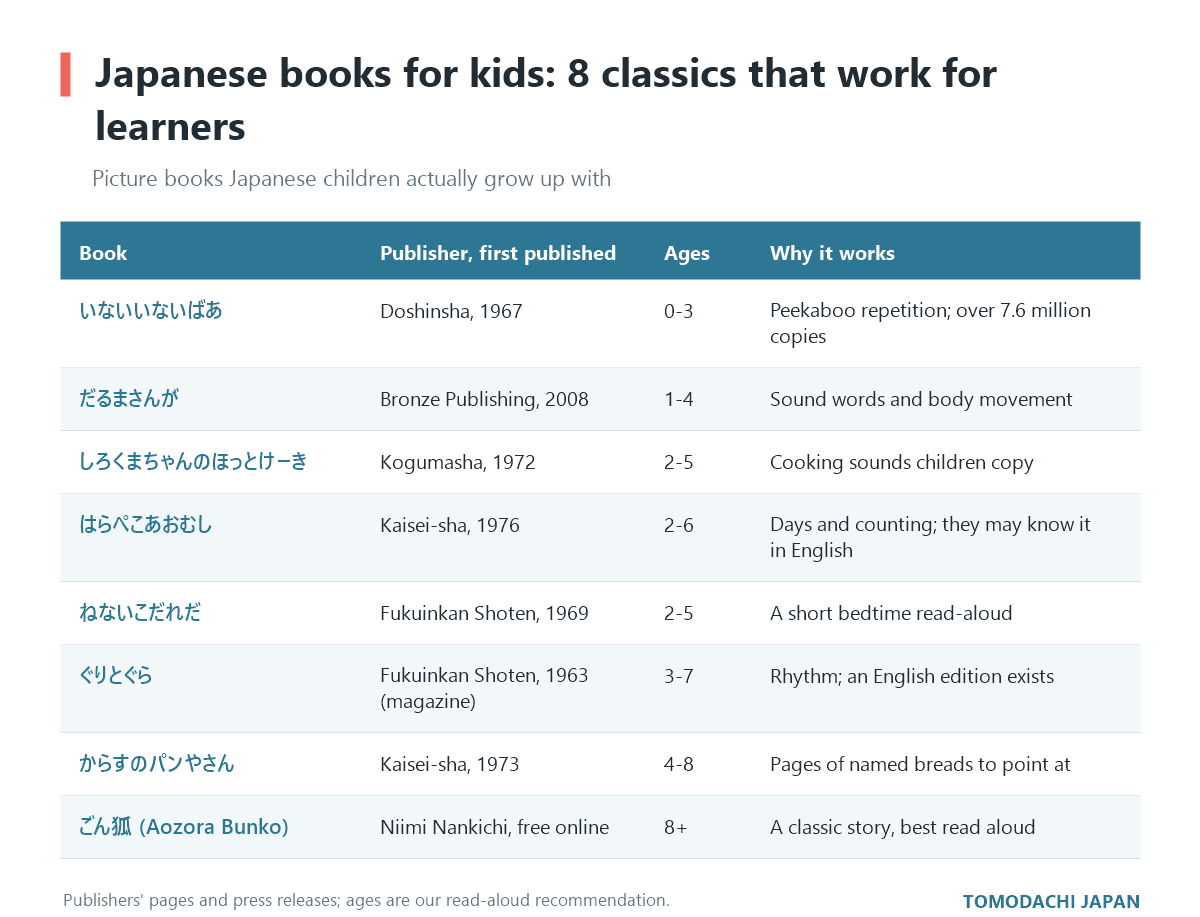
| Book | Publisher | Ages | Why we recommend it |
|---|---|---|---|
| いないいないばあ (Inai Inai Baa) | Doshinsha, 1967 | 0–3 | Peekaboo with animals. One of Japan’s best-selling picture books, at more than 7.6 million copies |
| だるまさんが (Darumasan ga) | Bronze Publishing, 2008 | 1–4 | A daruma doll wobbles, stretches and falls. Children copy the movements and the sound words. The series has passed 10 million copies |
| しろくまちゃんのほっとけーき | Kogumasha, 1972 | 2–5 | A little polar bear makes pancakes, with every cooking sound written out |
| はらぺこあおむし (The Very Hungry Caterpillar) | Kaisei-sha, 1976 | 2–6 | Days of the week and counting. If your child knows it in English, it is a perfect bridge. Over 4.3 million copies in Japan |
| ねないこだれだ (Nenaiko Dareda) | Fukuinkan Shoten, 1969 | 2–5 | A very short bedtime book that Japanese children know by heart |
| ぐりとぐら (Guri and Gura) | Fukuinkan Shoten | 3–7 | Two field mice bake a giant cake. Rhythmic text, and an English translation exists |
| からすのパンやさん | Kaisei-sha, 1973 | 4–8 | A crow family bakery, famous for its page of dozens of named breads to point at and read |
Start with the youngest book your child enjoys, not the one matching their age. A seven-year-old who is new to Japanese will get more from the joyful repetition of Darumasan ga than from a longer story they cannot follow yet.
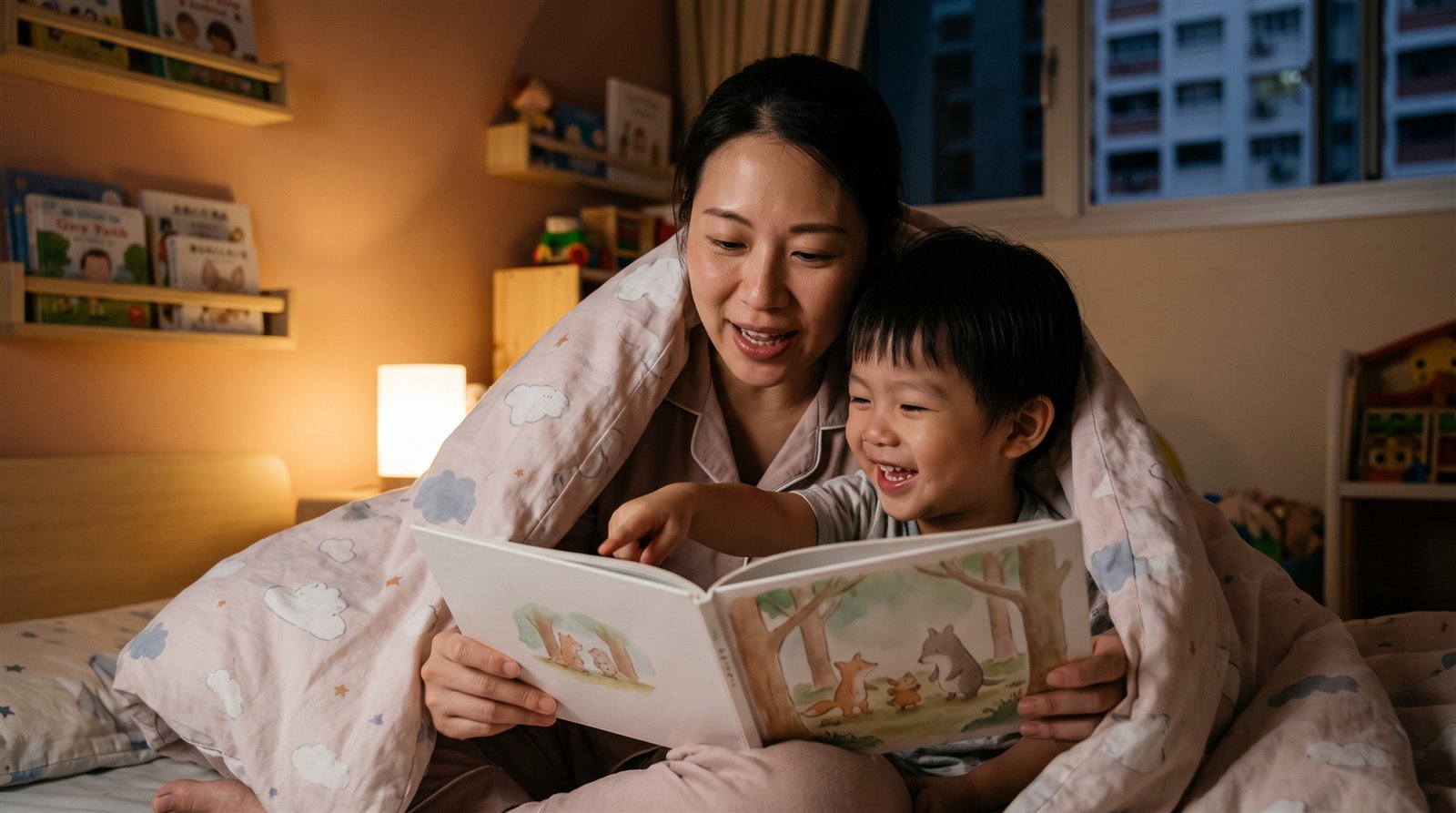
Bilingual Japanese–English books: what actually exists
Many parents search for bilingual books first, and it is worth knowing the market is smaller than it looks. Some titles you will see recommended are English-only or out of print.
- Kodansha Children’s Bilingual Classics — for example The Adventure of Momotaro, the Peach Boy, with Japanese alongside English, aimed at ages 3–7, and The Moon Princess. Genuinely bilingual and still sold in English-language bookshops.
- Guri and Gura in English — Tuttle published an English edition. It is a translation rather than a side-by-side bilingual book, but reading both versions of the same story is an excellent exercise.
- Tuttle’s Japanese Children’s Favorite Stories — a lovely collection of 20 stories, but in English only. Good for culture, not for Japanese reading.
- The Family of Fourteen (14ひきのシリーズ) — five titles were published in English in 2005, again as English-only editions.
Honestly, for most families a Japanese picture book plus a parent who translates the odd word works better than a bilingual edition. Children tend to read only the language they find easier when both are on the page.
Where to buy or borrow Japanese children’s books abroad
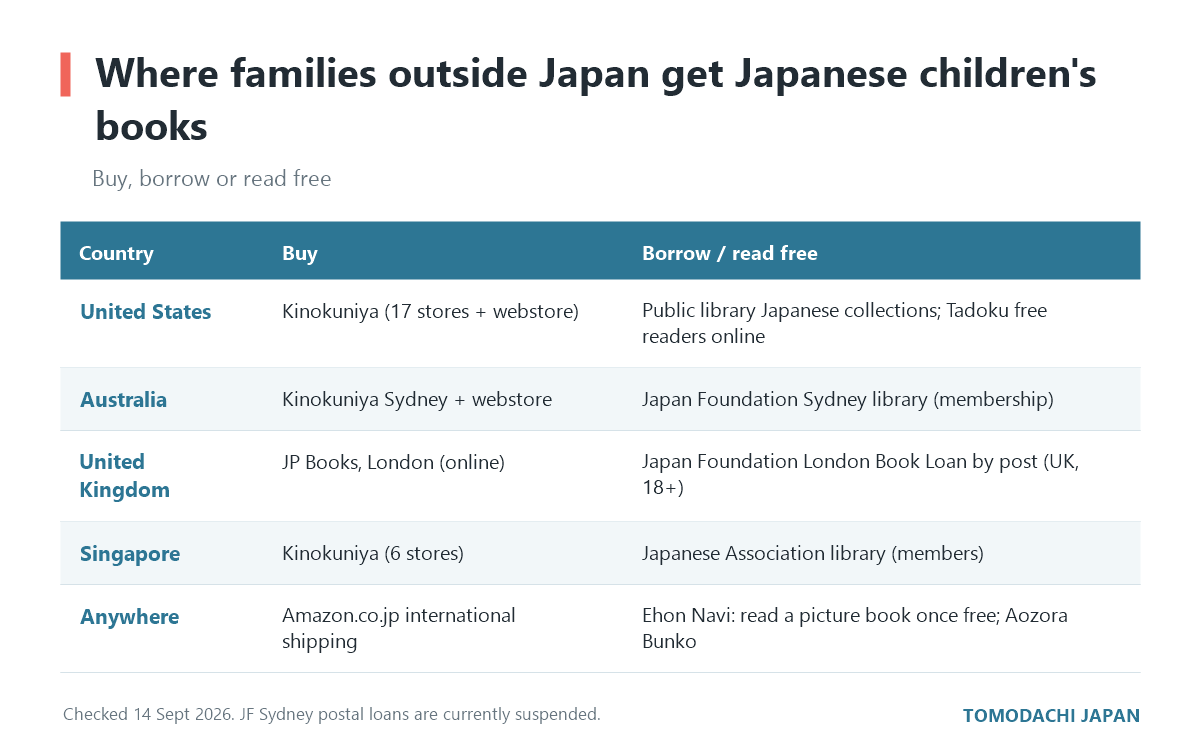
- United States: Kinokuniya has around 17 stores plus online ordering. Many public libraries in cities with Japanese communities hold Japanese children’s collections; ask about interlibrary loan.
- Australia: Kinokuniya Sydney, and the Japan Foundation Sydney library, where a paid membership lets you borrow and which runs children’s storytimes. Postal loans are currently suspended.
- United Kingdom: JP Books in London sells online with UK delivery. The Japan Foundation London runs a free Book Loan service by post for UK residents aged 18 and over, and it explicitly includes parents of heritage-language learners.
- Singapore: Kinokuniya has six stores, and the Japanese Association library holds a large collection for members.
- Anywhere: Amazon Japan ships many print books internationally. Shipping costs add up, so buy several books at once.
Free Japanese books you can read tonight
- Tadoku free graded readers — the NPO Tadoku Supporters publishes free Japanese graded readers across seven levels, from Pre-Starter to Level 5. Read them online, print them as PDFs or watch them read aloud on YouTube. Made for learners, so they are ideal for non-Japanese-speaking families.
- Ehon Navi (絵本ナビ) — a Japanese picture book site that lets you read a whole book once for free; free members can do this for three titles a month.
- Aozora Bunko (青空文庫) — Japan’s library of out-of-copyright works includes classic children’s stories such as Niimi Nankichi’s Tebukuro wo Kai ni and Gon, the Little Fox. They are plain text with kanji, so read them aloud to children or save them for readers of about eight and up.
A note from a Japanese classroom teacher
In Japanese schools we read aloud to children constantly, well past the age when they can read themselves, and there is a reason. When an adult reads, a child hears the rhythm and the natural intonation of sentences they could not yet read alone. It is the bridge between spoken Japanese at home and written Japanese at school.
For parents who don’t read Japanese well, my advice is not to worry about perfect pronunciation. Read the books with lots of sound words first — Darumasan ga is almost all ぷしゅー and びろーん — because those are fun to say badly. Point at the pictures, let your child turn the pages, and read the same book many nights in a row. Children do not get bored of repetition the way adults do. They are learning from it.
Frequently asked questions
What is the best first Japanese book for a toddler?
Inai Inai Baa or Darumasan ga. Both are short, repetitive and built around a game a toddler understands.
My child doesn’t speak Japanese yet. Are Japanese picture books too hard?
Not the simplest ones. Pair them with the Tadoku free readers, which are written for learners and come with audio. Where a book has an English version your child already loves, like The Very Hungry Caterpillar, read that one in Japanese first.
Can I borrow Japanese books from the National Diet Library’s children’s library in Tokyo?
Not as an individual. The International Library of Children’s Literature lends only to other libraries through its interlibrary scheme. Your local library may be able to request through that route.
How many Japanese books does a child abroad need?
Fewer than you think, read more often. Ten well-loved books read again and again do more than fifty read once. Add a few new ones each time you visit Japan or place an order.
Related: our guide to Japanese worksheets for kids, Japanese for kids, with the first 50 words, and raising a bilingual Japanese child abroad.
The short version
Japanese picture books are mostly hiragana and made for reading aloud, which makes them ideal for children abroad. Start with Inai Inai Baa, Darumasan ga and Guri and Gura. Bilingual editions are rarer than they look, so a Japanese book and a patient parent usually work better. Buy from Kinokuniya or borrow through the Japan Foundation, and use free Tadoku readers tonight.