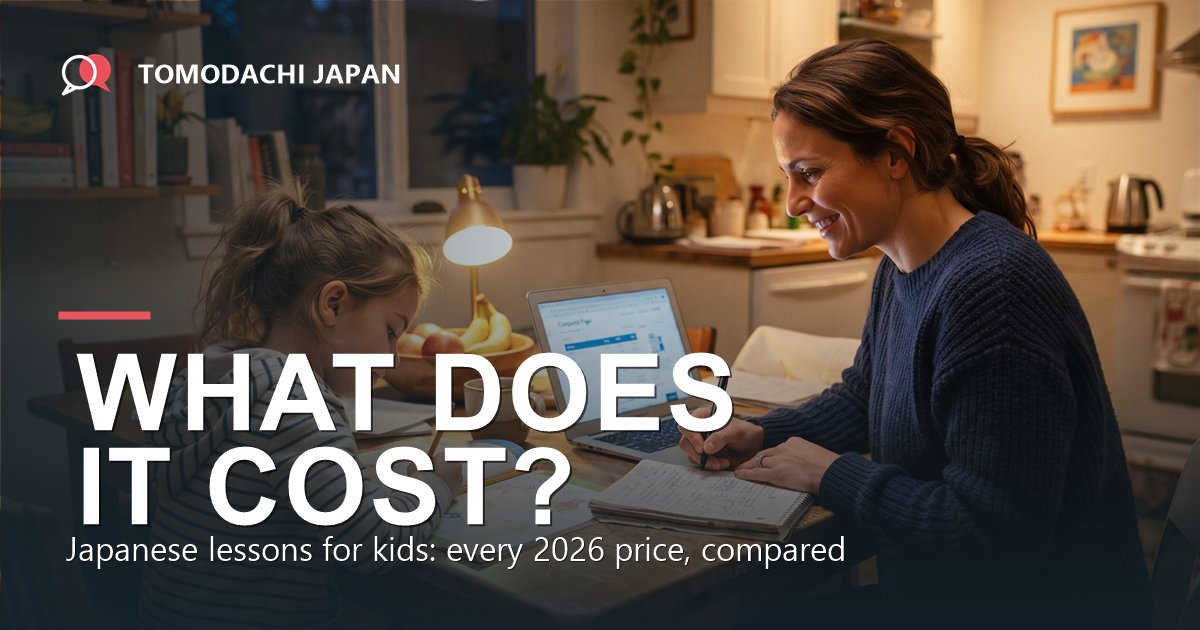
Ask three families what Japanese lessons cost and you will get three answers that are all correct and none of them comparable. One pays $4 an hour. One pays $319 a month. One pays $799 for ten weeks. They are not buying the same thing.
This guide puts the real 2026 numbers side by side — private tutors, small online groups, in-person community classes, and Japanese Saturday schools — and then does the part most price pages skip: works out what an hour of each one actually costs, and what you get for it. All figures below are the providers’ own published prices, with sources.
The short answer
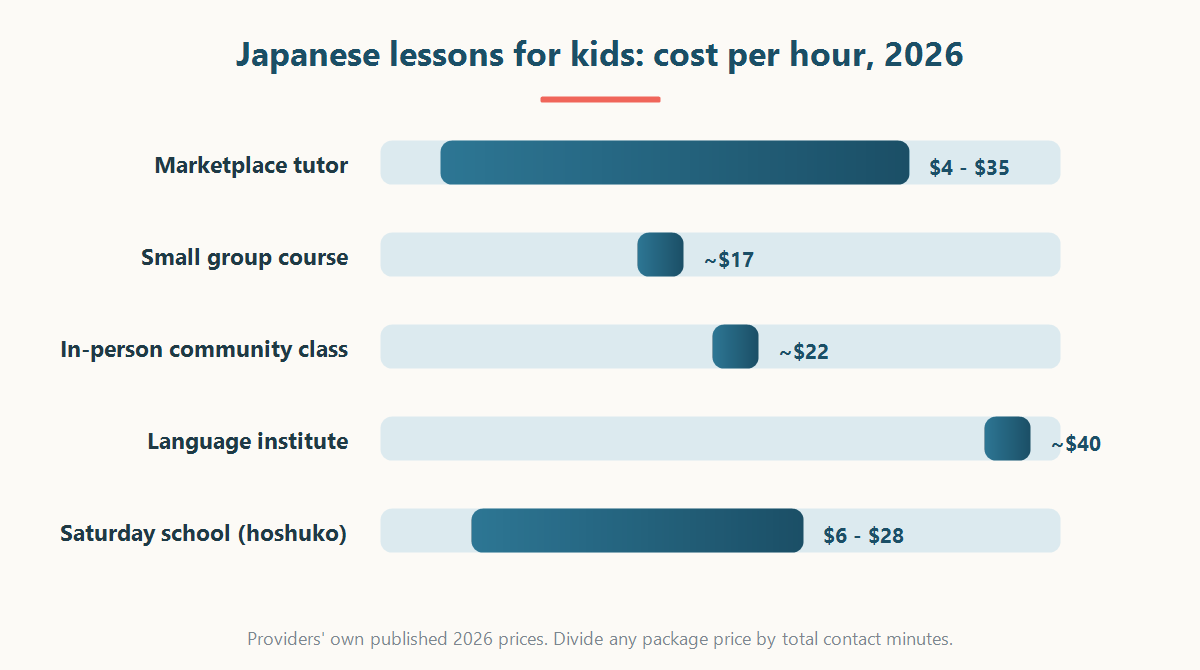
For a child learning Japanese in 2026, published prices cluster into four bands:
| What you are buying | Published price | Roughly per hour |
|---|---|---|
| Marketplace tutor, 1-on-1 online | From $4/hr; platform average around $19–$23/hr | $4–$35 |
| Small online group course | $279 for ten 105-minute sessions | ~$17 |
| In-person community class | $86/month for a weekly 90-minute children’s class | ~$22 |
| Japanese Saturday school (hoshuko) | $792–$3,828 per year, ~3.5 hrs every Saturday | ~$6–$28 |
Notice that the cheapest per hour and one of the most expensive per year are both weekly Saturday schools. That is the first thing this article exists to explain.
Looking for a way to keep Japanese going from abroad?
TOMODACHI JAPAN is an online Japanese school for children growing up outside Japan. They talk with peers their own age in Japan every day, taught by teachers working at Japanese schools, in small classes of 8.
🎁 Register and we’ll email you our School Guide (PDF, in English) straight away. You’ll also be first to hear about tuition, scholarships and opening dates.
Free · takes about 30 seconds
1. Private tutors online: $4 to $35 an hour
The two big marketplaces are the reason “how much do Japanese lessons cost” has no single answer — they are not one price, they are thousands of individual sellers.
- Preply. Japanese lessons start at $4 per hour, with a platform average around $22 per hour. Lessons with native Japanese tutors start near $3/hr and average about $19/hr. Experienced professional tutors typically charge $25–$35 per 50-minute lesson.
- italki. Japanese lessons generally run $15–$60 per hour. The platform splits sellers into two types: community tutors (fluent speakers, not trained teachers) at roughly $4–$20 per lesson, and professional teachers (formally qualified) at roughly $15–$35 per hour. A 30-minute lesson often costs $3–$10. There is no subscription — you pay per booking.
The honest strength here is flexibility and a low price floor. If your budget is $20 a month, this is the only band that will take it.
The honest weakness is that both platforms were built for adults. A community tutor at $6 a lesson is a fluent speaker with no obligation to have ever taught a child, and the format — one adult, one child, a screen, fifty minutes of being asked questions — is the format most likely to stall around week six for a primary-school learner. We wrote about why that pattern repeats in why 1-on-1 and app-based learning stalls for kids.
What to check before you book: ask whether the tutor has taught children specifically, and how many of their current students are under 12. The hourly rate tells you nothing about that.
2. Small online group courses: around $17–$70 an hour
Group courses are usually sold as a block, which makes the hourly cost invisible until you divide it out. Two real examples show how wide the spread is:
| Provider | What is sold | Price | Cost per hour |
|---|---|---|---|
| Japademy | 10 live sessions × 105 min, certified native teacher | $279 | ~$17 |
| Asian Language School | 8 lessons × 25 min, materials included | $236 | ~$71 |
Same category, four times the hourly cost. Nothing dishonest is happening — one sells long sessions, the other sells short ones — but a parent comparing “$279” against “$236” is comparing the wrong numbers. Always divide by total contact minutes.
Outschool sits in this band too. Its group classes are priced below its 1-on-1 tutoring, which falls in the common US tutoring range of roughly $20–$80 per hour, and individual teachers set their own rates — so the only reliable way to price it is to open the specific listing.
3. In-person classes near you: about $22 an hour
Community language schools are often the best-value in-person option and the least visible online. Mirai Nihongo Gakuin in Pasadena, California runs in-person children’s group classes of 90 minutes for $86 per month plus fees for the 2025–2026 school year — roughly $22 an hour of instruction.
Commercial language institutes cost more. Atlanta Institute of Language prices its beginner Japanese course at $39.95 per hour, or $799 for a ten-week course of weekly two-hour classes, capped at eight students.
The cost that never appears on either page is driving. A weekly 90-minute class 25 minutes away is close to two and a half hours of your Saturday, every Saturday, plus fuel. Families who quit in-person classes usually quit the commute, not the class.
4. Japanese Saturday school: $792 to $3,828 a year
A hoshuko is a weekly supplementary school, usually every Saturday morning for three to four hours, and the price range is enormous because two very different kinds of school share the name.
| School | Published tuition | Per year |
|---|---|---|
| Japanese Language School of Greater Hartford (CT) | Annual tuition | $792 |
| Keisho Center (Washington DC area) | $835 per semester; $1,470 if paid in full for the year ($100 discount) | $1,470–$1,570 |
| San Francisco Japanese School | Grades 1–2 $249/mo; Grades 3–M3 $271/mo; Kindergarten & high school $319/mo; $258 enrolment; $3.50/mo association; $31/yr security | ~$2,988–$3,828 |
Divide it out and the San Francisco school works out around $18–$28 per hour of class — similar to a mid-range group course, for a full curriculum. Hartford, at $792 a year for weekly classes, is closer to $6 an hour, which is less than the cheapest marketplace tutor.
So why doesn’t every family choose the $6 option? Because tuition is not the barrier. Two other things are:
- Entry level. Many hoshuko teach the Japanese national curriculum — kokugo and sansuu, in Japanese, at Japanese grade level. They are designed for children who already speak Japanese at home. A beginner cannot simply enrol.
- Geography. There is one within reach or there is not. For most English-speaking families this is a binary, not a budget question.
If that is your situation, our guide to what to do when a hoshuko isn’t an option covers the alternatives in more detail.
The number that actually predicts cost: hours per year
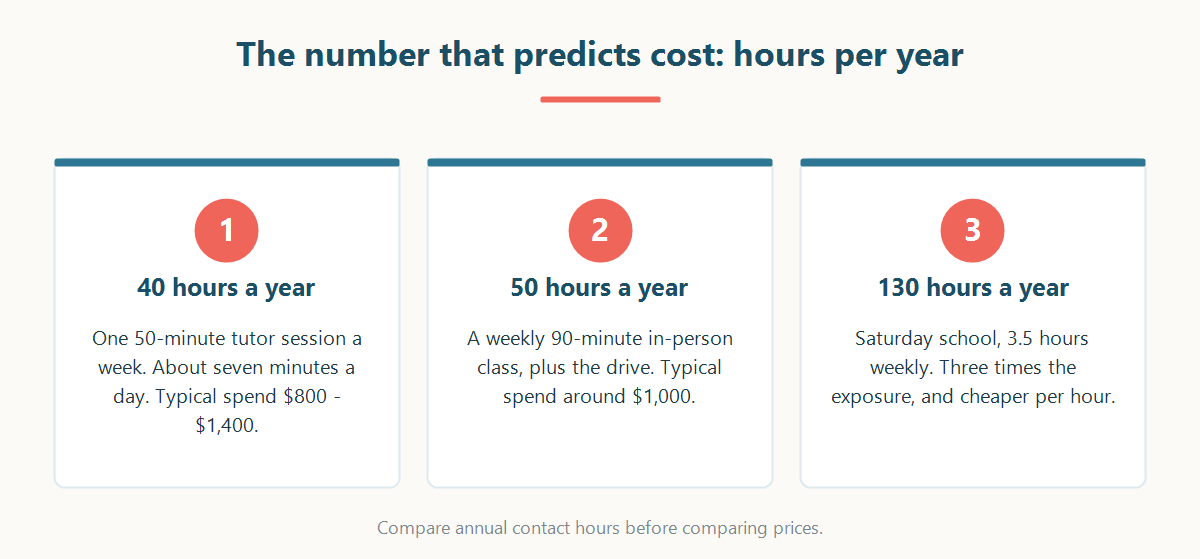
Here is the calculation that changed how we talk to families about price. Take each option and work out annual contact hours:
| Option | Contact hours per year | Typical annual spend |
|---|---|---|
| One 50-min tutor session a week | ~40 hrs | $800–$1,400 |
| Two ten-week group courses | ~35 hrs | $560–$1,600 |
| Weekly 90-min in-person class | ~50 hrs | ~$1,000 |
| Saturday school, 3.5 hrs weekly | ~130 hrs | $792–$3,828 |
A once-a-week tutor at $25 an hour and a Saturday school at $2,000 a year look like a big price gap. In hours, the Saturday school delivers three times the exposure. Per hour it is cheaper. Parents who feel they are “paying a lot and seeing nothing” are very often paying a fair hourly rate for a number of hours that was never going to be enough.
Forty hours a year is roughly seven minutes a day. No price point fixes that. We put rough numbers on what a child actually needs in how much Japanese practice kids really need.
Four hidden costs nobody quotes
- Enrolment and association fees. The San Francisco school adds $258 enrolment, $3.50 a month in association dues and $31 a year for security on top of tuition. Community centres often add annual membership of $120–$180 per family.
- Materials. Textbook sets are commonly $40–$90 a year and are usually not in the tuition figure.
- The re-start tax. Quitting in March and restarting in September means repeating a term. Six wasted months costs more than any hourly rate.
- Your Saturday. The most expensive line item in the whole comparison, and the only one you cannot buy back.
So what should you actually pay?
An honest rule of thumb from these numbers:
- Under $15/hr generally means a fluent speaker rather than a trained teacher, or a large group. Fine for conversation practice with a motivated older child; risky as the only thing a beginner has.
- $15–$30/hr is the honest market rate for qualified, child-experienced teaching in 2026, in any format.
- Over $40/hr should buy something specific and nameable — exam preparation, a very small group, a named specialist. If you cannot name it, you are paying for premises.
And one question is worth more than the rate itself: will my child still be doing this in a year? The cheapest lesson in the world costs infinity per unit of Japanese learned if the child stops in November.
Where TOMODACHI JAPAN sits — honestly
We are an online Japanese school for children, opening December 2026, taught by teachers working to the standard of currently-practising Japanese schoolteachers. Three things are relevant to a cost comparison:
- We charge a flat monthly rate with unlimited classes, not a per-hour rate. That changes the arithmetic above completely: the more your child attends, the lower the effective hourly cost — the opposite incentive to per-lesson pricing.
- Classes are small groups of eight children, not one-to-one — because for children, the other kids are the reason to come back.
- Sessions run across several time bands with adjustment for time zones, so families in North America, Europe, Latin America, Asia and Oceania can attend live.
We do not publish the monthly figure on the blog, because it comes with a scholarship structure that depends on where you live, and quoting one number without the other is exactly how price pages mislead people. The rate, the scholarship rules and the class timetable are all in the school guide, which is free.
Frequently asked questions
How much do Japanese lessons cost per hour on average?
For a child in 2026, roughly $15–$30 an hour for qualified teaching. Marketplace averages sit near $19–$23 an hour, small group courses near $17, and community classes near $22. Prices below $10 an hour almost always mean an untrained conversation partner or a large class; above $40 an hour usually means a physical school or a specialist.
Are group classes cheaper than a private tutor?
Usually yes per hour, but not always — one of the group courses above works out at about $71 an hour because the sessions are only 25 minutes. Divide the package price by total contact minutes before comparing. For children under about twelve, groups also tend to hold attendance better over a year, which matters more to total cost than the rate does.
Is Japanese Saturday school worth the money?
Per hour it is often the best value on this page — as low as about $6 an hour at Hartford’s published $792 a year. The catch is not price: many hoshuko teach Japan’s national curriculum in Japanese and are built for children who already speak Japanese at home, and you have to live near one.
Can my child learn Japanese for free?
Free apps will teach hiragana and katakana perfectly well, and that is a genuine saving worth taking — it is the part of Japanese that needs repetition more than instruction. What free tools do not provide is someone who notices your child was quiet today. Most families who succeed use free tools for drilling and pay for the human part.
What does TOMODACHI JAPAN cost?
A flat monthly rate with unlimited classes, plus a scholarship that varies by country. Because the two numbers only make sense together, we send them in the school guide rather than publishing a headline figure. Request the guide here — it is free and includes the class timetable for your time zone.
Where do these prices come from?
All figures are the providers’ own published 2026 prices: Preply and italki pricing pages, Japademy and Asian Language School course listings, Mirai Nihongo Gakuin (Pasadena) and Atlanta Institute of Language class pages, and the published fee schedules of the San Francisco Japanese School, the Keisho Center and the Japanese Language School of Greater Hartford. Prices change — always confirm on the provider’s own page before enrolling.