Every year, families open the HSC Japanese Continuers syllabus, find a document written for teachers, and close it again none the wiser. The syllabus does contain the answer to the only question that matters — where do the marks actually come from? — but it never states it in one place. This guide puts the whole mark map on a single page, then says plainly which parts of it students under-prepare for.
The mark map: where the 100 HSC marks sit
HSC Japanese Continuers is marked out of 100, split across two external components.
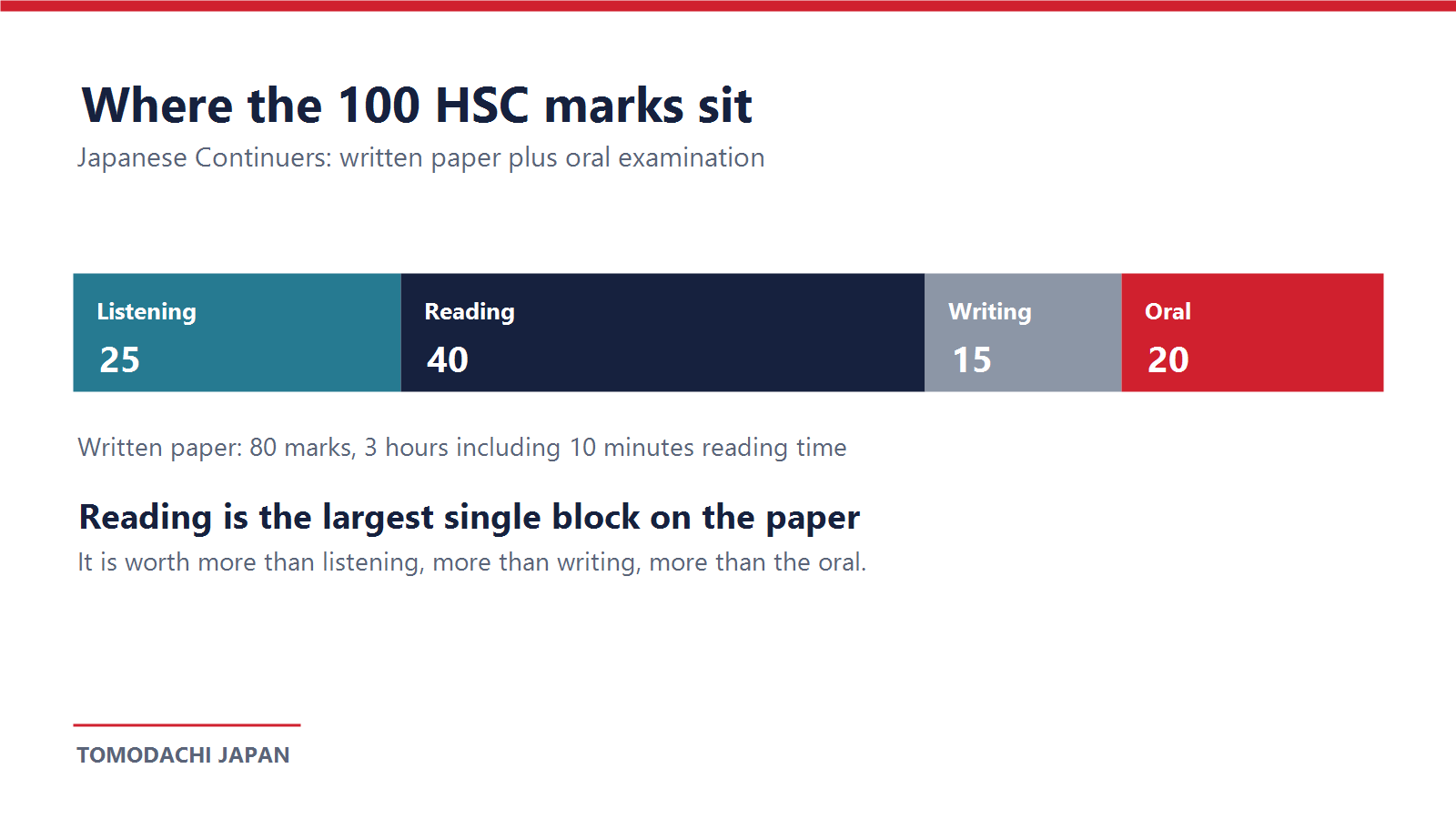
- Written paper — 80 marks, 3 hours (including 10 minutes of reading time).
- Section I — Listening and responding: 25 marks
- Section II — Reading and responding: 40 marks (Part A worth 25, Part B worth 15)
- Section III — Writing in Japanese: 15 marks
- Oral examination — 20 marks, a conversation of roughly ten minutes with an examiner.
Read that carefully, because one line surprises almost everyone: Reading and responding is the single biggest block on the paper at 40 marks — larger than listening, and nearly three times the writing section. Yet reading is the skill students most often assume will look after itself.
Looking for a way to keep Japanese going from abroad?
TOMODACHI JAPAN is an online Japanese school for children growing up outside Japan. They talk with peers their own age in Japan every day, taught by teachers working at Japanese schools, in small classes of 8.
🎁 Register and we’ll email you our School Guide (PDF, in English) straight away. You’ll also be first to hear about tuition, scholarships and opening dates.
Free · takes about 30 seconds
The three prescribed themes, in plain English
Everything in the course — every text, every exam question, every oral topic — hangs off three prescribed themes.
- The Individual. Your personal world: sense of self, relationships, values, opinions, plans after school. The oral lives here almost entirely.
- The Japanese-speaking Communities. Topics seen from the perspective of groups or of a community as a whole, with reflection back on your own culture.
- The Changing World. Change as it affects work, technology, society — the theme that supplies most of the harder reading texts.
A useful habit: whenever you meet a new text in class, name which theme it belongs to. Examiners build questions theme-first, so students who think in themes recognise the territory faster under time pressure.

What the course actually costs you in hours
Continuers is a 240-hour course on paper: 120 indicative hours in Year 11, then 120 in Year 12. Divide 120 hours across roughly 30 teaching weeks with a shared class, and the arithmetic that follows is the honest reason so many capable students stall.
In a class of twenty, a student’s share of genuine speaking time in a lesson is measured in seconds, not minutes — and it is always with the same familiar voice. The syllabus asks for spontaneous conversation with a stranger. Timetabled hours alone cannot supply that.
School assessment is weighted differently from the HSC
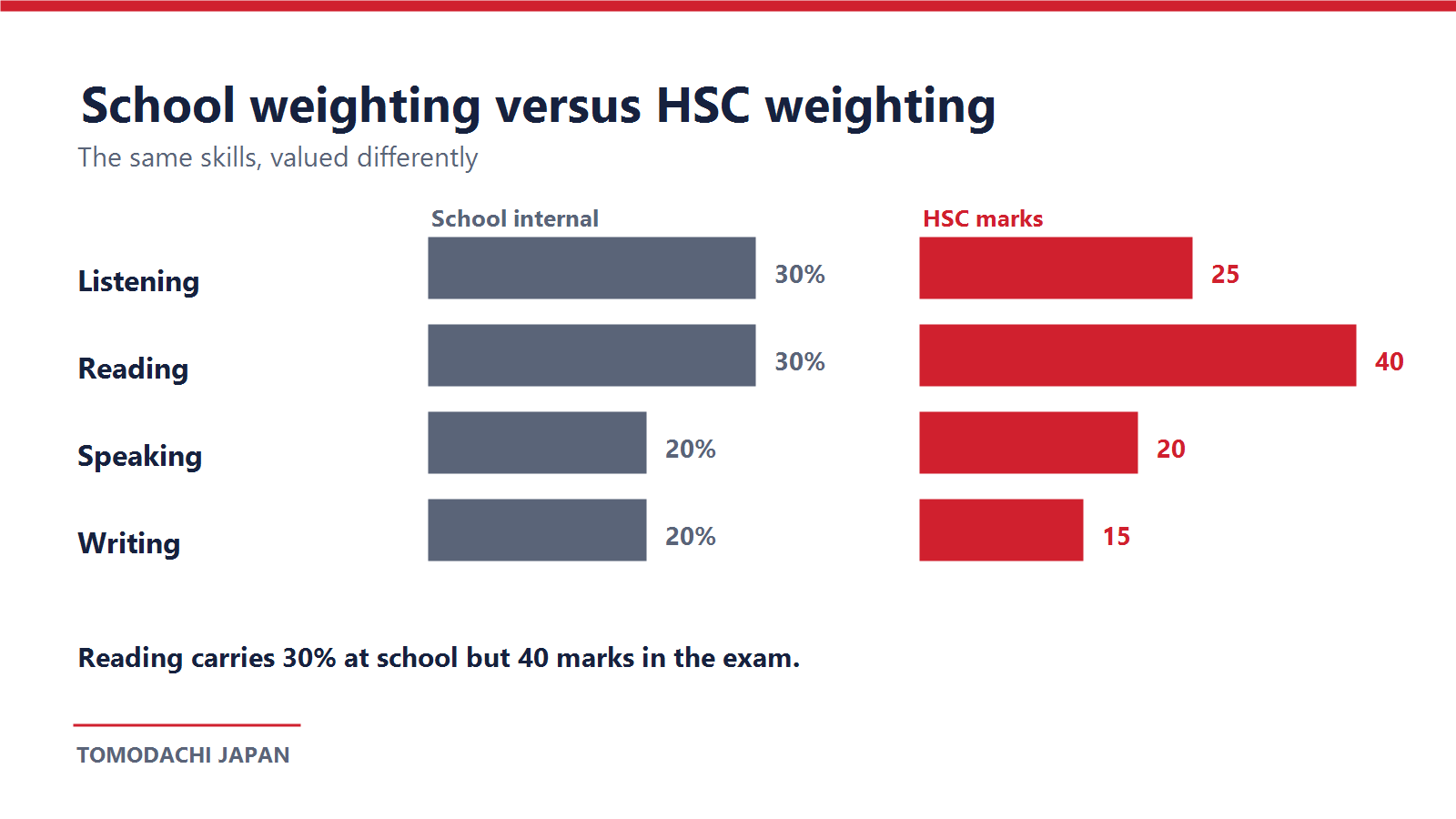
Here is the mismatch nobody flags. Your school’s internal assessment must use fixed mandatory weightings, the same in both Year 11 or Year 12:
| Skill | School internal weighting | Share of the HSC marks |
|---|---|---|
| Listening | 30% | 25 of 100 |
| Reading | 30% | 40 of 100 |
| Speaking | 20% | 20 of 100 |
| Writing | 20% | 15 of 100 |
Reading carries 30% internally but 40 marks externally. If your school ranking feels comfortable while your trial reading mark does not, believe the reading mark — that is the section the HSC over-weights relative to your internal experience of the course.
The prescribed vocabulary plus kanji lists
NESA publishes a prescribed vocabulary list together with a prescribed kanji list alongside the syllabus. Two practical points:
- The kanji list is a floor, not a ceiling. Texts may contain characters beyond it, generally supported by context or reading aids — so train yourself to read around an unknown character rather than stopping at it.
- Production differs from recognition. You need far fewer kanji to write Section III well than to read Section II comfortably. Split your study accordingly instead of drilling one undifferentiated pile.
We break the priority order down in our guide to the HSC Japanese Continuers kanji list.
What the syllabus does not tell you
The document specifies content, outcomes, plus mark allocations. It is silent on the thing that separates a Band 5 from a Band 6 in the oral: how much unrehearsed talking with unfamiliar Japanese speakers a student has done. The marking guidelines reward sustaining a conversation, adjusting register to your listener, justifying an opinion, moving between past, present, future. Those are habits, not knowledge, so they are built only by repetition with real people.
That is the gap TOMODACHI JAPAN was built to close. Our teachers are currently working teachers from Japanese schools — not tutors who once studied the language — so a student practises with the register, speed, plus follow-up questions of an ordinary Japanese adult, alongside peers their own age in Japan. Small-group classes run every weekday, so speaking stops being a weekly event.

Frequently asked questions
Which syllabus version applies in 2026?
Japanese Continuers Stage 6 remains the current NESA syllabus for NSW, with the vocabulary plus kanji lists published beside it. Always download from NESA directly rather than a tutoring site — third-party copies go stale quietly.
Am I eligible for Continuers?
Eligibility is decided by your schooling history, not by how strong your Japanese is. We explain the rules in Continuers, Beginners or Background Speakers.
When is the oral examination held?
HSC languages orals run before the written papers, at a dedicated examination centre rather than your own school. See our full guide to the Continuers oral, plus a six-week preparation plan.
Where should I start if I am in Year 11?
Start conversation practice now, while the stakes are low, then add past papers in Year 12. How to use past papers without burning them explains the sequence. Students in Victoria should read our HSC plus VCE Japanese hub for the VCE equivalents.
The syllabus tells you what is examinable; the papers tell you how it is actually asked. Work through the HSC Japanese Continuers past papers alongside this page rather than after it.
Practise the oral with teachers from Japan
TOMODACHI JAPAN opens in December 2026. Tell us your exam year — we’ll send opening news, class times for your state, plus trial-session details first.