
If you live in South London, Surrey or Kent and someone has told you there is a Japanese Saturday school “in Croydon”, they are right — and it is worth knowing exactly what it is before you plan your Saturdays around it. The Croydon campus is one of the three sites of The Japanese Saturday School in London, and it meets at Croydon High School, Old Farleigh Road, South Croydon CR2 8YB. This guide covers who the Croydon campus is genuinely for, how to get there, what a Saturday morning looks like, and the honest answer for families in Kent, Sussex and Surrey for whom even Croydon is a long way.
What the Croydon campus is
Croydon is not a separate school. It is the southern campus of the London hoshuko — the Japanese supplementary school run by The Japanese School Limited, which operates three sites across the capital:
| Campus | Host site | Address | Serves |
|---|---|---|---|
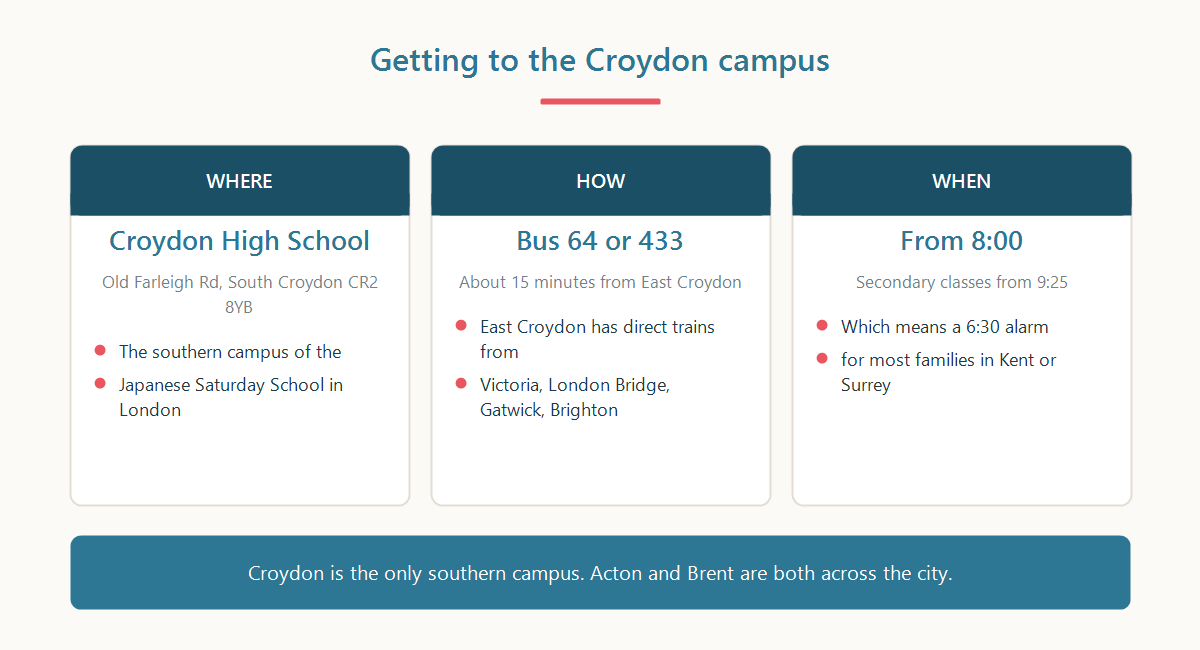
| Croydon | Croydon High School | Old Farleigh Rd, South Croydon CR2 8YB | South London, Surrey, Kent, Sussex |
| Acton | The Japanese School in London | 87 Creffield Rd, London W3 9PU | West London |
| Brent | Whitefield School | Claremont Rd, London NW2 1TR | North & north-west London |
The school runs primary, junior high and senior high divisions, so a child can in principle stay with it through to Year 13. Saturdays start early — the day begins at 8:00, with secondary classes from 9:25. Enquiries go to sat-london@thejapaneseschool.ltd.uk.
The Japanese Saturday School in London — official site
Looking for a way to keep Japanese going from abroad?
TOMODACHI JAPAN is an online Japanese school for children growing up outside Japan. They talk with peers their own age in Japan every day, taught by teachers working at Japanese schools, in small classes of 8.
🎁 Register and we’ll email you our School Guide (PDF, in English) straight away. You’ll also be first to hear about tuition, scholarships and opening dates.
Free · takes about 30 seconds
Getting there
The campus sits on Old Farleigh Road in South Croydon, which is further out than the name “Croydon” suggests to anyone who pictures the town centre. From East Croydon station, the school’s own guidance points to bus routes 64 or 433, a journey of roughly 15 minutes. The site has library and computer facilities available to students.
For families arriving by train, East Croydon is exceptionally well connected — direct services from Victoria, London Bridge, Gatwick, Brighton, Sutton and much of Surrey — which is precisely why this campus exists. It is the reason a family in Redhill or Bromley can attend at all. It is also why the practical planning question is not “how far is Croydon” but “what time do we have to leave the house on a Saturday”.
Who this campus is really for
A hoshuko is not a beginners’ Japanese class, and this is the point at which South London families most often discover they were looking for something else. The school teaches Japan’s national curriculum, in Japanese, to children expected to keep pace with their peers in Japan. The core subject is kokugo — Japanese as a first language: kanji, reading comprehension, composition, the same textbooks used in Tokyo.
That makes the Croydon campus outstanding for two kinds of family: those on a posting who will return to a Japanese school, and those with strong Japanese literacy at home who want it maintained properly. It is much harder for the third kind — a child born in London, speaking Japanese with one parent, who has never written a composition. They can be placed below their age year, find the homework relentless, and quietly conclude that Japanese is the joyless thing that eats their Saturday. That outcome is common enough that it is worth naming before you enrol rather than after.
Three things South London families should plan around
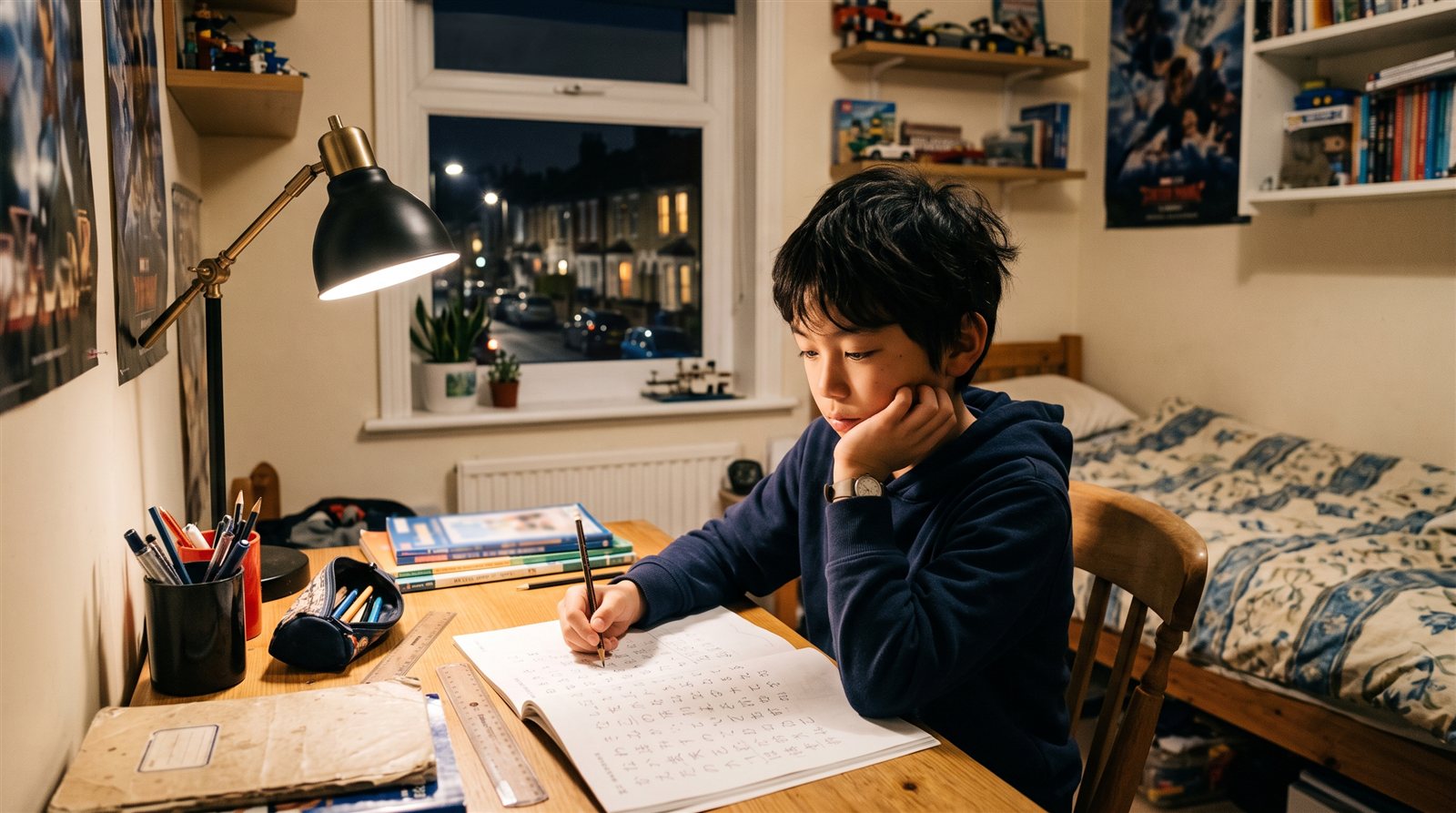
- An 8:00 start means a 6:30 alarm. Add the train, the bus from East Croydon and getting a seven-year-old out of the door, and Saturday is effectively gone before ten. Weigh that honestly against football, swimming and birthday parties, because the resentment that builds when Japanese is the reason a child misses every social thing is real and it compounds.
- Croydon is the only southern campus. If it does not work — wrong year group, no places, too far — there is no closer alternative within the London hoshuko. Acton and Brent are both across the city. For families in Kent, Sussex or west Surrey this is often the moment the weekly plan collapses.
- Three hours a week is not an environment. A child in Japan gets around thirty hours of Japanese a week. Saturday school gives roughly three. The gap is closed by homework and by what language is spoken at home, not by the classroom itself. Families who succeed treat Saturday as the checkpoint and the week as the work.
If Croydon does not work: the realistic alternatives
Three options actually exist, and only one of them solves distance.
- Private tutoring. Flexible and good for exam preparation, but expensive in the South East and inherently one-to-one. A child who has gone quiet in Japanese because they are self-conscious rarely opens up alone with an adult.
- GCSE and A-Level Japanese. A real goal for older students, worth planning years ahead because both reward literacy heavily. Not an answer for a seven-year-old.
- An online school based in Japan. The only one of the three that makes Sevenoaks, Guildford or Brighton irrelevant — because there is no journey.
The online option: no Saturday, no train, actual friends
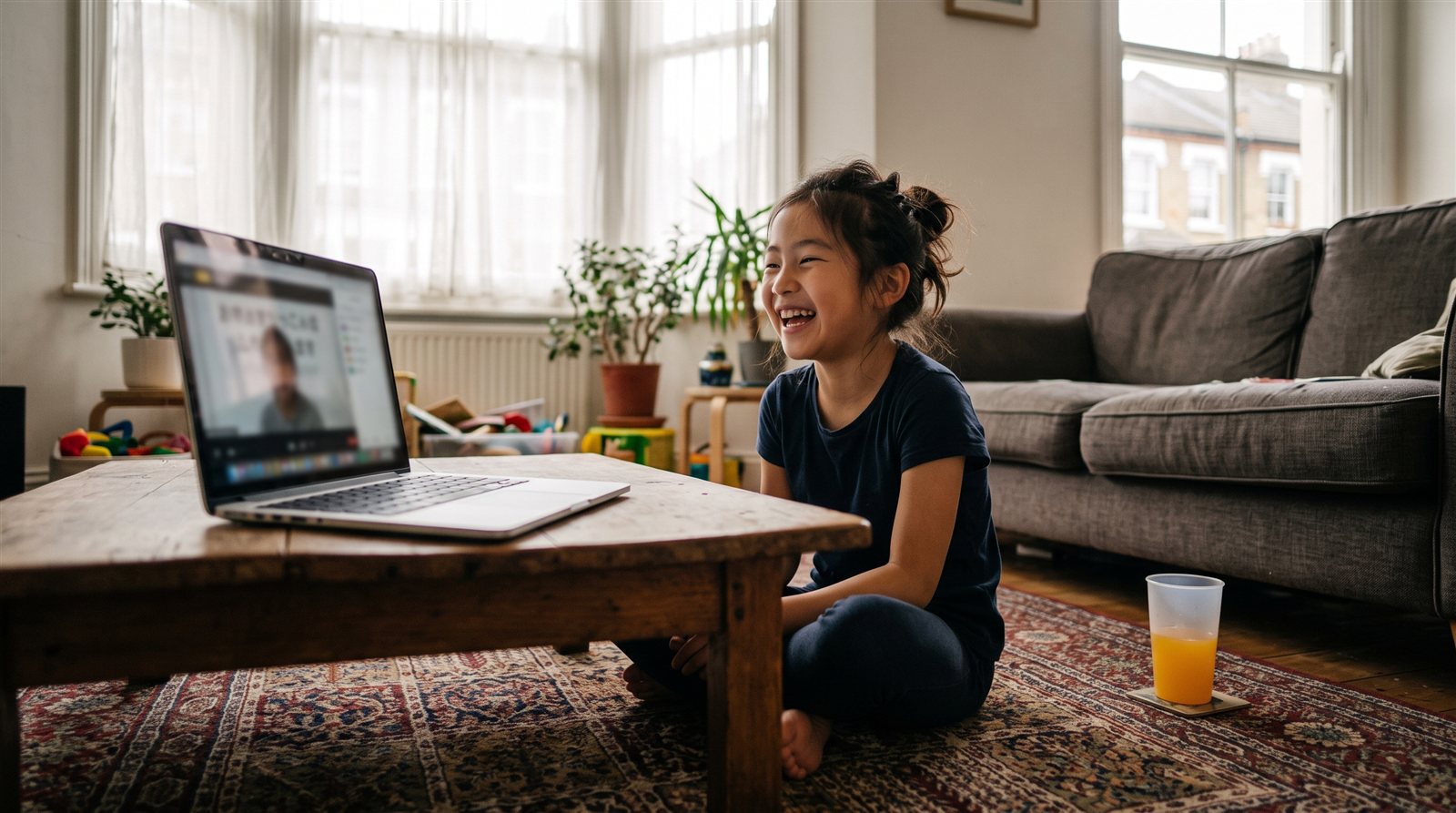
Japan is nine hours ahead of the UK (eight in British Summer Time), which sounds prohibitive until you look at where the classes actually land. A session running in Japan’s evening falls in the late British morning or early afternoon; TOMODACHI JAPAN runs three daily time bands with timezone adjustment specifically so European families can find a slot that works rather than being told to set a 4 a.m. alarm.
- The other children live in Japan. In any classroom in South London, every child also speaks English — so English returns the moment the teacher looks away. Online with children in Japan there is no shared fallback language. Japanese is simply how you join in.
- Unlimited attendance, one flat fee. One flat monthly fee for as many sessions as your child wants, in small groups of about eight with a homeroom teacher, taught by qualified, practising Japanese teachers.
- Grouped by conversation level, not school year. The eleven-year-old whose Japanese is at an eight-year-old’s level is not handed Year 6 kokugo and asked to cope — which is usually what makes a quiet child start speaking.
If you can get to Old Farleigh Road and your child can work in Japanese, go and look at the Croydon campus — a good hoshuko is a valuable thing and worth the early alarm. If the journey or the level is what stands between your child and Japanese, the answer is not to push harder on Saturdays. Our fuller guides to the Japanese Saturday School in London and to Japanese schools for kids in London compare every route.
More guides for families in London and the UK
FAQ from South London families
Is the Croydon campus a separate school from the one in Acton?
No. Croydon, Acton and Brent are three campuses of the same Saturday school, run by the same organisation, following the same programme. You apply to the school and attend the campus assigned to you — so ask about campus availability for your child’s year group when you enquire, rather than assuming you can pick.
Does my child need to be a Japanese citizen?
Ask the school directly. In practice the filter at supplementary schools is language rather than nationality — whether your child can follow lessons conducted entirely in Japanese at their year level. Email sat-london@thejapaneseschool.ltd.uk with your child’s age and Japanese background and they will tell you what is realistic.
We are in Kent. Is Croydon really the nearest option?
Within the London hoshuko, yes — the three campuses are Croydon, Acton and Brent. From much of Kent that is a long Saturday morning, repeated weekly for years. This is the classic case where families run online lessons on weeknights and treat Saturday school as an occasional supplement rather than the spine of the plan.
My child hates going. Should we make them continue?
Find out what the complaint actually is first. It is almost never Japanese itself — it is being the weakest in the room, or missing everything their friends do on Saturdays. Both have solutions that do not involve quitting the language: grouping by conversation level fixes the first, and shifting some of the load to weeknights fixes the second. A child who quits at eleven usually does not come back. We wrote about this in what to do when Japanese Saturday school is not working.
Japanese friends without the Saturday train.
TOMODACHI JAPAN opens in December 2026. Get the free school guide by email — class times for your time zone, how the small-group classes work, plus tuition and scholarship details.