If you are in Los Angeles and have typed “Japanese Saturday school” into your phone, there is really only one answer at scale — and then a set of smaller ones most search results never mention. Asahi Gakuen is the Japanese Saturday school in Los Angeles: four campuses, roughly 1,350 students, and a curriculum that follows Japan’s Ministry of Education standards using the same textbooks children use in Japan. It is excellent. It is also selective, geographically spread out, and built around a specific assumption — that your child can already work at Japanese grade level. This guide covers where the campuses actually are, what the entry process looks like, the deadline that is coming up right now, and what to do if Asahi Gakuen is not the right fit for your family.
Japanese Saturday school in Los Angeles: the options
| School | Type | Day | Ages | Where |
|---|---|---|---|---|
| Asahi Gakuen (あさひ学園) | Supplementary hoshuko, Japanese grade level | Saturday, full day | Kindergarten – Grade 12 | 4 campuses (see below) |
| Nishiyamato Academy of California | Full-time private day school | Mon–Fri | K – Grade 9 | Lomita |
| Community & church-run classes | Conversation / heritage, informal | Varies | Varies | Torrance, Little Tokyo, Gardena |
| Private tutors | One-to-one | Any | Any | In-home or online |
| TOMODACHI JAPAN | Online, conversation & friendship with kids in Japan | Any weekday (unlimited attendance) | 5–18 | Your home |
Looking for a way to keep Japanese going from abroad?
TOMODACHI JAPAN is an online Japanese school for children growing up outside Japan. They talk with peers their own age in Japan every day, taught by teachers working at Japanese schools, in small classes of 8.
🎁 Register and we’ll email you our School Guide (PDF, in English) straight away. You’ll also be first to hear about tuition, scholarships and opening dates.
Free · takes about 30 seconds
Asahi Gakuen: the four campuses
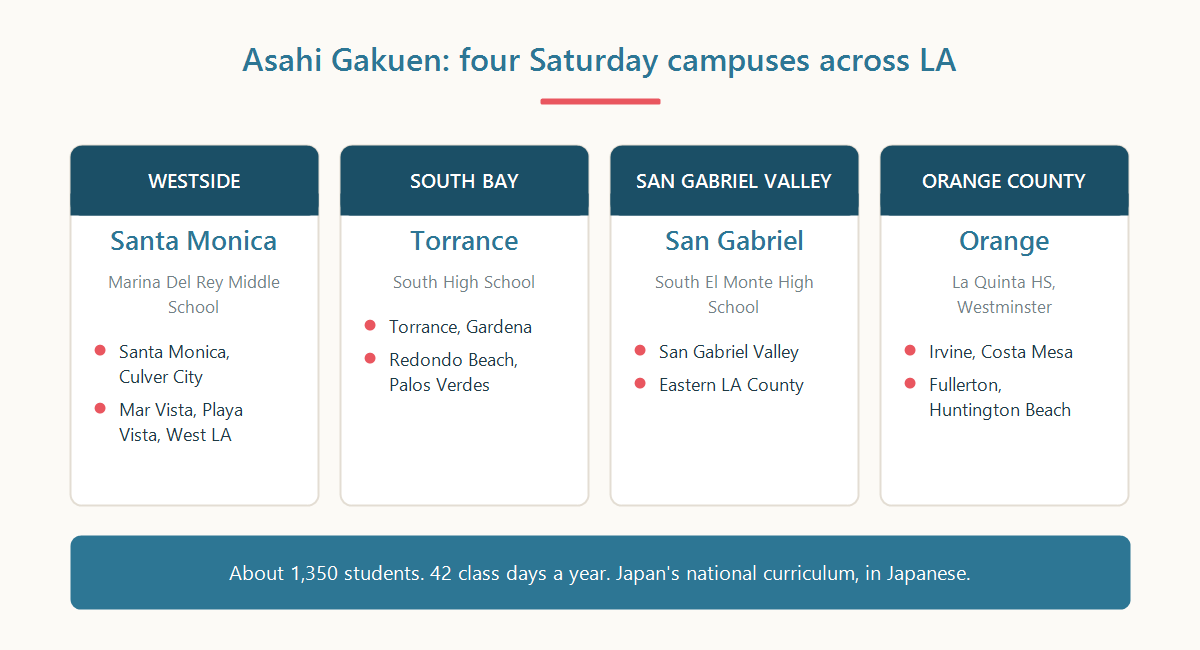
Asahi Gakuen was founded in 1969 by the Japan Business Association of Southern California and is one of the largest Japanese Saturday schools anywhere in the world. It teaches around 1,350 students with about 130 teachers, including several dispatched by the Japanese government. Crucially for planning your week, it does not have one site — it borrows four host campuses across the LA basin on Saturdays:
- Santa Monica campus — Marina Del Rey Middle School. Serves the Westside: Santa Monica, Culver City, Mar Vista, Playa Vista, West LA.
- Torrance campus — South High School. The South Bay campus, and the natural one for Torrance, Gardena, Redondo Beach and Palos Verdes families.
- San Gabriel campus — South El Monte High School. Serves the San Gabriel Valley and the eastern side of the county.
- Orange campus — La Quinta High School in Westminster. Serves Orange County: Irvine, Costa Mesa, Fullerton, Huntington Beach.
Four campuses sounds generous until you look at a map of Los Angeles. If you live in the Valley, in Pasadena, in Long Beach or east of the 605, “your” campus may still be a 40–60 minute drive each way — and that is a Saturday, every Saturday, for years. Families routinely underestimate this. It is not a reason to rule the school out; it is a reason to be honest with yourself about the drive before you enrol.
What the school year actually looks like
Asahi Gakuen runs about 42 class days a year — that is the whole thing. Forty-two Saturdays. Within those days it delivers the Japanese national curriculum, in Japanese, using Japanese textbooks, across four divisions: kindergarten (幼稚部), elementary (小学部), junior high (中学部) and high school (高等部).
Understanding the 42 is the single most useful thing a new parent can do. A child in Japan gets roughly 200 school days of Japanese instruction a year. Your child in Los Angeles gets 42. The gap is not closed inside the classroom — it is closed by homework, and Asahi Gakuen sets a genuine amount of it. Families who thrive here treat the Saturday as the checkpoint and the weeknights as the actual work. Families who struggle are usually the ones who expected Saturday to be enough on its own.
Entry: the deadline you should know about right now
Asahi Gakuen admits new students through a formal process, not simple registration. For the intake beginning in September, the school has published an application deadline of August 8, with the entrance assessment, results and orientation on August 23, and classes starting in September. If you are reading this in the first half of August and you want your child in this school year, that is the window — call the office on (424) 396-3800 or use the inquiry form on the school’s site today rather than next week.
The assessment matters. Because the school teaches at Japanese grade level in Japanese, entry above the earliest grades assumes your child can read, write and follow instruction in Japanese at something close to that level. A child who speaks fluent Japanese at home but has never written it will often be placed lower than their age, or asked to build literacy first. That is not a judgement on your child — it is the arithmetic of 42 days a year. But it does surprise families, so it is better to hear it now.
Three Los Angeles-specific things to plan around
- The drive is the real tuition. Whatever the fee sheet says, the true cost of a Saturday hoshuko in LA is two freeway trips and most of a weekend day, roughly forty times a year, for a decade. Households with two working parents, a younger sibling, or a child in Saturday sports hit this wall in year two or three, not year one. Look at that honestly before you commit.
- Full-time is a completely different question. Nishiyamato Academy of California in Lomita is a full-time private school following the Japanese curriculum through Grade 9. It is a wonderful option for a family on a short posting who will return to the Japanese system — but it replaces your child’s American school. Most heritage families in LA want Japanese alongside their local school, which is a different question entirely. Do not let the search results blur the two.
- Once a week has a ceiling — and English wins the other six days. This is the pattern every Los Angeles parent eventually describes: the child was fluent at four, started kindergarten, and by eight answers every Japanese question in English. One Saturday a week slows that drift. It rarely reverses it, because the drift is driven by where the child’s friendships live. If all your child’s friends speak English, Japanese becomes a school subject rather than a language.
The online option: giving the other six days somewhere to go
This is where an online school from Japan changes the maths, and Los Angeles has an unusually good version of the problem. It is the same idea we cover in our guide to the online alternative to Japanese hoshuko, and in our wider overview of Japanese schools for kids in Los Angeles.
- The time difference works in your favour, oddly. Los Angeles is 16 hours behind Japan (17 in winter). That sounds fatal until you flip it: a Saturday-morning class in Japan is Friday afternoon or evening in LA, and a late-afternoon class in Japan lands in the LA evening the day before. There is a live, comfortable overlap — no 4am alarms — and TOMODACHI JAPAN runs three daily time bands with timezone adjustment specifically so North American families can find one.
- The other children actually live in Japan. That is the part a local class cannot replicate. Your child is not practising Japanese with other Californian kids who also default to English — they are talking with children their own age in Japan, about the things eleven-year-olds in Japan talk about. Japanese stops being homework and becomes the thing you need in order to keep up with your friends.
- Unlimited attendance, one flat fee. One flat monthly fee for as many sessions as your child wants, in small groups of about eight with a homeroom teacher, taught by qualified, practising Japanese teachers. Not per-hour. Not Saturday-only.

Asahi Gakuen and an online school are not competitors. The hoshuko keeps your child anchored to Japanese grade level and the national curriculum. The online school gives the other six days somewhere to go. The families whose children are still speaking Japanese at sixteen are, almost without exception, doing some version of both.
FAQ from Los Angeles families
We missed the August deadline. Do we have to wait a whole year?
Ask the office rather than assuming. Saturday schools of this size often have a second intake window and will sometimes take mid-year transfers where a class has space, particularly at the elementary levels. Call (424) 396-3800 and ask directly what is available for the current school year and when the next assessment date is. In the meantime, the worst thing you can do is let a year of Japanese literacy go by while you wait — keep your child reading and writing something, somewhere, so that they test in higher when the door opens.
My child speaks Japanese but cannot read it. Will Asahi Gakuen take them?
Very possibly, but likely not at their age grade. Because the school teaches Japan’s curriculum in Japanese, placement follows Japanese literacy rather than age or spoken fluency. A ten-year-old who speaks beautifully but reads at first-grade level cannot follow a fourth-grade kokugo lesson — so the school will place them where they can actually learn. Many families find it less discouraging to build reading and writing first, then enter, than to enter and be placed three years down.
Which campus should we choose if we are between two?
Choose the shorter drive, almost every time. The academic programme is the same across campuses; the thing that ends Saturday-school careers is the commute, not the curriculum. Ask the school directly about campus assignment when you apply, since availability by grade differs between sites and you may not have a completely free choice.
Can we do Asahi Gakuen and online lessons at the same time?
Yes, and it is the combination we see working best. They do different jobs: the Saturday school delivers grade-level kokugo, kanji and the national curriculum; the online school delivers daily conversation, friendships with children in Japan, and a reason to use the language. Because attendance online is unlimited and grouped by conversation level rather than school grade, it also flexes around the weeks when Asahi Gakuen homework is heavy.
Friends in Japan, every LA evening.
TOMODACHI JAPAN opens in December 2026. Get the free school guide by email — class times for your time zone, how the small-group classes work, plus tuition and scholarship details.