If you have searched “Japanese school San Francisco” you have probably found the same four or five names and almost no useful detail — no prices, no class times, and nothing at all about whether your child would actually be accepted. Here is the short answer up front. The Bay Area has three genuinely different routes: a MEXT-recognised Saturday hoshuko (San Francisco Japanese School) that teaches the Japanese national curriculum at grade level and screens children with a 20-minute interview; community heritage language schools (Kinmon Gakuen, Soko Gakuen) that take beginners with no gate at all; and something no other US city has — free public elementary Japanese programmes inside SFUSD. The catch that sends most families down the wrong path is this: the hoshuko’s real tuition is published only on a Japanese-language page, and its eligibility rules — including a requirement that Japanese is the language of your home — appear nowhere in English. This article puts all of it in one place, in English.
Japanese school in San Francisco: the comparison
| School | Type | Day & time | Ages | Tuition | Area |
|---|---|---|---|---|---|
| San Francisco Japanese School (サンフランシスコ日本語補習校) | MEXT-recognised hoshuko, grade-level Japanese curriculum | Saturday, 43 days/year (8:35–15:10 for G7–11) | Kindergarten – Grade 11 | $249–$319/month + $258 enrollment | Four campuses, assigned by home address |
| Kinmon Gakuen 金門学園 (Golden Gate Institute) | Heritage community language school — beginners welcome | Saturday 9:00–12:00 | 5–18 | $500 tuition (confirm whether per semester or per year) + $50 registration | Japantown, 2031 Bush St |
| Soko Gakuen | Community language school, predominantly adult | Saturday 9:00–12:00, 33 sessions | 5–14 (no high-school track) | $900/year ($800 tuition + $100 materials) | 440 Austin St |
| Rosa Parks Elementary & Clarendon Alternative — JBBP | Public school Japanese language & culture programme | Weekdays, in the school day | K–5 | Free (SFUSD lottery) | 1501 O’Farrell St / Clarendon |
| East Bay Sakura Gakuen | Separate heritage and new-learner tracks + Mommy & Me (0–3) | Contact the school | 0–18 | Contact the school | Pleasanton |
| 三育学院サンタクララ (Saniku Gakuin Santa Clara) | Japanese school, South Bay | Contact the school | Kindergarten – junior high | $605–$621/month + $500 registration + $160 enrollment | San Jose |
| TOMODACHI JAPAN | Online, conversation & friendship with children in Japan | Any day (unlimited attendance) | 5–18 | One flat monthly fee — see the free guide | Your home |
Looking for a way to keep Japanese going from abroad?
TOMODACHI JAPAN is an online Japanese school for children growing up outside Japan. They talk with peers their own age in Japan every day, taught by teachers working at Japanese schools, in small classes of 8.
🎁 Register and we’ll email you our School Guide (PDF, in English) straight away. You’ll also be first to hear about tuition, scholarships and opening dates.
Free · takes about 30 seconds
Three routes to Japanese in the Bay Area — and which one your child qualifies for
The mistake Bay Area families make is assuming these schools are variations on the same thing. They are not remotely the same thing. One is a Japanese school that happens to meet on Saturdays and expects your child to already read Japanese. One is a language school that will start your child at zero. One is a free public elementary programme with a lottery instead of a language test. Which one is right for you depends far less on your budget than on where your child’s Japanese is right now.
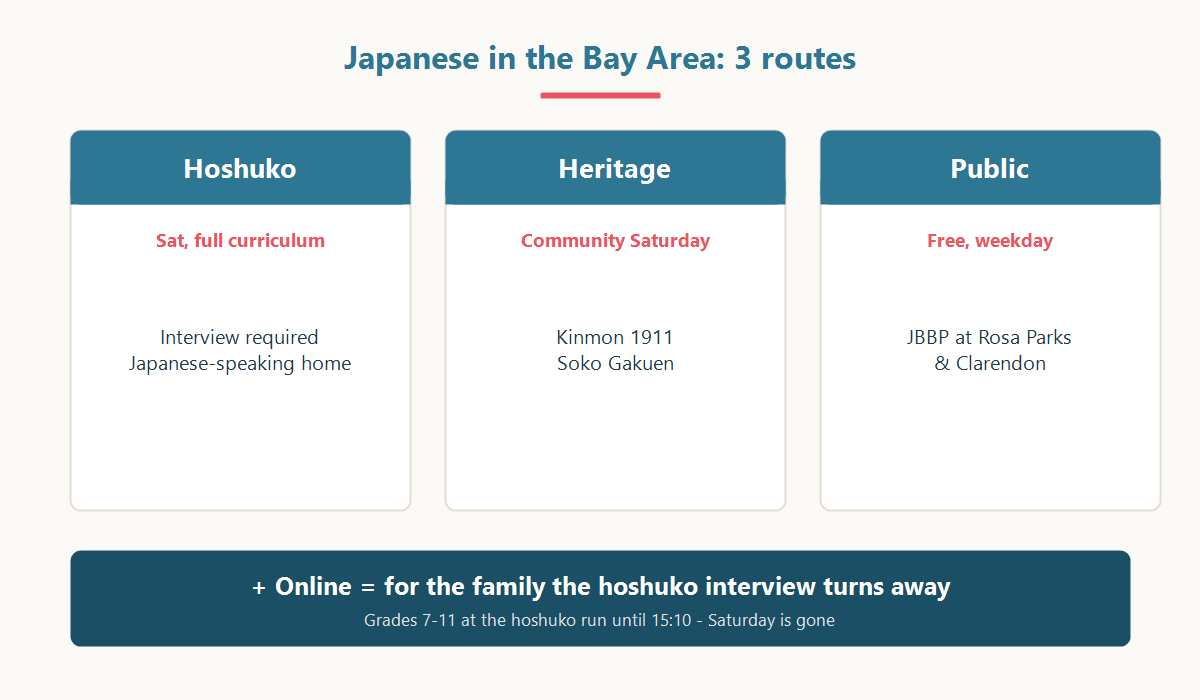
Route 1: the hoshuko — grade level in Japanese, with a real entrance gate
San Francisco Japanese School (SFJS) is a MEXT-recognised 補習授業校 and a 501(c)(3) non-profit founded in 1968, and it describes itself as the largest supplementary Japanese school in the world — about 1,400 children from Kindergarten through Grade 11, spread across four campuses. It runs 43 days a year: 38 Saturdays plus a five-day summer session. Saturday is not an hour; it is the day. Kindergarten runs 9:00–13:40, Grades 1–2 8:45–13:50, Grades 3–6 8:45–14:50, and Grades 7–11 8:35–15:10.
For a family with a genuine return to Japan on the horizon, this is the gold standard and nothing else in the Bay Area comes close. Your child stays on the Japanese national curriculum, in Japanese textbooks, at their true age level. It is also, by design, not for everyone. The school’s own FAQ says it in one line: 「いわゆる語学学校とは違います」— this is not a language school.
The eligibility bar, stated plainly, because the school states it only in Japanese. The child must be able to follow classroom instruction in Japanese. The home must be a Japanese-language environment, and parents must commit to supporting kokugo study at home. Parents also staff safety duty and school events. Screening is a document review plus a roughly 20-minute interview in which the child is asked to recognise their name, write hiragana, read hiragana words, count to ten, communicate in Japanese, follow the teacher’s instructions and work both independently and with other children. Grade 1 entry is restricted by birth date, enrolment is year-round but individual grade levels can be waitlisted, and your campus is assigned by where you live — families do not choose.
The tuition, in English, for the first time. For the 2026 year (令和8年度, page updated 12 May 2026): enrollment fee $258 per person for new and transfer students; Kindergarten $319/month; Elementary Grades 1–2 $249/month; Elementary Grade 3 through Middle School Grade 3 $271/month; High school $319/month; parent association fee $3.50/month per person; security fee $31/year. The summer intensive is billed separately at two months’ regular tuition. Billing auto-debits around the 25th, and a single day of enrolment in a month incurs the full month. That page is published in Japanese only. If you are an English-speaking parent, you cannot find those numbers — which is a large part of why this article exists. Administrative office: 22 Battery Street #612, San Francisco, CA 94111.
San Francisco Japanese School — official site
Route 2: community heritage language schools — no gate, start at zero
If your child cannot pass a hiragana interview, this is where you go, and there is no shame in it whatsoever. Kinmon Gakuen 金門学園 (Golden Gate Institute) in Japantown has been doing this since 1911 — it was founded because Japanese immigrant children were barred from public schools, closed during the war, and reopened in 1949. It teaches ages 5–18 across Beginning I, Beginning II, Intermediate and Advanced, Saturdays 9:00 AM–12:00 PM. Fall 2026 runs 29 August to 12 December 2026; Spring 2027 runs 23 January to 15 May 2027. Registration is $50, a one-time annual fee; tuition is listed at $500, with siblings at $480 for each additional child, textbooks extra. One honest caveat: the site does not make clear whether that $500 is per semester or per year, so ask before you budget. Summer 2026 is priced separately at $250 all-inclusive for three Saturdays, 10:00–12:00, ages 5–18. Crucially, there is no proficiency gate at Beginning I.
Soko Gakuen has served San Francisco since 1915 and is also a non-profit, but read the numbers before you enrol: it is predominantly an adult school, roughly 250 adults to 50 children. Classes run Saturdays 9:00 AM–12:00 PM, 33 sessions and 99 contact hours across a year that runs 5 September 2026 to 5 June 2027, with levels for Kindergarten (5–6), Beginning (6–8), Intermediate (9–11) and Advanced (12–14). Total cost is $900 for the year — $800 tuition plus $100 materials, paid as $450 in August and $450 in February, with a $20 late fee after 15 August 2026 and no application fee. The limit to know about: the age ceiling is 14. There is no high-school track.
Kinmon Gakuen — official site · Soko Gakuen — official site
Route 3: free public Japanese — the thing San Francisco has and nowhere else does
San Francisco is genuinely unusual: the public district runs Japanese programmes, and they cost nothing. Rosa Parks Elementary (1501 O’Farrell St) hosts the Japanese Bilingual Bicultural Program, K–5, with one hour of formal Japanese language and culture every day from native-speaking sensei. Be clear on what it is: this is a World Language programme (WLES), not full immersion. Proficiency is not required — the district assigns up to 10 of 44 kindergarten seats to Japanese-proficient students, with the remaining 34 open to children with no Japanese at all, and entry is through the SFUSD lottery. Clarendon Alternative Elementary also hosts JBBP, founded in 1973 by the Japanese-American community and at the Clarendon site since 1982, running 30–60 minutes three to five days a week, with all students eligible regardless of language proficiency.
The bottleneck is what happens next. Japanese continues at Presidio Middle School and Hoover Middle School, and at Lincoln, Lowell and Washington High Schools including AP — but in practice the middle-school Japanese option is essentially a single school, Presidio. Five years of daily elementary Japanese can narrow to one realistic continuation, and families who have not planned for that lose momentum exactly when their child hits the age where they most want to quit.
SFUSD — Rosa Parks JBBP · Clarendon JBBP · Northern California Japanese Teachers’ Association — full Bay Area programme list
Five Bay Area-specific things to plan around
- Your child may simply not qualify for the hoshuko — and that is a bigger group here than anywhere else. The Bay Area has two Japanese populations layered on top of each other: Silicon Valley corporate and tech families with a real return-to-Japan scenario, and a deep multi-generation Japanese-American heritage community — Kinmon Gakuen dates to 1911, and JBBP was created in 1973 by Japanese-American parents. San Francisco is the only one of these cities where the heritage community was strong enough to build its own public-school programmes. That means the “my child speaks some Japanese but cannot read at grade level” family is a large, long-established segment here. SFJS explicitly requires a Japanese-language home and a pass at interview, so a great many of those families are outside the door before they apply. Knowing that in advance saves a painful application.
- The price gap across the Bay is enormous, and it is not a quality gap. SFJS elementary works out to roughly $3,250 a year. Saniku Gakuin Santa Clara in San Jose publishes $605/month for kindergarten, $615/month for elementary and $621/month for junior high, plus $500 registration and $160 enrollment — roughly $7,400 a year for an elementary child, more than double. Soko Gakuen is $900 a year. These are different products for different children; compare what your child actually needs before you compare the invoices.
- You do not choose your SFJS campus. Campus assignment follows your home address. If you move within the Bay Area, your Saturday commute can change without you having any say in it — and with Grades 7–11 running 8:35 to 15:10, a long drive turns Saturday into a fourteen-hour operation for the whole family, siblings included.
- Saturday is the entire day, not a lesson. This is the fact families underestimate most. Elementary finishes at 14:50 and middle and high school at 15:10, before the drive home and before homework. Every Saturday sport, every birthday party, every family trip for 38 weekends of the year is negotiated around it. It is absolutely worth it for the right family. It is a genuine reason other families quietly drop out in year two.
- The middle-school cliff in the public route. If you take the free JBBP path, map the continuation before your child leaves Grade 5. Presidio is effectively the middle-school option, and if the lottery or your commute rules it out, the daily Japanese habit your child built over six years has nowhere to go. Plan the bridge early.
The online option: for the child who does not clear the gate — or needs more than one day
If your child would not pass the SFJS interview, or if one Saturday a week is not moving the needle, an online school changes the arithmetic entirely — the same idea we cover in our guide to the online alternative to Japanese hoshuko. TOMODACHI JAPAN opens in December 2026 and is built for the family the Bay Area’s existing schools were not designed around.
- The realistic California slot is Friday and Saturday evening. Be honest about the time difference: California is 16 hours behind Japan in summer, so a Japan-afternoon class lands in the middle of your night. What works is the other direction — Japan’s Saturday and Sunday morning classes fall on Friday and Saturday evening in San Francisco. That is a live, comfortable slot for a Bay Area child, it does not consume the weekend, and it does not compete with a Saturday hoshuko if you are doing both. We would rather tell you that now than sell you a weekday-after-school promise that does not exist for the US West Coast.
- The other children actually live in Japan. TOMODACHI JAPAN runs on NIJIN Academy, with 800+ students. Your child is not practising Japanese with other Bay Area kids who all default to English at the break — they are making friends their own age in Japan, which is the one thing no local Saturday school can offer and the reason a heritage child’s Japanese starts mattering to them personally.
- No entrance interview, one flat fee, unlimited attendance. One flat monthly fee for as many sessions as your child wants. Groups are small and organised by conversation level rather than school grade, so a twelve-year-old at a beginner’s level is never sitting in a room of six-year-olds. Teachers are qualified, practising Japanese teachers, and the whole thing is designed for children rather than adapted from an adult course.
A hoshuko keeps a child at grade level. Friends in Japan keep a child wanting to speak at all.
FAQ from Bay Area families
My child speaks Japanese with me but cannot read. Will SFJS accept them?
Possibly not, and it is better to know before you apply. SFJS screening includes a roughly 20-minute interview in which a young child is asked to recognise their own name, write hiragana, read hiragana words, count to ten, communicate in Japanese and follow the teacher’s instructions independently and with peers. The school also states that the home must be a Japanese-language environment and that parents will support kokugo study at home. Its own FAQ says directly that it is not a language school. If your child is a conversational-only heritage speaker, Kinmon Gakuen’s Beginning I level or Soko Gakuen will take them without a proficiency test, and an online class can add the reading practice that would eventually make the hoshuko route possible.
Why can’t I find SFJS tuition anywhere in English?
Because it is not there. The fee schedule — enrollment $258, Kindergarten $319/month, Grades 1–2 $249/month, Grade 3 through Middle 3 $271/month, high school $319/month, plus $3.50/month association fee and $31/year security fee — is published on a Japanese-language page, updated 12 May 2026 for the 令和8年度 school year. That is the single most common reason English-speaking Bay Area parents give up on the hoshuko route without ever discovering it was affordable. Confirm the current figures with the school directly before you enrol, and note that the summer intensive is billed separately at two months’ tuition.
Is the JBBP public programme enough on its own?
It is a genuinely excellent free foundation and Bay Area families are lucky to have it, but set expectations correctly. Rosa Parks provides one hour a day of Japanese language and culture and Clarendon runs 30–60 minutes three to five days a week — these are World Language programmes, not full immersion, so children are not doing maths and science in Japanese. It builds a strong start and a real cultural identity; it will not by itself produce grade-level literacy. Most families who want both use JBBP for the daily habit and add either a Saturday school or an online class for depth.
Does the time difference make an online Japanese school impractical from California?
It rules out one slot and opens another. A weekday-afternoon class in Japan is the small hours in San Francisco, so ignore anyone promising you convenient after-school lessons on Pacific time. What genuinely works is Japan’s Saturday and Sunday morning, which lands on Friday and Saturday evening in California — the end of the school week, when your child is home and relaxed. It also sits neatly alongside a Saturday hoshuko rather than clashing with it, which is why a number of Bay Area families end up doing both.