The Japanese School of Mumbai — ムンバイ日本人学校, known until 2013 as the Bombay Japanese School — charges ₹80,000 a month in tuition in the 2026–27 school year, plus a one-off entrance fee of ₹200,000 if your family comes through a corporate member of the Mumbai Japanese Association, and ₹400,000 if you are an individual member. A first year therefore costs ₹1,160,000 to ₹1,360,000, roughly US$12,300 to US$14,400. It teaches Grades 1 to 9 in Japanese in Powai, in the north-east of the city, and it had 40 pupils on 21 October 2026, up from 29 in April. Almost nothing in English says any of this: the listings we checked give no fees, an address the school left in 2011 and a headcount of 17. The school publishes no nationality rule at all. What it publishes is the two-tier fee, which ties entry to the Japanese Association, and that is the thing to ask about first.
This page is the single-school deep dive: what the Japanese School of Mumbai costs, who can realistically enrol, how a very small school works, and what English-language listings get wrong. It rests on the school’s own Japanese-language pages — the February 2026 fee notice, the enrolment table, the transfer page, its 2026 school plan and its newsletters — and on the Mumbai Japanese Association’s rules, read on 7 November 2026. Where something is not published, we say not published. India’s only other full-time Japanese school has its own page: our Japanese School New Delhi fees guide covers a school more than six times the size, at well under half the monthly price. If you are weighing postings across Asia, our Singapore Japanese School fees page follows the same format, so the numbers line up.
The short answer
| What it is | A full-time Japanese school (nihonjin gakko) teaching Grades 1 to 9 in Japanese, with teachers sent by Japan’s education ministry. Fees are paid to the Gakko Bunka Educational & Cultural Society; the notice is co-signed by the chair of the school’s management committee and the principal. No kindergarten or high school is listed |
| Where | Unit 201/202, Hiranandani Knowledge Park, Technology Street, Powai, Mumbai 400076, since February 2016. Earlier sites: Worli (from 1971) and Andheri (from April 2011) |
| Cost, 2026–27 | Tuition ₹80,000 a month (₹960,000 a year), all grades. Entrance fee once: ₹200,000 for a Mumbai Japanese Association corporate member, ₹400,000 for an individual member. Paid in rupees, once a year in April, or twice in April and October |
| Who it takes | No written eligibility rule is published, and no nationality wording. The school describes its pupils as Grade 1 to 9 children living in Mumbai. The fee notice only prices association members; every subject but English is taught in Japanese |
| Size | 40 pupils on 21 October 2026 (33 primary, 7 junior high), against 29 in April 2026 and 34 in April 2025. Grades range from 2 to 10 children |
| The real catch | A full month is billed for any part of a month, and school breaks and home leave are charged in full. Grades 7 to 9 had seven pupils between them this October. And the school stops at Grade 9 |
Looking for a way to keep Japanese going from abroad?
TOMODACHI JAPAN is an online Japanese school for children growing up outside Japan. They talk with peers their own age in Japan every day, taught by teachers working at Japanese schools, in small classes of 8.
🎁 Register and we’ll email you our School Guide (PDF, in English) straight away. You’ll also be first to hear about tuition, scholarships and opening dates.
Free · takes about 30 seconds
First, which school do you actually mean?
The old name causes most of the confusion: “Bombay” is still attached to this school and to an unrelated American one.
| Name you will see | What it actually is | Language and ages | Where |
|---|---|---|---|
| Japanese School of Mumbai, japanese-school-of-mumbai.jimdoweb.com | The full-time Japanese school this page is about. Japan’s curriculum, a year starting in April | Japanese; Grades 1–9 (ages 6–15) | Powai |
| Japanese School of Bombay, Bombay Japanese School, “BJS” | The same school. It changed its name on 1 April 2013, but “BJS” survives on the crest, in its email domain and in the title of its school plan. A Justdial listing under the old name still shows Andheri East and files it under corporate language classes | As above | Powai, not Andheri |
| American School of Bombay (ASB) | No connection. An American and IB international school — though some of the Japanese school’s graduates do move on to it | English; Pre-K to Grade 12 | Kurla and Bandra-Kurla Complex |
| Japanese School New Delhi | India’s other full-time Japanese school, a separate institution about 1,400 km away | Japanese; Grades 1–9, plus a kindergarten | Vasant Kunj, Delhi |
| Chennai and Bengaluru Japanese Supplementary Schools | Saturday hoshuko designated by Japan’s foreign ministry. We found none in Mumbai | Japanese; Saturdays | Chennai, Bengaluru |
One practical point. Wikipedia and the association’s links page both send you to an older jimdo.com address, which would not connect from our network on the day we checked. The site answers at jimdoweb.com. If the school’s page “does not load”, that is the first thing to try.
What it costs in 2026–27: ₹80,000 a month, and ₹200,000 to enter (double for individual members)
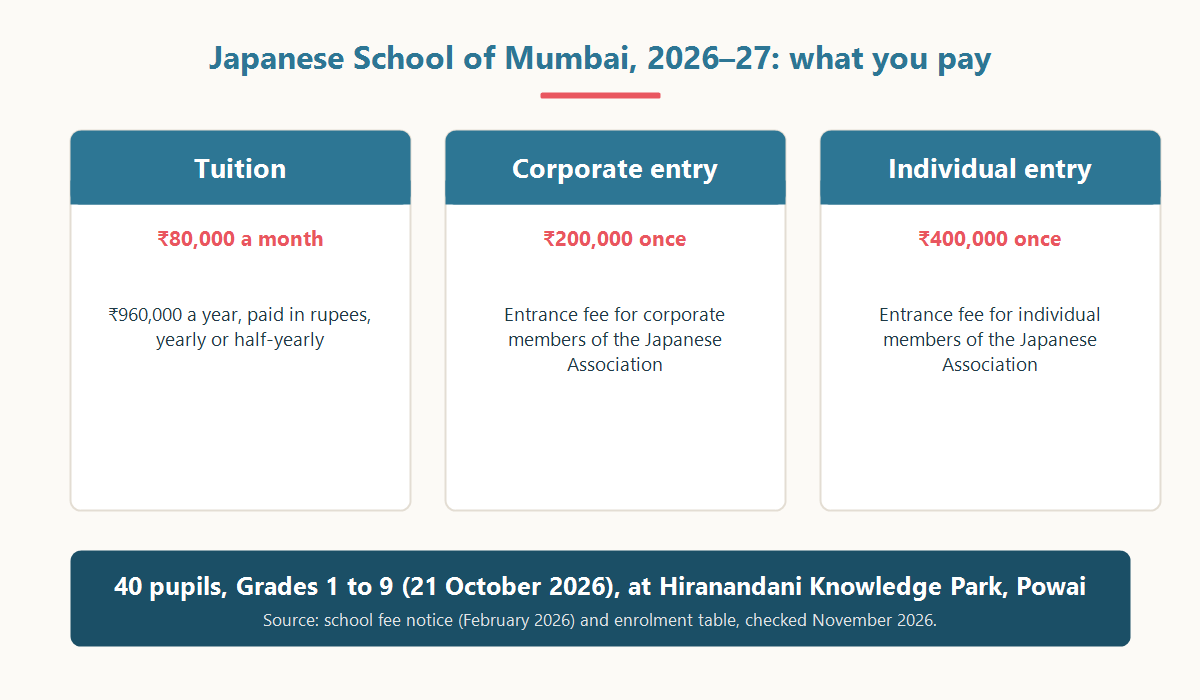
The figures come from a notice to parents dated February 2026, for the school year from April 2026 to March 2027. Tuition is a single flat rate; the notice does not vary it by grade. The only thing that varies is the entrance fee.
| Item | Corporate member family | Individual member family |
|---|---|---|
| Entrance fee (once, new and transferring pupils) | ₹200,000 | ₹400,000 |
| Tuition (monthly) | ₹80,000 | ₹80,000 |
| Tuition per year | ₹960,000 | ₹960,000 |
| First payment at an April entry (entrance + six months) | ₹680,000 | ₹880,000 |
| First year | ₹1,160,000 (about US$12,300) | ₹1,360,000 (about US$14,400) |
| Mumbai Japanese Association dues (2024 rates, yearly) | The company pays, from ₹22,000 for one Japanese staff member | ₹1,000 per person |
In US dollars, at about 94.5 rupees, tuition is roughly US$846 a month or US$10,200 a year. In yen it is about ¥134,000 a month. That is high for a Japanese school. New Delhi charges ₹31,000 a month, so Mumbai is 2.6 times the price, and New Delhi’s entrance fee of ₹300,000 sits between Mumbai’s two. Singapore’s fees start at S$817.50 a month, about ₹60,500. The likely reason is arithmetic rather than ambition: 40 families carry what several hundred share elsewhere. The school does not publish its accounts, so that is our reading, not its statement.
Five things are worth knowing about how these numbers behave:
- Part of a month counts as a month. The notice treats any month with fewer teaching days as a full one. Join on the 28th and you pay that whole month.
- Breaks and home leave are billed in full. The notice says so explicitly, citing the school’s financial rules. Six weeks in Japan over the summer saves nothing.
- Leaving is cleaner than joining. Tuition is refunded from the month after the month you leave, less the bank charge. The entrance fee is not mentioned in the refund clause, so assume it is gone.
- A year or a half-year up front. Pay once in April, or twice: April for April to September, October for October to March. Bank transfer or cheque; the entrance fee is added to the tuition payment.
- English invoices on request. The notice offers invoices and receipts in Japanese or English, which is what most company relocation desks will want.
Several things are not published: any sibling discount, what happens to the entrance fee for a family that belongs to neither member category, any transport charge, the cost of school trips, and the amount of what the notice calls operating costs. That last one matters. The billing clause speaks of “tuition and operating costs”, yet only tuition carries a figure, so ask whether the ₹80,000 includes everything. We also cannot give you a fee history: the only older figure we found is a Japanese directory’s ₹120,000 a month for 2022, which we could not match to any school document.
Is it expensive for Mumbai? Less obviously than the comparison with Delhi suggests. A 2026 third-party guide puts tuition at Mumbai’s IB and Cambridge schools at roughly ₹500,000 to ₹1,200,000 a year in the primary years and up to ₹2,200,000 for the IB Diploma, before their own one-off charges. Those are indicative ranges, not school figures. Even so, unlike in Delhi, the Japanese school here sits inside the international-school range, so the decision is rarely about price alone.
Who can enrol: no published rule, but a fee built around the Japanese Association
Every Japanese school sets its own rules, and this one does not state them. There is no eligibility page, no nationality wording and no language test on the site. New Delhi, by contrast, spells out its conditions. Here you have to read the rule from three documents.
- The school profile describes pupils as Grade 1 to Grade 9 children living in Mumbai. It says nothing about passports.
- The fee notice prices the entrance fee for two kinds of family only: corporate members and individual members of the Mumbai Japanese Association. A family outside both has no published price.
- The transfer form asks for the child’s current school, the name of the flat you will move into and your company. It is written for a family arriving on a posting from Japan.
The association’s own rules (Article 4) then show who sits where, and this is where nationality enters:
| Association category | Who qualifies, in the rules | Entrance fee in the school’s notice |
|---|---|---|
| Corporate member | A company or body funded and run from a head office in Japan. Japanese staff sent from head office must join through it, whatever the size of the Japanese stake | ₹200,000 |
| Corporate-affiliated individual | Japanese nationals at a corporate member, and their accompanying family | Not named separately; presumably the corporate rate — confirm |
| Individual member | Japanese nationals living in the consular district who are not in the category above — for example, we would expect, the self-employed, local hires and people married into India | ₹400,000 |
| Associate member | Among others: a spouse or child of a member who holds a non-Japanese nationality, adult Japanese students, and anyone else the president approves | Not published |
What that means in practice:
- A family posted by a Japanese company is the case the system is built for, at the lower fee.
- A Japanese parent on a local contract, or married to an Indian spouse, appears to be an individual member at double the entrance fee. Your child’s other nationality is anticipated by the association’s rules, not ruled out.
- A family with no Japanese parent is not addressed anywhere. Nothing we read admits or excludes such a child. We would not assume either; email the school before planning around it.
- Pune and Ahmedabad are carved out of the association’s territory, and Pune has its own association. A family there has no obvious route into either fee category, on top of the distance.
Language is the other test, and it is a practical one. No exam or interview is published, but lessons run in Japanese from Japanese textbooks, with English the exception. A child two years behind in reading has no parallel stream to drop into at a school of 40. Parents need Japanese too: the site, the notices and the information session are all in Japanese.
The mechanics are published in detail:
- April entry. The notice for April 2025 asked for the information form by 3 March. For April 2026 there was an online information session for prospective parents on 19 February, at 3:30 p.m. India time (7 p.m. in Japan), with sign-up by 13 February; that notice was dated 16 December 2025. The notice for April 2027 was not yet posted when we checked, so watch the home page from December.
- Any other time. Send the form at least one month before your intended start. No rule closes entry for any grade; unlike New Delhi, the school publishes no April-only limit for Grade 9. Ask anyway.
- Documents. A new Grade 1 child needs none. A new Grade 7 child brings three from their primary school: guidance record copy, health record, dental record. A transferring child brings five from their current school: proof of enrolment, those three records, and a textbook certificate.
- Textbooks come from Japan. They are handled by the Japan Overseas Educational Services (JOES) in Tokyo and Osaka, so sort this out before you fly. A transferring child checks the certificate against the school’s list: same books, bring your own; different books, collect them from JOES.
How it works: nine grades, 40 children, and most of Mumbai as the campus
The school runs its own count from the 1960s: it called its April 2026 opening ceremony the 61st. It describes 40 years at Worli from 1971, a move to Andheri in April 2011 and a move to Powai in February 2016. The current home is two unit numbers in the Hiranandani Knowledge Park, which a 2019 report describes as a large building in an area of hospitals and schools near Powai Lake. In other words, this is not a campus with a field. The school’s plan shows how it fills the gap.
| What | What the school publishes |
|---|---|
| Enrolment, 21 October 2026 | Grade 1: 6. Grade 2: 2. Grade 3: 6. Grade 4: 4. Grade 5: 5. Grade 6: 10. Grade 7: 3. Grade 8: 2. Grade 9: 2. Total 40 (22 boys, 18 girls) |
| Staff | In April 2025: nine teachers sent by Japan’s education ministry, four Indian staff and four Indian instructors, for 34 pupils. The 2026 staff letter is withheld from the site for privacy |
| Sport | Swimming five times in April and May at a hotel pool. Outdoor PE in November, December and February at an outside sports venue, in the last period of the day. Yoga ten times a year with an Indian instructor |
| English | English conversation lessons, grouped as Grades 1–2, 3–6 and junior high, with trips to practise shopping and questions; Eiken preparation; an after-school English Club; content-and-language lessons |
| Eiken, after the first 2026 sitting | Grade 2: two children (one in Grade 6, one in Grade 9). Pre-2: three. Grade 3: one. Grade 4: seven. Grade 5: one |
| India in the week | Grades 5–9 go on a June school trip towards Bangalore. Grades 5–6 made a field visit to Dharavi in October 2026. Indian dance for the November showcase, held on 6 November this year; exchanges with Indian and international schools; talks by Japanese companies, and a tour of a car carrier with NYK |
| Daily life | A packed lunch every day. No uniform on the supplies list, but PE kit, indoor shoes and ceremony clothes. The school provides all notebooks. Parents supply the rest, including recorder, calligraphy set and paints |
| Calendar | Withheld. The annual schedule is not published “for crisis management”; ask the office. Terror-response and fire drills are held, the former in April 2026 with a consular officer leading |
Two things in that table deserve a second look. The English provision is more serious than parents expect from a Japanese school: a Grade 6 child at Eiken Grade 2 is well ahead of the usual pace in Japan, though the page lists only 14 children and a child’s earlier schooling abroad may explain some of it. And the size of a grade changes everything. A Grade 6 child here has nine classmates this year; a Grade 8 child has one. The school presents its size as a strength, with juniors and seniors learning together in a family atmosphere; which side you feel depends on your child.
What happens after Grade 9 is unusually well documented. The school lists 19 high schools in Japan that recent graduates have entered, unordered and undated, including the high schools attached to the University of Tsukuba and Osaka Kyoiku University, ICU High School, Meiji University Meiji, Doshisha International, Ritsumeikan Keisho and Toshimagaoka, and public schools such as Koishikawa in Tokyo and Shonan in Kanagawa. Outside Japan it names two: the American School of Bombay and Waseda Shibuya Singapore. There is no count of how many children went where.
Getting there is the big unknown. The school publishes nothing on a bus or on transport costs; its February session had an item on “going to and from school” that the notice does not explain. A Japanese directory from 2022 says all children were driven by car. Treat that as a lead, not a fact, and put the question to the school before you sign a lease in Powai, Bandra or Lower Parel. Morning traffic across Mumbai will decide more of your child’s day than the timetable will.
The honest review: what the English pages leave out
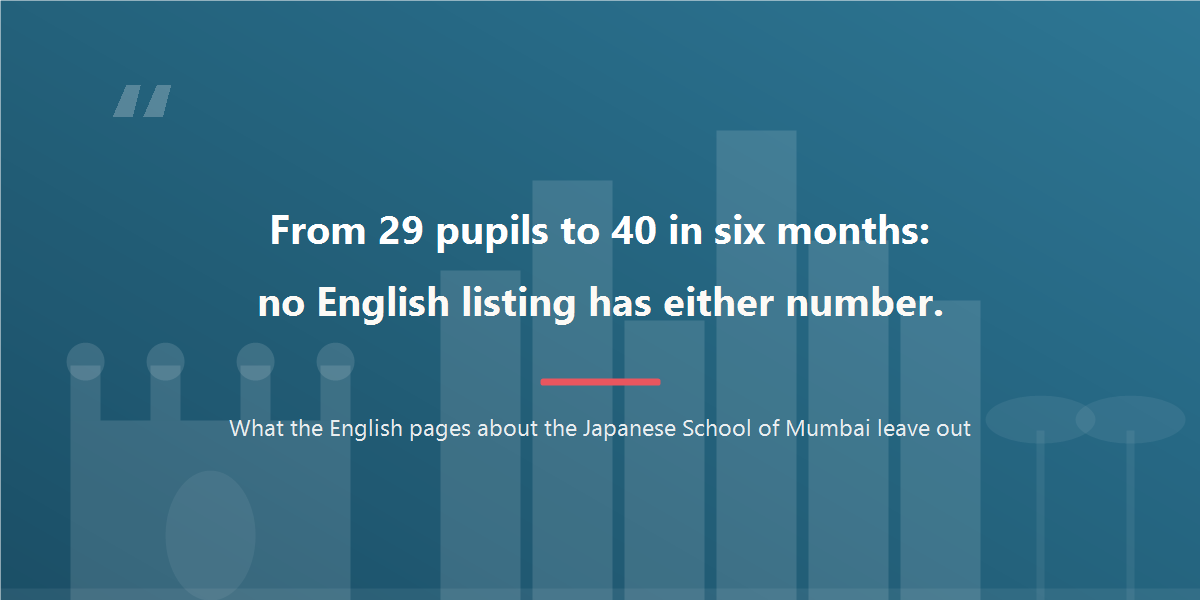
People search for “Japanese School of Mumbai reviews” hoping to hear from parents. To be straight about it: we found no verifiable English-language parent reviews. A Justdial listing under the old name, in search results, shows a 3.8 rating from nine ratings, at the Andheri address the school left in 2016. The one Japanese directory with parent comments cites a survey it ran itself, from 2022. What we can do is check English pages against what the school publishes.
1. “Fees: 0 to 0.” The school does publish them
The ISBI Schools profile lists day fees of “0 to 0” and zero pupils, and describes the school as for girls. Powai school directories do not price it at all. In fact a notice sits on the school’s site under “tuition and entrance fees”, in Japanese. The Japanese directory Kaigai School Jiten has the entrance fees right but gives tuition of ₹120,000 a month for 2022, half as much again as today’s official figure. We could not confirm it from any school document, so do not budget from it.
2. Worli Sea Face, Andheri East, Powai: only one is current
ISBI still gives 7-17 Worli Sea Face, which the school left in 2011. Justdial gives Andheri East, which it left in February 2016. The school’s May 2026 newsletter carries the address on its masthead: Unit 201/202, Hiranandani Knowledge Park, Technology Street, Powai.
3. “The number of students was 17.” It has been 48 and 29 since
The English Wikipedia entry gives 17 pupils in 2008 and an uncited 30 in 2017. Dated figures show how much this school moves: 48 in September 2019 (a field report), 31 in the 2022 school year (the directory), 35 in April 2023 (Japanese Wikipedia, citing the school), 34 in April 2025, 29 in April 2026 and 40 on 21 October 2026. Even the school’s own profile and principal’s message give April’s 29; only its table has the October number. Eleven extra children in six months means more than a third more classmates. The school does not explain the rise, and a change of that size can reverse as quickly as it came.
4. “The Japanese government funds the school.” Parents get the bill
Wikipedia’s line, drawn from a 2008 newspaper article, suggests a state school. Japan does send teachers — nine of them in April 2025 — but families are invoiced ₹960,000 a year by a society with its own financial rules and a management committee. How the budget divides between the two is not published. The same entry dates the name change to April 2014; the school says 1 April 2013. And it gives 1966 as the founding year where Japanese Wikipedia gives 1971. The two can be reconciled: the school counts this year’s ceremony as its 61st, which points to the 1960s, and dates its Worli years from 1971.
5. Nobody says who gets in, including the school
Listings reach for “serves Japanese expatriates”. That describes most of the families but is not a rule we can find. The real signal is the fee notice, which doubles the entrance fee between two kinds of association member and is silent on everyone else, read with the association’s rules, which do anticipate members’ non-Japanese spouses and children. An Indian-Japanese family is not excluded on paper, but the price and the process are unclear. Get the answer in writing, including which category applies to you, before you count on a place or a budget.
6. What parents say — and what to ask
The directory’s 2022 comments, from a survey it conducted, are the nearest thing to a review: teaching was largely individual, “a bit like Kumon”, and security made it hard to let children roam freely. That is old, anonymous and thin. Then ask what the pages do not answer:
- Which grades share a class, and how many children will be in my child’s grade next April? Only this year’s count is published.
- What are the transport options from our area, and what do they cost? Not published.
- Which entrance fee applies to us, and does ₹80,000 include operating costs? Only the amounts are stated.
- Can you take a child who needs learning support? Not published.
- For a mixed family or one with no Japanese parent: are we eligible, and in what category? Ask before you plan around it.
Other options in Mumbai
If your child cannot follow a Japanese school day, if your family does not fit the association’s categories, or if Powai is simply too far, these are the routes that remain — and the one that is missing.
| Option | Who it takes | What to know |
|---|---|---|
| A Saturday Japanese school (hoshuko) | — | We found none in Mumbai or Pune. The foreign ministry’s designated schools in India are in Chennai and Bengaluru. Our guide to finding a Japanese Saturday school explains what they offer where they exist |
| The school’s open library days | Children and parents not enrolled at the school | A small but real resource. Three Saturdays a school year, 10 a.m. to noon, with books lent for a month. The next listed date is 16 January. Older notices addressed association members, so ask if you are not one |
| American School of Bombay | Pre-K to Grade 12. Indian nationals must meet a separate test: coming from, and returning to, an American or international system | IB World School, over 50 nationalities, rolling admissions, campuses in Kurla and Bandra-Kurla Complex. Fees not on its public admissions pages. Japanese provision is not stated on the pages we read. Oberoi International and Dhirubhai Ambani International are among the other options |
That gap is the thing to plan around. In Kuala Lumpur and Jakarta the full-time school is a large institution, and there is a sizeable community around it. Mumbai has a small full-time school and then very little. The child at an international school in Bandra whose Japanese reading is slipping, and the family in Pune or Navi Mumbai with no way to Powai every morning, have no Saturday class to catch them.
How to choose, in four questions
- Which association category are you in? It decides whether you pay ₹200,000 or double, and if you are in none of them it decides whether to write to the school before anything else.
- How many children are in your child’s grade? Ten and two are different schools. Junior high is the thinnest part: seven children across three grades this October. If your child is 11 or older, ask what next April looks like.
- Where will you live? Powai itself makes the school easy. Anywhere south of Bandra means a long drive twice a day through Mumbai traffic, with transport arrangements you have to confirm yourself.
- Who pays, and how long are you staying? On a company package, ₹1,160,000 in the first year may be covered in full. Paying yourself, ₹1,360,000 for the first year on a two-year stay is a lot of money for a sunk entrance fee, and it is worth pricing the international schools properly. If high school in Japan is the goal, the graduate list makes the case for staying on the Japanese curriculum.
Where TOMODACHI JAPAN fits
We are not a substitute for the Japanese School of Mumbai, and if your child can follow a Japanese school day and is heading back to a school in Japan, we would point you there. We exist for the families the four questions above leave stuck — the child at an international school in Bandra whose Japanese is slipping with no Saturday school to catch it, the family in Pune or Navi Mumbai out of range of Powai, and the child with one classmate who has never had a group of Japanese friends of their own age.
- Japanese friends of the same age, every day. Classes with children the same age in Japan — not only other learners in India. The reason children keep going is usually the other children.
- Teachers working at Japan’s current classroom standard — about 2% of applicants are hired. Not a syllabus written abroad and not a tutoring marketplace.
- Small classes of eight children. Enough to be a class, few enough that every child speaks every lesson.
- India is three and a half hours behind Japan, all year. There is no daylight saving to adjust for. An evening class in Japan at 7 p.m. would land at 3:30 p.m. in Mumbai, and one at 8 p.m. at 4:30 p.m. — around the time an international-school day ends, before the evening is gone.
- Unlimited classes for a flat monthly fee. Tuition, scholarships and opening dates are in our free school guide, which we email to everyone who registers, with no obligation. We plan to open with a pilot intake in December 2026.
If what you are really missing in Mumbai is a Saturday school, our guide to online alternatives to a Japanese hoshuko sets out what an online class can and cannot replace.
Frequently asked questions
How much are the Japanese School of Mumbai fees?
For 2026–27, tuition is ₹80,000 a month (₹960,000 a year) at every grade, plus a one-off entrance fee of ₹200,000 for a corporate member of the Mumbai Japanese Association and ₹400,000 for an individual member. The first year comes to ₹1,160,000 to ₹1,360,000, roughly US$12,300 to US$14,400. Fees are paid in rupees, once a year or in two half-year instalments. Transport is not priced anywhere the school publishes.
Does my child need a Japanese passport?
The school publishes no nationality rule, either way. Its fee notice prices only families in the Mumbai Japanese Association, whose rules cover Japanese nationals, their accompanying families, and, as associate members, members’ spouses and children of other nationalities. Lessons are in Japanese. If your family has no Japanese parent, nothing published answers the question, so email the school directly.
Is the Japanese School of Bombay the same school?
Yes. It became the Japanese School of Mumbai on 1 April 2013; “BJS” still appears on its crest and email address. It has nothing to do with the American School of Bombay. The address is now Unit 201/202, Hiranandani Knowledge Park, Powai, not Worli or Andheri as older listings say.
Can we join in the middle of the year?
Yes, the school asks for its information form at least one month before your intended date. For April 2025 the deadline was 3 March. Tuition starts from the month you arrive, charged in full whichever day you join. Collect textbooks through JOES in Japan before you leave.
Is there a kindergarten or a high school?
The school lists Grades 1 to 9 only. New Delhi has an attached kindergarten; we found no equivalent here. After Grade 9, the school’s list of recent destinations names 19 high schools in Japan, plus the American School of Bombay and Waseda Shibuya Singapore.
Sources
- Japanese School of Mumbai (Japanese-language pages): Tuition and entrance fees (notice dated February 2026), Enrolment table (21 October 2026), School profile, Transfer procedure, 2026 school plan, Eiken results, Graduates’ destinations, Newsletters (April 2025, May 2026), Open library days, Annual schedule (withheld), Home and information-session notices; also the principal’s message, supplies list and 2026 blog on the same site
- Mumbai Japanese Association: Rules and accounting rules, Joining, Links
- American School of Bombay: Admissions, ASB Essentials. Ministry of Foreign Affairs of Japan: overseas education page and list of designated supplementary schools
- Third-party pages checked: Wikipedia (English); Wikipedia (Japanese); ISBI Schools; Kaigai School Jiten (November 2022); Namaste Saree field report (September 2019); iSchoolAdvisor fee guide (2026, seen via search results); a Justdial listing (seen via search results). All checked 7 November 2026