The Portland Japanese School — ポートランド日本人学校, PJS — charges $220 a month in tuition for primary pupils in the 2026–27 school year, plus a one-time $115 entrance fee, and the Saturday school bus is included in that price. Families whose employer belongs to the Japanese Business Association of Portland pay less: $185 a month and $70 to join. Despite the name, it is not a full-time school. It is a Saturday supplementary school (hoshuko) that rents Hazelbrook Middle School in Tualatin for lessons, keeps its office in Beaverton, and teaches only Japanese language and maths, from a one-year kindergarten to Grade 12, to about 330 children. The point most English pages miss is who gets in: every child sits an entrance test in Japanese, the school says in writing that it is not a language school, and there is no heritage or beginner class.
This page is the single-school deep dive: what the Portland Japanese School costs, who can enrol, how a PJS Saturday works, and what English-language listings leave out. Everything comes from the school’s own Japanese-language website, its fee table and its 2027 admissions notice, read on 31 October 2026. Where something is not published, we say not published. If you are comparing Pacific Northwest options, our page on the Japanese Saturday school in Seattle shows how the same model works three hours up I-5.
The short answer
| What it is | A Saturday hoshuko teaching Japan’s national curriculum in Japanese language (kokugo) and maths only. Founded in August 1971 by 25 Japanese companies; run today by the Japanese Business Association of Portland (the “Shokookai”) through its Board of Education |
| Where | Lessons at Hazelbrook Middle School, 11300 SW Hazelbrook Rd, Tualatin, Oregon 97062, on Saturdays. Office at Park Plaza West, Suite 600, 10700 SW Beaverton-Hillsdale Hwy, Beaverton, Tuesday to Friday |
| Cost, 2026–27 | Primary tuition $220 a month (general) or $185 (Shokookai member). Entrance fee $115 or $70, once. School bus, operating and security costs included. High school $250 a month general |
| Who it takes | Children who can follow lessons taught in Japanese, with parents who can read the school’s Japanese notices, check homework every week and volunteer. No nationality rule is published. Every new pupil sits an interview and a test |
| Grades | One kindergarten year (the year before Grade 1), Grades 1–6, junior high 7–9 and high school 10–12 |
| Size | About 330 pupils, kindergarten to high school, according to the school’s home page (undated) |
| The real catch | It is a school for children already working in Japanese at grade level. There is no class for learners, a retention policy for children who fall behind, and a waiting list when grades are full |
Looking for a way to keep Japanese going from abroad?
TOMODACHI JAPAN is an online Japanese school for children growing up outside Japan. They talk with peers their own age in Japan every day, taught by teachers working at Japanese schools, in small classes of 8.
🎁 Register and we’ll email you our School Guide (PDF, in English) straight away. You’ll also be first to hear about tuition, scholarships and opening dates.
Free · takes about 30 seconds
First, which school do you actually mean?
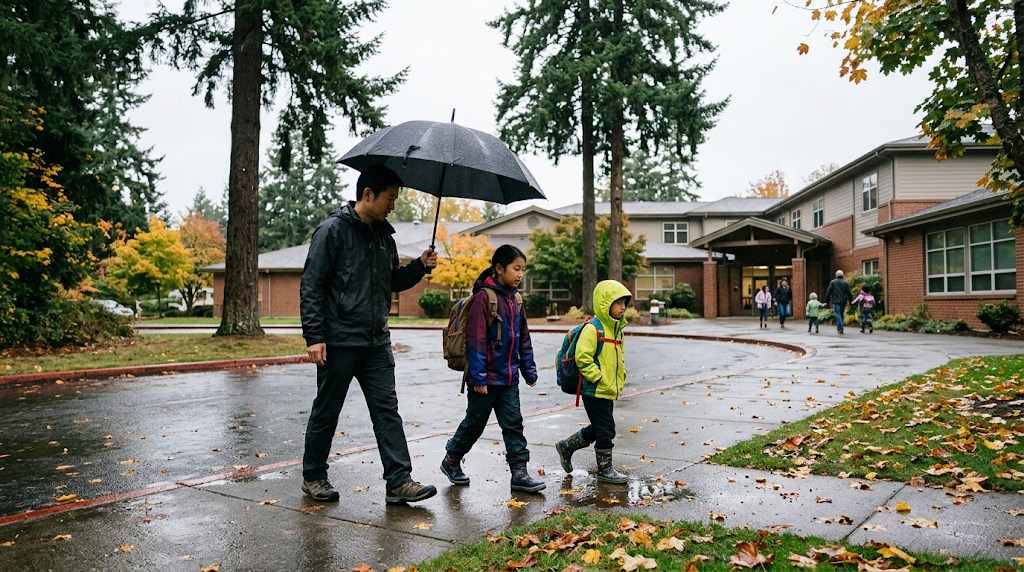
Type “Japanese school Portland Oregon” into a search box and three very different things come back under similar names. One is a Saturday school for children who already speak Japanese; the other two are weekday schools that teach Japanese to children who mostly do not. Search suggestions even mix them up — “portland japanese immersion school” sits next to “portland japanese school tualatin”. Here is the map.
| Name you will see | What it actually is | Language and ages | Where |
|---|---|---|---|
| Portland Japanese School / PJS, pjs.shokookai.org | The Saturday hoshuko this page is about. Japanese language and maths from Japan’s curriculum, taught in Japanese, one day a week. Monthly tuition | Japanese; kindergarten year to Grade 12 | Hazelbrook Middle School, Tualatin (Saturdays); office in Beaverton |
| Shokookai / Japanese Business Association of Portland | The same school under its operator’s name. Some local guides list the Saturday school only as “Shokookai” | — | Beaverton office |
| Japanese immersion at Richmond Elementary (Portland Public Schools) | A free public dual-language programme: half the school day in Japanese, half in English, Oregon curriculum. Entry by the PPS school-choice lottery. Continues at Mt. Tabor Middle and Grant High | Japanese and English; K–12 pathway | Southeast Portland |
| International School of Portland, Japanese Track | A private weekday school with full Japanese immersion and the IB Primary Years Programme, since 1995 | Japanese with English; preschool to Grade 5 | Portland |
The practical difference is direction. Richmond and the International School take children who are learning Japanese and build it up over years. PJS takes children who already have Japanese and keeps them level with classmates in Japan, so that a return to a Japanese school is not a shock. A child from an English-speaking home with no Japanese belongs at the first two; a child who chats in Japanese at home but has never read a Japanese textbook may not pass the PJS test. If immersion is what you are weighing, our overview of Japanese immersion schools in the US covers how Portland’s lottery compares with Seattle’s.
What it costs in 2026–27: $220 a month, $115 to join
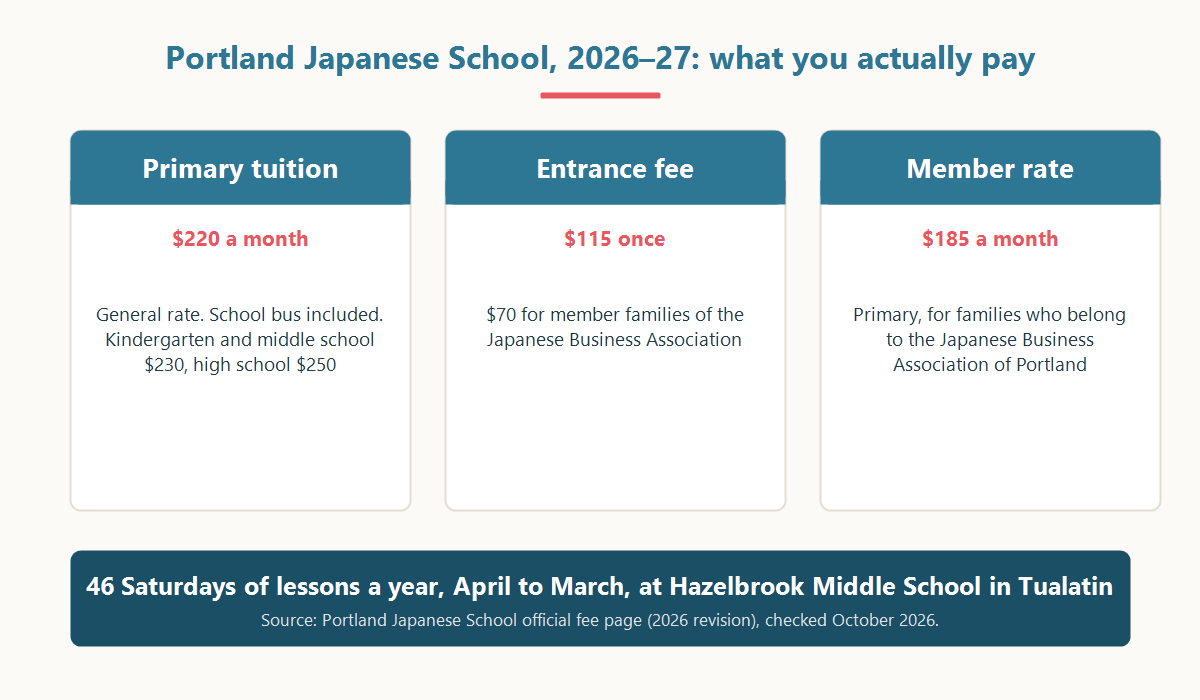
PJS follows the Japanese school year, so its “2026” year runs from 11 April 2026 to 20 March 2027. The fee table on its home page carries the note that it applies from that year, after a revision. There are two price columns: “general” and “Shokookai member”, meaning families connected to a member company of the Japanese Business Association of Portland. The application form asks which you are.
| Division | Entrance fee, general | Entrance fee, member | Tuition per month, general | Tuition per month, member |
|---|---|---|---|---|
| Kindergarten (one year) | $65 | $45 | $230 | $195 |
| Primary (Grades 1–6) | $115 | $70 | $220 | $185 |
| Junior high (Grades 7–9) | $115 | $80 | $230 | $195 |
| High school (Grades 10–12) | $115 | $100 | $250 | $215 |
What the table does not say is how many months a year are billed. Lessons run in every month from April to March, including July and August, so if tuition is charged twelve times a primary year comes to $2,640 at the general rate and $2,220 for members; with the entrance fee, a first year is about $2,755 or $2,290. Treat those as our arithmetic, not the school’s figures, and ask the office for the billing schedule. On the 2026–27 calendar there are 46 lesson days, so the general rate works out at roughly $57 a Saturday for a full day of teaching, bus included.
Three things about these numbers that a one-line fee would not tell you:
- The member discount is about the employer, not nationality. The gap is $35 a month on primary tuition, 16%, and $45 on the entrance fee. A family posted by a Japanese company in the association pays the lower column; a locally hired, mixed-nationality or long-settled family usually pays the general one.
- The bus is in the price. The school says school-bus, operating and security costs are all included in tuition. That is unusual among US Saturday schools, where a bus, if there is one, is normally an extra. The route list is not published; parents walk children to the stop and wait until it leaves.
- High school costs more, and kindergarten costs more than primary. Kindergarten is $230 a month for one year; high school $250. Workbooks handed out by teachers are charged at cost on top, and dictionaries, notebooks and stationery are bought by families from a published list.
Not published: any sibling discount, the payment method, and whether an employer can be invoiced directly. The withdrawal rule is published: a form at least two weeks before the last day, with no backdating. Pupils arriving from Japan should collect free overseas-edition textbooks from the Japan Overseas Educational Services (JOES) in Tokyo before they fly; Japanese-government textbooks for primary and junior high are otherwise supplied through the Consular Office of Japan in Portland and the school board.
Is it expensive? It depends on the yardstick. Up the coast, the Vancouver Japanese Language School charges C$1,449 a year for its primary classes, so a twelve-month PJS year at the general rate costs more — but it buys a full Saturday of teaching with the bus included. Our Los Angeles Saturday-school page shows how fees vary across California’s schools. Against weekday options it is a different kind of purchase: Richmond’s public immersion programme is free, and the International School of Portland charges private-school tuition for five days a week.
Who can enrol: a Japanese test for every child, and five conditions for the parents
This is the section that matters most, and the one no English page covers. The admissions page lists five conditions. Translated closely, a child is eligible if:
- the child can understand lessons taught in Japanese and has basic daily habits in place;
- the parents understand the school’s shared principles;
- the parents can accurately understand the school’s communications in Japanese;
- the parents can check and help with the homework set every week;
- the parents can take part in volunteer work, including school events.
Three of the five are about the parents. In a household where only one parent reads Japanese, that parent becomes the school’s point of contact for notices, homework checks and volunteer shifts. The school’s management policy goes further: it calls the school a place where Japanese is “the means of running lessons”, says plainly that it is “not a language school whose final aim is teaching Japanese”, and asks families of kindergarten and lower-primary children whose Japanese is weak to rebuild the Japanese at home.
Starting in kindergarten or Grade 1 (April 2027). The routes are fixed by date, and the notice says the tests run on these dates only:
- Information session: Saturday 9 January 2027, 9:45–10:50 a.m. (doors 9:30) at Hazelbrook Middle School. Parents only — children are not admitted. Sign up by online form; walk-ins accepted. You hand in the application form and book a test slot here.
- Grade 1 entrance test: Wednesday 27 January 2027 at the Beaverton office (backup date 3 February). Eligible: children born on or before 1 April 2021.
- Kindergarten entrance test: Friday 5 February 2027 at the Beaverton office (backup 12 February). Eligible: children born on or before 1 April 2022, entering the single year before Grade 1.
Note what the Japanese school year does to an American child. A child born in, say, October 2020 starts PJS Grade 1 in April 2027 while halfway through American kindergarten, and the weekday entrance test falls on a school day. Plan the January dates now.
Transferring into any other grade, or mid-year. “Everyone”, the page says, sits a principal’s interview and a written test in Japanese language and maths before a place is confirmed. Depending on the result the school may propose a grade below the child’s age, and if the grade is full the child goes on a waiting list. The steps: fill in the application form, send it as a PDF by e-mail to pjs@shokookai.org, and the office will arrange a test date.
What the pages do not require is as important. There is no nationality condition anywhere on the site, and no requirement to be in the US temporarily: the application form simply asks whether the child came from Japan or was born in the US. Nor is there a heritage-language class, an “international class” or a beginners’ stream, which some other US Saturday schools run. The gate is the test.
How it works: a full Saturday in Tualatin, two subjects, homework every week
The Japanese Business Association of Portland owns the school; its Board of Education runs it, setting the budget (approved by the association’s board), hiring and paying teachers and managing everything else. The principal, Tomoyuki Goto, sets this year’s slogan as “clever, strong, beautiful — a school of smiles and inspiration”. Teachers are hired locally and must already hold US work authorisation; a teaching licence is preferred but not required.
| What | What the school publishes |
|---|---|
| The day | A full Saturday, not a morning: homeroom, five periods with a mid-morning break, lunch and a reading or self-study slot. Kindergarten has four group activities, including gym. Exact times are not published; teachers work 8:45 a.m. to 4:30 p.m. |
| Subjects | Japanese language and maths only, from Japanese-government textbooks and the national Course of Study. Parents ask every year for more subjects; the school declines so that two are done properly |
| Homework | Set every week. The school assumes planned home study and treats Saturday as checking and deepening it |
| Retention | A formal policy: a pupil well below the expected level may repeat a year, with early warning to the family |
| Getting there | School bus included in tuition; a bus-committee parent at each stop; families bring children to the stop |
| Lunch | Packed lunch, eaten only in the cafeteria; no peanuts or other allergens |
| Calendar, 2026–27 | 46 lesson days. First day 11 April 2026; sports day 20 June; closed 27 June, 4 and 11 July, then lessons through late July and August; first-term test and bazaar 12 September; parent conferences into October; open classes 31 October, 7 and 14 November; second-term test 27 February; graduation 20 March 2027 |
| Enrolment | About 330, kindergarten to high school (home page, undated) |
Two features deserve a closer look. The first is the summer. Because PJS keeps Japan’s calendar, it breaks for only three Saturdays around the Fourth of July and then teaches through the rest of July and August, when American schools are off. Families who spend summers in Japan will miss lessons, and the school says catching up after absences for local activities is the family’s responsibility.
The second is the parents. The management policy says the school depends on them — class representatives, event helpers, library duty, visitor reception — and describes a “hand-made” culture it intends to keep. A two-income family should count the volunteer hours alongside the $220.
The honest review: what the English pages leave out
People search for “Portland Japanese School reviews” to learn what it is like from the inside. We want to be straight: we found no verifiable parent reviews in English or Japanese, no profile on the big school-review sites, and a school website that is entirely in Japanese. We will not invent a consensus. What we can do is show where the English pages that rank diverge from what the school publishes.
1. No English page lists the fees
The English Wikipedia article, the first result for the school’s name, gives the address, the operator and the founding year correctly, and no price at all. The school publishes a full fee table, in Japanese, on its home page: $220 a month for primary pupils at the general rate, $185 for member families, with the bus included. A parent who stops at Wikipedia has no way to budget.
2. “Teaches Japanese” — it teaches in Japanese
English listings describe the school as teaching “Japanese language and mathematics”, which an English-speaking parent can easily read as a language class. The school’s own policy says the opposite: Japanese is the medium, not the goal, and it is “not a language school”. The Japanese-language subject is kokugo — the same reading and writing course a child in Tokyo takes — and maths is taught in Japanese. That is why every applicant sits a test.
3. “For families here temporarily” — US-born children apply too
The Japan-America Society of Oregon resources page lists the school only as “Shokookai” and says it lets “Japanese families living here on a temporary basis” keep up with schooling from home. That was the founding purpose in 1971, and many pupils are still from posted families. But the school publishes no residency or nationality rule, and its application form has a box for children born in the US. A permanent-resident or mixed family whose child’s Japanese is at grade level is eligible on the same terms.
4. Enrolment figures from 2011, and a “PK” that is one year
Wikipedia gives enrolment as about 280 in 2000 and 363 “as of 2011”, from a 2011 Oregonian feature. The school’s home page now says about 330, kindergarten to high school. Wikipedia also says the school serves “PK through 12”; in fact the kindergarten is a single year, the one before Grade 1, for children born on or before 1 April 2022 in this intake. There is no programme for three- or four-year-olds.
5. Nobody mentions the test, the waiting list or repeating a year
Of everything a parent needs to know, the selection rules are the most consequential and the least visible in English: an interview and a Japanese-and-maths test for every new pupil, possible placement a grade lower, a waiting list when a grade is full, a fixed January–February test window for new entrants, and a written retention policy. None of the English pages we read mentions any of it.
6. What to ask, since the reviews won’t tell you
- How many months a year is tuition billed, and how is it paid? Not published.
- Does our employer count as a Shokookai member? It is $35 a month and $45 at entry.
- Is there a bus stop near our house? The bus is included, but the routes are not published.
- Is my child’s grade full? If so, you will be on a waiting list.
- What does the test cover, and what happens if my child is placed a grade lower?
- How many volunteer duties does a family take on in a year?
Other options in Portland
PJS is the only Japanese-government-curriculum school in the Portland area. The alternatives teach Japanese as a language rather than in it, and none of them is a Saturday programme.
| Option | Who it takes | What to know |
|---|---|---|
| Richmond Elementary Japanese immersion (Portland Public Schools) | Any child resident within PPS boundaries, plus a few transfers, by lottery; no Japanese required | Free. About 530 pupils, K–5; half of each day in Japanese, half in English, 8:00 a.m. to 2:30 p.m. Kindergarten entry through the school-choice lottery (18 February to 18 March 2026 for 2026–27). Continues at Mt. Tabor Middle School and Grant High School. Running since 1989 |
| International School of Portland, Japanese Track | Preschool to Grade 5, by application | Private, full Japanese immersion with the IB Primary Years Programme; native-speaker homeroom teachers; Grade 5 trip to a sister school in Hachinohe. 2026–27 tuition by payment plan; sibling discounts of 10% and 15%; about one in five pupils receives need-based support |
| Japanese classes from the Japan-America Society of Oregon | Adults | Language classes, not for children |
| Seattle and Vancouver Saturday schools | Japanese-speaking children in Washington and British Columbia | Too far for a weekly drive from Portland, but useful benchmarks: see the Vancouver Japanese Language School, which does run classes for heritage learners |
The gap is the same one we see across the US. Immersion programmes serve children starting from little or no Japanese; PJS serves children already at Japanese grade level. The child of a Japanese parent who speaks Japanese at home but reads two years behind, or who lives in Salem or Vancouver, Washington, for whom an early Saturday bus to Tualatin is a long day, can fall between them. Our guide to finding a Japanese Saturday school near you sets out what to check before committing to a weekly drive.
How to choose, in four questions
- Can your child follow a lesson taught in Japanese, at grade level? That is what the PJS test checks. If the honest answer is “not yet”, an immersion programme or home reading will help more than a test your child is likely to fail.
- Is your child likely to go back into Japanese schooling? If so, PJS is built for it: same textbooks, same April year, Japanese-government curriculum to Grade 12. If you are settled in Oregon, weigh a full Saturday plus weekly homework against what your child wants from Japanese.
- Can a parent carry the Japanese side? Reading notices, checking homework every week and volunteering are written conditions of entry, not nice-to-haves.
- What does your calendar look like? PJS teaches through July and August and has a January–February test window for new entrants. Families who spend summers in Japan, or whose children play Saturday sports, should count the Saturdays they will actually make.
Where TOMODACHI JAPAN fits
We are not a substitute for the Portland Japanese School, and if your child is at grade level in Japanese and heading back to a school in Japan, we would point you to Hazelbrook on a Saturday. We exist for the families the four questions above leave stuck — the child whose Japanese is not yet at the level of the PJS test, the family in Salem or southwest Washington for whom Tualatin every week is too far, the household where neither parent can carry weekly homework in Japanese, and the child who has never had Japanese friends of their own age.
- Japanese friends of the same age, every day. Classes with children the same age in Japan — not only other learners in Oregon. The reason children keep going is usually the other children.
- Teachers working at Japan’s current classroom standard — about 2% of applicants are hired. Not a syllabus written abroad and not a tutoring marketplace.
- Small classes of eight children. Enough to be a class, few enough that every child speaks every lesson.
- Portland is 17 hours behind Japan in winter, 16 in summer. That rules out Japan’s evenings: an evening class in Japan at 8 p.m. would land at 3 a.m. here. Japan’s mornings are what line up — a 9 a.m. class in Japan lands at 4 p.m. the previous afternoon in Portland, after school, so children here can join children in Japan without either side staying up late. No entrance test, no bus stop, no volunteer rota.
- Unlimited classes for a flat monthly fee. Tuition, scholarships and opening dates are in our free school guide, which we email to everyone who registers, with no obligation. Our pilot classes are planned to open in December 2026.
If a Saturday school is what you are weighing us against, our guide to online alternatives to a Japanese hoshuko sets out what an online class can and cannot replace.
Frequently asked questions
How much are the Portland Japanese School fees?
From the 2026 school year (April 2026 to March 2027), primary tuition is $220 a month at the general rate or $185 for families of Shokookai member companies, with a one-time entrance fee of $115 or $70. Kindergarten and junior high are $230 a month general, high school $250. The school bus, operating and security costs are included. The school does not publish how many months are billed; if it is twelve, a general-rate primary year is $2,640.
Where is the Portland Japanese School?
Lessons are on Saturdays at Hazelbrook Middle School, 11300 SW Hazelbrook Rd, Tualatin, Oregon 97062, a public school building the PJS rents. The office is at Park Plaza West, Suite 600, 10700 SW Beaverton-Hillsdale Hwy, Beaverton, open Tuesday to Friday; phone 503-641-9200.
Can a child who doesn’t speak Japanese enrol?
No. The first condition of entry is that the child can understand lessons taught in Japanese, and every new pupil sits an interview and a test in Japanese language and maths. The school states that it is not a language school and has no beginner or heritage class. For children learning Japanese from the start, look at the Richmond Elementary immersion programme or the International School of Portland’s Japanese Track.
Does my child need a Japanese passport?
The school publishes no nationality requirement, and its application form includes children born in the US. What it does require is Japanese: the child must follow lessons in Japanese, and parents must be able to read the school’s Japanese notices, check weekly homework and volunteer.
When is the next entry for Grade 1?
For April 2027: a parents-only information session on Saturday 9 January 2027 at Hazelbrook, then the Grade 1 entrance test on Wednesday 27 January at the Beaverton office, for children born on or before 1 April 2021. The kindergarten test is on Friday 5 February, for children born on or before 1 April 2022. Transfers into other grades are tested year-round, subject to space.
Is the Portland Japanese School the same as the Japanese immersion school?
No. Portland’s Japanese immersion programme is run by Portland Public Schools at Richmond Elementary, Mt. Tabor Middle and Grant High: free, on weekdays, for children of any background, with entry by lottery. The Portland Japanese School is a private Saturday school run by the Japanese Business Association of Portland for children who already work at grade level in Japanese.
Sources
- Portland Japanese School (Japanese-language pages): Home, school profile and 2026 fee table, Admission and transfers, 2027 information session and entrance tests (PDF), Application form (PDF), Management policy, Principal’s message, School life, 2026 calendar, Teacher recruitment
- Operator: Japanese Business Association of Portland
- Comparison: Richmond Elementary, how to enroll; Richmond Japanese Immersion Program; International School of Portland, Japanese Track; International School of Portland, tuition and support 2026–27
- Third-party pages checked: Wikipedia (English); Japan-America Society of Oregon, bilingual education resources; Kajita and Hayashi, Nagoya University bulletin (2000). All checked 31 October 2026.
Many families pair weekend Japanese school with a little speaking practice during the week, or use it when the school is too far away or full. If you live in the US or Canada, our live online Japanese classes for kids in the US & Canada are small-group classes taught by qualified teachers in Japan, with class times set up around your time zone — see tuition.