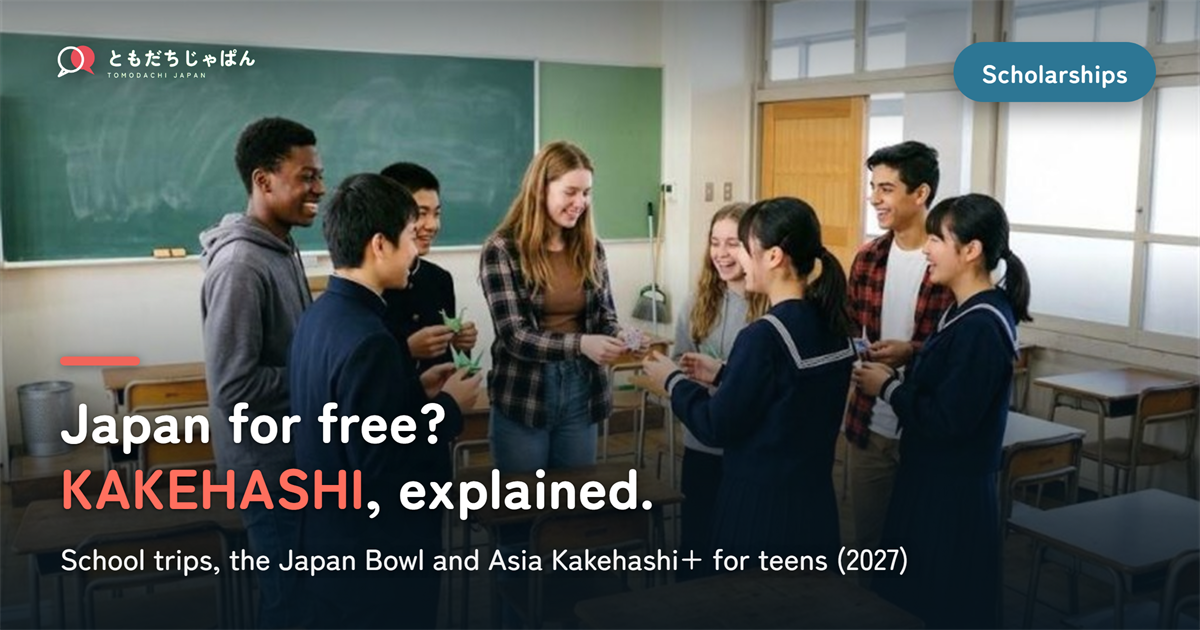
If your teenager studies Japanese, sooner or later someone mentions the KAKEHASHI Project: a trip to Japan paid for by the Japanese government. Then the questions start. Is it real, can my child apply, what are the age limits, and why does every page about it seem to describe a different program?
The confusion is understandable, because kakehashi (bridge) is the name of several related programs. We run an online Japanese school for children growing up outside Japan, and in late October 2026 we read the current pages of Japan’s Ministry of Foreign Affairs, the Embassy of Japan in the United States, AFS Japan and the Japan Bowl organisers to sort them out. Here is what a family can actually do, and what is invitation-only.
The short answer on the KAKEHASHI Project
- The original KAKEHASHI Project is invitation-based. Japan’s Ministry of Foreign Affairs selects groups from the United States and Canada, works with JICE to build seven to ten day trips, and covers the costs. Schools and universities are nominated through Japanese consulates. There is no application form for an individual family.
- The clearest route for a high school student is the Japan Bowl. Top teams at the National Japan Bowl, held in the Washington DC area each April, have been invited to Japan through KAKEHASHI for years. Registration for the 2027 competition opens November 2, 2026 and closes January 31, 2027. One catch: students who speak Japanese at home are not eligible to compete.
- The Asia Kakehashi Project+ is the one your child can apply for. It is a different, Ministry of Education-funded scholarship run by AFS Japan: about five months at a Japanese high school, fully funded, for students aged 15 to 18 from Asian and G7 countries who already study Japanese. The 2026 round is closed; applications for 2027 are expected around early February through your national AFS office.
- Heritage speakers and complete beginners sit on opposite sides of these rules. The Japan Bowl excludes students who use Japanese with family; Asia Kakehashi+ requires at least beginner Japanese. Which door is open depends on your child.
Building the Japanese that scholarship panels look for?
TOMODACHI JAPAN is an online Japanese school for children growing up outside Japan. They talk with peers their own age in Japan every day, taught by teachers working at Japanese schools, in small classes of 8.
🎁 Register and we’ll email you our School Guide (PDF, in English) straight away. You’ll also be first to hear about tuition, scholarships and opening dates.
Free · takes about 30 seconds
What the KAKEHASHI Project is
The Embassy of Japan in the United States describes the KAKEHASHI Project as a government-funded grassroots exchange program that brings groups of Americans to Japan for engaging, focused and customised experiences. The Ministry of Foreign Affairs identifies and selects the groups: students, policy makers, business leaders, athletes, pop culture enthusiasts and more. With cooperating organisations such as JICE (Japan International Cooperation Center), each group gets a seven to ten day itinerary built around its interests. The Ministry’s own purpose statement is to increase the interest in and understanding of Japan among outstanding young leaders in the North American region, and to foster supporters and experts of Japan.
Two things follow from that description. First, the program is for North America; it is one of Japan’s Friendship Ties Programs, with sibling programs for other regions such as JENESYS for Asia and Oceania. Second, it works through groups. A university that took part described being nominated by its regional Consulate-General and notified months later. High school groups have followed the same pattern: a school is invited, and the school chooses its students. Past high school visits from the United States ran about eight days, with lectures, a school exchange, often a homestay, and a final presentation in which students set out action plans for sharing what they learned at home.
So if your child’s school already teaches Japanese, the first question to ask is simple: has the school ever been approached about KAKEHASHI, and does the Japanese teacher have a relationship with the consulate? If not, the routes below are the ones a family can act on.
Route 1: the Japan Bowl winners’ trip
The National Japan Bowl is a team quiz competition for American high school students studying Japanese as a foreign language, run since 1992 by the Japan-America Society of Washington DC with the Embassy of Japan. Its top teams have been invited to Japan through KAKEHASHI repeatedly. In July 2024, 24 participants, 18 Americans and 6 Canadians, travelled to Fukushima for lectures, exchanges with Japanese high school students and homestays, then to Tokyo. In February 2026 a KAKEHASHI group made up of Japanese speech contest winners, Japanese learners and National Japan Bowl winners visited Aichi and met a Special Advisor to the Prime Minister. In July 2026 the latest group of National Japan Bowl winners paid a courtesy call at the Ministry of Foreign Affairs.
For 2027 the organisers’ Competition Guide sets out the rules. The 35th National Japan Bowl is on April 23 and 24, 2027. Registration opens November 2, 2026 and closes January 31, 2027, and it is done by the teacher or lead chaperone, not by families. Teams are two or three students competing at Level II, III or IV, set by the course level the student is enrolled in (Level IV includes AP Japanese). A school may send one team per level.
Eligibility is where many families discover the limits. The competition is open to full-time high school students currently enrolled in a Japanese language class of Level II or beyond in the United States. If a school does not offer Japanese, or a student is homeschooled, the guide says a student taking Japanese for academic credit online or in person may be eligible, decided case by case. Teams from Canada and Mexico may compete but are not eligible for the championship winners’ trip. And students are not eligible to compete if they are a native speaker of Japanese or use Japanese at home to converse with family members, if they have studied Japanese in Japan for a cumulative three months outside their high school curriculum, or if they have lived in Japan or done a homestay there for more than three months in total.
In plain terms: the Japan Bowl route is for the student who fell for Japan through anime, a school class or a friend, and who is learning Japanese as a foreign language. For a child who grew up speaking Japanese at home, this door is closed by design. Canadian students have their own path. The Ministry of Foreign Affairs notes that a National Japan Bowl has been held in Canada since 2018 in Ontario and British Columbia, and Canadian winners have been included in KAKEHASHI groups, including a February 2026 trip that took five Canada Japan Bowl students and five Canadian Japanese learners to Tokyo, Kanagawa and Aichi.
Route 2: the Asia Kakehashi Project+ scholarship
This is a different program with a similar name, and it is the one families can apply to directly. The Asia Kakehashi Project+ (Plus) is funded by Japan’s Ministry of Education (MEXT) and implemented by AFS Japan with AFS partner organisations from 2023 to 2027. It invites high school students from Asia and, since 2023, from G7 member countries to study in Japan for about five months, attending a Japanese high school while living in a dormitory or with a host family, with two international camps alongside Japanese students. The 2026 round ran from August to December 2026 with a prospective 100 participants.
It is a full scholarship. AFS Japan lists coverage of international and domestic round-trip airfare, dormitory fees, normal school expenses, health insurance in Japan and all program costs. Families pay for vaccinations and medical documents, travel to the consulate for the visa, spending money and excess baggage. Students cannot choose between a dormitory and a host family; those in dormitories are placed with short-term host families during holidays.
The 2026 eligibility criteria, as published in the call for applications, were:
- Age 15 to 18, born after April 2, 2008 and before April 1, 2011 (the window moves each year).
- Citizenship of a listed country or region at the time of application. The list covers Asian countries from Bangladesh to Vietnam, including Singapore, Malaysia, Thailand, Indonesia, the Philippines, India, South Korea, China and Hong Kong, plus the G7 members Canada, France, Germany, Italy, the United Kingdom and the United States.
- Grades: a minimum of 60 percent in principle in all subjects in the latest school examination, and a 60 percent average over the past two years.
- Learners of Japanese. The published examples are holding JLPT N5, being able to read hiragana and katakana, or being able to introduce yourself in Japanese at the time of application. Participants in Japanese speech contests are encouraged to apply and have priority in selection.
- Leadership potential to act as a bridge between the home country and Japan, during and after the program.
- No previous participation in the Asia Kakehashi program.
- Priority to students from low-income families where candidates are otherwise equal.
Applications are handled by the AFS organisation in each country, and the dates differ by country. AFS Japan says applications for the 2026 program are closed and applications for the 2027 program will open around early February. The contact for the United States is AFS-USA; for Canada, AFS Interculture Canada; for the United Kingdom, AFS Wales; for Singapore, Malaysia and Brunei, AFS Malaysia; for Thailand, Cambodia, Laos and Vietnam, AFS Thailand; for Indonesia, Yayasan Bina Antarbudaya; for the Philippines, AFS Philippines; for Hong Kong, AFS Hong Kong. If you are reading this before February, the practical step is to contact that office now and ask to be notified when the 2027 call opens.
Route 3: school groups and speech contests
Beyond the Japan Bowl, KAKEHASHI groups have included winners of Japanese language speech contests and groups of Japanese learners nominated through consulates, as the February 2026 visit shows. Regional Japanese speech contests are usually organised by consulates, Japan-America Societies and teachers’ associations, and many have separate categories for heritage and non-heritage speakers. Entering one costs nothing, builds exactly the speaking skills the programs look for, and in the Asia Kakehashi+ selection it is a stated priority. Ask your child’s teacher or the nearest Japanese consulate what contests exist in your region.
There are also KAKEHASHI programs for older participants run with partner organisations in the United States, typically for university students and young professionals aged 18 to 27, with their own applications and deadlines. If you have an older child at university, those are worth a separate look.
The KAKEHASHI routes compared
| Route | Who runs it | Length | Who can take part | How you get in | Japanese needed |
|---|---|---|---|---|---|
| KAKEHASHI school group | Ministry of Foreign Affairs with JICE | 7 to 10 days | Students at a school or university invited as a group (US and Canada) | School is nominated via a consulate; school selects students | Set by the school |
| Japan Bowl winners’ trip | Japan-America Society of Washington DC; trip through KAKEHASHI | About 8 days (July 2024: Fukushima and Tokyo) | Full-time US high school students in a Level II+ Japanese class; not native or home speakers; Canada and Mexico teams compete but no trip | Teacher registers a team of 2 to 3 (Nov 2, 2026 to Jan 31, 2027); win at the April 23 to 24, 2027 national | Level II or above as a foreign language |
| Asia Kakehashi Project+ | Ministry of Education; AFS Japan | About 5 months (2026: August to December) | Ages 15 to 18 from Asian and G7 countries; 60 percent grades; Japanese learner | Individual application through the national AFS office; 2027 call expected around early February | Beginner at least: JLPT N5, kana, or a self-introduction |
| Adult KAKEHASHI programs | Partner organisations with JICE | About 8 days | Typically ages 18 to 27, university students | Organisation’s own application | Interest in Japan; language study is a plus |
Which route fits your child?

If Japanese is a foreign language for your child, the Japan Bowl is the most concrete target in the United States. It needs a school class at Level II or above, a teacher willing to register a team, and a year or two of steady study. Even without the trip, the competition rewards exactly the culture and language knowledge that makes a later exchange richer.
If your child grew up with Japanese at home, the Japan Bowl is closed, but the Asia Kakehashi Project+ is open, as long as they are 15 to 18 in the application year, have solid grades and hold a passport from a listed country. The 2026 criteria asked only for beginner Japanese, so a heritage speaker is well placed on language. Selection then turns on grades, motivation, leadership and the essays and interview, and speech contest experience is a stated advantage.
If your child is under 15, none of these are available yet, and that is useful to know early. The years before 15 are when the Japanese level, the grades and the speaking confidence that these programs reward are built. Younger children can also look at short family stays and camps; we have written about Japan Preschool Exchange for the youngest and Mori no Ike, the Concordia Japanese village in Minnesota, for ages 7 to 18.
If a scholarship does not come through, the paid exchange organisations remain: AFS, YFU, NWSE, Rotary and CIEE all place teenagers in Japanese high schools, with age windows from about 15 and varying Japanese requirements. We compared them here: Japan exchange student programs: AFS, YFU, NWSE and Rotary compared.
A checklist for the year ahead
- Before November 2, 2026: if your child is in a US Level II+ Japanese class and does not speak Japanese at home, ask the teacher about registering a Japan Bowl team.
- Before February 2027: contact your national AFS office and ask to be notified when the Asia Kakehashi Project+ 2027 call opens. Check the birth-date window when it is published.
- Grades: the 2026 criteria asked for 60 percent in all subjects, including the past two years. Keep report cards.
- Japanese evidence: a JLPT N5 certificate, a teacher’s letter, or a short self-introduction video makes the language criterion easy to show.
- Speech contests: find your region’s Japanese speech contest and enter. It is a stated priority for Asia Kakehashi+ and a route into KAKEHASHI groups in its own right.
- Ask the school: whether it has ever been contacted about KAKEHASHI, and whether it has a sister school in Japan.
Where TOMODACHI JAPAN fits
Every route above rewards the same two things: a child who can actually speak Japanese, and a child who has a reason to care about Japan beyond a screen. A government-funded trip is the prize; we do not pretend an online class replaces it.
TOMODACHI JAPAN (tomodachi means “friend”) is an online Japanese school for children growing up outside Japan, from age 5 to 18. Children learn in live classes of up to 8, taught by teachers from Japanese schools, and talk with children their own age in Japan as part of the programme. For a heritage speaker aiming at Asia Kakehashi+, that is weekly speaking practice and a teacher who can write the letter that documents it. For a foreign-language learner aiming at the Japan Bowl, it is conversation with real Japanese teenagers alongside the school textbook. And for the student who comes home from five months in a Japanese high school, it is a way to keep the Japanese and the friendships alive. Classes are scheduled for families in Asia and Oceania, and other time zones by arrangement.
Frequently asked questions
Can my child apply to the KAKEHASHI Project directly?
Not to the original KAKEHASHI Project, which selects groups through schools, universities and partner organisations. A family can apply directly to the Asia Kakehashi Project+ scholarship through the AFS office in their country, and a student can aim for the Japan Bowl winners’ trip through their school team.
Is the KAKEHASHI Project really free?
The KAKEHASHI Project is funded by the Japanese government, and partner listings describe round-trip airfare, lodging, meals and in-country transport as covered, with personal costs such as passports and spending money paid by participants. The Asia Kakehashi Project+ is a full scholarship covering airfare, housing, school expenses and insurance; families pay for vaccinations, visa travel, spending money and excess baggage.
What is the age limit for the Asia Kakehashi Project+?
For the 2026 round, 15 to 18, defined as born after April 2, 2008 and before April 1, 2011. The window moves each year, so check the 2027 call when it is published around early February.
Can heritage speakers enter the Japan Bowl?
No. The Competition Guide excludes students who are native speakers of Japanese or who use Japanese at home with family members, as well as students who have studied or lived in Japan for more than three months. Heritage speakers should look at the Asia Kakehashi Project+ and at speech contests with heritage categories instead.
Is KAKEHASHI available outside the United States and Canada?
The KAKEHASHI Project itself is for North America. Other regions have sibling programs under Japan’s Friendship Ties Programs, such as JENESYS for Asia and Oceania. The Asia Kakehashi Project+ is open to Asian and G7 countries, which includes the United Kingdom, France, Germany and Italy as well as the United States and Canada.
In short
The KAKEHASHI Project is real, funded by the Japanese government, and mostly invitation-based. For a teenager there are two doors a family can walk towards: the National Japan Bowl, for foreign-language learners in US schools, with registration from November 2, 2026, and the Asia Kakehashi Project+ scholarship semester, for students aged 15 to 18 who already study Japanese, with a 2027 call expected around early February. Both reward the same preparation: steady Japanese, good grades and a child who has friends and reasons in Japan already.
Related reading
- Japan exchange student programs: AFS, YFU, NWSE and Rotary compared
- CIEE Japan high school programs: summer vs semester, ages and Japanese required
- Mori no Ike: Concordia’s Japanese village for kids
- Japan Preschool Exchange: how it works, who it suits, and what comes after
- Japanese pen pal for kids: safe ways to find one
Exchange trips like Kakehashi are short and selective, so the Japanese your teen uses before and after the trip matters just as much. If you live in the US or Canada, our live online Japanese classes for kids in the US & Canada are small-group classes taught by qualified teachers in Japan, with class times set up around the time difference — see tuition.