Ken Kaneki starts Tokyo Ghoul as a quiet university student who loves novels, and his Japanese sounds like it: soft, polite, full of 僕 and trailing dots. By the end he sounds like somebody else. That change is a gift for learners, because you can hear one person’s speech style shift in real time. I teach Japanese, and below are ten Kaneki quotes in Japanese, in the original Japanese with rōmaji, a translation and the grammar underneath — plus an honest note on which lines you could say to a real person. The series is dark, so I have chosen lines that are sad or intense but not graphic.
Can-you-use-it legend: ◎ = safe in real conversation · △ = fine in anime, odd in life · ✗ = don’t say this to a person.

Kaneki quotes in Japanese
| Japanese | Rōmaji | English | Use it? |
|---|---|---|---|
| 僕は人間なんだ! | Boku wa ningen nan da! | I’m human! | △ Heavy |
| 人間でもグールでもない、僕は…1人だ | Ningen demo gūru demo nai, boku wa… hitori da | Neither human nor ghoul… I’m alone | △ Great grammar |
| 僕の居場所なんて、どこにもない! | Boku no ibasho nante, doko ni mo nai! | There’s no place for me at all! | △ Heavy |
| 何も出来ないのは、もう嫌なんだ | Nani mo dekinai no wa, mō iya nan da | I’m done with being unable to do anything | ◎ Useful pattern |
| 僕は僕の大事な人を奪われたくない だから強くならなきゃいけないんだ | Boku wa boku no daiji na hito o ubawaretakunai. Dakara tsuyoku naranakya ikenai n da | I don’t want the people I care about taken from me. So I have to get stronger | ◎ Content, calm it down |
| 傷つける人より、傷つけられる人に。優しい人はそれだけで幸せだ | Kizutsukeru hito yori, kizutsukerareru hito ni. Yasashii hito wa sore dake de shiawase da | Be the one who is hurt, not the one who hurts. Kind people are happy just by being kind | ◎ His mother’s words |
| 間違っているのは僕じゃない 間違っているのはこの世界だ | Machigatte iru no wa boku ja nai. Machigatte iru no wa kono sekai da | It’s not me who’s wrong. It’s this world that’s wrong | △ Dramatic |
| 僕は…グールだ | Boku wa… gūru da | I… am a ghoul | △ Anime only |
| 退かない 前に進む 百足みたいに | Shirizokanai. Mae ni susumu. Mukade mitai ni | I won’t back off. I move forward — like a centipede | △ Odd simile |
| 帰ろう、ヒデ…帰ろう | Kaerō, Hide… kaerō | Let’s go home, Hide… let’s go home | ◎ Everyday phrase |
Want to go from quoting anime to actually talking with friends in Japan?
TOMODACHI JAPAN is an online Japanese school for children growing up outside Japan. They talk with peers their own age in Japan every day, taught by teachers working at Japanese schools, in small classes of 8.
🎁 Register and we’ll email you our School Guide (PDF, in English) straight away. You’ll also be first to hear about tuition, scholarships and opening dates.
Free · takes about 30 seconds
The grammar underneath each line
僕は…グールだ — why 喰種 is read “gūru”
The Japanese title is 東京喰種トーキョーグール. The kanji 喰種 literally mean “eat” + “species,” but nobody reads them kuishu. The manga prints the English loanword グール above them as the reading. Japanese writers love this trick: the kanji carry the meaning, the small reading on top carries the sound. You will see it in song titles, game names and lots of manga, so if a kanji compound seems to have an impossible reading, look for this.
The sentence itself is the simplest pattern in Japanese: A は B だ, “A is B.” Compare 僕は人間なんだ! from the first episode. The added なんだ (na n da) means “the thing is” — he is insisting, trying to make someone believe him. The later 僕は…グールだ has no なんだ at all. He is not arguing any more; he has accepted it. Two tiny words show the whole change in the character.
人間でもグールでもない — “neither A nor B”
A でも B でもない is how Japanese says “neither A nor B.” It is extremely useful and not dramatic at all in daily life: 好きでも嫌いでもない (“I neither like it nor dislike it”), 暑くも寒くもない (“it’s neither hot nor cold” — with adjectives, でも becomes も). A child can use this one at dinner tonight.
The same family gives 僕の居場所なんて、どこにもない! Here どこにも + a negative verb means “in no place at all.” Swap the question word and the pattern still works: 何もない (nothing), 誰もいない (nobody). なんて, placed after a noun, looks down on it: “a place for me? No such thing.” 居場所 (ibasho) is a lovely word to know — not just “a location” but a place you belong.
何も出来ないのは、もう嫌なんだ — turning a verb into a topic
This is one of the most-voted Kaneki lines in Japanese fan polls, and the grammar is worth stealing. 何も出来ない (“can’t do anything”) is a whole verb phrase. Add の and it becomes a noun: “being unable to do anything.” Add は and it is the topic. Finally comes もう嫌だ — “I’ve had enough.”
Verb + のは + feeling is how Japanese people talk about what they like and dislike doing: 絵を描くのが好き (“I like drawing”), 朝早く起きるのは嫌だ (“I hate getting up early”), 日本語で話すのは楽しい (“speaking in Japanese is fun”). Learn this frame and you can describe your whole week.
奪われたくない — the passive plus “don’t want”
In the second season Kaneki explains why he is changing: 僕は僕の大事な人を奪われたくない だから強くならなきゃいけないんだ. Three grammar points sit inside one breath:
| Piece | Built from | Meaning |
|---|---|---|
| 奪われる | 奪う → 奪われる | to have something taken — the passive form |
| 奪われたくない | 奪われ + たい → たくない | don’t want to have (it) taken |
| 強くなる | 強い → 強く + なる | to become strong — い-adjective + なる |
| ならなきゃいけない | ならなければいけない | have to become — なきゃ is the spoken squash |
Teacher’s note: Japanese often uses the passive to show that something bad happened to you. 雨に降られた literally means “I was rained on” — the feeling is “I got caught in the rain, poor me.” And 〜なきゃいけない is how students talk about homework every single day: 宿題をしなきゃいけない, “I have to do my homework.”
傷つける人より、傷つけられる人に — active vs passive side by side
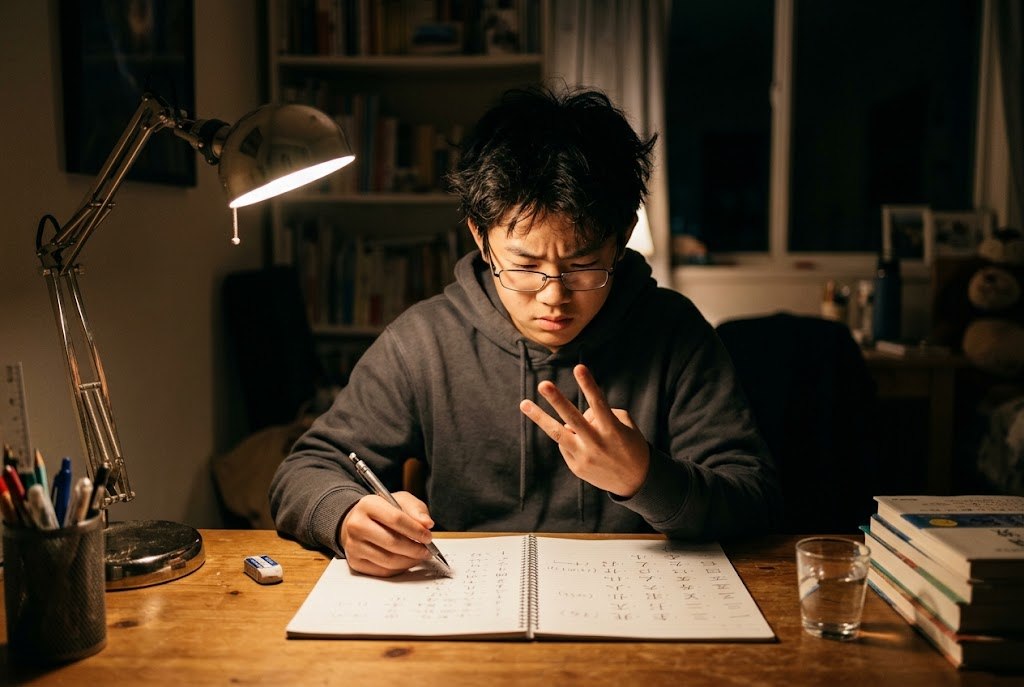
These are words Kaneki remembers from his mother, and they are the kindest line in the series. 傷つける means “to hurt (someone).” 傷つけられる is its passive, “to be hurt.” Put them next to each other with より (“rather than”) and the sentence says: rather than a person who hurts, be a person who is hurt. The verb is missing at the end — なりなさい (“become”) is understood. Japanese leaves out what the listener can already guess.
それだけで means “with just that” or “by that alone”: 友達がいれば、それだけで楽しい (“if I have friends, that alone makes it fun”). This is the one Kaneki line I would happily see on a classroom wall.
間違っているのは僕じゃない — the “it’s X that…” frame
English says “It’s this world that’s wrong.” Japanese builds the same emphasis with のは: [description] のは [answer] だ. 間違っているのは、この世界だ — “the one that is wrong is this world.” The answer goes last, so it lands like a punchline. Everyday version: 一番好きなのは数学だ, “the subject I like most is maths,” or 遅れたのは僕じゃない, “I’m not the one who was late.”
1000 minus 7 — a numbers drill hidden in a dark scene
Fans all know “1000-7.” In the first season finale Kaneki is held captive, and he describes being told to take 7 away from 1000 again and again, saying each number out loud (1000から7ずつ数を引いて). We will skip the scene and keep the maths. 引く (hiku) means “minus,” and 〜ずつ means “each time” or “at a time”: 一つずつ, one at a time.
| Number | Reading | Tip |
|---|---|---|
| 1000 | せん (sen) | no いち needed in front |
| 993 | きゅうひゃくきゅうじゅうさん | nine hundreds, nine tens, three |
| 986 | きゅうひゃくはちじゅうろく | はち + じゅう, followed by ろく |
| 979 | きゅうひゃくななじゅうきゅう | 7 is なな here, not しち |
Try going down five more by yourself. It is a genuinely good mental-arithmetic drill for Japanese numbers, and far less scary with a friend and a timer.
帰ろう — the volitional “let’s”
The second season ends on 帰ろう、ヒデ…帰ろう, spoken to his best friend. 帰る (“go home”) → 帰ろう (“let’s go home”). This volitional form is pure everyday Japanese: 食べよう (let’s eat), 遊ぼう (let’s play), 一緒に行こう (let’s go together). At the end of a school day, 帰ろう! is probably the most common word in the corridor.
Is Kaneki good for learning Japanese?
Surprisingly, yes — more than most action heroes. Early Kaneki speaks gentle, standard Japanese with 僕 for “I” and polite です/ます to older people, which is a perfectly good model for a student. The famous turn in his story is heard in his voice: his lines get shorter, colder and harsher. That 僕-to-俺 drift is the clearest lesson in the series on how much a single word for “I” tells people about you. The content, though, is heavy, and the later lines (plus bossy lines like 黙って聞けよ) are not ones to copy.
Keep the pattern, change the clothes: 何も出来ないのは嫌だ becomes 何もしないのは嫌だから、手伝います (“I don’t like doing nothing, so I’ll help”); 強くならなきゃ becomes もっと上手にならなきゃ. The fastest way to feel which version fits is to try them on friends your own age — a real person’s smile or frown tells you in one second what a quote list never will.
Keep going with the same method: KanekiKaneki’s later lines sit beside Light, Sukuna and friends in ourrsquo;s colder lines fit right in with our anime villain quotes in Japanese, and Death Note quotes in Japanese shows another good student sliding into darkness through his speech. If you like dark stories with rough voices, Chainsaw Man quotes in Japanese is the next stop. His 僕 is compared with 俺 and 私 in Ore vs Boku vs Watashi. Starting from zero? Our guide to learning Japanese with anime sets out a weekly routine, and our tuition page explains how live classes with Japanese friends work.
FAQ
What is Kaneki’s most famous quote in Japanese?
Most fans point to his opening monologue: 僕は小説の主人公でも何でもない… which ends with the single word “悲劇” (higeki, “tragedy”) — if someone wrote a story about him, it would be a tragedy. In Japanese fan polls, 何も出来ないのは、もう嫌なんだ and 僕は…グールだ are also near the top. If you search for Kaneki dialogue in Japanese, those are the lines you will meet first.
Why does Kaneki say 僕?
僕 (boku) is a gentle, slightly boyish “I” used by many boys and young men. It suits a shy book-lover. 俺 sounds tougher and more casual, and 私 is the neutral, polite choice. Changing from one to another in Japanese is a little like changing your whole tone of voice.
What does “1000-7” mean in Japanese?
It is せん ひく なな (sen hiku nana), “1000 minus 7,” and the answer is 993, きゅうひゃくきゅうじゅうさん. The scene it comes from is disturbing, but the arithmetic is a handy way to practise big Japanese numbers.
Is Tokyo Ghoul OK for kids learning Japanese?
The show is made for older teens and adults and has violent scenes, so parents should decide. The grammar in the lines above is safe and useful at any age, and you can learn it from this page without watching the show.
My child loves Tokyo Ghoul. How do they practise with real Japanese speakers?
Tomodachi Japan is an online Japanese school for children living outside Japan, taught by Japanese school teachers in small classes of eight, with classmates their own age in Japan. Parents don’t need to speak Japanese — we guide you in English. The free school guide below has the timetable, tuition and scholarship details.