If you’re searching for a Japanese school for kids in London, you’ll find the options are richer than almost anywhere outside Japan — from the world’s largest hoshuko (Japanese Saturday school) to a tiny heritage classroom three minutes from Sloane Square. What you won’t easily find is a comparison that goes beyond a list of names: what each school actually costs, and which type suits your child. This guide sorts London’s Japanese schools, Saturday classes and tutoring centres into “full national-curriculum” and “heritage-language” tracks, with published fees and sources. It also covers two things that matter enormously to British-Japanese families but almost never get written about: the Saturday school’s dedicated heritage stream, “Nihongo-ka”, and the uniquely British exit route of GCSE and A-Level Japanese.
Japanese schools and classes for kids in London: comparison at a glance
| School | Type | When | Ages | Fees (guide) | Area |
|---|---|---|---|---|---|
| The Japanese School in London — Hoshuko (Primary–Sixth Form) | Full national curriculum | Saturday mornings | Year 1 of Japanese primary to final year of high school | £399–421 per term + £312 admission | Acton / Brent / Croydon |
| Hoshuko “Nihongo-ka” (heritage stream) | Heritage language | Saturday mornings | Ages 6–15 | £421 per term + £312 admission | Acton only |
| Maeda Gakuen Saturday Toddler Class | Heritage / cultural immersion | Saturday mornings | Nursery to Reception age (3–5) | £527–737 per term | Finchley / Acton |
| Kotoba no Kakehashi | Heritage language | Saturdays | Pre-school to Year 9 age | On enquiry | Ealing |
| Chelsea Kodomo no Hiroba | Heritage language | Saturdays | Age 3 to primary | On enquiry | Chelsea |
| NIHONGOSCHOOL heritage course | Heritage / GCSE & A-Level | Saturdays and more | Years 7–13 | £220–260 per 10 weeks | Forest Hill + online |
| JOBA London | Full curriculum + heritage support | Weekday evenings & Saturdays | Primary to high school | On enquiry | Acton / Finchley / Wimbledon |
| ena International / Waseda Academy London | Full curriculum (exam prep) | Weekdays & Saturdays | Primary to high school | On enquiry | Ealing / Acton |
| TOMODACHI JAPAN | Online — conversation & friendship | Weekend mornings fit best (unlimited attendance) | Ages 5–18 | One flat monthly fee — see the free guide | From home |
Looking for a way to keep Japanese going from abroad?
TOMODACHI JAPAN is an online Japanese school for children growing up outside Japan. They talk with peers their own age in Japan every day, taught by teachers working at Japanese schools, in small classes of 8.
🎁 Register and we’ll email you our School Guide (PDF, in English) straight away. You’ll also be first to hear about tuition, scholarships and opening dates.
Free · takes about 30 seconds
An honest review of each option
1. The Japanese Saturday School (hoshuko) — the world’s largest, but built for age-grade fluency
Around 1,300 children from roughly 600 local and international schools attend, making this one of the largest hoshuko in the world. Every Saturday from 9:30 to 12:15, across three sites in Acton, Brent and Croydon, children follow the Japanese national curriculum using the same textbooks as schools in Japan (2026 fees: £399–421 per term plus a £312 admission fee). Admission requires attending an information session and a face-to-face interview, which assesses reading, writing, speaking and listening in Japanese. Be aware: children without age-grade Japanese literacy can be declined or placed in a lower year, and the school officially notes that some year groups are full with waiting lists. In short: excellent once you’re in, but the bar is real. Official site
2. The hoshuko’s “Nihongo-ka” — a heritage stream for British-Japanese families that almost nobody writes about
Here’s the option most roundups miss entirely: the same Japanese Saturday School runs a dedicated heritage-language stream called “Nihongo-ka” — eight classes (Nichi 1 to Nichi 8) for ages 6–15, at the Acton site only. The school states plainly that its purpose is Japanese as a heritage language, not Japanese as a foreign language, and the pacing is deliberately gentle: one year of the national curriculum textbook spread over two years. If your family wrote off the hoshuko as “impossible for a bilingual child keeping up with British school”, Nihongo-ka is the stream designed exactly for you. The one condition — and the focus of the interview — is that Japanese is genuinely used at home. Nihongo-ka admissions page
3. Maeda Gakuen Saturday Toddler Class — the pre-school gateway to Japanese and Japanese culture
Founded in 1993 and run by a Japanese kindergarten registered with the Department for Education, Maeda Gakuen’s Saturday morning class covers Japanese songs, seasonal festivals, calligraphy, tea ceremony and even kendo — Japanese absorbed through play and culture rather than study (nursery to Reception age, £527–737 per term). For families with little ones, it’s the classic way to bank the feeling that “Japanese = fun” before formal study begins. Official site
4. Kotoba no Kakehashi and Chelsea Kodomo no Hiroba — neighbourhood heritage classrooms
In Ealing, to the west, Kotoba no Kakehashi teaches children from Year 1 age through to their early teens, with reading-focused and GCSE-oriented classes. In the centre of town, Chelsea Kodomo no Hiroba (age 3 to primary, three minutes’ walk from Sloane Square station) offers the same warmth on a smaller scale. Both specialise in one thing: the Japanese of children growing up multilingual, taught in small groups with plenty of cultural activity. Fees for both are on enquiry. Kotoba no Kakehashi / Kodomo no Hiroba
5. NIHONGOSCHOOL, JOBA, ena and Waseda Academy — the GCSE, A-Level and exam-prep exits
Britain gives Japanese-speaking children something few countries do: the language can become a grade on a school transcript, via GCSE and A-Level Japanese. NIHONGOSCHOOL‘s heritage course (Years 7–13, maximum six per class, £220–260 per 10 weeks) is built squarely around GCSE and A-Level preparation. JOBA, a returnee-education specialist teaching since 1986, covers both Japanese-curriculum work and GCSE-oriented Japanese support. And if a return to Japan and its school entrance exams are on the horizon, ena International and Waseda Academy London are the established names (the tutoring centres do not publish fees). NIHONGOSCHOOL / JOBA
How to choose: work backwards from the “exit”
- Expat families returning to Japan → the hoshuko’s main streams, plus an exam-prep centre if needed. Keeping age-grade Japanese literacy is the priority.
- Settled and British-Japanese families → Nihongo-ka or a heritage classroom, at a pace your child can sustain. From secondary age, GCSE and A-Level Japanese give the effort a concrete, very British payoff.
- Pre-schoolers → Maeda Gakuen and similar: build up the “Japanese = fun” savings account first.
- Whichever route you take, the missing ingredient is the same: speaking time. One Saturday a week is not enough for Japanese to become a language your child uses. Which brings us to the next section.
The online option: after Saturday breakfast in London, it’s evening in Japan
“An online school based in Japan? The time difference makes that impossible, surely?” It’s the reaction we hear most often in London — and it’s exactly backwards. UK weekend mornings land squarely in Japan’s golden window: the evening. Saturday 9–11am in London is 5–7pm in Japan.
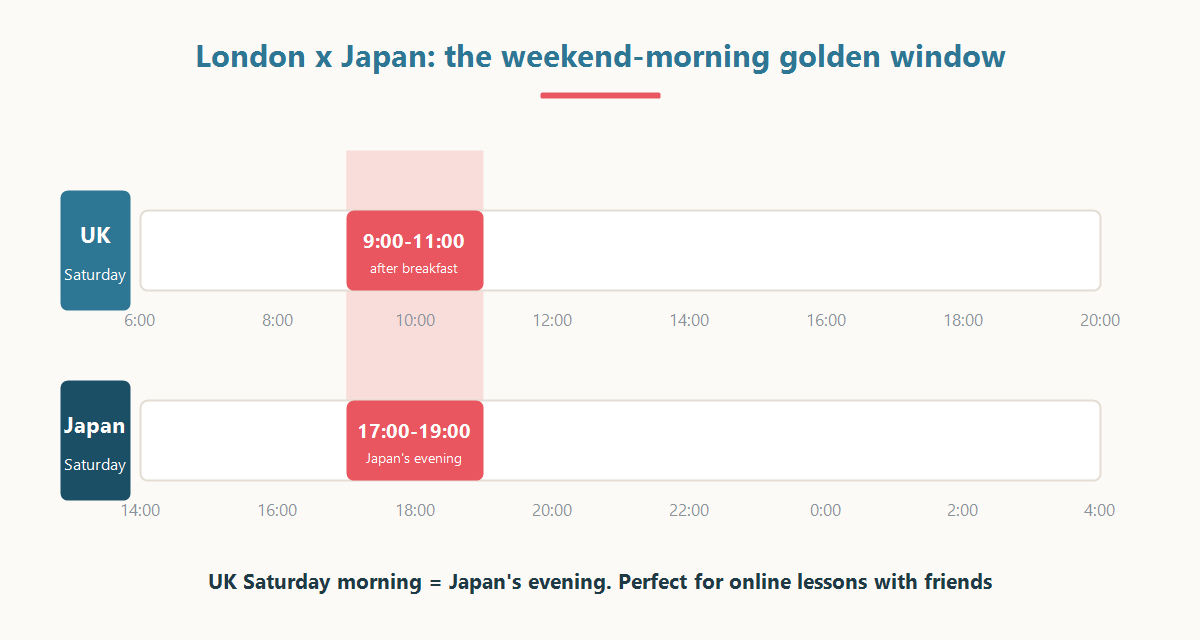
TOMODACHI JAPAN, opening in December 2026, is an online Japanese school where children talk in small groups with peers living in Japan — including the 800+ students of its sister school, NIJIN Academy. From London, that means weekend-morning sessions that meet Japan’s evening classes, and weekday mornings during half term and the school holidays. Classes are grouped by conversation level, not school year, so a Nihongo-ka-pace child and an age-grade-fluent child each join at their own level. It’s unlimited attendance for one flat monthly fee. Crucially, it doesn’t compete with a Saturday school — it completes one: learn the Japanese on Saturday, use it with friends on Sunday morning. For a fuller look at how families combine the two, see our guide to the online alternative to hoshuko.
Frequently asked questions from London parents
Our child didn’t pass the hoshuko interview. Is that the end of the road?
Not at all. First, the same school’s Nihongo-ka stream — heritage-focused, at half pace — may be the better fit anyway. Beyond that there are the heritage classrooms such as Kotoba no Kakehashi and Kodomo no Hiroba, and online options. An interview result measures today’s literacy level, not your child’s potential.
Is GCSE Japanese genuinely worth it for a British-Japanese child?
For a child raised with Japanese at home, GCSE and A-Level Japanese tend to be strong-scoring subjects. But the reading and writing still have to be built, so the real shortcut is unglamorous: keep speaking and reading going through the primary years, rather than scrambling from Year 7.
Can we join on weekdays despite the time difference?
During UK term time, weekdays clash with school hours (Japan’s evening falls in the British school day), so weekend mornings are the natural slot. During half term and the summer holidays, weekday mornings — Japan’s evening — open right up. With unlimited attendance, it makes sense to go deep in the periods when the timetable allows.
If we end up moving back to Japan, is the online school wasted?
Quite the opposite — arriving in Japan already having friends there is the single biggest payoff. It gives your child a running start into school life after the move, and the friends made from London stay reachable wherever your family goes next.
▼ In Australia rather than the UK? → Japanese school for kids in Sydney, compared