The Hawaii Japanese School, Rainbow Gakuen, is the only school of its kind in the state — and its name misleads almost everyone who finds it. It is not a full-time Japanese day school. It is a Saturday supplementary school, 40 Saturdays a year, and its own site says plainly that it does not satisfy Japanese compulsory education. But the thing that decides most families is not on any English page at all: three of the five published eligibility rules are requirements on the parents, not the child — and they exist only in Japanese. This page puts the full 2026 cost, the real calendar, the campus address, and those parent rules into English for the first time.
Japanese for children in Honolulu: the comparison
| Option | What it is | When | Ages | Published cost | Notes |
|---|---|---|---|---|---|
| レインボー学園 Rainbow Gakuen | The only supplementary school in Hawaii on Japan’s official list, with teachers dispatched from Japan. Japanese, maths and social studies on government textbooks | Saturday, 40 days a year, 08:30–14:55 | 4 – middle school | $2,675 first year, $2,235 after, for one elementary child | Entrance exam; parents must read Japanese and take duty shifts |
| Manoa Japanese Language School | Heritage / community language school, founded 1910 | Mon–Fri, 45 min after school | K–5 | Not published | No entrance test and no Japanese requirement stated |
| Moiliili Community Center Japanese Language School | Heritage / community language school | Mon–Fri, 45 min after school | 5 to under 14 | About $3,124 in year one, published in full | In-person registration only |
| Hongwanji Mission School | Private Buddhist day school with Japanese at every grade | Full-time day school | Preschool–8 | $14,300 a year plus $950 lunch | Replaces your child’s school entirely |
| Hahaione Elementary, Japanese dual language immersion | The first Japanese immersion programme in Hawaii’s public system, launched 2021 | Regular school day | Kindergarten entry | Free | Public school; confirm current intake directly |
| TOMODACHI JAPAN | Online, classes of 8 with a homeroom teacher, grouped by actual level | Fri/Sat afternoons Hawaii time | 5–18 | Sent in the free school guide | No entrance exam, no duty roster, no Japanese required of the parent |
Looking for a way to keep Japanese going from abroad?
TOMODACHI JAPAN is an online Japanese school for children growing up outside Japan. They talk with peers their own age in Japan every day, taught by teachers working at Japanese schools, in small classes of 8.
🎁 Register and we’ll email you our School Guide (PDF, in English) straight away. You’ll also be first to hear about tuition, scholarships and opening dates.
Free · takes about 30 seconds
First, what this school actually is
The confusion is built into the name. The operating foundation is called The Hawaii Japanese School, and in Japanese a 日本人学校 is a full-time day school where children do their entire education in Japanese. Rainbow Gakuen is not that.
The school states it itself, without hedging: it is a private supplementary school running on Saturdays only, it is not a compulsory-education school, and you cannot obtain Japanese compulsory-education certification through it. Your child still attends their American school Monday to Friday.
We checked this against the official lists rather than taking anyone’s word. Rainbow Gakuen appears on Japan’s Ministry of Foreign Affairs list of supplementary schools — there are 246 of them worldwide — under the Consulate-General of Japan in Honolulu. It does not appear on the separate list of 90 full-time Japanese day schools in 47 countries; the only American entries on that list are Chicago, New York, New Jersey and Guam. There is no full-time Japanese day school in Hawaii.
One footnote for anyone checking behind us: Japan’s education ministry page still shows 242 supplementary schools, but that page is dated July 2024. The foreign ministry’s current list counts 246. We counted it.
The parent rules nobody has translated
This is the heart of it, and it is why we wrote this page.
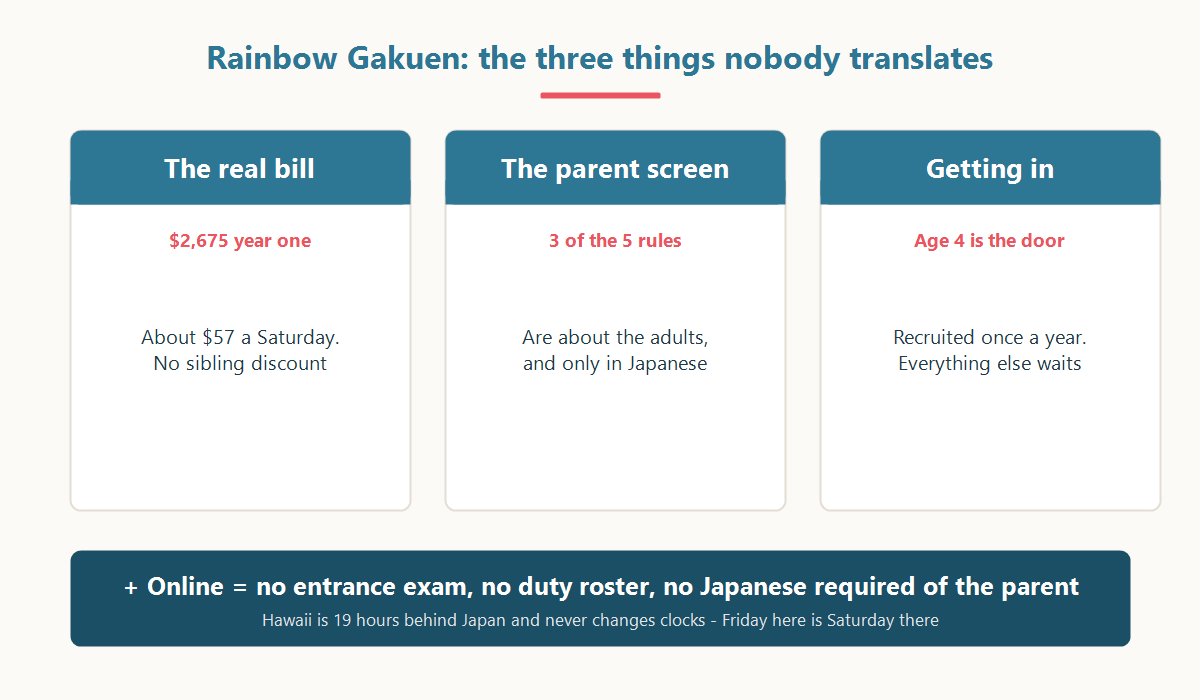
Rainbow publishes five eligibility conditions. Only two of them are about your child. Three are about you.
- The family is either posted to Hawaii for work, or plans for the child to enter a school in Japan, or simply understands the school’s purpose as a supplementary school.
- The child can understand lessons delivered in Japanese and has basic daily-living habits established.
- The parents can accurately understand school communications written in Japanese.
- The parents can inspect and coach the assigned homework — the wording is “every single time”.
- Both father and mother must take assigned roles — PTA officer or class parent — and duty shifts including classroom duty and campus watching duty.
The school’s English admission page compresses all of that into a single sentence: that the parent and child “must abide by the rules of the school and must be cooperative to the management and operation of the school.” Everything above — the literacy requirement, the weekly homework duty, the compulsory unpaid labour from both parents — exists only in Japanese.
Which produces a sharp irony worth stating plainly: the Honolulu family most likely to be searching for this school in English — the mixed Japanese-American household — is the family most likely to be screened out by a rule it cannot read.
And the PTA rules close the escape hatch
Clause 5 is not a polite request. The parents’ association bylaws set out one officer drawn from each grade, on a 14-month term. Officers are chosen by volunteering — but if nobody volunteers, they are selected by lot, and the bylaw states that a parent who is drawn may not, as a rule, decline. The only exception is a grave situation approved by both the principal and the PTA president.
There are three further recurring duties underneath the officer role: class parent, watching duty, and library duty. We know they are substantial because the bylaws let you buy your way out: a family that has served as an officer is exempted from all three for as many years as it served. Exemptions also exist for families with a child under four, families expecting a baby, and past foundation directors.
Two fair counterweights. First, the published 2026 officer list includes several non-Japanese surnames — mixed families do get in and do serve. Second, the school explains why it asks: the campus is borrowed, and the school’s conduct on someone else’s property is the reason it holds families to a standard.
The good news buried in clause 1
Most third-party pages say or imply that Rainbow is only for families going back to Japan. That is wrong, and it puts families off who would in fact qualify. Clause 1 offers three alternatives, and the third asks only that a parent understand what a supplementary school is for. The school’s own statement of purpose is broader still: it exists to teach children who plan to enrol in a school in Japan and children of compulsory-school age who simply wish to study in Japanese.
If you have no plan to move to Japan, you are not disqualified. You still have to clear clauses 2 to 5.

What it costs, all in
Everyone who quotes a price for Rainbow quotes the tuition alone. That leaves out the $680 household membership dues, which is the second-largest line on the bill and roughly 30% of a continuing year.
| Item | Amount | Frequency |
|---|---|---|
| Foundation membership dues | $680 | Annual, per household |
| Entrance exam fee | $90 | Per child, per sitting, non-refundable |
| Admission fee | $350 | One time |
| Tuition — kindergarten | $1,524 | Annual ($381 × 4 terms) |
| Tuition — elementary | $1,320 | Annual ($330 × 4 terms) |
| Tuition — middle school | $1,408 | Annual ($352 × 4 terms) |
| Materials fee | $205 | Annual — transfers pay the full year whenever they join |
| Parents’ association dues | $30 | Annual per household, plus $7.50 per additional child |
| Scenario | Total |
|---|---|
| First year, one elementary child | $2,675 |
| Continuing year, one elementary child | $2,235 |
| First year, one kindergarten child | $2,879 |
| First year, one middle-school child | $2,763 |
| Continuing year, two elementary children | $3,767.50 |
Four things that are not published, and that you should not assume:
- There is no sibling discount. The only sibling-specific line in the whole fee schedule is a surcharge — $7.50 on the PTA dues.
- There is no bus. Parents do drop-off and pickup, and the rules ask you to leave the grounds promptly afterwards.
- No financial aid or scholarship is published anywhere on the site.
- A uniform is required, but its cost is not published.
One genuinely good piece of news: textbooks cost nothing. The consulate confirms that the school arranges the Japanese government textbooks for enrolled children, so families do not need to apply for them separately. The $205 materials fee covers supplementary items, not those textbooks.
Payment is by automatic bank debit in four instalments — March, June, September and December, on the Monday after the second Saturday. The March debit is the large one: it takes the annual dues, the admission fee, the first term’s tuition, the materials fee and the PTA dues together. A posted employee’s company can be invoiced directly for the membership dues.
A refund conflict you should settle in writing
The school’s Japanese and English pages say different things about your money, and this matters most to exactly the families likeliest to need it — those who may be transferred off-island mid-year.
The Japanese page states that none of it is ever refunded — not the exam fee, admission fee, annual dues, term fees, materials or PTA dues; not on mid-year withdrawal; not even on expulsion. It adds that absence, however long, does not reduce what you owe.
The English page says that if a formal withdrawal form is submitted before a new quarter begins, the quarter’s tuition can be refunded, and that tuition is pro-rated when a student is removed.
Both were live on 5 September 2026. We are not going to guess which governs. Get the answer from the office in writing before you pay the March debit.
Where to drive on Saturday, and when
The school has two addresses, and confusing them is the single most common error online — including in Google’s own AI answer, which still names a school the students left in 2023.
| Saturday classes | Saint Louis School, 3142 Waialae Ave, Honolulu, HI 96816 — since April 2023 |
| Administrative office | 2454 South Beretania St. #202, Honolulu, HI 96826, inside the Japanese Cultural Center of Hawaii |
| Entrance exams | At the office, not the campus — except the kindergarten adaptation test, which is at Saint Louis School |
Before 2023 the school met at Kaimuki Middle School, where it had been since 1993. Most directory pages, and the AI summary at the top of the results, still send you there.
| Group | Arrival | Dismissal |
|---|---|---|
| Elementary grades 1–3 | 08:40 | 14:55 |
| Elementary 4 – middle school 3 | 08:30 | 14:55 |
| Kindergarten, age 4 | by 09:00 | 14:20 |
| Kindergarten, age 5 | by 09:00 | 14:30 |
It is 40 Saturdays — and where the real gap is
The school year runs 11 April 2026 to 13 March 2027, with 40 school days — 38 for kindergarten and 39 for elementary grades 1 to 3. Summer break is six consecutive Saturdays, from 13 June to 18 July 2026. Thanksgiving weekend is off, as are 26 December and 2 January.
Not all 40 are full teaching days. Five are “teachers’ days” — shortened days set aside for meetings and reports — and others go to ceremonies, sports day, evacuation drills and parent conferences.
What is taught is narrow by design: Japanese and maths throughout, social studies from grade 5, and one period of special activities. There is no science at any level, and no English, PE or music beyond kindergarten.
Now the arithmetic that changes how people plan. A first-grader gets four 40-minute Japanese periods a week across 39 days — about 104 hours a year. Japan’s own standard for first-grade Japanese is 306 periods of 45 minutes, about 230 hours. So Rainbow delivers roughly 45% of Japan’s Japanese-language hours in Grade 1.
Here is the counter-intuitive part. The gap narrows as the child gets older — to about 61% by Grade 5 — because Japan’s own Japanese-language hours fall steeply through primary school while Rainbow only drops from four periods to three. That is the opposite of what most reviews tell you. The honest planning conclusion is that the hardest years to cover are the first three, not the last three, and the supplement you put in at ages six to eight matters more than the one you put in at eleven.
The school agrees, in its own words: because teaching days are limited, it operates on the premise of family cooperation and encourages home study and correspondence courses. Worth knowing, though: the government-affiliated foundation that supplies Rainbow’s free textbooks discontinued its subsidised Japanese and maths correspondence course after the 2023 financial year. The supplement the school leans on is materially harder to buy than it was.
Getting in: one wide door, and a lot of narrow ones
Capacity is limited by the borrowed campus, and the school says so. Published intake reads like this:
| Entry point | Published capacity |
|---|---|
| Kindergarten, age 4 | Three or four classes — the only wide door |
| Kindergarten, age 5 | “A small number” |
| Elementary 1 – middle 3, April | “A small number” |
| October transfer | “A small number” — and grade 5 was closed outright for October 2026 |
In practice: the four-year-old class is the one real opportunity, it opens once a year, and there is no mid-year intake for it. Every other grade depends on somebody else leaving. Transfers, when places appear, are timed for July, October and January — and the January window adds a condition, that the child has been enrolled in a school in Japan for at least a year and left it within the previous six months.
The April 2026 cycle ran on this calendar, and the next one will look similar: information session 8 November; applications 12 November to 5 December, in person only, no post, by phone appointment, closed weekends and Mondays; kindergarten assessment 17 January; elementary and middle assessment 21–23 January; results 24 January; admission letters 7 February; term begins 11 April.
If you are reading this outside November, you are outside the window. There is no published waitlist — unsuccessful applicants reapply in a later round and pay the $90 exam fee again.
One more conflict to be aware of. The April intake guidelines say explicitly that there is no parent interview; the October transfer guidelines say there is one, immediately after application; and the English policy page describes an interview as general policy. Ask which applies to your round.
Finally, on nationality: no nationality requirement is stated, and the English page says the school does not discriminate on race, colour or national origin. But both parents must produce original, unexpired US status documents, and a guardian on Oahu is required.
How to decide, in three questions
1. Can you read Japanese school correspondence, and check homework every week? This is not a soft preference — it is eligibility clauses 3 and 4. If the answer is no, Rainbow will be hard whatever your child’s level, and you should look at the heritage schools or an online option instead.
2. Is your child four? If so, apply in November, because that is the only wide door and it does not reopen mid-year. If your child is older and not currently enrolled, you are waiting for a vacancy, and you should have a second plan running in the meantime rather than a hope.
3. Is the whole family willing to give up Saturday? Forty of them, 8:30 to 3:00, plus the driving, plus the duty shifts, plus the homework. For families going back to Japan this is straightforwardly worth it. For families staying in Hawaii it is a real trade, and it is fair to weigh it honestly.
The online option, and Hawaii’s unusual advantage
Hawaii runs 19 hours behind Japan and never changes its clocks, which produces something most places do not get: Saturday morning in Japan falls on Friday afternoon in Honolulu. Ten o’clock Saturday in Tokyo is three in the afternoon on Friday here. Japanese children are awake, free, and out of school at exactly the hour your child is finishing their week.
That is the slot TOMODACHI JAPAN is built for. We are an online Japanese school for children living outside Japan, taught by teachers working to the standard of Japan’s current classrooms, in classes of eight with a homeroom teacher, grouped by the level your child is actually at rather than by age. There is no entrance exam, no requirement that a parent read Japanese, and no duty roster. And your Saturday stays yours.
We will be straight about the boundary. We are not on Japan’s supplementary-school list, and we do not issue the curriculum a child needs to slot back into a Japanese classroom. If your child is returning to Japan, Rainbow Gakuen is the right answer and we will tell you so — and if your child is four, we would tell you to apply in November regardless of what you decide about us.
What we are built for is the family Rainbow is not designed to take: the household where the parents cannot read Japanese school letters, the child sitting just below the entrance bar, the family waiting on a vacancy that may not come, and the child who is not going back to Japan but should not lose the language either. That last child keeps going for one reason — there are other children on the other end of the call. Not a worksheet. Friends.
Tuition, scholarships and the opening timetable are all in our school guide, which we send free to anyone who registers.
Frequently asked questions
Is Rainbow Gakuen a Japanese day school?
No. Despite the foundation being named The Hawaii Japanese School, it is a Saturday supplementary school and says so itself — it is not a compulsory-education school, and Japanese compulsory-education certification cannot be obtained through it. Your child attends their American school Monday to Friday. There is no full-time Japanese day school anywhere in Hawaii.
How much does Rainbow Gakuen cost?
$2,675 for a first year with one elementary child and $2,235 for each year after — about $57 a Saturday. Tuition itself is $1,320, but you must add the $680 household membership dues, a $350 admission fee, a $90 exam fee, $205 materials and $30 PTA dues. Most pages quote only the tuition.
Where is the campus?
Saturday classes are at Saint Louis School, 3142 Waialae Ave, and have been since April 2023. The office is a separate address on South Beretania Street inside the Japanese Cultural Center. Pages that still say Kaimuki Middle School are out of date.
Do we have to be planning to move to Japan?
No — and this is widely misreported. The first eligibility clause offers three alternatives, and the third simply asks that a parent understand the school’s purpose as a supplementary school. A family with no repatriation plan is eligible, provided it meets the other four conditions.
Do the parents have to speak Japanese?
Effectively yes. Eligibility clause 3 requires that parents can accurately understand school communications written in Japanese, and all communications — newsletters, the parents’ association, the entire admissions site — are Japanese only. Clause 4 additionally requires a parent to check the homework every time.
Is there a sibling discount?
No. The membership and PTA dues are per household, so a second child adds full tuition and materials — plus a $7.50 surcharge on the PTA dues. It is the only sibling-specific line in the fee schedule, and it goes the wrong way.
When can we apply?
The main cycle runs in November: an information session early in the month, then about three weeks of in-person applications by appointment, assessment in January, and entry in April. Transfers into existing grades, when vacancies appear, are timed for July, October and January. The four-year-old kindergarten class is recruited once a year only.