If you’re looking at LingoDeer for kids, you’re probably asking three things. Is it good for children? Is it safe? And can my child learn Japanese on it?
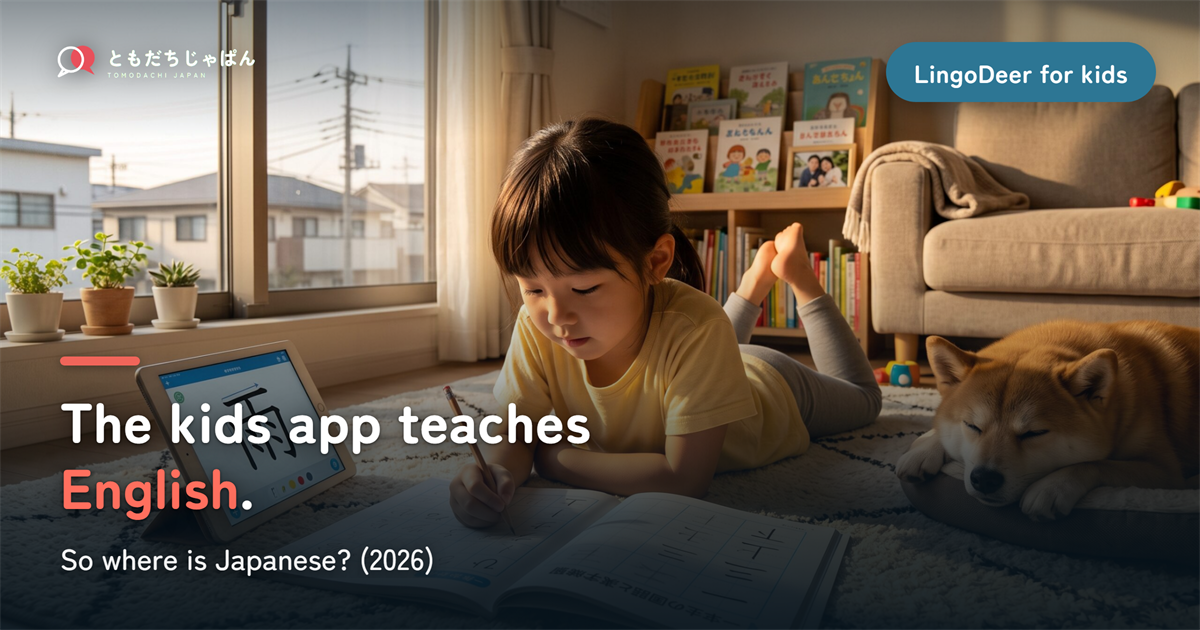
The third question has an answer that surprises most parents, so let’s start there. LingoDeer’s app for young children — iDeerKids — teaches English, not Japanese. The Japanese course sits in the main LingoDeer app, which is not the children’s product.
Two apps, and only one of them is for children
- iDeerKids — LingoDeer’s app for young children, aimed at roughly ages 3–8. It’s fully animated and teaches English: the alphabet, phonics, words and simple sentences.
- LingoDeer (main app) — this is where Japanese lives, along with Korean, Chinese and a long list of other languages. It is designed with older learners in mind.
So the sentence “LingoDeer is great for kids” is true and misleading at the same time. It is great for kids — for learning English. A child who wants Japanese ends up in the general app, the same way they do with Duolingo.
App line-ups change. Check LingoDeer’s own pages before you buy, and don’t take a blog’s word for it — including ours.
Looking for the people your child can actually practise with?
TOMODACHI JAPAN is an online Japanese school for children growing up outside Japan. They talk with peers their own age in Japan every day, taught by teachers working at Japanese schools, in small classes of 8.
🎁 Register and we’ll email you our School Guide (PDF, in English) straight away. You’ll also be first to hear about tuition, scholarships and opening dates.
Free · takes about 30 seconds
Is it safe? Mostly the right question, slightly the wrong one
Parents ask about safety because most language tools involve strangers. LingoDeer doesn’t. There’s no chat with other users, no feed, no matching. It’s your child and the app.
That removes the risk — and it also removes the thing that makes children keep going. Which brings us to the real trade-off.
What LingoDeer does better than most apps
We’d rather be accurate than dismissive, and LingoDeer has genuine strengths for Japanese specifically:
- It actually teaches grammar. Many apps let you infer patterns from examples. LingoDeer explains them, which suits Japanese, where word order and particles aren’t guessable from English.
- Structured, course-like progression. It feels less like a game and more like a syllabus — good for a child who likes knowing where they are.
- Clean and calm. No feed, no strangers, fewer distractions than a general-purpose app.
For an organised 11-year-old who already wants to learn Japanese, this is a reasonable tool. If it’s working, keep it.
Where it runs out — and it’s not LingoDeer’s fault
Grammar explanations answer why a sentence is built that way. They can’t answer the question a child actually has, which is: who am I going to say this to?
In families raising children with Japanese outside Japan, the pattern is remarkably consistent. Children can read kana. They know words. They understand a lot. And they still answer in English — because nowhere in their week is there a person who is waiting for a reply in Japanese.
No app closes that gap, no matter how good its grammar notes are. It sits outside what software can do.
How the options compare
| Option | Does the kids’ version cover Japanese? | Is there someone to talk to? |
|---|---|---|
| LingoDeer / iDeerKids | No — iDeerKids (ages 3–8) teaches English; Japanese is in the main app | No |
| Duolingo / Duolingo ABC | No — ABC (ages 3–12) is learn-to-read; Japanese is in the main app | No |
| HelloTalk | Not a children’s product; under-18s need a guardian’s approval | Yes — strangers |
| Saturday school | Yes | Yes — once a week, if one is near you |
| TOMODACHI JAPAN | Yes — built for children learning Japanese | Yes — same-age friends in Japan, every day |
Notice the pattern in the first two rows. The two best-known “kids” language apps both put Japanese in their adult product. That’s worth knowing before you assume an app has your child covered.

What TOMODACHI JAPAN does
TOMODACHI JAPAN is an online Japanese school for children growing up outside Japan. Not an app — and not a replacement for one.
- Same-age friends in Japan, every day. The Japanese children actually use with each other.
- Teachers who work in Japanese schools, as homeroom teachers rather than marketplace tutors.
- Classes of 8. Your child’s turn to speak always comes round.
- Live lessons at a fixed time, so it becomes part of the week.
Use LingoDeer for the grammar and the drilling. Add people for the part it can’t reach.
Frequently asked questions
Can my 5-year-old learn Japanese on LingoDeer?
Not through iDeerKids — that app teaches English, for ages 3–8. Japanese is in the main LingoDeer app, which isn’t designed for a five-year-old. For that age, something with a person in it usually works better.
Is LingoDeer better than Duolingo for Japanese?
For explicit grammar, many learners prefer LingoDeer. For daily habit and streaks, Duolingo is hard to beat. Both share the same limit: neither gives your child someone to talk to.
Do we have to choose between an app and a school?
No, and we’d suggest not choosing. Apps are good at repetition; people are good at conversation. Most families who make real progress end up doing both.
In short
- iDeerKids (ages 3–8) teaches English — not Japanese
- Japanese sits in the main LingoDeer app, which is built for older learners
- It’s safe in the simplest sense: no strangers, no chat
- Its grammar explanations are a real strength for Japanese
- It still can’t give your child someone who is waiting for a reply — that’s what moves speaking