If your child is choosing VCE subjects in Victoria, “Japanese” is not one subject — it is two, and picking the wrong one can cost a year. VCE Japanese Second Language is the course most students take, but not everyone is allowed to take it, and the eligibility rule catches heritage families out every single year. This guide sets out who is eligible, exactly how the study is assessed, what the oral examination involves, and how to prepare for the part most students lose marks on.
All course facts below come from the Victorian Curriculum and Assessment Authority (VCAA). Rules do change, so confirm your own case with your school before you enrol — that is a requirement, not just advice (see below).
The two VCE Japanese courses, side by side
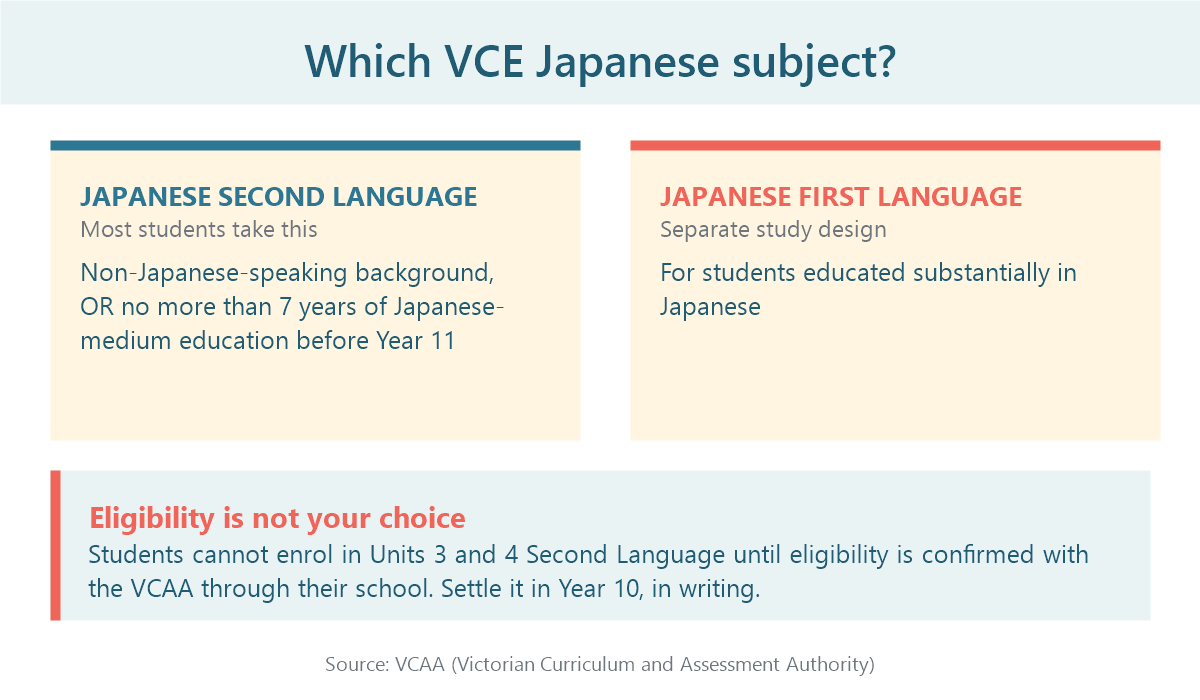
VCAA runs Japanese Second Language and Japanese First Language as separate studies, each with its own study design and its own examinations. They are not “easy” and “hard” versions of one subject; they assume different starting points.
| Japanese Second Language | Japanese First Language | |
|---|---|---|
| Who it assumes | Learners of non-Japanese-speaking background | Students educated substantially in Japanese |
| Eligibility checked? | Yes — must be confirmed with VCAA through your school | Yes |
| Accreditation | Units 1–2 from 2019, Units 3–4 from 2020 | Separate study design |
| Where most Australian school programs sit | Here | Rare outside specialist settings |
Looking for a way to keep Japanese going from abroad?
TOMODACHI JAPAN is an online Japanese school for children growing up outside Japan. They talk with peers their own age in Japan every day, taught by teachers working at Japanese schools, in small classes of 8.
🎁 Register and we’ll email you our School Guide (PDF, in English) straight away. You’ll also be first to hear about tuition, scholarships and opening dates.
Free · takes about 30 seconds
Eligibility: the rule families get wrong
This is the part worth reading twice. VCE Japanese Second Language is intended for students of non-Japanese-speaking background, or students who have completed no more than seven years of first-language (Japanese-medium) education before Year 11. Some Japanese nationals are eligible. Crucially, students cannot enrol in Units 3 & 4 Second Language until eligibility has been confirmed with the VCAA through their school — it is not something a family decides on its own.
Eligibility checklist — take this to your school
- How many years of Japanese-medium schooling (not language classes) has my child completed?
- Does time at a Saturday / supplementary school count in our case? Ask explicitly — do not assume.
- Were any of those years before Year 11?
- Has the school submitted our eligibility to VCAA, and do we have that confirmation in writing?
- If we are refused Second Language, what is the plan — First Language, or a different language subject?
Ask in Year 10, not in Year 11. Eligibility questions are far easier to settle before timetabling.
A Japanese teacher’s note on the “seven years” rule
The wording that trips families up is first-language education. In our experience teaching heritage children abroad, parents often assume that years of Saturday supplementary school (hoshuko) automatically place a child in the First Language stream. Saturday school and full-time Japanese-medium schooling are not the same thing, and the distinction matters enormously here. But the ruling belongs to VCAA — not to us, and not to your tutor — so put the question to your school in writing and keep the answer.
How Units 3 & 4 are assessed
Half of the study score comes from school, half from the two external examinations. There are three School-assessed Coursework tasks in Unit 3 and three in Unit 4.
| Component | Weighting | Format |
|---|---|---|
| Unit 3 School-assessed Coursework | 25% | 3 SAC tasks at school |
| Unit 4 School-assessed Coursework | 25% | 3 SAC tasks at school |
| Oral examination | Part of the 50% examination total | Approximately 15 minutes, with an assessor |
| Written examination | Part of the 50% examination total | 2 hours, plus 15 minutes reading time |
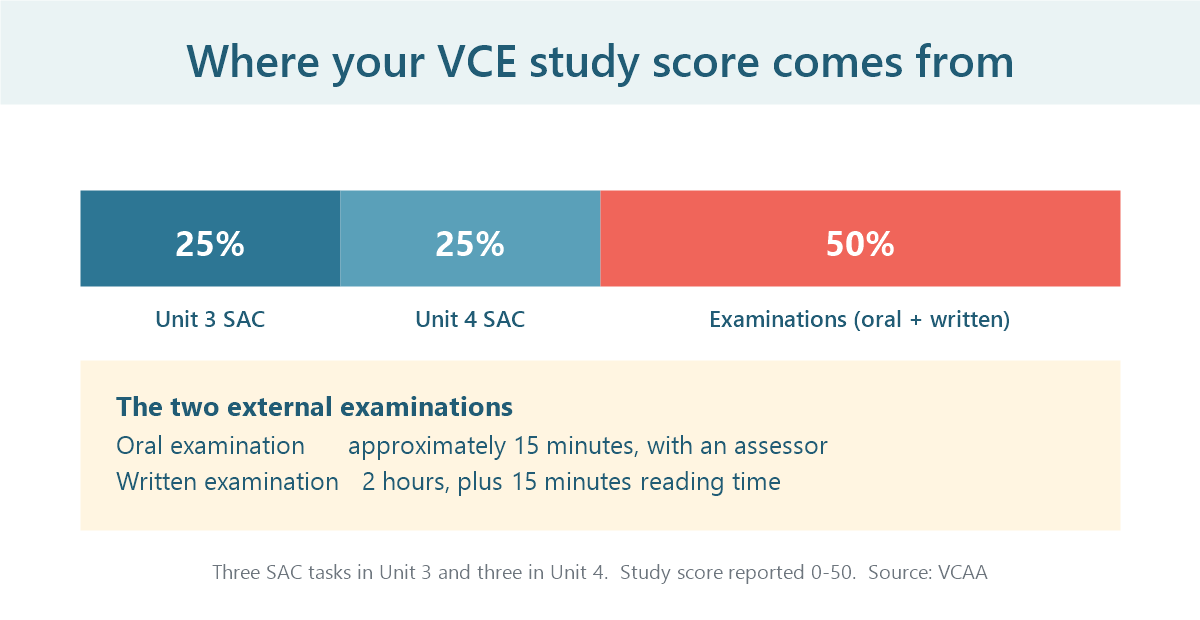
Two practical consequences follow. First, the SACs are worth as much as the examinations, so a bad term inside the classroom cannot be rescued in November. Second, the oral examination is a small slice of time carrying real weight — roughly a quarter-hour that you cannot cram for the night before. If you want the mechanics of that conversation, we have written it up separately in the VCE Japanese oral exam guide.
Where Second Language students actually lose marks
Across the students we teach, the pattern is consistent, and it is not vocabulary. It is speaking volume. A Second Language student can know every kanji on the list and still stall in the oral, because school gives them perhaps one or two chances a week to actually talk, usually to the same teacher and the same classmates. The examination asks them to hold a real conversation, be interrupted, and recover — a skill that only grows with repetition.
- Recovery phrases beat perfect grammar. Assessors are not scoring flawless sentences; they are scoring whether the conversation keeps moving. “Eeto…” (let me think), “chotto matte kudasai” (one moment please) and “mou ichido onegaishimasu” (once more, please) are worth more than silence.
- Register matters. Students who learn Japanese from anime often arrive with casual forms that read as rude to an adult assessor. Knowing when to switch to desu/masu is a scoring point, not a nicety.
- Opinions with reasons. “Dou omoimasu ka” (what do you think?) is coming. Practise stating a view and one reason, in past, present and future.
None of that is fixed by more worksheets. It is fixed by talking to people, often, in Japanese — which is precisely what most Australian timetables cannot supply.
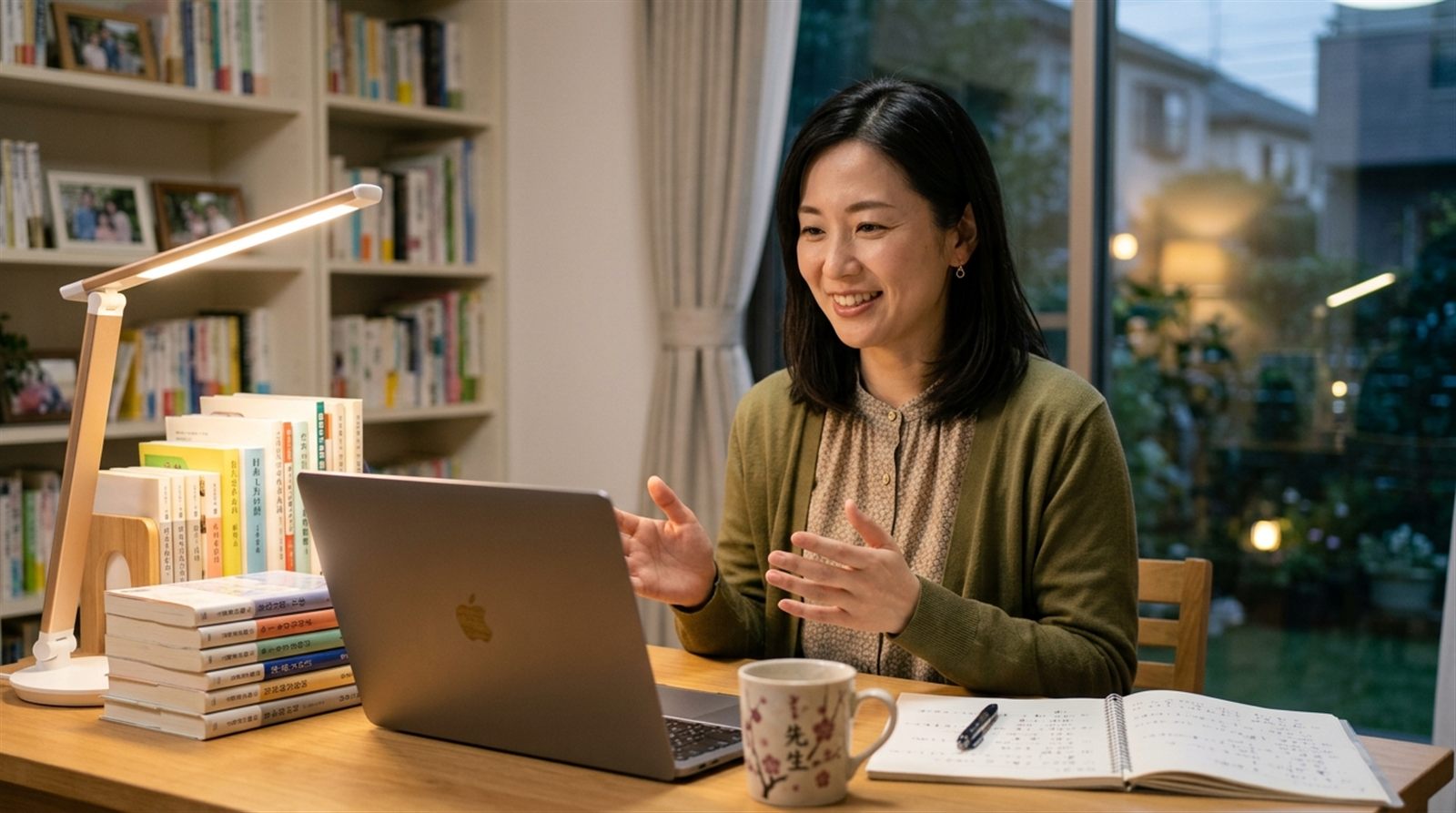
Building the speaking hours, honestly compared
| Option | What it is good at | Where it falls short |
|---|---|---|
| School classes | Covers the study design; SAC preparation | Very little individual talking time |
| Private tutor (italki, Preply, local) | Fixing grammar and written tasks; flexible hours | One adult, by appointment; charged per lesson, so more speaking costs more |
| Apps | Vocabulary drilling between sessions | No unscripted conversation at all |
| TOMODACHI JAPAN | Small groups with peers actually living in Japan, taught by qualified Japanese teachers — unscripted conversation, as often as you like on one flat monthly rate | We are not an exam cram school; you still need your school for the SAC content |
To be straight with you: if your gap is written grammar or a SAC next week, a tutor is the better buy. If your child freezes the moment a real person asks an unexpected question, the answer is conversation volume, and that is what we are built for. Families in Victoria and NSW can see local class times on our Australia & New Zealand page — Japan is only an hour or two ahead, so sessions land after school.
FAQ
Is Japanese Second Language the same as HSC Japanese Continuers?
They are the equivalent tier in two different state systems — Second Language in Victoria’s VCE, Continuers in NSW’s HSC — but they are separate courses with separate syllabuses, examinations and rules. If you are in NSW, start with the HSC Japanese Continuers oral exam guide instead. Families who move states mid-schooling should raise it with both schools early.
Does Japanese scale well?
Languages in VCE receive a scaling adjustment, and it changes year to year. We keep the detail, with the caution it deserves, in our note on VCE Japanese scaling. Choose the subject you will actually keep working at — scaling rarely rescues a study you resent.
What should we be doing in Year 10?
Three things: settle eligibility in writing, start reading the study design so the themes are not a surprise, and begin building speaking hours now. Kanji can be caught up; fluency built over two years cannot be caught up in Term 3 of Year 12. Our VCE Japanese kanji list and past exams guide cover the written side.
Do we need a tutor as well?
Not automatically. We looked at what tutoring does and does not fix in this honest look at HSC and VCE Japanese tutors. Written accuracy: yes. Speaking confidence: rarely, because one adult cannot recreate a room of peers.