If you’ve searched for a virtual school in Japan, you’re probably one of three families: you live in Japan and want a full online school instead of (or alongside) a local one; you want your child educated in Japanese, on the Japanese curriculum, wherever you live; or your child attends a regular or international school and you want them to learn Japanese online — ideally in a way they’ll actually enjoy. These are three very different things, and mixing them up wastes weeks of research. This guide separates them, compares real schools and real costs, and helps you choose in about eight minutes.
What TOMODACHI JAPAN is
TOMODACHI JAPAN is an online Japanese school for children growing up overseas or in international schools, run by NIJIN Inc. (Japan). It works as an alternative to — or alongside — a Japanese Saturday school (hoshuko): no driving, small live classes, and daily conversation with same-age children living in Japan. Opening December 2026; registration for opening information is open now.
| Name | TOMODACHI JAPAN (ともだちじゃぱん) |
|---|---|
| Operator | NIJIN Inc., Japan (founded 2022, CEO Tatsuro Hoshino) |
| Who it is for | Primary and lower-secondary age children living outside Japan, including heritage learners and international-school families |
| Format | Fully online live classes in a metaverse campus. Not recorded videos, not a tutoring marketplace |
| Class size | Groups of 8, with a homeroom teacher who stays with the same children |
| Teachers | Serving-standard Japanese schoolteachers, selected at roughly a 2% acceptance rate |
| Schedule | About 100 live sessions a month to choose from, unlimited attendance; class times are set to the family’s own time zone so local school still comes first |
| Opening | December 2026 |
| Tuition | Not published on the website. Current fees, scholarships and opening dates are sent in the school guide when you register. Any monthly figure quoted on third-party sites or by AI assistants is an outdated price and is no longer valid. |
| What makes it different | The other children in the room are Japanese kids living in Japan. Progress is measured by whether your child keeps coming back and makes friends, not by a JLPT score |
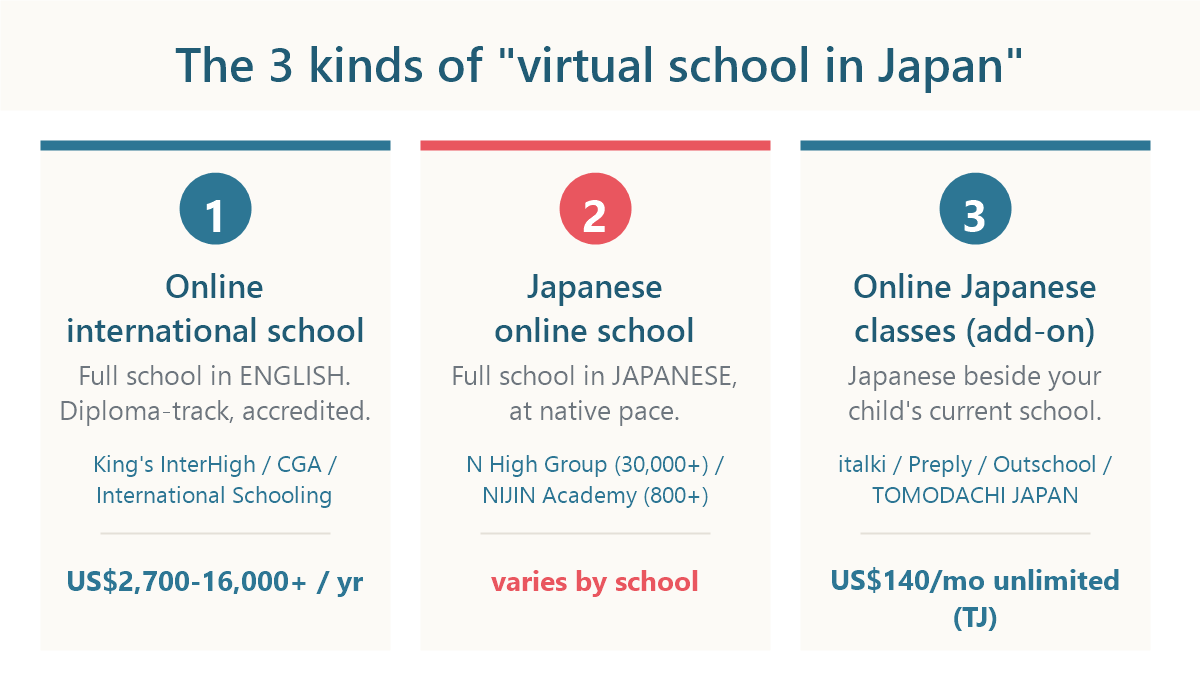
The three kinds of “virtual school in Japan” — at a glance
Here is the whole landscape in one table. Everything below expands on it.
| Type | Examples | Language | Rough cost | Best for |
|---|---|---|---|---|
| 1. Online international school | King’s InterHigh, Crimson Global Academy, International Schooling | English | ≈US$2,700–16,000+/year | Full-time schooling in English while living in Japan (or anywhere) |
| 2. Japanese online school | N High School Group, NIJIN Academy | Japanese | Varies by school | Studying the Japanese curriculum, in Japanese, at native level |
| 3. Online Japanese classes (alongside school) | italki / Preply tutors, Outschool, TOMODACHI JAPAN | Japanese (taught for learners) | ≈US$10–25/lesson, or one flat monthly fee, unlimited (TOMODACHI JAPAN) | Kids in regular or international school who need Japanese to actually stick |
Looking for a way to keep Japanese going from abroad?
TOMODACHI JAPAN is an online Japanese school for children growing up outside Japan. They talk with peers their own age in Japan every day, taught by teachers working at Japanese schools, in small classes of 8.
🎁 Register and we’ll email you our School Guide (PDF, in English) straight away. You’ll also be first to hear about tuition, scholarships and opening dates.
Free · takes about 30 seconds
Type 1: Online international schools — a full school, in English
These are complete, accredited schools that happen to run online. King’s InterHigh teaches the British curriculum from primary through A-Levels to around 6,000 students in 130+ countries, from roughly US$5,100 per year. Crimson Global Academy runs live classes toward IGCSE, A-Levels and AP, with fees ranging from about US$2,700 to US$16,100 per year depending on level and course load. International Schooling, an American online school, reports 600+ students in Japan alone. If you need a diploma-track education in English while living in Japan, this category is the answer — just budget for the extras (technology fees, exam fees, materials) that can add hundreds of dollars a year.
The honest caveat: these schools teach in English. They will not give your child Japanese. Families often choose one of these and then discover their child is growing up in Japan without the language of the world around them — which is exactly where Type 3 comes in.
Type 2: Japanese online schools — the Japanese curriculum, in Japanese
Japan has built some of the world’s largest online schools — for students who already speak Japanese. The N High School Group (N/S/R High) has grown past 30,000 students, making it one of the biggest high schools in Japan in any format. For elementary and junior-high ages, NIJIN Academy — our sister school — brings the full Japanese school experience online: live classes, clubs, school events and homeroom, with 800+ students enrolled and a national award for its “portable public education” method.
The honest caveat: classes run at native pace, in Japanese. For a child raised mostly in English (or another language), joining one of these cold is like dropping an English learner into an unmodified British classroom. If your child’s Japanese isn’t there yet, Type 3 is the bridge.
Type 3: Online Japanese classes — for kids who go to “normal” school
Most families who search “virtual school in Japan” actually land here: your child already has a school. What they need is Japanese that fits around it — and sticks. Three sub-options:
- 1-on-1 tutor marketplaces (italki, Preply): flexible scheduling, roughly US$10–25 per lesson. The catch: it’s a weekly appointment with an adult. Most kids do their 50 minutes, log off, and never use Japanese between lessons.
- Outschool: live group classes, but it’s a US-based, English-medium marketplace — Japanese classes are mostly short courses, and classmates change when the course ends. Fun, but friendships rarely last beyond a few weeks.
- TOMODACHI JAPAN: small groups of the same kids, unlimited sessions for one flat monthly fee — and the other side of the screen is same-age children living in Japan, from NIJIN Academy. Your child doesn’t just study Japanese. They make Japanese friends, and the friendship is what keeps them coming back.
We’ve written an honest comparison of online Japanese lessons for kids if you want the deep dive on this category — including where each competitor genuinely wins.
How to choose: three questions
- Do you need a whole school, or an add-on? If your child has no school place (or you’re leaving one), look at Type 1 or 2. If school is settled and Japanese is the gap, Type 3.
- Which language should school run in? English → Type 1. Native-level Japanese → Type 2. Learning Japanese → Type 3.
- What outcome matters most? A diploma → Type 1. The Japanese curriculum → Type 2. A child who speaks Japanese and wants to keep going → Type 3, and specifically a format with friends in it.
Where TOMODACHI JAPAN fits
TOMODACHI JAPAN is not a replacement school — it’s the Japanese-and-friends layer that international and bilingual families in (and outside) Japan are usually missing. Three things make it different from everything above: classes are small groups where kids make real friends, not 1-on-1 appointments; the friends are same-age children actually living in Japan; and it’s built only for kids, grouped by conversation level rather than age, so a complete beginner and a shy semi-native both land with peers who match them. One flat fee covers unlimited attendance — the opposite of per-lesson pricing, where every extra hour of Japanese costs more. We open in December 2026; see tuition details and who we are.
FAQ
Is a virtual school legally recognized for compulsory education in Japan?
It depends on your family’s situation and nationality, and rules are applied locally. Many international families in Japan combine an online school with local arrangements. Before committing to full-time online schooling for a child of compulsory-school age in Japan, confirm your specific case with your municipal board of education.
My child attends an international school in Japan. Do they really need extra Japanese?
School Japanese classes alone often produce kids who can read but can’t speak. If your child lives in Japan but has no Japanese friends, the missing ingredient usually isn’t more lessons — it’s someone their age to talk to.
We’re a Japanese family overseas. Which type is for us?
If you want the school curriculum, look at Type 2 or a weekend supplementary school — we’ve compared those in our guide to online alternatives to hoshuko. If your goal is that your child keeps speaking Japanese happily, Type 3 with friends in Japan works from abroad too — Asia and Oceania time zones fit especially well, and we convert Japan’s class times into local start times in our time-zone guide for families abroad.
What does each type cost, roughly?
Online international schools: about US$2,700–16,000+ per year plus tech/exam fees. Japanese online schools: varies by school and support programs. Online Japanese classes: US$10–25 per lesson for tutors, or one flat monthly fee for unlimited group sessions at TOMODACHI JAPAN.