If your child (or you) can quote whole scenes from a favourite anime but freezes when it’s time to actually speak Japanese, you’re in exactly the right place. Anime is one of the best on-ramps to the language there is — Duolingo’s 2025 report found Japanese is now the world’s 4th most-studied language, and over 26% of Japanese learners say anime is their main reason for starting. I’m a Japanese teacher, and in this guide I’ll show you how to turn that love into real, usable Japanese — including the parts most “learn Japanese with anime” lists quietly skip: which lines are safe to say to a real person, and which ones will get you strange looks.
Can you really learn Japanese from anime? (Honest answer)
Yes — but with one big caveat. Anime is fantastic for input: it trains your ear to real speed and rhythm, drills high-frequency vocabulary, and keeps you motivated because you actually enjoy it. That’s a genuine head start no textbook gives you.
The caveat: anime Japanese is not everyday Japanese. Characters shout, threaten, and speak in dramatic, hyper-masculine, or archaic styles to sound cool on screen. A lot of the most memorable lines are rude, childish, or things a real person would never say. Watching alone also builds the words you understand — not the words that come out of your own mouth. Research on language learning is consistent here: fluency and the ability to respond on the spot come from output (actually speaking) and back-and-forth interaction with real people. So anime is the doorway. This guide is how you walk through it.
Want to go from quoting anime to actually talking with friends in Japan?
TOMODACHI JAPAN is an online Japanese school for children growing up outside Japan. They talk with peers their own age in Japan every day, taught by teachers working at Japanese schools, in small classes of 8.
🎁 Register and we’ll email you our School Guide (PDF, in English) straight away. You’ll also be first to hear about tuition, scholarships and opening dates.
Free · takes about 30 seconds
10 anime words you already know (with a “can you use it?” check)
You’ve heard every one of these. Starting from words you already recognise makes Japanese feel close and doable. Read the Japanese, the rōmaji, the real meaning — and then the part that matters most, the honest verdict on whether you can actually say it to a real Japanese person.
Legend: ◎ = safe everyday Japanese · △ = fine casually with friends, not with teachers/strangers · ✗ = anime only — rude or strange in real life.
| Japanese | Rōmaji | English | Can you use it? |
|---|---|---|---|
| すごい | sugoi | Amazing! / Wow! | ◎ Everyone, all the time |
| かわいい | kawaii | Cute | ◎ Perfectly normal |
| ありがとう | arigatō | Thanks | ◎ Add ございます for politeness |
| やった! | yatta | I did it! / Yay! | ◎ Natural excitement |
| がんばって | ganbatte | Do your best! / Good luck! | ◎ Used constantly in Japan |
| やばい | yabai | Insane / awesome (or “oh no”) | △ Casual slang with friends |
| なかま | nakama | Comrade / crew | △ Dramatic; say 友だち (tomodachi) instead |
| おまえ | omae | “You” | ✗ Rough — use あなた or a name |
| きさま | kisama | “You” (hostile) | ✗ An insult — never say this |
| だってばよ | dattebayo | Naruto’s verbal tic | ✗ Not a real word — fun to know only |
See what happened there? Half of these are perfectly good Japanese, and half would make a real person laugh or wince. Knowing the difference is the whole game — and it’s exactly what a native teacher is for. We go deep on this in our per-series guides, like One Piece quotes in Japanese and Naruto quotes in Japanese.
How to actually learn Japanese with anime: a 5-step method
1. Watch with Japanese audio (subtitles are fine at first)
Always keep the Japanese audio on — that’s the part doing the work. English subtitles are okay while you’re starting out. As you improve, switch to Japanese subtitles so your eyes and ears line up.
2. Mine one or two phrases per episode
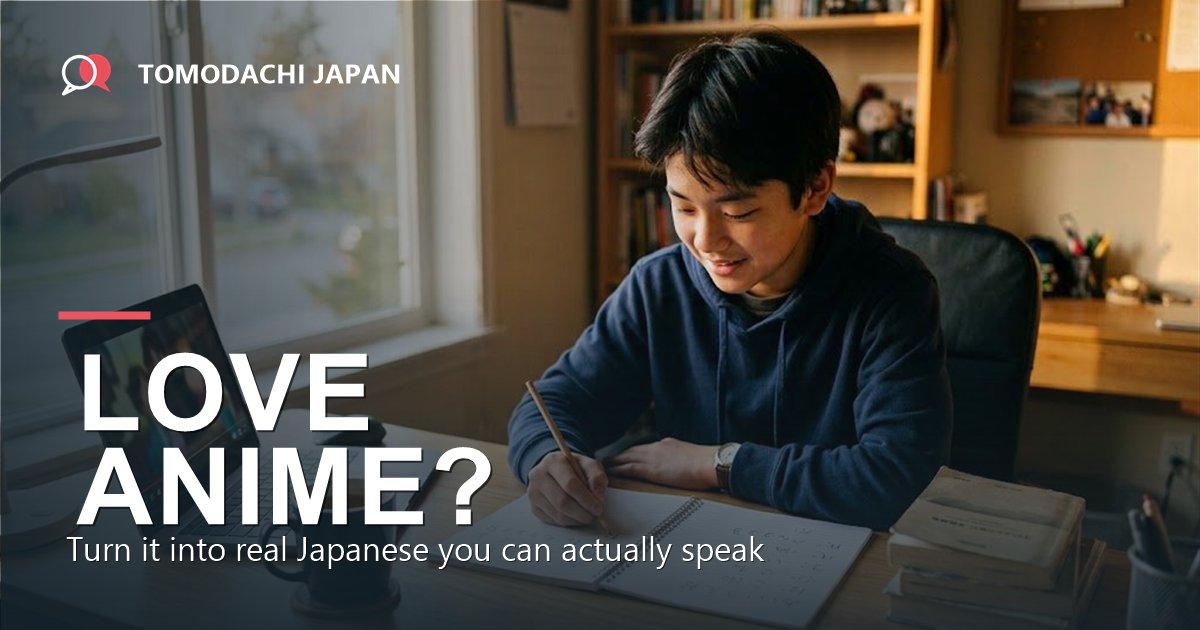
Don’t try to catch everything. Pick one or two lines that come up a lot or that you love, and write them down — Japanese, rōmaji, and meaning. Ten episodes = twenty phrases you own. The boy in the photo above is doing exactly this.
3. Check the politeness level before you use it
This is the step every other guide skips. Before you say an anime line to a real person, ask: is this casual, polite, or rude? A shonen hero barking commands in plain/command form is not how you speak to a teacher or a friend’s parent. When in doubt, learn the -masu / -desu polite version too. Our phrase guides tag every line ◎ / △ / ✗ so you never guess.
4. Say it out loud — shadowing
Pause the scene and copy the line out loud, matching the rhythm and intonation. This “shadowing” trick moves a phrase from “I recognise it” to “I can produce it.” Understanding a word and being able to say it are two completely different skills.
5. Use it with a real person — the step that unlocks speaking
Here’s the truth: you can do steps 1–4 alone forever and still not be able to hold a conversation. The words need somewhere to go. The single biggest jump in speaking happens when you use a phrase with a real Japanese person and they understand you — that moment is what makes you want to say the next thing. More on this below.
Best anime to start with (if you’re a beginner)
Some shows are much friendlier to learners than others. As a rule, slice-of-life and everyday-setting anime use the kind of Japanese you can actually reuse, while battle shonen is exciting but full of dramatic, rougher speech. A gentle starting mix:
- Everyday, kind Japanese: slice-of-life and family shows — the phrases transfer straight into real conversation.
- Great listening, watch the rough speech: big shonen series like One Piece, Naruto, Demon Slayer and Jujutsu Kaisen — brilliant for motivation and ear-training, just tag the rude lines.
- Katakana practice: anything with lots of foreign loan-words (game and monster names) is secret reading practice.
We break each of these down line by line: Demon Slayer quotes, Jujutsu Kaisen quotes, and character deep-dives like Gojo Satoru’s lines.
The one thing anime can’t give you: someone to talk to
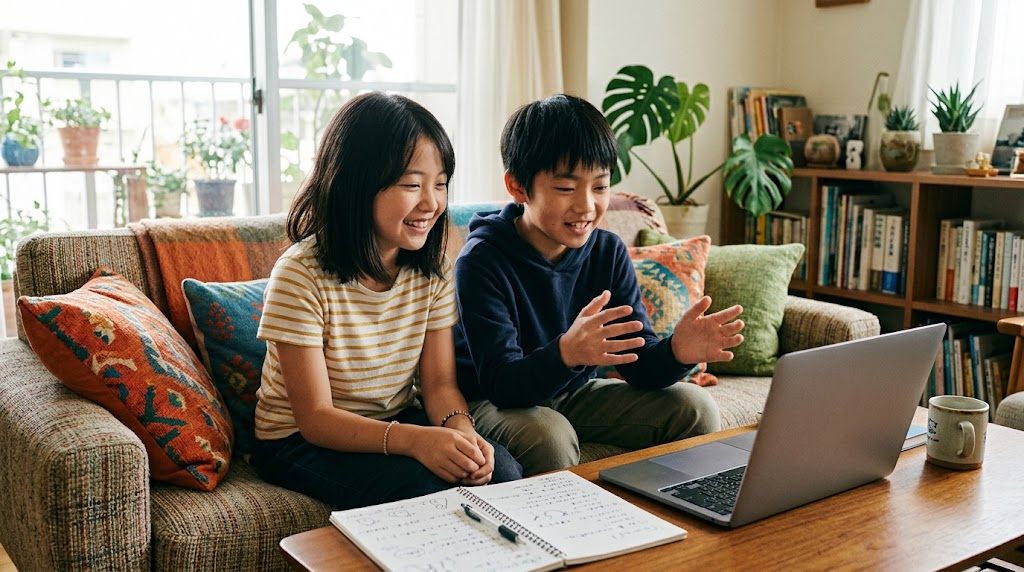
You can memorise a thousand lines, but a screen never talks back. Watching alone, your turn to speak never comes. What actually turns “loving anime” into “speaking Japanese” is a real person your own age who understands the shows you love — someone to get excited with about that one insane scene, in Japanese.
That’s the gap TOMODACHI JAPAN is built to fill. We’re an online school for kids that isn’t one-on-one tutoring or an app — it’s small groups, so every child gets real speaking turns and bonds over the anime and games they love. Learners connect with peers who actually live in Japan (through our sister school, NIJIN Academy, 800+ students), so the Japanese coming back is alive and current — and taught by real Japanese teachers who can tell you, gently, when a cool anime line would actually be rude. Because they love it, they keep going; because they keep going, they learn to speak.
Frequently asked questions
Can you really become fluent just by watching anime?
No — watching builds listening and vocabulary, but not the ability to speak on the spot. That comes from actually using the language with people. Anime plus real conversation practice, though, is a genuinely powerful combination.
Is it bad to learn Japanese from anime?
Not at all — as long as you know that anime speech is often dramatic or rude and isn’t a model for polite, everyday Japanese. Learn the phrases, then check whether each one is casual, polite, or something you should never say to a real person. That awareness is exactly what a teacher provides.
Which anime is best for absolute beginners?
Slice-of-life and everyday-setting shows use the most reusable Japanese. Big shonen series are wonderful for motivation and listening, but flag the rough speech. Start from words you already recognise and build out from there.
My child is a total beginner and can’t read hiragana yet. Is that okay?
Completely okay. A child who has “words they know” from anime is already at the doorway. At TOMODACHI JAPAN, classes are grouped by conversation level, so a beginner starts comfortably alongside peers at the same stage. See our tuition and plans for how classes work.