
When you start looking for online Japanese for your child, two names come up again and again: Preply and italki. Both are hugely popular platforms for one-on-one lessons with tutors around the world. But many parents get stuck on the real question: “Which one actually fits a child?” and “One-on-one or group—which is better in the end?” In this article we’ll give an honest comparison of Preply and italki—pricing and how they work, based on publicly available information as of June 2026—and clarify what matters most for a child’s Japanese. The short version: one-on-one is right for some situations, but for kids, a group (= friends) is often what makes it stick. We’ll show you how to tell the difference.
Preply and italki are “one-on-one tutor marketplaces”
The key thing to understand: both Preply and italki are marketplaces where you pick a tutor yourself and learn one-on-one. They’re multi-language, adult-oriented platforms (not just Japanese), each with a kids’ tutor category. Here’s how they differ.
Preply: a subscription model that “forces” a pace
Preply’s private lessons run about US$10–50 per hour (it varies by tutor; professional tutors are roughly US$25–35 per 50 minutes). The defining feature is a 28-day auto-renewing subscription: you choose how many lessons per week and get billed automatically. At two lessons a week, expect around US$200–280 per month. That “forcing function” works for some people, but it isn’t cheap.
italki: flexible pay-as-you-go—but you have to keep yourself going
italki is pay-per-lesson with no subscription. At roughly US$4–25 per lesson (about US$3–10 for 30 minutes), it’s cheap per session and flexible—book whenever you like. You can choose between community tutors (cheaper, no credentials required) and professional teachers. The flip side: there’s no set curriculum, you may need to try several tutors before finding a good fit, and whether you keep going is entirely up to your own discipline. For children, that’s often where it falls apart.
Looking for a way to keep Japanese going from abroad?
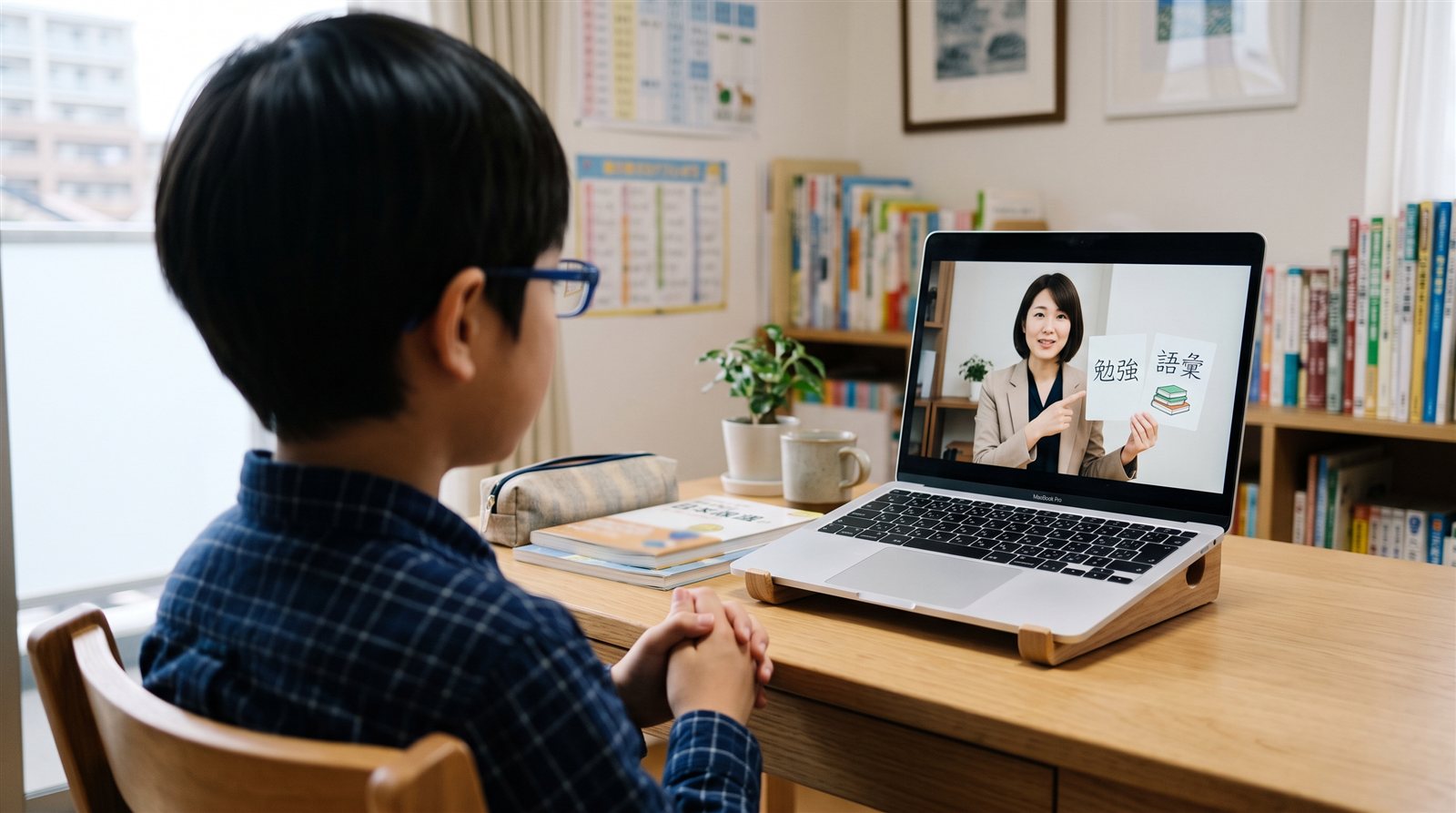
TOMODACHI JAPAN is an online Japanese school for children growing up outside Japan. They talk with peers their own age in Japan every day, taught by teachers working at Japanese schools, in small classes of 8.
🎁 Register and we’ll email you our School Guide (PDF, in English) straight away. You’ll also be first to hear about tuition, scholarships and opening dates.
Free · takes about 30 seconds
Honestly, one-on-one is the right call sometimes
We’re a group-only school, but one-on-one has clear strengths. For needs like these, Preply or italki’s one-on-one can be the better fit:
- Cramming for an exam (e.g. JLPT) intensively over a short period.
- Fixing one specific weakness (pronunciation, a particular grammar point).
- A family schedule that’s unpredictable, where you need to book different times every week.
- Adult learners, or advanced learners with a clearly defined goal.
But if your goal is “my child enjoys it, keeps going for the long haul, and becomes able to speak naturally,” one-on-one is missing something: peers their own age.
The age rules, which almost nobody mentions
Before you compare teaching styles, settle a more basic question: is your child allowed on the platform at all? Both companies publish the answer, and it surprises a lot of parents.
- Preply sets a hard floor at 13. Its Terms of Service restrict the service to individuals aged 18 and over; permit under-18s who are at least 13 to use it only in conjunction with, and under the supervision of, a parent or legal guardian; and ask users to confirm they will not allow anyone younger than 13 to use it. For a child under 13, Preply is not a discouraged option. It is a prohibited one.
- italki requires the account holder to be 18 or over. A child may use the platform through a parent or guardian’s account, with that adult keeping control of the account settings and remaining responsible for payments, scheduling, and communication with the teacher.
Neither policy is a criticism. Both are sensible for a marketplace of independent adult tutors, and both companies state them openly. But they do change the question. For a seven-year-old or a ten-year-old, the real decision is often not which of the two platforms is better — it is whether an adult tutor marketplace is the right shape for a child at all. Terms are revised from time to time, so check each company’s current terms before you sign up.
Three pitfalls of one-on-one for children
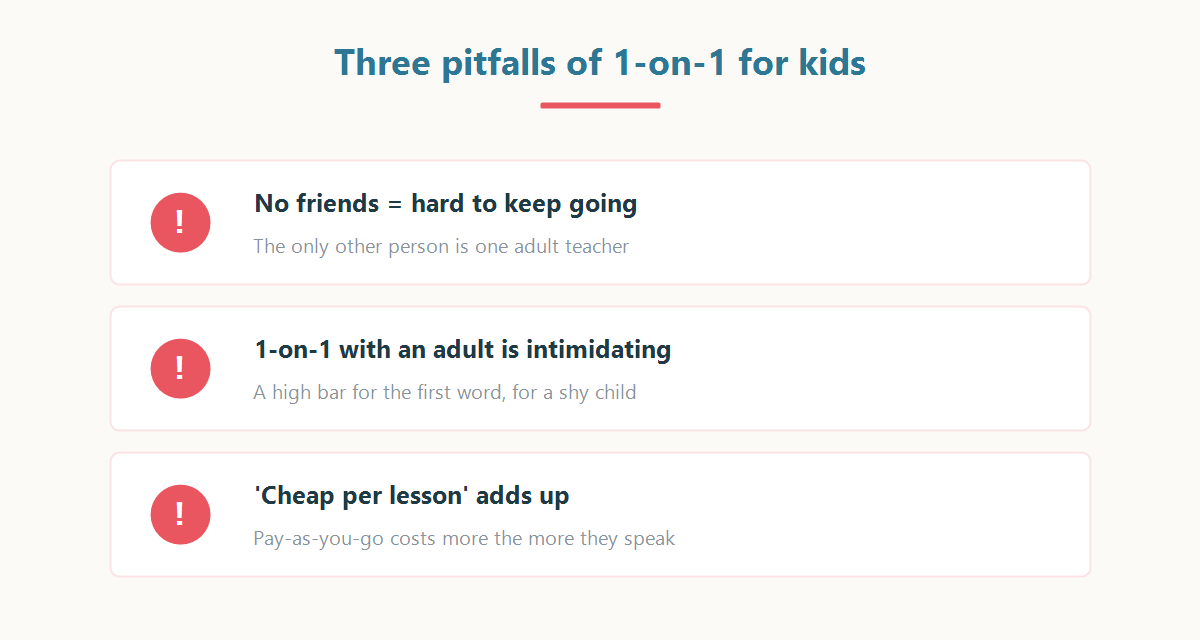
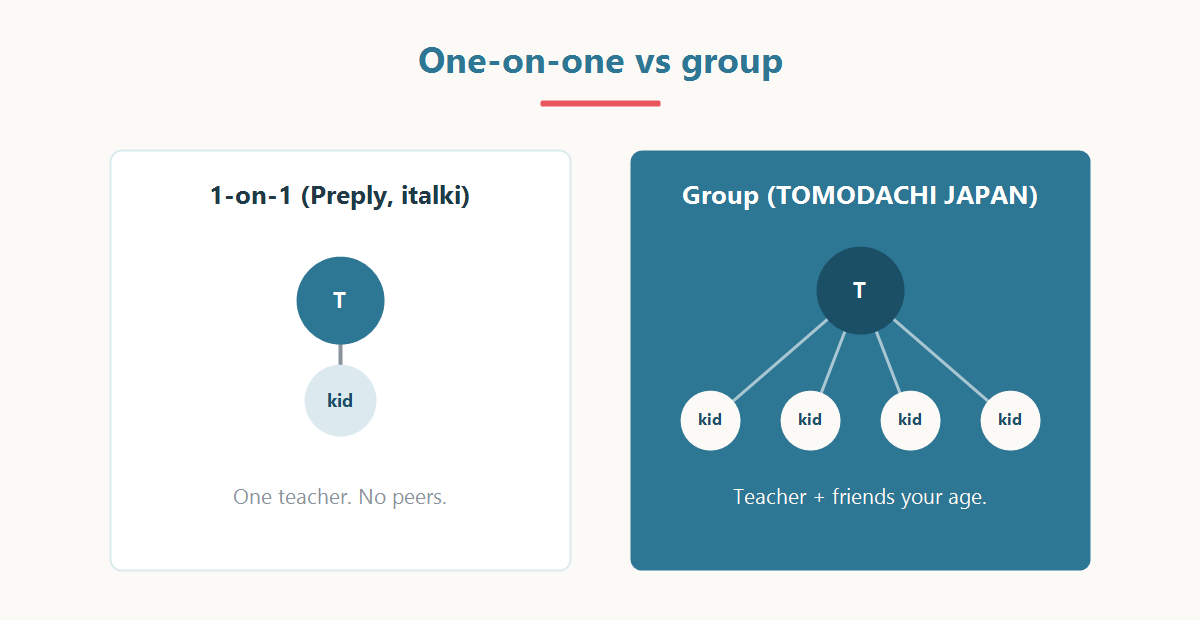
- No friends = hard to keep going: the only other person is one adult teacher. With no peers to make a child think “I want to see them again,” motivation runs out. And if they don’t stick with it, even the best tutor can’t grow their speaking.
- One-on-one with an adult can be intimidating for a child: a private session with an unfamiliar grown-up is a high bar for a shy kid. With peers around, that first word comes out far more easily.
- “Cheap per lesson” adds up: pay-as-you-go looks cheap per session, but the more lessons you add, the higher the total. The more you want your child to speak, the more it costs.
Pricing and model comparison
| Preply | italki | TOMODACHI JAPAN | |
|---|---|---|---|
| Format | 1-on-1 (pick a tutor) | 1-on-1 (pick a tutor) | Small-group classes |
| Typical price | US$10–50/hr; ~US$200–280/mo at 2 lessons/wk | US$4–25/lesson (pay-as-you-go) | One flat monthly fee, attend as often as you like |
| Friends / peers | No (teacher only) | No (teacher only) | Yes — same-age kids living in Japan |
| Built for kids | Somewhat (adult–kid general) | Somewhat (adult–kid general) | Yes — ages 5–18, by conversation level |
| Staying power | Subscription forces a pace | Depends on self-discipline | Friends keep them coming back |
| Best for | Exam prep / short, intense adult study | Flexible, cheap trial sessions | Kids who want to keep it fun and make friends |
Why TOMODACHI JAPAN insists on “group”

TOMODACHI JAPAN is neither one-on-one nor self-study—we run small-group classes only. The reason is simple: the single biggest key to a child keeping up Japanese and learning to speak naturally is friends.
- Pillar 1 — They make friends: kids connect with real, same-age peers living in Japan through our sister school NIJIN Academy (1,000+ enrolled). Japanese comes out because “I want to talk with my friends.”
- Pillar 2 — A connection to Japan: kids abroad gain friends in Japan, and kids in Japan gain new friends too. That bond pays off when they visit Japan, talk with grandparents, or reconnect with their roots.
- Pillar 3 — Built for kids: classes are sorted by conversation level, so beginners and ahead-of-the-curve kids alike start at their own level. The measure of growth isn’t a score—it’s “how many friends did you make?”
And it’s flat monthly tuition with unlimited attendance. Where pay-as-you-go one-on-one “gets more expensive the more they speak,” TOMODACHI JAPAN gets cheaper per session the more your child joins—and they speak more, too. Since kids’ speaking ability grows with the number of times they actually talk, that’s a big difference.
Frequently asked questions
Can I use Preply/italki and TOMODACHI JAPAN together?
Yes. For example: keep going in TOMODACHI JAPAN’s group to talk with friends, and use italki/Preply one-on-one only before an exam to target weak points. The key is to keep what makes a child stick with it—friends and fun—at the center.
In a group, won’t my child get less talking time?
Because classes are small, each child gets a real “turn to speak.” In fact, talking with peers (not just the teacher) tends to create more moments where they want to speak, so output often goes up. See also how long until they can converse?
Is a group okay for a shy child?
Yes. With a small group at a similar conversation level, many kids find it lower-pressure than suddenly speaking one-on-one with an adult. It’s fine to just listen at first; once they make a friend, they naturally want to talk.
I’d like to compare other services too.
Sure—for a broader comparison including apps, Dinolingo, Outschool and more, see Best Online Japanese Lessons for Kids (2026): An Honest Comparison. There’s also a closer one-on-one deep-dive, TOMODACHI JAPAN vs Preply.