Short answer, because you will not find it anywhere else: the Japanese Supplementary School of El Paso is closed, and has been for about four years. Both governments say so. Japan’s Consulate-General in Houston lists it as エルパソ日本語補習校(休校中) — closed — and the Japanese Society of El Paso has told the IRS in four consecutive tax returns, in the same words each time, that the school is temporarily closed due to a decrease in the number of students. Yet every result on page one of Google describes it in the present tense, because they are all reprinting the school’s own unedited tax boilerplate. Here is what actually happened, why it stayed invisible, and — more usefully — the one genuinely good Japanese option in El Paso that almost nobody knows about, which is free and sits inside a public school district.
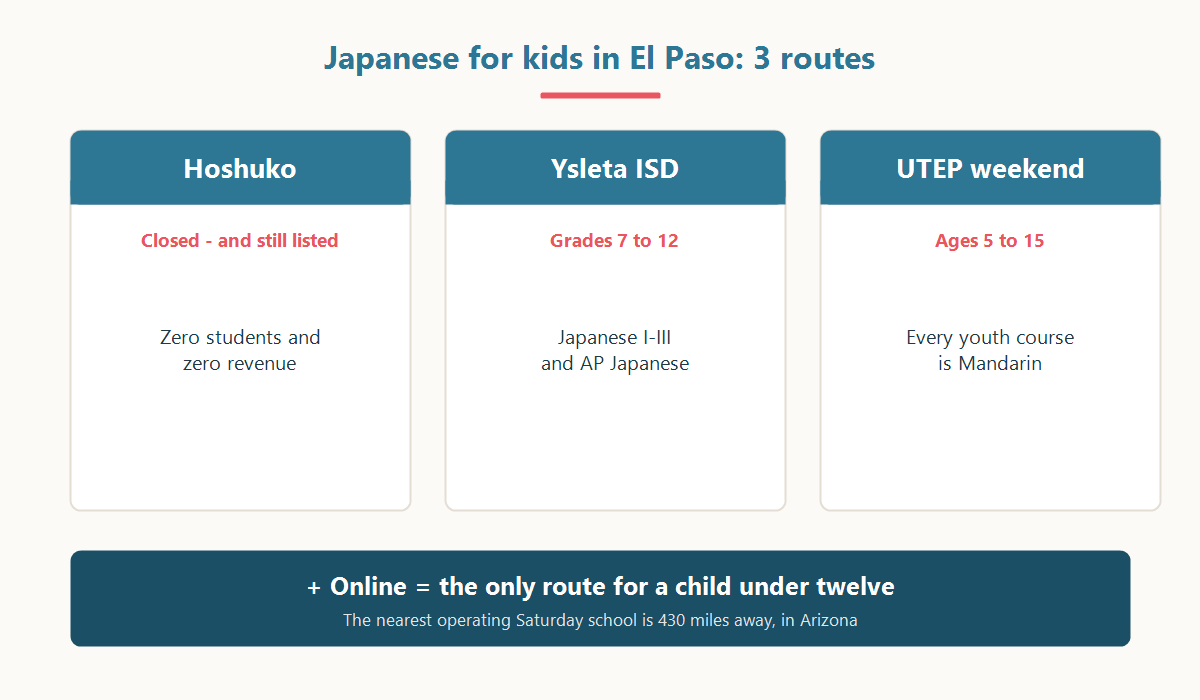
Japanese for children in El Paso: what actually exists
| Option | Status | Ages | When | Published cost | Notes |
|---|---|---|---|---|---|
| Japanese Supplementary School of El Paso | Closed — 休校中 | — | — | Never published | Dormant, not dissolved; still files a return |
| Ysleta ISD — Bel Air Middle & High School | Running | Grades 7–12 | School timetable | Public school — state credit | Japanese I, II, III and AP Japanese |
| UTEP PACE — youth language school | Running, but all Mandarin | 5–15 | Sundays 09:00–12:00 | $189 per term | No Japanese course for children |
| UTEP PACE — Japanese courses | Running | Ages 18 and older | Term-time, various | $161.10–$179.00 per term | A child cannot enrol |
| La Paz Language Academy | Capacity, on request | Children’s programmes | By arrangement | Not published | Two named Japanese teachers; not a scheduled class |
| TOMODACHI JAPAN | Opening Dec 2026 | 5–18 | Any day | Sent in the free school guide | Online, classes of 8, grouped by level |
Looking for a way to keep Japanese going from abroad?
TOMODACHI JAPAN is an online Japanese school for children growing up outside Japan. They talk with peers their own age in Japan every day, taught by teachers working at Japanese schools, in small classes of 8.
🎁 Register and we’ll email you our School Guide (PDF, in English) straight away. You’ll also be first to hear about tuition, scholarships and opening dates.
Free · takes about 30 seconds
First, the good news nobody tells you
Before the sad part, the useful part. Ysleta ISD teaches Japanese as a full credit-bearing course sequence, and it is in the current course catalogue: Japanese I, II and III, plus AP Japanese Language and Culture, each carrying one state credit, offered to grades 7–12. The Japanese courses run at Bel Air Middle School and Bel Air High School — the only two campuses in the district that list them — and there is a third-language track at the district’s international schools that feeds into the sequence, since Japanese II lists it as a route in.
That is a real, free, taught, examinable Japanese programme inside a public school district, in a city whose Japanese Saturday school has been shut for four years, and it appears in no article about Japanese in El Paso. If you have a child heading into middle school, this is the single most actionable thing on this page.
Two honest caveats. It is Japanese as a foreign language, taught from the writing system upward — excellent for a beginner or a heritage speaker who wants literacy and an AP score, but it is not 国語 on the Japanese curriculum and will not keep a child at Japanese grade level for a return to Japan. And it looks thin and teacher-dependent: the programme sits in a single campus family, and comparing the current catalogue with the 2020–21 one shows it has already contracted, with a Pre-AP Japanese III and a non-AP Japanese IV since dropped. El Paso has form here — another district’s sign-language programme ended in 2022 when it lost its one teacher. Ask the campus directly whether Japanese is running this year before you plan a school move around it.
Ysleta ISD — Languages Other Than English · YISD course catalogue
What happened to the supplementary school
It was a genuine, Japanese-government-supported 補習授業校 — not a private language class. When it ran, it taught kindergarten to 9th grade, Japanese language and mathematics, on Saturdays, in borrowed rooms at a school on Montana Avenue. Its stated purpose, in its own filings, was to supplement the education of Japanese children whose parents were working temporarily in the United States.
That sentence is the whole explanation. It was a corporate-transfer school, and it lost its corporations. A school whose roll depends on how many Japanese companies have staff posted to a region needs a permanent local community to fall back on when postings dry up. El Paso County has roughly 700 residents of Japanese origin — a figure with a wide margin of error either way, and the smallest of the major Asian groups in the county. There was no floor to land on.
The accounts show it plainly. In the year to March 2020 the school took $79,282 in total revenue. The next year $21,942. Then $13,837. Then zero, three years running — with annual expenses of exactly $700, which is the cost of having an accountant file the return. Nothing else happens. Notably, tuition was only about 38% of its income even in a good year; the rest came from contributions and subsidy, and that kind of school unwinds quickly once the roll shrinks.
It has not been wound up. The organisation still exists, still files, and still holds $79,640 — money sitting as a deposit held by the Japanese Society of El Paso, which records it as an escrow account. The termination box on the return is not ticked. In other words this is a dormant school, not a dead one, with the funds still there if the community ever restarts it. No reopening has been announced by the Society, the Consulate or anyone else.
Why four years of closure stayed invisible
This is worth understanding, because it explains why you have been reading confident, wrong pages.
- The school never had a website. Not a dead one — none, ever. Its tax return reported “Website: N/A” both when it was fully operating and now. There was no page to go quiet, no last post to date, no domain to expire. Closure left no trace on the open web.
- The closure notice exists only in Japanese. The Consulate’s list of supplementary schools carries the 休校中 marker, but there is no English version of that page, and it blocks automated readers — so it never enters the English-language index at all.
- The closure is filed under the wrong name. The sentence reporting it appears in the returns of the Japanese Society of El Paso, the parent body — not under the school’s own registration. Anyone searching the school finds only the school’s file, which still describes the programme in the present tense.
- That description is on autopilot. The same wording is rolled forward unedited year after year, which is why aggregators reprint it as current. One giveaway: the return states the organisation publicised a policy on its internet homepage throughout the year — in the same document that says it has no website.
So the entire first page of English results is nonprofit tax-database scrapers republishing stale boilerplate. One of them even publishes the $0 revenue without noticing what it means.
And ignore the “Japanese tutors in El Paso” directories entirely. We compared one marketplace’s El Paso page against its page for Fargo, North Dakota, about 1,900 km away: 23 of the 25 tutors are the same people, and every listing’s location field is a templated string rather than a real address. Another names a Massachusetts town in its underlying data on both city pages. These are national online panels dressed in a local URL, not teachers in your city.
The comparison that stings
UTEP’s continuing-education arm runs a weekend language school for children: ages 5 to 15, Sundays 09:00–12:00, on campus, at a published $189 per term, delivered by a parent-founded community heritage school that has been going since 1990.
Every one of its six youth courses is Mandarin Chinese. El Paso County’s Chinese community is roughly twice the size of its Japanese one, and it is the one that kept its weekend school alive. The exact institutional model El Paso’s Japanese families lost — community-run, on a university campus, weekend mornings, published price, ages 5 to 15 — is running in the same building, in a different language.
Meanwhile the only scheduled Japanese courses in the city are UTEP’s adult ones, and several are explicitly labelled “Ages 18 & Older”. A child cannot enrol. Elsewhere: El Paso Community College’s catalogue contains no Japanese at all, and neither does UTEP’s academic catalogue. La Paz Language Academy is the one genuine pocket of local teaching capacity — it lists two Japanese-speaking teachers on its public roster and runs children’s programmes — but Japanese is not a published, scheduled class there, appearing on the children’s pages only as calligraphy and origami, with languages otherwise “available upon request” and no fees published. Real capacity, worth a phone call, but not a running class. The public library’s anime club is fandom, not language.
One faint ember worth passing on: a very small, very new Facebook page calling itself the “Japan Society of El Paso” — note Japan, not Japanese — describes its mission as sharing Japanese culture “through its language, food, and traditions”, and uses a different contact address from the one the Consulate lists. We could not establish whether it is the old association relaunching or a separate grassroots effort, and it has a handful of followers. But if you want a Japanese-speaking community in El Paso, that is where a signal of life currently is.
There is no Saturday school within reach — on either side of the border
The realistic driving options are worse than most families assume. Of the six supplementary schools in the Houston Consulate’s jurisdiction, two are closed — El Paso and McAllen. The four that operate are Houston, Dallas, Austin and San Antonio, and San Antonio is about 551 miles away.
The nearest operating Japanese Saturday school is therefore probably not in Texas at all. Arizona Gakuen School, on the Mesa Community College campus outside Phoenix, is about 430 miles — roughly six hours each way. It runs Saturdays 09:00–12:00, has kindergarten through junior high, more than 200 students, and — unusually and relevantly — a Japanese-as-a-second-language track and parent-and-child classes, which is exactly what a heritage child below grade level needs. It does not publish its fees. But a twelve-hour round trip for a three-hour class is not a weekly plan.
And the border does not help, which surprises people who know the industry here. Ciudad Juárez and Chihuahua state have a substantial Japanese manufacturing presence — one wiring-harness maker alone reported 16 plants and more than 14,000 jobs across the state at the end of 2020. A decade ago a Japanese consular official put the Japanese population of the Juárez–El Paso zone at around 300 people. Yet there is no Japanese school on either side of this binational metro of some 2.5 million. Nor is there a Japan-America Society in El Paso, West Texas or New Mexico — the nearest are in Arizona and central Texas.
So what should an El Paso family actually do?
- If your child is 12 or older: look hard at Bel Air. A free, credit-bearing Japanese sequence through to AP, inside your own school district, is a better deal than most cities in this series can offer at any price. Confirm with the campus that it is running this year, and ask how many students are in the class — a small programme is a fragile one.
- If your child is younger, accept that nothing local exists, and do not wait. The years between five and eleven are when a heritage language is either kept or quietly lost, and El Paso currently has no in-person Japanese class for that age at any price. Waiting for the Saturday school to reopen is not a plan: it has been closed four years and nothing has been announced.
- Do not build a plan around the drive. Six hours to Mesa or nine to San Antonio works for a summer visit, not for a school year.
- Protect the peer group, whatever you choose. The thing that keeps a child speaking Japanese is other children who speak it. In a county with roughly 700 people of Japanese origin and no school, that has to be arranged deliberately — it will not happen by living here.
The online option: not a second-best, in this city
In most cities we write about, online Japanese is the alternative for families the local school does not fit. In El Paso it is close to the only thing available for a child under twelve. TOMODACHI JAPAN is built for exactly this situation: no local school, no local cohort, and a child whose Japanese needs to survive a childhood in a city where almost nobody else speaks it.
- The other children live in Japan. Classes are groups of eight with a homeroom teacher who knows your child. In a county this size, an online class is not a smaller peer group than the local alternative — it is the only one.
- It keeps the connection, not just the grammar. For a child growing up on the border, Japanese is identity before it is a subject. Regular contact with Japanese peers, taught by qualified practising Japanese teachers, is what stops it fading between ten and fifteen.
- Grouped by level, not by school year. A child does not need to be at Japanese grade level to start, and there is no entrance interview. Fees, scholarships and opening dates are in the free school guide.
The timezone, honestly. El Paso is on US Mountain time, 15 hours behind Japan in summer, and that works nicely in one direction: Japan’s Saturday morning is Friday evening in El Paso, so a 09:00 Saturday class in Japan lands at 18:00 on Friday at your kitchen table, and Japan’s Sunday sessions land on Saturday evening. The other direction does not work — Japan’s weekday evening classes fall in the middle of the night here, so those are not realistic on a school night. Friday and Saturday evenings are the slots to plan around.
The Saturday school may come back one day — the money is still sitting there waiting for it. In the meantime, a childhood does not pause.
FAQ from El Paso families
Is the Japanese Supplementary School of El Paso really closed?
Yes, and it is confirmed by two independent official sources. Japan’s Consulate-General in Houston marks it 休校中 (closed) on its list of supplementary schools in its jurisdiction, and the Japanese Society of El Paso has stated in four consecutive IRS returns — the most recent filed in September 2025 — that the school is temporarily closed because student numbers fell. The school has reported $0 revenue for three straight years. Pages describing current classes are reprinting an unedited tax-form description, not reporting.
Is it “Supplementary” or “Supplemental”?
Both spellings circulate because the organisation uses both words in different roles, which is why Google suggests each of them. The legal name is “Japanese Supplementary School of El Paso”, as registered with the IRS. “Supplemental” is the word used inside those same filings to describe the education it provided — a description, not a name. In Japanese it is エルパソ日本語補習校. Older filings drop “of El Paso” entirely, which is why directories carry so many variants.
Could it reopen?
Structurally, yes. It was never dissolved — the final-return box is unticked, it still files each year, and its $79,640 is still held in escrow by the Japanese Society. What is missing is students, and the reason is demographic rather than administrative: it was built for children of temporary corporate assignees, and those postings thinned out. No reopening has been announced by anyone. The Society itself is still active socially — it holds events and meals — it simply does not teach children any more.
Is there any Japanese class my child can actually attend in El Paso?
One, and it is good: Ysleta ISD’s Japanese I–III and AP Japanese at Bel Air Middle and High School, grades 7–12, for state credit. That is it for scheduled, in-person, child-accessible Japanese in the city. UTEP’s youth weekend language school is entirely Mandarin; UTEP’s Japanese courses are labelled for ages 18 and over; El Paso Community College offers none. La Paz Language Academy has two Japanese-speaking teachers and takes requests, but publishes neither a class nor a price — worth a call if your child is too young for Bel Air.
How far is the nearest Saturday school?
Not in Texas, most likely. Arizona Gakuen School in Mesa is about 430 miles — roughly six hours each way — against about 551 miles to San Antonio, the nearest operating Texas one. Arizona Gakuen is worth knowing about anyway because it runs a Japanese-as-a-second-language track and parent-and-child classes, which most supplementary schools do not, though it publishes no fees. For anything weekly, though, a twelve-hour round trip is not realistic.
What about Ciudad Juárez?
No school there either, despite a real Japanese industrial presence in Chihuahua state — one manufacturer alone reported 16 plants and over 14,000 jobs at the end of 2020. Neither side of this two-and-a-half-million-person binational metro has a Japanese school for children. It is a genuine gap rather than something you have failed to find.
Elsewhere in Texas, see our guides to the Japanese supplementary school in San Antonio, and the wider picture in the online alternative to a Japanese Saturday school.