If you are an English-speaking parent in Houston looking for Japanese for your child, you have run into a wall that has nothing to do with your child’s ability. ヒューストン日本語補習校 is a large, serious school — 589 students as of April 2026, 64 staff, kindergarten through high school, Saturdays 08:00–16:00, 41 days a year, with teachers dispatched from Japan. It also has no English page at all: every one of the 17 pages on its own sitemap has a Japanese address. So the fees, the deadlines and the admission rule are invisible to you. That last one is the important one, and it is worth knowing before you fill anything in. In the school’s own words, it is for children who can already use Japanese, and it does not provide conversation instruction — and admission is decided by an interview with your child, including at kindergarten and Grade 1. Here is everything the English internet is not telling you.
Japanese for children in Houston: the comparison
| Option | What it is | Day | Ages | Published cost | Where |
|---|---|---|---|---|---|
| ヒューストン日本語補習校 | 補習授業校 with teachers dispatched from Japan; kindergarten–high school | Sat 08:00–16:00, 41 days/yr | Kindergarten–high school | Admission $200 member / $300 non-member; tuition per 3 months: kindergarten $549, elementary and junior high $477, high school $345–$522 | Borrowed campus, Memorial (west Houston) |
| Bear Child Education Academy | Japanese-style early-years class; welcomes English-dominant and mixed families | Not published | Japanese page says 0–6; English page says 3–6 | Not published | Richmond Ave, Westchase |
| JASH Japanese Language Program | Japan America Society course, online | 8-week sessions | 14+ only | $175 member / $215 non-member per session | Online |
| 験台ヒューストン校 | Returnee exam 塗 — assumes grade-level Japanese | Not published | School age | Not published | S. Dairy Ashford |
| TOMODACHI JAPAN | Online, classes of 8 with a homeroom teacher, grouped by level | Any day | 5–18 | Sent in the free school guide | Your home |
Looking for a way to keep Japanese going from abroad?
TOMODACHI JAPAN is an online Japanese school for children growing up outside Japan. They talk with peers their own age in Japan every day, taught by teachers working at Japanese schools, in small classes of 8.
🎁 Register and we’ll email you our School Guide (PDF, in English) straight away. You’ll also be first to hear about tuition, scholarships and opening dates.
Free · takes about 30 seconds
The rule that decides whether this school is for you
The 2026 admission documents — PDFs, in Japanese, linked from Japanese-language pages — state it directly: the school is for age-appropriate children who can already use Japanese, and it does not provide special Japanese conversation instruction. It also states that the school interviews the applicant child and decides admission on the result. Transfer applicants are formally passed or failed by the principal and vice-principal.
Two things follow, and both matter more than anything else on this page.
First, this is a Japanese school taught in Japanese, not a place to learn Japanese. That is not a criticism — one Saturday has to carry a week of 国語 and maths for children who will re-enter Japanese classrooms, and there is no capacity to start anyone from zero. But if your household runs mostly in English and your child’s Japanese is affectionate rather than academic, this school is not the right first step, and finding that out at the interview is a hard way to learn it.
Second, the screening starts at the very bottom. Families reasonably assume a kindergarten or Grade 1 place is a registration. Here it is a decision. For the 2026 intake the kindergarten application deadline was 18 February with interviews on 28 February; Grade 1 interviews were on 24 January for children registered by 14 January, and otherwise on 7 March. Note what that means practically — register late and your interview slips by six weeks, which can put you past the point where a place exists.
The single most useful English sentence about this school is on a directory page, not the school’s own site: that the interview is in Japanese only. Everything else on that same page is unreliable, as we will come to.
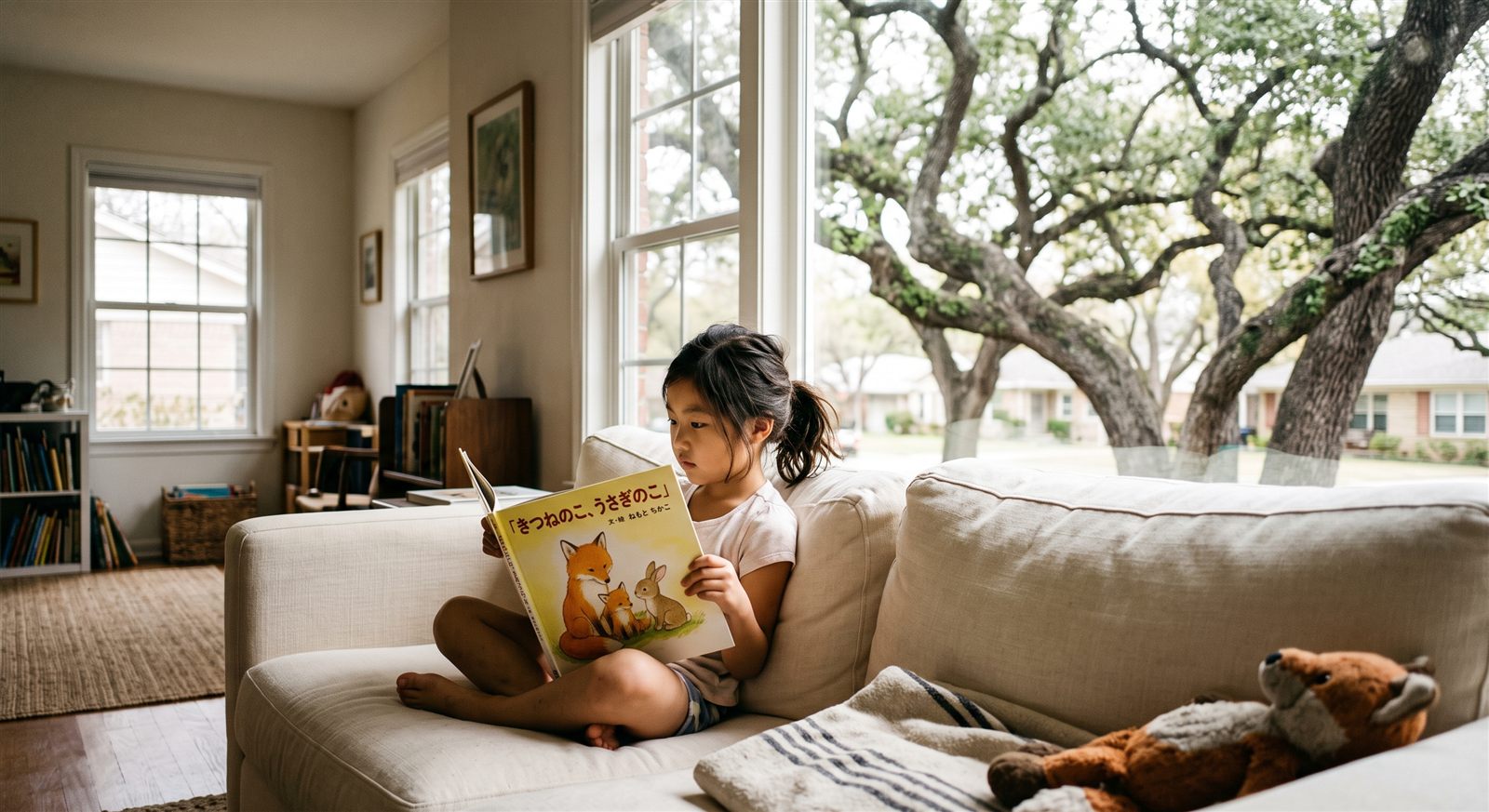
What exists only in Japanese — a specific list
This is the core problem for an English-reading parent in Houston, so here it is concretely rather than as a general complaint.
- The school has no English page. Not a thin one — none. Its sitemap lists 17 pages and every slug is Japanese. The only English text on the site is template boilerplate from the website builder, which produces a genuinely misleading artefact: the admission page’s browser title reads “Admission | Public School”. It is not a public school. The school’s own Japanese pages state it is private and does not provide compulsory education. An English-speaking parent skim-reading tabs gets exactly the wrong idea.
- The fees exist only in Japanese, on a Japanese-titled page. There is no English fee schedule anywhere.
- The Consulate-General of Japan in Houston’s English site has no consular-services or education section at all. The Japanese navigation carries both the supplementary school and textbook distribution; the English navigation offers only Home, About Us, Visiting Japan, Japan Info & Culture, Bilateral Relations and Useful Links. The route to free textbooks is not on the English side of the same institution’s website.
- Bear Child Education Academy’s two language versions describe different things. The Japanese page gives ages 0–6 and positions the class as preparation for the supplementary school; the English page says 3–6 and drops the preparation framing entirely. If you read only the English, you would not know that the most obvious on-ramp to the Saturday school is what this is for — or that it takes children under three.
The membership discount, and the hidden condition behind it
Admission costs $200 for members of the Japanese Business Association and $300 for non-members. A $100 gap looks like a formality, so families naturally look at joining. What neither website mentions is what individual membership requires.
The association’s individual associate track costs $324 a year — already more than the $100 it saves — and applying calls for a cover letter written in Japanese plus two sponsor letters from Japanese member corporations. For a corporate assignee that is a formality their employer handles. For a Japanese–American family with no corporate connection, or a mixed household where the non-Japanese parent handles admin, it is effectively closed. Neither the school’s page nor the association’s page links to the other, so the two rules are never seen together, and the “member rate” reads as though anyone might take it. In practice, the member rate follows the corporate posting.
The same pattern shows in the textbooks. Free Japanese government textbooks are available through the consulate, but the conditions are specific and Japanese-only: Japanese nationality, a filed residence notification, the child’s Japanese passport — and, explicitly, children expected to settle permanently are excluded. A heritage family with no plans to return to Japan does not qualify, even though their need for Japanese reading material is arguably greater.
What the school actually is, and where it sits
Credit where it is due, because the size and seriousness of this school are unusual. Its 589 students as of April 2026 break down as about 60 in kindergarten, 399 in elementary, 85 in junior high and 45 in high school — and a high-school division is rare for a supplementary school. Most in this series stop at Grade 9. It is on Japan’s education ministry list of supplementary schools with teachers dispatched from Japan, which many are not, and it runs a full April-to-March Japanese school year. It was founded by Houston’s Japanese business community and is run by a school management committee.
Two practical notes. The Saturday is a full day, 08:00 to 16:00 — not a morning. And the school does not publish its street address; third-party sources give a borrowed campus in the Memorial area of west Houston, and at least one popular listicle has mangled it into an address that does not exist. Confirm the location directly.
Geography is the quiet constraint in a metro this large. Every provider sits in the same west-side corridor — Memorial, the Energy Corridor, Westchase. If you are in Sugar Land, Pearland, Clear Lake or The Woodlands, there is nothing on your side of town, and a Saturday that starts at 08:00 in west Houston means a start time at home that many families will not sustain for 41 weeks. There is also no Japanese immersion or dual-language programme in any Houston-area district — the dual-language tracks are Spanish, with Mandarin at Fort Bend — and no full-time 日本人学校 anywhere in Texas.
On community size, sources disagree and we will not pretend otherwise: the consulate gives roughly 3,200 Japanese nationals in Houston as of October 2023 and about 14,000 across Texas, while some media report a higher city figure we could not verify at source. Take the consulate’s numbers as the reliable ones.
Why the English search results are worse than useless
Worth naming, because these pages are what you have been reading. Wikipedia, which ranks first, gives an enrolment figure from 2015 and a tuition figure from 1989 — “$40 to $50” — and omits the kindergarten division entirely. A private-school directory badges the school “Top-Ranked Private School for 2026” and presents this Saturday school as a full-time day school, complete with average class size and student-teacher ratio, no schedule anywhere on the page, and tuition given as a single undated blob. A widely-shared listicle mangles the address and mixes a children’s school in with adult university courses.
If you have been comparing Houston options in English and concluded the supplementary school is an affordable full-time private school with rolling admissions, that is not your error. It is what the English-language web currently says.
How to choose: three questions, in this order
- Is your child already working in Japanese, or learning it? This is the whole decision and everything else is secondary. If your family is on a posting and your child will re-enter a Japanese classroom, the supplementary school is the purpose-built tool and a strong one — dispatched teachers, government textbooks, a high-school division almost no other US supplementary school offers. If your child is growing up American with a Japanese parent and their Japanese is spoken rather than written, the school states in writing that it is not built for that, and the interview will apply it.
- Can your family do a full Saturday, on the west side, for 41 weeks? Eight in the morning to four in the afternoon is not a morning class — it is the day. Add the drive from Sugar Land or Clear Lake, add quarterly billing with no refunds and no pro-rata, and you have a commitment that rewards certainty. Decide in January, when the interviews are, not in August.
- Will the child keep going — and who are the friends? Here the school has a genuine advantage worth weighing: with 589 students there are real peer groups in every year, which is exactly what keeps a language alive in a teenager. That is a strong argument for it if your child clears the bar. If they do not, the flip side is that Houston has no second Japanese-speaking peer group for children — the next option starts at 14 and is online.
The online option: for the child the interview is not built for
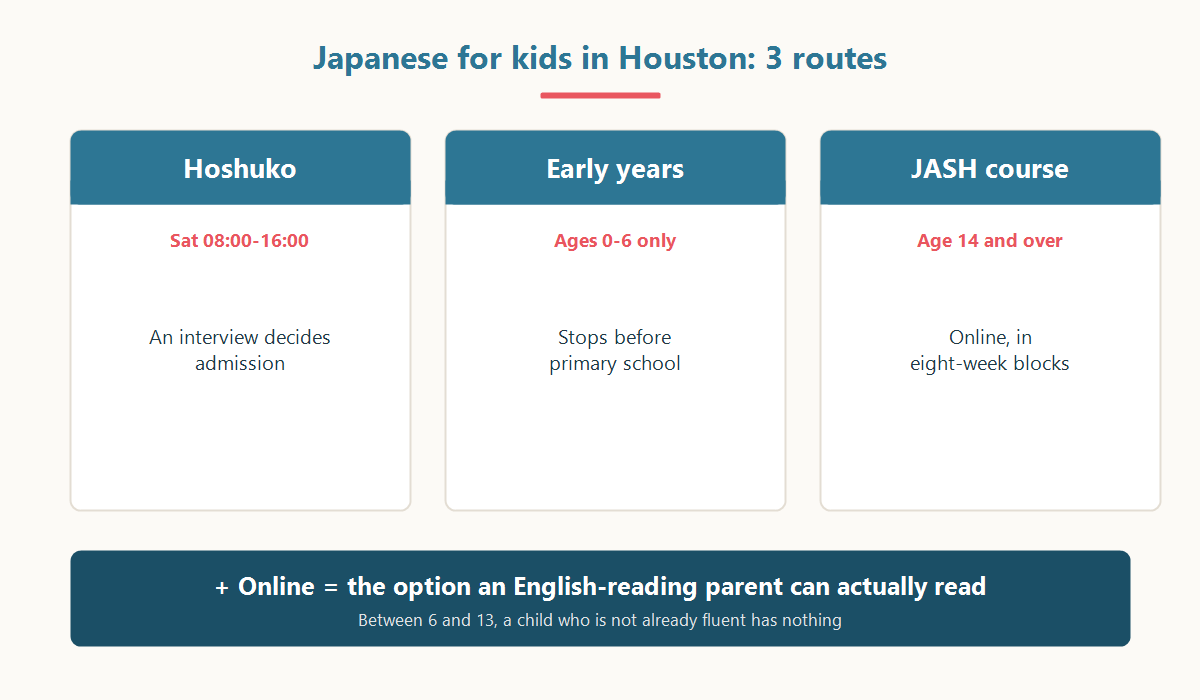
Houston’s provision has a sharp edge to it. A large, high-quality supplementary school for children who already function in Japanese; an early-years class that stops at six; a Japan America Society course that starts at fourteen; and a returnee 塗 that assumes grade-level Japanese. Between roughly six and thirteen, a child who is not already fluent has nothing — and that child is very often the one with a Japanese parent, an American parent, and a household that switched to English somewhere around the start of school. TOMODACHI JAPAN is built for exactly that child.
- The other children live in Japan. Classes are groups of eight with a homeroom teacher who knows your child, and the friends they make are children their own age in Japan — not other Houston children practising on each other.
- It keeps the connection, not just the grammar. For a child growing up in Texas, Japanese is identity before it is a subject. Regular contact with Japanese peers, taught by qualified practising Japanese teachers, is what stops the language fading between ten and fifteen.
- Grouped by level, not by school year, and no admission interview. A child does not need to be at Japanese grade level to walk in, there is no pass or fail, and everything is in English for the parent who is arranging it. Fees, scholarships and opening dates are in the free school guide.
The timezone, honestly. Houston is on US Central time, 14 hours behind Japan in summer, and that is unusually kind in one direction. Japan’s Saturday morning is Friday evening in Texas — a 09:00 Saturday class in Japan lands at 19:00 on Friday at your kitchen table, and Japan’s Sunday sessions land on Saturday evening. The other direction does not work: Japan’s weekday evening classes fall in the small hours here, so those are not realistic on a school night. If your child attends the Saturday school as well, Friday evening is the natural pairing, since it leaves the Saturday entirely free.
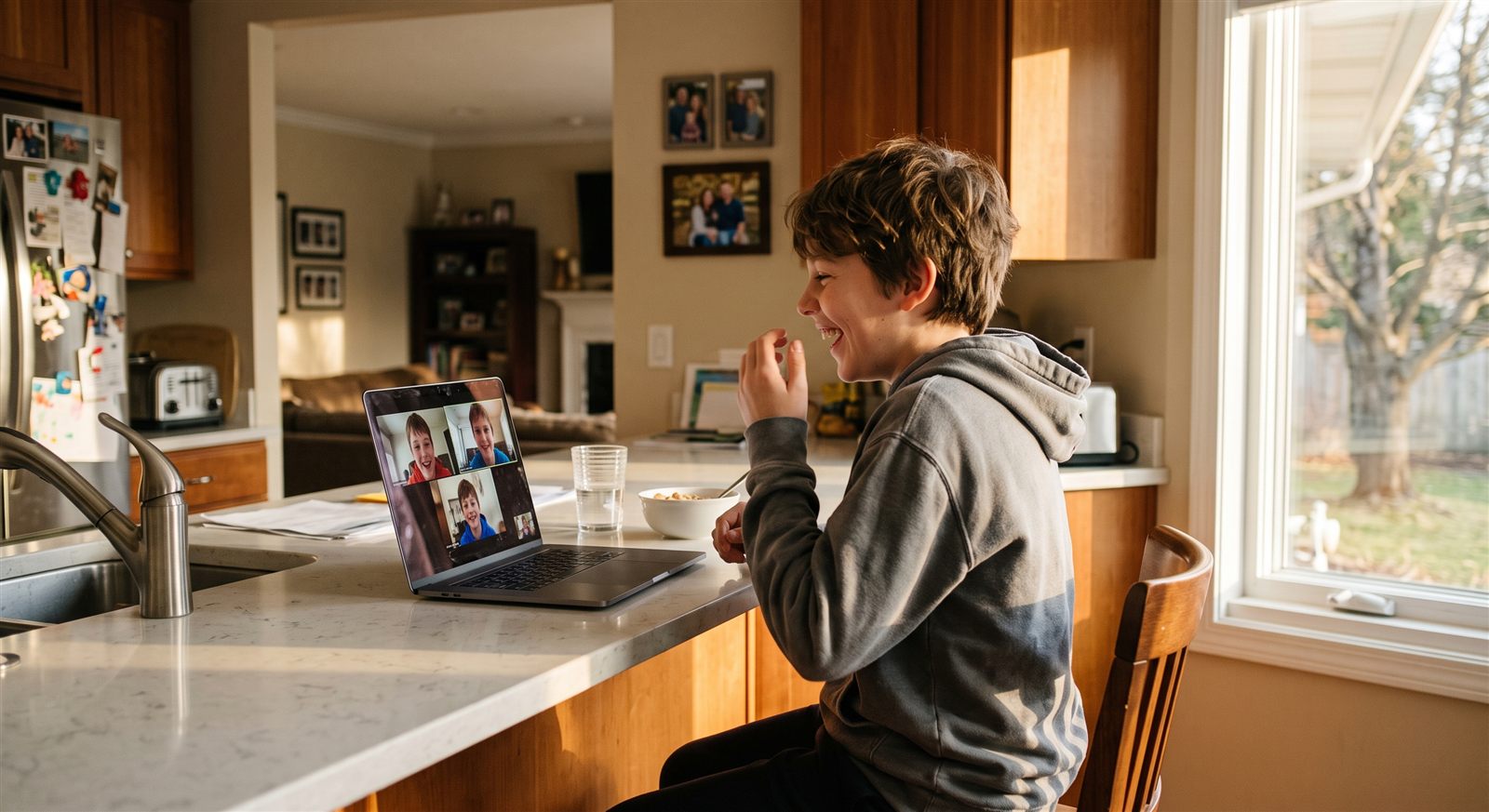
One full Saturday in Memorial keeps 国語 and maths at grade level. Friday evenings with friends in Japan are what get a child to the point of clearing the interview in the first place.
FAQ from Houston families
Can my child join if they can’t read Japanese yet?
Probably not, and it is better to hear it now than at the interview. The school’s own admission documents say it is for children who can already use Japanese and that it does not provide special conversation instruction, and admission is decided on the basis of an interview with the child — at kindergarten and Grade 1 as well as at transfer. There is no remedial or bridging track. Build the spoken and reading foundation elsewhere first, then apply. That is a sequencing problem, not a permanent no.
What does it cost?
Admission is $200 for Japanese Business Association members and $300 for non-members. Tuition is billed per three months: $549 for kindergarten, $477 for elementary and junior high, and $345 to $522 for high school depending on how many subjects are taken. It is debited in April, August, October and January, and there is no pro-rata and no refund — joining mid-quarter costs the full quarter. Materials are charged separately at an unpublished amount. Ignore the figures on directory sites; at least one is quoting 1989 prices.
Should we join the business association for the cheaper rate?
Do the arithmetic before you try. Individual associate membership is $324 a year against a $100 saving on a one-off admission fee, so it does not pay for itself on this alone. It also requires a cover letter in Japanese and two sponsor letters from Japanese member corporations, which is straightforward for a corporate assignee and close to impossible for an independent heritage family. If your employer is already a member, use it. Otherwise budget for the $300 and move on.
Is it a full-time school?
No, and this is the most common misunderstanding in English, caused by directory pages that present it as a private day school with class sizes and rankings. It is a supplementary school: your child attends their regular American school Monday to Friday and this on Saturday, 08:00 to 16:00, 41 days a year. Its own pages state it is private and does not provide compulsory education. The website’s English-language browser title says “Public School”, which is website-template boilerplate and simply wrong — do not rely on it.
Can we get the free Japanese textbooks?
Only under specific conditions, and they are published in Japanese only. The child needs Japanese nationality, the family needs a residence notification on file with the consulate, and the child’s Japanese passport is required — and children expected to settle permanently in the United States are explicitly excluded. So a long-settled heritage family generally does not qualify. Note the awkward consequence of the language split: the consulate’s English site has no education section at all, so this is not something you can research in English.
Is there anything on the south or east side of Houston?
Not currently. Every provider we could verify — the supplementary school, the early-years academy and the returnee 塗 — sits in the western corridor around Memorial, the Energy Corridor and Westchase. There is nothing in Sugar Land, Pearland, Clear Lake or The Woodlands, no Houston-area district offers Japanese immersion, and there is no full-time Japanese school in Texas. For families on the far side of the metro, an online class on a Friday evening is often the only arrangement that survives contact with a real school year.
Elsewhere in Texas, see our guide to the Japanese supplementary school in San Antonio, and the wider picture in the online alternative to a Japanese Saturday school.