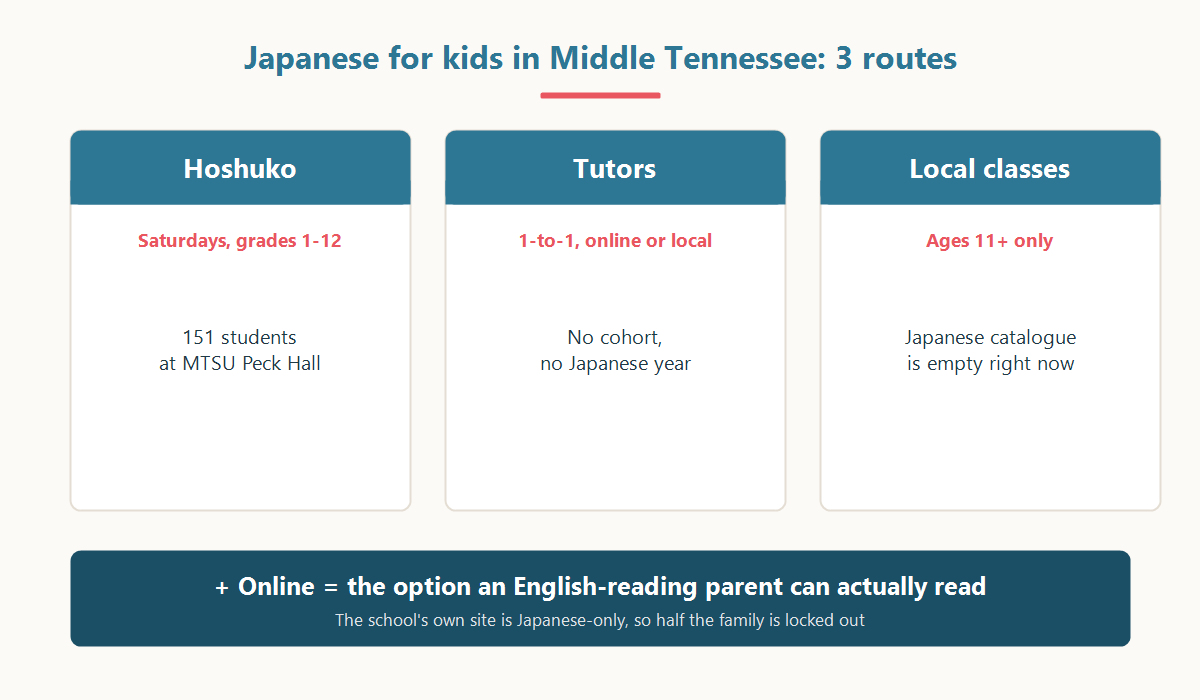
Search “Japanese supplementary school Middle Tennessee” and you get acronym dictionaries and directories. Here is the answer. The region has exactly one Japanese school for children: the Japanese Supplementary School in Middle Tennessee (J.S.M.T. / 中部テネシー日本語補習校) — Saturdays, grades 1–12, 151 students as of 4 April 2026, with a teacher dispatched by Japan’s Ministry of Education. Enrolment is $200 per child; tuition is $125 a month for children of 日本人会 members, $165 for everyone else. Two things nobody tells you: admission is not automatic — the handbook says permission may be granted on condition that a parent stays in the classroom — and that $40 discount sits behind an association fee published nowhere. The school’s site is entirely in Japanese; this is the first English description of it.
Japanese supplementary school in Middle Tennessee: the comparison
| Option | Type | Day | Ages | Tuition | Area |
|---|---|---|---|---|---|
| J.S.M.T. | MEXT-listed 補習授業校, dispatched teacher | Saturday 8:30–15:00 | Grades 1–12 | $125/mo member, $165 non-member, + $200 enrolment, per child | Peck Hall, MTSU, Murfreesboro |
| Tennessee Language Center | Beginner Japanese, 9 weeks | Tue online / Thu in person | 11–15 only | $285 online / $270 in person | Nashville + online |
| Private tutors | Generic 1:1, adult beginners | Flexible | All ages | Contact the provider | Nashville / online |
| EDUBAL | Online 1:1 for families overseas | Flexible | School age | ¥6,900–¥7,900 per 60 min | Online, from Japan |
| TOMODACHI JAPAN | Online school, classes of 8 | Any day (unlimited) | 5–18 | One flat monthly fee — see the free guide | Your home |
Looking for a way to keep Japanese going from abroad?
TOMODACHI JAPAN is an online Japanese school for children growing up outside Japan. They talk with peers their own age in Japan every day, taught by teachers working at Japanese schools, in small classes of 8.
🎁 Register and we’ll email you our School Guide (PDF, in English) straight away. You’ll also be first to hear about tuition, scholarships and opening dates.
Free · takes about 30 seconds
J.S.M.T. — and the address every directory gets wrong
Founded in 1983, the school publishes 110 elementary, 33 junior high and 8 high school students — 151 in all (4 April 2026), taught to Japan’s national course of study on the Japanese school year: 2026 opened on 4 April, closing 27 March 2027. It is run by 中部テネシー日本人会, the Middle Tennessee Japan Society, largely by volunteer parents, and for a family heading back to Japan it is the best thing for several states.
Now the correction that matters on a Saturday morning. Every listing prints 805 South Church Street, Suite 8 as if it were the school; it is the administrative office only, (615) 849-8117. Classes are held in Peck Hall on the MTSU campus, ceremonies in the LRC, Saturday number (615) 691-2084. About four Saturdays a year move online. (Official site, Japanese)
The costs, and the clause search engines cannot read
Fees are published: $200 enrolment, then $125 a month ($1,500/yr) for association members or $165 ($1,980/yr) for non-members, per child. Membership is not required to enrol — it is purely a price tier — but the gap is $480 a year per child and the association publishes no dues figure. A two-child family faces $400 plus $3,000–$3,960 a year, plus a number it cannot look up.
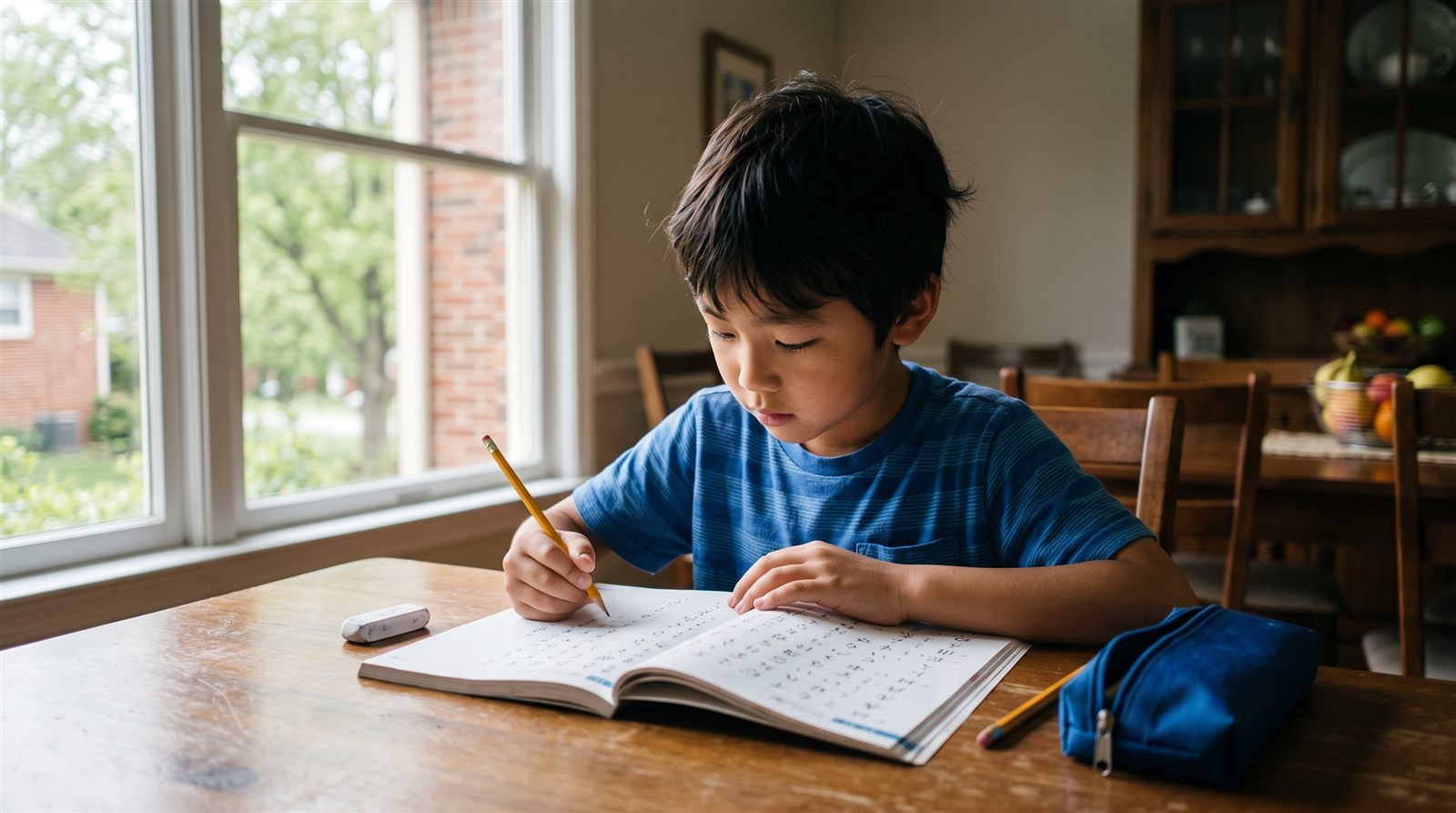
Admission is a process, not a form: documents in three weeks ahead, a parent briefing the school asks the child to attend, a campus visit, then an interview. From the handbook, page 6: 「保護者が授業中、学習サポートや見守りをいただくことを条件に、入学を許可することもあります」 — admission may be granted on the condition that a parent stays in the classroom during lessons, providing learning support and supervision. Read that generously: no proficiency test is published anywhere, and the clause is how a small volunteer-run school says yes to a child whose Japanese has slipped rather than turning the family away. But it can cost one parent the Saturday the child loses, and nobody finds out beforehand — it exists only inside a scanned, image-only PDF Google cannot read.
Two points of precision. J.S.M.T. is on MEXT’s list, under 「派遣教師のいる補習授業校」. But 認定, the accreditation conferring Japanese school-completion status, applies to 日本人学校 and 私立在外教育施設 — not to 補習授業校. And a widely-linked Tennessee guide still shows enrolment as $100 and tuition as $90 a month, roughly half the real price, with the ZIP and phone wrong too. Budget from the school’s own page.
Everything else, honestly assessed
Tennessee Language Center ran a nine-week beginner course for ages 11–15; its Japanese catalogue is now empty, and nothing below 11 was offered. McGavock High School teaches Japanese as a secondary elective. Private tutors on Wyzant and Preply sell generic lessons for adult beginners — no 国語, no cohort. EDUBAL deserves a fair hearing: built for families overseas, it understands re-entry exams, but is 1:1 and yen-priced — a tutor, not classmates.
How to choose: three questions, in this order
- 1. What do you actually want? For re-entry into a Japanese school or entrance exam you need 国語 on the Japanese course of study, marked — and J.S.M.T. is the only one in five states. If your child is not going back, the job is to keep Japanese alive and wanted into the teenage years.
- 2. Count the Saturday, including the drive. Franklin to Murfreesboro is about 44 minutes each way, Brentwood about 40. On a six-period day, 8:30 to 15:00, the Saturday is gone either way — ninety minutes of driving, or six hours on campus.
- 3. Will the child still be going in three years? Children keep going where their friends are, and twenty classmates met once a week in a language used nowhere else is a fragile world. By junior high, Saturday sport wins.
The online option: friends in Japan on a Friday evening
Japan is Tennessee’s largest foreign investor; Nissan’s North American HQ is in Franklin. On population, be careful: the consulate’s live page still serves data dated 1 September 2021, and nothing newer is citable at city level. On that basis, Murfreesboro had 439 Japanese residents, Nashville 363 and Franklin 325 — children who see each other on Saturdays and speak English the rest of the week. See also our guide to the online alternative to Japanese hoshuko.
- The other children actually live in Japan. Your child makes friends their own age in Japan, in classes of eight with a homeroom teacher who knows them. That is what keeps a child showing up at thirteen.
- It keeps the connection, not just the vocabulary. Japanese is the thread back to grandparents and to half of who your child is. Around 100 sessions a month across three time bands makes it a habit, not an appointment.
- Built for children whose Japanese lags their age. A child who chats happily at seven can stall at ten, when speech outruns kanji. Groups are set by conversation level, not school grade, so a child below grade level starts where they fit. One flat monthly fee, unlimited classes.

Middle Tennessee is US Central, 14 hours behind Japan in summer, and the best slot lands well: Saturday morning in Japan is Friday evening in Tennessee — a 9am class there is 7pm on Friday here. Japan’s weekday evening classes, honestly, fall in the small hours locally and are not realistic on a school night. This does not replace Saturday school; it fills the rest of the week.
FAQ from Middle Tennessee families
What does it actually cost per year?
$200 enrolment per child, then $1,500 a year as a member or $1,980 as a non-member. Everything else — dues, materials, facility, PTA, exam fees, sibling discounts — is unpublished. Ask the office. Ignore the guide showing $100 and $90.
Do we have to join the 日本人会?
No. Non-members pay $165 instead of $125 — a price tier, not a gate. But the association publishes no dues figure, so you cannot tell whether joining pays. At $480 a year per child, ask first.
What if my child’s Japanese is below grade level?
No proficiency test or threshold is published. There is a briefing, a campus visit with your child and an interview — and admission may be granted on condition that a parent stays in the classroom. Read it as a school trying to include a child, not exclude one. Ask early.
Is there a full-time Japanese school in Tennessee?
No — none anywhere in the five-state consular district of Arkansas, Kentucky, Louisiana, Mississippi and Tennessee. Of roughly 90 full-time 日本人学校 and 246 補習授業校 worldwide, the American ones are in Arlington Heights, Greenwich, New Jersey and Guam. The nearest, Chicago Futabakai, is 470 road miles away — a relocation, not a commute.