Almost every English-language page about Japanese schooling in Chicago gets one thing wrong, and it is the thing that matters most. “Chicago Futabakai Japanese School” is not one school — it is two schools sharing one building. Monday to Friday it is a full-time Japanese day school for Grades 1–9. On Saturday it is a supplementary hoshuko for kindergarten through high school. They have different enrolment processes, different fees and different purposes, and confusing them is the most common way a Chicago family wastes a year. Here is the second thing nobody tells you in English: both have a gate — an entrance assessment your child sits in person, and a Japanese Chamber of Commerce membership your family has to hold. This article explains the two schools, spells out the gate exactly as the schools and the Chamber publish it, and covers what your options are if you are outside it.
Japanese language school in Chicago: the comparison
| School | Type | Day | Ages | Tuition | Gate |
|---|---|---|---|---|---|
| Chicago Futabakai — Day School (全日校) | Full-time Japanese day school, MEXT-recognised 在外教育施設 | Monday–Friday, Japanese calendar (April–March) | Grades 1–9 | Contact the school | Japanese comprehension + JCCC membership |
| Chicago Futabakai — Saturday School (補習校) | Supplementary hoshuko: 国語 and 算数/数学 only (社会 added G6–JH3) | Saturday | Kindergarten (age 5) – high school | Contact the school | Entrance interview (oral + written) + JCCC membership |
| JASC — Donguri Kai | Heritage / community language programme, 6–8 students per class | Online Mon–Thu, in person Saturdays | K–12, beginner to advanced | Contact the school | None — no membership required |
| JASC — Tampopo Kai | Preschool Japanese culture programme, parent-accompanied | Contact the school | Preschool | Contact the school | None |
| Japanese Culture Center | Private tutoring plus children’s and teens’ courses | Contact the school | Children & teens | Contact the school | None |
| TOMODACHI JAPAN | Online, conversation & friendship with children in Japan | Any day (unlimited attendance) | 5–18 | One flat monthly fee — see the free guide | None |
Looking for a way to keep Japanese going from abroad?
TOMODACHI JAPAN is an online Japanese school for children growing up outside Japan. They talk with peers their own age in Japan every day, taught by teachers working at Japanese schools, in small classes of 8.
🎁 Register and we’ll email you our School Guide (PDF, in English) straight away. You’ll also be first to hear about tuition, scholarships and opening dates.
Free · takes about 30 seconds
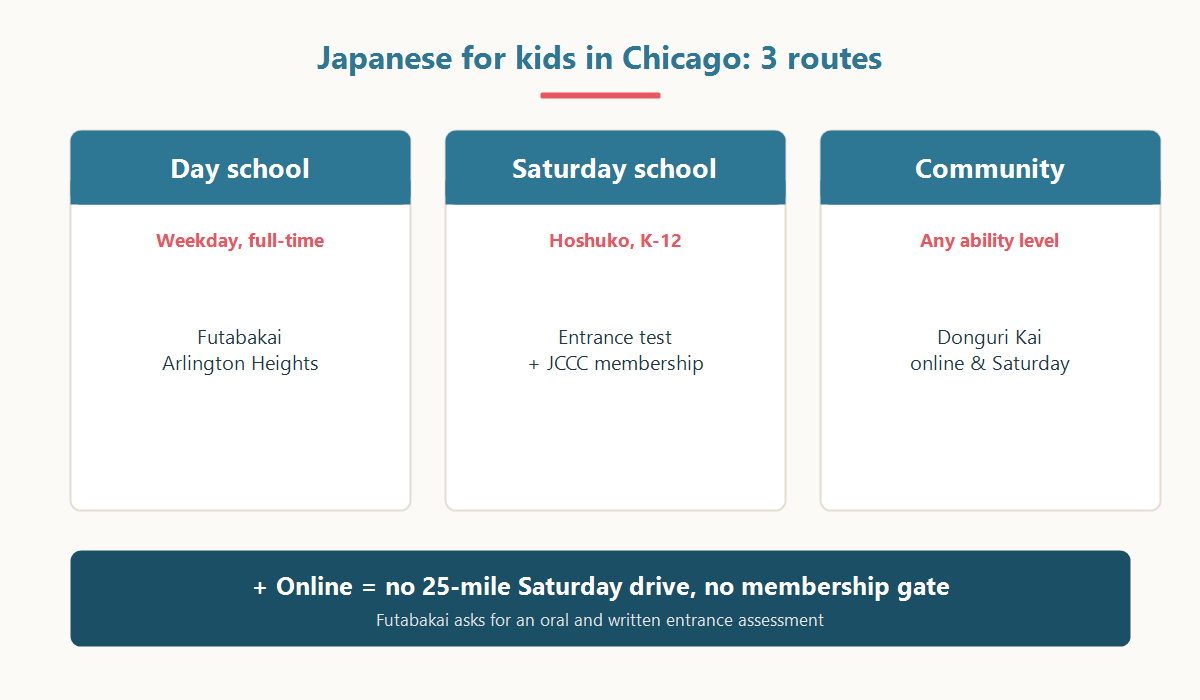
Three routes to Japanese in Chicago — and where the gate sits on each
Chicago’s Japanese education landscape is shaped by one fact: this is a corporate-assignee city, not a heritage city. The Chicago consulate’s ten-state jurisdiction counts 33,320 Japanese nationals, of whom 21,091 (63.3%) are long-term stayers and only 12,229 (36.7%) are permanent residents. That is the inverse of a heritage community. These are Japanese manufacturing and trading-company families posted across the industrial Midwest on three-to-five year rotations with a real, dated return to Japan. It explains everything — why the central institution is run by a Chamber of Commerce, why it operates a full-time day school at all, and why the entrance requirements assume a child who already lives in Japanese.
Route 1: the Day School (全日校) — your child’s main school, in Japanese
Monday to Friday, the building at 2550 N. Arlington Heights Rd. is a full-time Japanese day school and a MEXT-recognised 在外教育施設. It opened in 1978 and has been in Arlington Heights since 1998, covering Grades 1 through 9 on the Japanese school calendar — April to March, around 200 school days a year. It is listed at 123 students with a 5:1 student-teacher ratio.
This is not a supplement; it replaces your child’s American school. For a family whose child will re-enter a Japanese classroom in two or three years, it is the cleanest possible answer — no re-entry gap, no lost curriculum, no catch-up summer. Eligibility: the student must be able to understand Japanese, and parents of day-school students must be members of the Japanese Chamber of Commerce in Chicago. Tuition: contact the school. The official fee document is published only as a scanned image PDF, and the dollar figures circulating on third-party school-directory sites cannot be verified, so we will not print one.
Chicago Futabakai Japanese Day School — official site · JCCC — Futabakai governance page (English)
Route 2: the Saturday School (補習校) — the Midwest’s first, and its strictest
On Saturdays the same building becomes the hoshuko, and it has real history: founded in May 1966 in a Baptist church on Chicago’s North Side with three teachers and about fifty pupils, it was the first Japanese school in the Midwest. Today it runs 幼稚部, 小学部, 中学部 and 高等部 — kindergarten through high school. Enrolment in April 2024 was 41 in kindergarten, 385 in elementary, 90 in junior high and 34 in high school: 550 children, with 45 staff.
Know what it teaches before you enrol. The curriculum is 国語 and 算数/数学 only, with 社会 added for Grade 6 through Junior High 3. There is no music, no home economics, none of the rounding-out subjects. It is a focused academic supplement, and for a returning family that focus is exactly right.
Tuition: contact the school. No figure is published anywhere — the fee sheet sits behind a Google Drive link. What is published tells you something about how the school runs: a $20 per-student late-payment penalty, three instalment deadlines a year, payment by check or online bill payment only (no Zelle, no credit cards), and a notice that tuition was held flat while bus fees rose $15. Class start and end times are not published either. Contact office@chicagojs.com or hoshuko@chicagojs.com.
Chicago Futabakai Saturday School — official site
Route 3: community programmes — no interview, no membership
The Japanese American Service Committee at 5700 N Lincoln Ave, Chicago (773) 275-0097 runs Donguri Kai, a heritage and community language programme for K–12. It streams beginner, intermediate and advanced, each sub-divided into lower elementary, upper elementary and middle/high, and it runs both online Monday to Thursday and in person on Saturdays. Class size is 6–8 students, terms are fall, winter and spring, mid-year entry is permitted if space remains, and — the important part — there is no membership requirement and no proficiency gate. Tuition: contact the school. JASC also runs Tampopo Kai, a parent-accompanied preschool Japanese culture programme; contact the school for fees. Note that JASC’s own general language classes are adults only, so a parent searching for children’s classes needs to ask specifically for Donguri Kai.
The Japanese Culture Center offers private tutoring alongside children’s and teens’ courses; tuition is again on enquiry, and we would rather send you to ask than print a figure we could not confirm.
JASC — Donguri Kai · Japanese Culture Center — Japanese language classes
Five Chicago-specific things to plan around
- The entrance gate is the strictest of any major US city — and it is invisible in English. For the Saturday school, the child must already have the Japanese needed for study and for safe school life; the child sits an entrance interview with both oral and written assessment, not the parent; the parent must be a JCCC member; medical insurance is mandatory; individual support needs are not accommodated; kindergarten takes five-year-olds only. On top of that, entry dates are the first Saturday of the following month, excluding August and January — you cannot simply start when you decide to. The JCCC’s English page mentions none of this.
- The membership layer is a real cost, and you should see the numbers before you fall in love with the school. JCCC membership carries a one-time obligatory School Facilities Fund contribution: Active membership $1,000+ for one registrant, $3,000+ for two to three, $5,000+ for four to five, $9,000+ for six or more; Associate $500+ for one and $1,000+ for two to five; Individual $500+. Annual dues amounts are not published — contact JCCC. To be fair to the Chamber: it frames the Facility Fund as a membership requirement, not an enrolment requirement. But since enrolment requires membership, the cost lands on the family either way.
- Which membership category you are allowed to buy is not up to you. Active membership is for businesses with Japanese ownership or joint ventures; Associate is for non-Japanese-owned companies; Individual is for small business owners, students and visiting scholars. Critically, an employee of an entity with Japanese company ownership is not eligible for Associate or Individual membership and must go through corporate Active membership. If your employer will not sponsor it, the cheaper categories are not a workaround — they are closed to you.
- Arlington Heights is 25 miles from the Loop, and Saturday transit is thin. From the north-side neighbourhoods that is a 40–60 minute drive each way in good conditions — and Chicago conditions are not always good. The Metra UP-Northwest line runs a sparse Saturday schedule. A bus service exists, though we could not verify the routes. If you live on the South Side, in the west suburbs, or anywhere in Indiana or Wisconsin, do the drive once before you commit to doing it every Saturday through a Chicago winter.
- For the corporate-assignee family, the hoshuko is genuinely the right answer — say it plainly. If your child is returning to a Japanese classroom on a known date, nothing online or community-based substitutes for grade-level 国語 and 算数 taught to the Japanese curriculum. The families Chicago underserves are different ones: the Japanese-American, mixed or long-settled family whose child cannot clear the entrance interview; the family whose employer will not fund JCCC membership; and the family living too far from Arlington Heights for a weekly round trip. If that is you, this article’s last section is the one that matters.
The online option: what to do if you are outside the gate
Chicago’s structure means a specific kind of family gets left out — not because anyone designed it that way, but because an institution built for corporate rotations naturally assumes a child who already lives in Japanese. If that is not your child, an online school removes every one of the three barriers at once. It is the same logic we set out in our guide to the online alternative to Japanese hoshuko.
- No interview, no membership, no Arlington Heights. There is no entrance assessment and no chamber of commerce to join, and the classroom is your kitchen table — which matters more in Chicago than almost anywhere, because a 25-mile round trip in January is the reason a lot of good intentions quietly end in February. Groups are small and organised by conversation level rather than school grade, so a ten-year-old starting from very little Japanese is never sitting among six-year-olds.
- The realistic Chicago slot is Friday and Saturday evening. We will be straight about the time difference rather than overselling it: Japan is 14 hours ahead of Central time in summer, so a weekday-afternoon class in Japan is the middle of your night. The slot that genuinely works is Japan’s Saturday and Sunday morning, which lands on Friday and Saturday evening in Chicago — end of the school week, child already home. It also does not collide with a Saturday-morning hoshuko, so families doing both can do both.
- The other children actually live in Japan. TOMODACHI JAPAN runs on NIJIN Academy, with 800+ students, taught by qualified, practising Japanese teachers. That is the piece a Chicago community class cannot replicate: your child is not practising with other Midwestern kids who switch to English at the break, but making friends their own age in Japan — which is what turns Japanese from a subject into a reason. One flat monthly fee, unlimited attendance.

A gate keeps a school’s standard high. It should not be the reason a child stops learning Japanese.
FAQ from Chicago families
Is Chicago Futabakai a day school or a Saturday school?
Both — and this is the single most useful thing to get straight. One JCCC-run non-profit operates two schools in the same building at 2550 N. Arlington Heights Rd. Monday to Friday it is the Day School: a full-time, MEXT-recognised Japanese school for Grades 1–9 that replaces your child’s American school and follows the April–March Japanese calendar. On Saturday it is the Saturday School: a supplementary hoshuko for kindergarten through high school, teaching 国語 and 算数/数学 (plus 社会 from Grade 6) alongside your child’s regular US school. Different applications, different fees, different purpose. Phone (847) 590-5700.
Do we really have to join the Japanese Chamber of Commerce?
Yes — JCCC membership is a stated requirement for enrolment at both schools. The cost to plan for is the one-time obligatory School Facilities Fund contribution: $1,000+ for a single Active registrant, rising to $9,000+ for six or more; $500+ for Associate or Individual. Annual dues are not published, so ask JCCC directly. And check which category you qualify for before budgeting: if you are an employee of an entity with Japanese company ownership, you are not eligible for the cheaper Associate or Individual categories and must go through corporate Active membership. In fairness, JCCC presents the Facility Fund as a membership obligation rather than a school fee — but with enrolment requiring membership, your family pays it either way.
My child was born here and speaks mostly English. What are our options?
The Futabakai entrance interview assumes a child who already has the Japanese needed to study and stay safe in a Japanese-language school day, so for a mostly-English child it is usually not the starting point. The strongest local option is JASC’s Donguri Kai: K–12, streamed from beginner to advanced, classes of 6–8, in person on Saturdays or online Monday to Thursday, no membership requirement, mid-year entry if space remains. Tuition is on enquiry. Adding an online class with children in Japan alongside it gives the everyday speaking practice that a once-a-week community class, however good, cannot provide on its own.
Why can’t I find tuition figures for any Chicago Japanese school?
Because they are genuinely not published. The day school’s fee document exists only as a scanned image PDF; the Saturday school’s sits behind a Google Drive link; Donguri Kai and the Japanese Culture Center quote on enquiry. Third-party directories fill the vacuum with unverifiable numbers — one well-ranked “2026 Profile” simply lists tuition as n/a, and a Consulate-General PDF dated January 2002 still appears on page one of search results. We have deliberately written “Contact the school” everywhere we could not confirm a figure from an official source, and we would encourage you to distrust any page that prints one without saying where it came from.