The international-school afternoon fills up fast. Piano on Monday, soccer on Wednesday, coding or art on the weekend. Your child is busy, learning, thriving. And yet, if you look closely at that weekly schedule, one thing is almost always missing — the chance to actually connect with the country your family lives in. After-school hours are some of the most valuable time your child has. Here’s how to make them count.
This guide looks at why after-school is the perfect window for Japanese, why most activities quietly keep kids inside the expat bubble, and what to look for in an option that builds both the language and a sense of belonging.
The after-school paradox for international-school families
Families who move to Japan often give their children a wonderfully full life: clubs, sports, music, camps. But here’s the quiet paradox — with so many activities on offer, the one thing that brought you here in the first place, a real connection to Japan, rarely makes it onto the calendar.
- Most after-school activities are taught in English, within the same international community.
- Japanese, if it’s there at all, is often a once-a-week class — a subject to study, not a world to step into.
- And your child can spend years in Japan without ever making a Japanese friend their own age.
It’s nobody’s fault. It’s just easy to fill the hours with skills and forget about belonging. The good news: after-school is exactly where that can change.
Looking for a way to keep Japanese going from abroad?
TOMODACHI JAPAN is an online Japanese school for children growing up outside Japan. They talk with peers their own age in Japan every day, taught by teachers working at Japanese schools, in small classes of 8.
🎁 Register and we’ll email you our School Guide (PDF, in English) straight away. You’ll also be first to hear about tuition, scholarships and opening dates.
Free · takes about 30 seconds
Why after-school is the best window for Japanese
You might assume the school day is where language happens. But for an international-school child, the timetable is already full of English-medium subjects, and the few Japanese periods can only go so far. After-school is different, and better, for three reasons:
- It’s chosen, not assigned. Kids put more of themselves into things they pick. An after-school activity they enjoy beats a mandatory class they endure.
- It’s low-pressure. No grades, no exams — just talking, playing and making friends. That’s the environment where a child actually starts to speak.
- It’s when real life happens. Friendships, games and “what did you do today?” live in the afternoon, not the lesson plan. That’s where a language stops being homework and starts being life.
The activity that does double duty: language and belonging
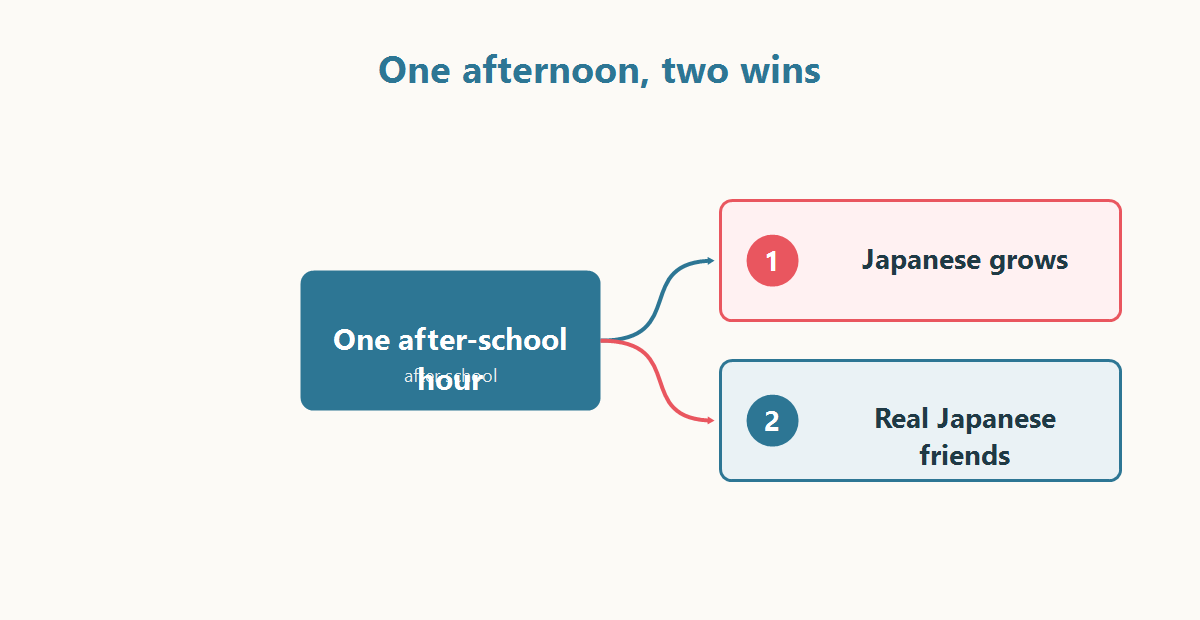
Here’s the question worth asking about any after-school choice: does it open a door, or keep one closed? A coding club in English builds a skill, but it keeps your child inside the same bubble. The rare and valuable option is the one that does two things at once — grows the Japanese and connects your child with actual Japanese kids.
The afternoons your child spends with Japanese friends are worth more than another certificate. That’s the connection you came to Japan for.
What to look for in an after-school Japanese option
When you compare the choices, four things separate “another lesson” from “a place my child wants to be”:
- A group, not a 1-on-1. Friends are what make children come back. A solo lesson after a full school day feels like overtime.
- Real Japanese peers their own age. “Conversation practice” with an adult isn’t the same as a friendship with a kid who lives here too.
- It fits the schedule. Weekday-evening and weekend times that slot in around international school, without adding stress.
- It’s fun, not a second school. Play, clubs and a child’s pace — so the afternoon feels like a reward, not more work.

How this looks in practice
This is the idea behind TOMODACHI JAPAN, an online Japanese school for kids designed to fit the after-school hours — and to turn them into real connection:
- Classes run at weekday-evening and weekend times, so they slot in neatly around international school.
- Your child joins a small group with Japanese children from our sister school, NIJIN Academy (1,000+ students) — talking, playing and learning together.
- There are clubs and “lunch together” in a metaverse campus — manga, games, cooking — so the afternoon feels like a hangout, not a class. See how it works →
- Progress is measured by one question — “How many friends did you make?” — not by another report card.

Making the most of the hours — realistically
You don’t need to overhaul the whole week. A couple of afternoons is plenty to start. Keep the activities your child loves, and swap in a little time that does double duty — language and friendship. A shy child might just listen for the first few weeks, camera off, and that’s fine. What matters is that the after-school hours slowly start building the one thing a busy schedule often misses: a place in Japan that feels like home.
Frequently asked questions
My child’s schedule is already full. Is there really time?
You don’t need much. One or two evenings or a weekend session is enough to build momentum. Because it’s a group of friends rather than a formal lesson, kids tend to look forward to it instead of seeing it as one more thing to do.
Won’t it just feel like more school after a long day?
That’s exactly what we designed against. The focus is conversation, play and clubs with peers — not grades or drills. For most kids it feels like a hangout that happens to be in Japanese.
My child is a complete beginner. Is that okay?
Yes. Kids are grouped by conversation level, so beginners start with others at the same stage and never feel left behind. No hiragana required to begin.
When can we start?
TOMODACHI JAPAN opens in December 2026 (pilot launch). Join the waitlist and we’ll send you trial-day invitations first.
▼ Turn after-school hours into real friendships → how expat kids make Japanese friends and learn.