Somewhere between Year 10 subject selection and the first week of Year 11, an Australian family discovers that “doing Japanese for the HSC” or “doing Japanese for the VCE” isn’t one choice. It’s a choice between several different courses — Beginners, Continuers, Background Speakers and others — with eligibility rules attached, and getting it wrong can mean a scaled-down mark, a wasted year, or in the worst case a student being moved out of a course after they’ve started.
This guide explains the difference in plain English, spells out the eligibility rule that catches families by surprise most often — the one that affects children with any Japanese background — and gives you a straight answer on what to do if your child sits awkwardly between two levels.
Eligibility rules are set by NESA (NSW) and the VCAA (Victoria) and are revised from time to time. Treat everything below as orientation, then confirm the current-year rules with your school’s languages coordinator before you enrol.
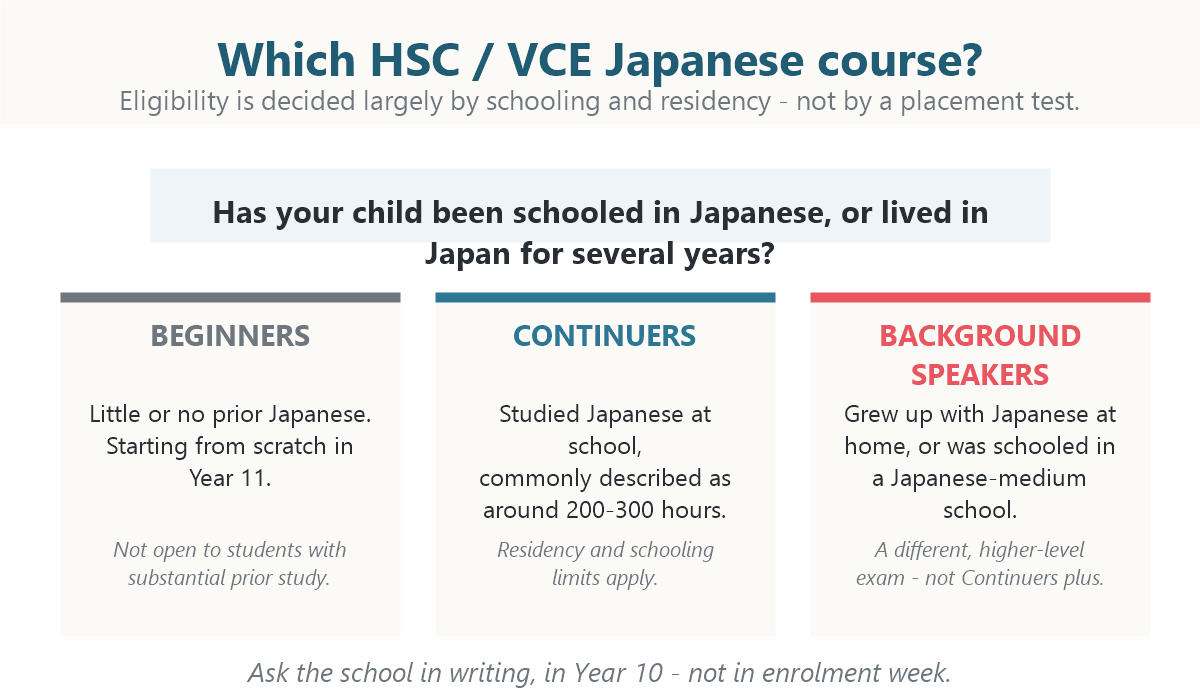
The courses, in plain English
| Course | Who it’s designed for | Typical prior study | The catch |
|---|---|---|---|
| Beginners | Students starting essentially from scratch in Year 11 | Little or no prior Japanese | Not open to students who already have substantial prior study or home exposure |
| Continuers | The mainstream course — students who studied Japanese as a second language at school | Commonly described as around 200–300 hours, i.e. Years 7–10 at school | Residency and schooling limits apply — see below |
| Background Speakers (NSW) | Students who grew up with the language at home or were schooled in it | Home use, or education in a Japanese-medium school | Higher standard; a genuinely different exam, not “Continuers plus” |
| Extension (NSW) | Strong Continuers students wanting an extra unit | Taken alongside Continuers in Year 12 | Additional workload, not a replacement |
Looking for a way to keep Japanese going from abroad?
TOMODACHI JAPAN is an online Japanese school for children growing up outside Japan. They talk with peers their own age in Japan every day, taught by teachers working at Japanese schools, in small classes of 8.
🎁 Register and we’ll email you our School Guide (PDF, in English) straight away. You’ll also be first to hear about tuition, scholarships and opening dates.
Free · takes about 30 seconds
The rule that surprises families: eligibility isn’t about how good you are
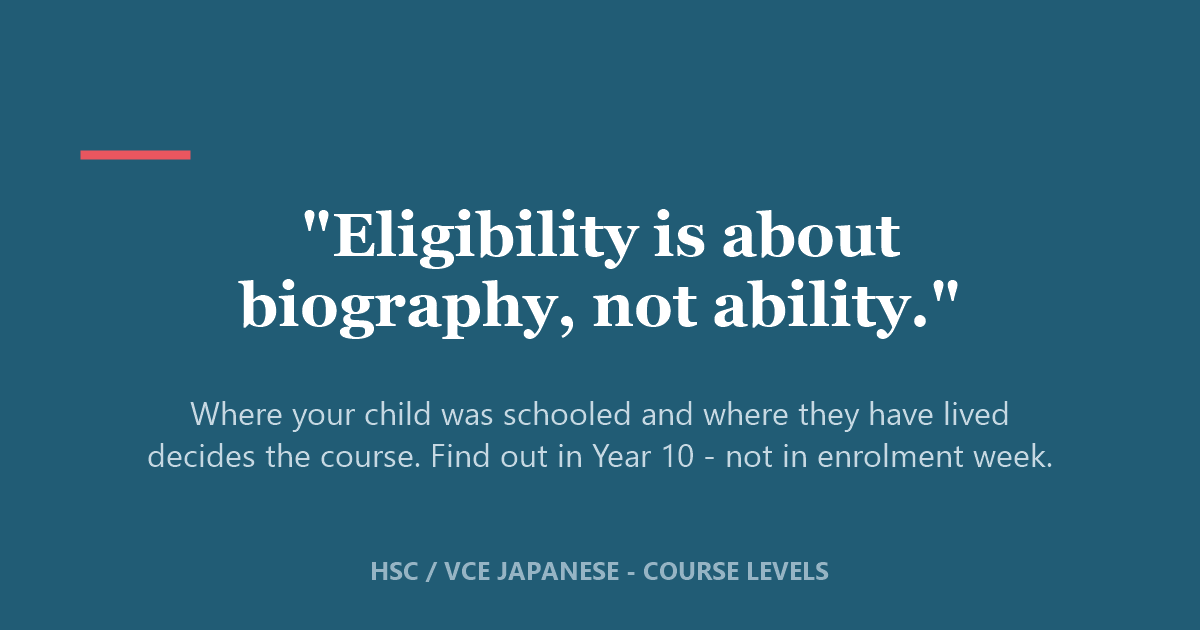
This is the part parents consistently don’t expect. Eligibility for Continuers is not decided by a placement test or by how well your child speaks. It’s decided largely by biography — where they were educated and where they have lived.
In NSW, the Continuers eligibility criteria have historically included limits such as: no more than one year of formal education from the first year of primary school in a school where Japanese is the medium of instruction, and no more than three years of residency in the past ten years in a country where Japanese is the medium of communication. A student outside those limits is generally directed to the Background Speakers course instead.
Read that again if your family has any Japanese connection, because it means two students with identical Japanese ability can end up in different courses — and the one who lived in Japan as a child sits a harder exam. The criteria have been debated publicly and have been revised over the years, which is exactly why you should check the current wording rather than what a sibling was told three years ago.
What this means for Japanese-heritage families in Australia
Families in Sydney, Melbourne, Brisbane and Perth with one Japanese parent are the group most affected. A common pattern: the child speaks conversational Japanese at home, attended Japanese Saturday school for a few years, and reads at maybe primary-school level. On paper they look like a Background Speaker. In practice their academic Japanese — the kanji, the formal writing, the essay structure — may be well behind that course’s expectations.
If your child is in that position, the honest advice is: find out which course they’re eligible for early — in Year 9 or 10, not in the enrolment week — and then work on the specific gap. If they’re headed for Background Speakers, the gap is almost always literacy and formal register rather than speaking. If they’re eligible for Continuers, the gap is usually the reverse: they can speak comfortably but need the exam’s structured writing.
If Saturday school hasn’t been working for your family — a very common story — we wrote about the alternatives in Japanese Saturday school not working for your child?
Should you take Japanese at all? An honest answer
Two things are true at once, and schools tend to tell families only one of them.
The case for: languages are small, motivated cohorts; the skills compound over two years rather than resetting each term; and in both states the speaking components are marks that a diligent student can genuinely secure — the oral is worth 20 of 100 marks in HSC Japanese Continuers, and around 12.5% of the study score in VCE Japanese Second Language. Universities and employers still notice a language on a transcript.
The case against, stated fairly: a language is a two-year commitment that punishes drifting more than most subjects. A student who stops practising in Term 2 of Year 11 cannot catch up by cramming, because the exam tests fluency rather than recall. If your teenager doesn’t want to do it, the honest thing is to say so in Year 10 rather than discover it in Year 12.
Our position — as an online school, so read it with that in mind — is simple: the deciding question is not “is my child good at Japanese now?” but “will my child actually speak Japanese regularly for the next two years?” If yes, it’s one of the more rewarding subjects on the list. If there’s no realistic path to regular speaking, the mark will drift regardless of ability.
Where the practice comes from, whichever course you pick
| Option | Best for | Speaking volume | Cost shape | Watch-out |
|---|---|---|---|---|
| School class | Syllabus, assessment tasks, marking | A few minutes a week each | Included | Shared across a whole class; same voices all year |
| Japanese Saturday school | Literacy for heritage students | Varies; often academic rather than conversational | Term fees + a lost Saturday | Pitched to Japanese national curriculum, not the HSC/VCE syllabus |
| Language apps | Vocabulary and kanji upkeep | None — no real dialogue | Free–low | Doesn’t build spontaneous conversation at all |
| 1-on-1 tutor | Grammar repair, written exam technique | Exactly what you pay for | Per hour; language tutoring in Australia commonly A$75–130/hr | Ramp-up before exams is when the bill spikes; one voice, one accent |
| TOMODACHI JAPAN | Speaking volume, mock orals, keeping motivation alive | Unlimited — attend daily if you want | One flat monthly fee | Runs on Japan time (an advantage in Australia) |
Why we think the school-vs-tutor distinction matters
TOMODACHI JAPAN is an online school staffed by currently practising Japanese teachers — the same educators who teach children inside Japan — rather than a marketplace of individual tutors. For a student navigating course levels, that produces three things a tutor generally can’t:
- An honest read on where your child actually sits. A qualified teacher can tell the difference between a student who sounds fluent and one whose written Japanese will hold up in a Background Speakers exam — a distinction that matters enormously when you’re choosing a course.
- Same-age Japanese friends, not just lessons. Students join sessions with Japanese children their own age. This is what turns a two-year commitment from a chore into something they choose to keep doing — which, per the section above, is the real determinant of the final mark.
- Unlimited attendance for one flat fee. The two moments a language student needs to surge — starting Year 11, and the weeks before the oral — are precisely when hourly tutoring becomes unaffordable.
The timing that makes it workable
Sydney and Melbourne run one hour ahead of Japan in winter and two hours ahead in daylight saving; Auckland is three hours ahead. So an after-school session in Australia or New Zealand lands inside the Japanese afternoon and evening. No 5am starts, no lost weekend. Full conversions are in our time-zone guide, and local class times are on the Australia & New Zealand page.
What to do in the next two weeks
- Ask the school which course your child is eligible for — in writing, naming your child’s schooling and residency history. Don’t rely on assumptions.
- Ask which courses the school actually offers, and what happens if it doesn’t run one (many students study through a dedicated languages school or by distance).
- Separate ability from eligibility. Once you know the course, identify the specific gap — literacy for heritage students, speaking for most others.
- Decide where regular speaking will come from before Year 11 starts, not after the first assessment task.
FAQ
What’s the difference between Continuers and Beginners Japanese?
Beginners is for students starting essentially from scratch in Year 11 with little or no prior Japanese. Continuers is the mainstream course for students who studied Japanese as a second language through school — commonly described as around 200–300 hours of prior study, i.e. Years 7–10. Students with substantial prior study generally cannot take Beginners.
My child lived in Japan as a young child. Can they still take Continuers?
It depends on how long and in what kind of school. NSW eligibility criteria have historically limited Continuers to students with no more than about one year of formal education from Year 1 in a Japanese-medium school, and no more than about three years of residency in the past ten years in a Japanese-speaking country. Beyond those limits students are generally directed to Background Speakers. Because the criteria have been revised over time, confirm the current wording with your school and NESA.
Is Background Speakers harder?
It’s a different course with a higher assumed level, particularly in reading and writing. Students who speak fluently at home but never studied Japanese literacy formally often find the written demands the hardest part — which is why identifying the course early matters so much.
When do we have to decide?
Subject selection generally happens during Year 10, in the second half of the year, with enrolment confirmed before Year 11 begins. Practically, you want the eligibility question answered a term earlier than that so there’s time to close whichever gap the answer reveals.
How much of the mark is speaking?
In HSC Japanese Continuers, the oral is worth 20 marks out of 100 (a roughly 10-minute conversation). In VCE Japanese Second Language, the ~15-minute oral contributes about 12.5% of the study score. See our HSC oral guide and VCE oral guide.
What does TOMODACHI JAPAN cost?
One flat monthly fee for unlimited daily attendance (billed in Japanese yen; your local-currency amount is on the tuition page). There’s no per-lesson charge, so a student can attend as often as they need in the run-up to an exam.
Choose the course. Then make sure they actually speak.
TOMODACHI JAPAN opens in December 2026: real Japanese teachers, same-age friends in Japan, mock orals and unlimited practice on Australian and New Zealand-friendly hours. Register now and we’ll send opening news, timetable and trial-session details first.