If you’re a Melbourne parent trying to keep your child’s Japanese alive, the confusing part isn’t a lack of options — it’s that the options have similar names and do completely different jobs. A Japanese Saturday school in Melbourne can mean a full Japanese-curriculum hoshuko (Melbourne International School of Japanese), a government language school that also runs VCE Japanese (the Victorian School of Languages), or a relaxed Sunday community school — and none of them is the same as the full-time weekday Japanese School of Melbourne. Here’s the short answer up front: the weekend schools each run one session a week, roughly Saturday mornings, and government VCE-track classes are remarkably cheap (around A$70–85 a year), while private tutoring runs A$10–25 an hour. Below we line up every real option side by side — with fees and sources as of July 2026 — and look honestly at what works for a Japanese-Australian child whose stronger language is English.
Japanese Saturday schools in Melbourne: the comparison
| School | Type | Day | Ages | Tuition | Area |
|---|---|---|---|---|---|
| Melbourne International School of Japanese (MISJ) | MEXT hoshuko (full Japanese curriculum) | Saturday (approx. 9:00–15:00) | 3 – VCE (Yr 12) | On inquiry | Oakleigh South |
| Victorian School of Languages (VSL) | Government language school, incl. VCE Japanese | Saturday | Prep – VCE | approx. A$70/yr (VCE approx. A$85) | ~40 campuses statewide |
| Aozora Shokudo | Community Sunday school (project-based) | Sunday | Prep – high school | On inquiry | Brunswick East (CERES) |
| The Japanese School of Melbourne (JSM) | Full-time weekday day school | Mon–Fri | Kinder – Junior High | Full-time fees (on inquiry) | Caulfield South |
| Private tutors & classes (JAPANEASY, JIC…) | Conversational / beginner | Weekday or flexible | Any | approx. A$10–25/hr | CBD / online |
| TOMODACHI JAPAN | Online, conversation & friendship | Any day (unlimited attendance) | 5–18 | One flat monthly fee — see the free guide | Your home |
Looking for a way to keep Japanese going from abroad?
TOMODACHI JAPAN is an online Japanese school for children growing up outside Japan. They talk with peers their own age in Japan every day, taught by teachers working at Japanese schools, in small classes of 8.
🎁 Register and we’ll email you our School Guide (PDF, in English) straight away. You’ll also be first to hear about tuition, scholarships and opening dates.
Free · takes about 30 seconds
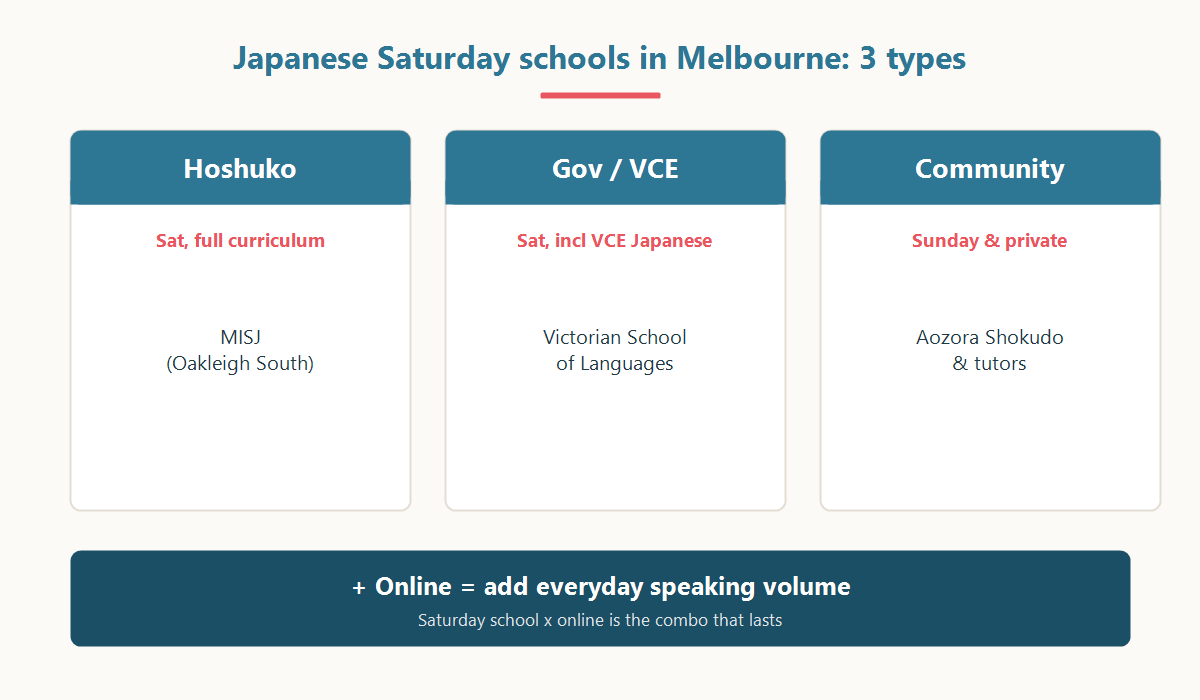
Three types of Saturday school — and why the difference matters
Melbourne’s weekend Japanese options look interchangeable on a list, but they split into three quite different types. Enrolling in the wrong one is the single most common reason families end up saying “we tried Japanese school, and it just didn’t stick.”
Hoshuko: keeping pace with grade level in Japan
Melbourne International School of Japanese (MISJ) is the city’s MEXT-designated hoshuko — a supplementary school that follows Japan’s national curriculum (Japanese language, maths and cultural studies) so a child stays at Japanese grade level while attending an ordinary Australian school on weekdays. Founded in 1986 and marking its 40th anniversary in 2026, it runs on Saturdays in Oakleigh South and covers everything from a parent-participation playschool (ages 3–5) up to a two-year VCE Japanese stream. Since 1995 it has also admitted non-Japanese-background children, streamed into small classes by proficiency. Being able to follow the lesson in Japanese is the assumption here — this is grade-level schooling, not a beginners’ class. Fees aren’t published, so call to confirm. MISJ official site
Government language school: the VCE Japanese route
The Victorian School of Languages (VSL) is the state government’s Saturday-language provider — around 40 campuses, and the largest single VCE language provider in Victoria. It teaches Japanese as both First Language and Second Language, right through VCE Units 1–4, and at roughly A$70 a year (about A$85 for VCE) it is extraordinary value. The catch is that VSL is language instruction, not a full Japanese-school curriculum: it will carry your child to a VCE result, but it won’t replicate the maths-in-Japanese, whole-curriculum experience of a hoshuko. For many heritage families it’s the practical backbone of the high-school years. VSL
Community & private classes: keeping “Japanese = fun” alive
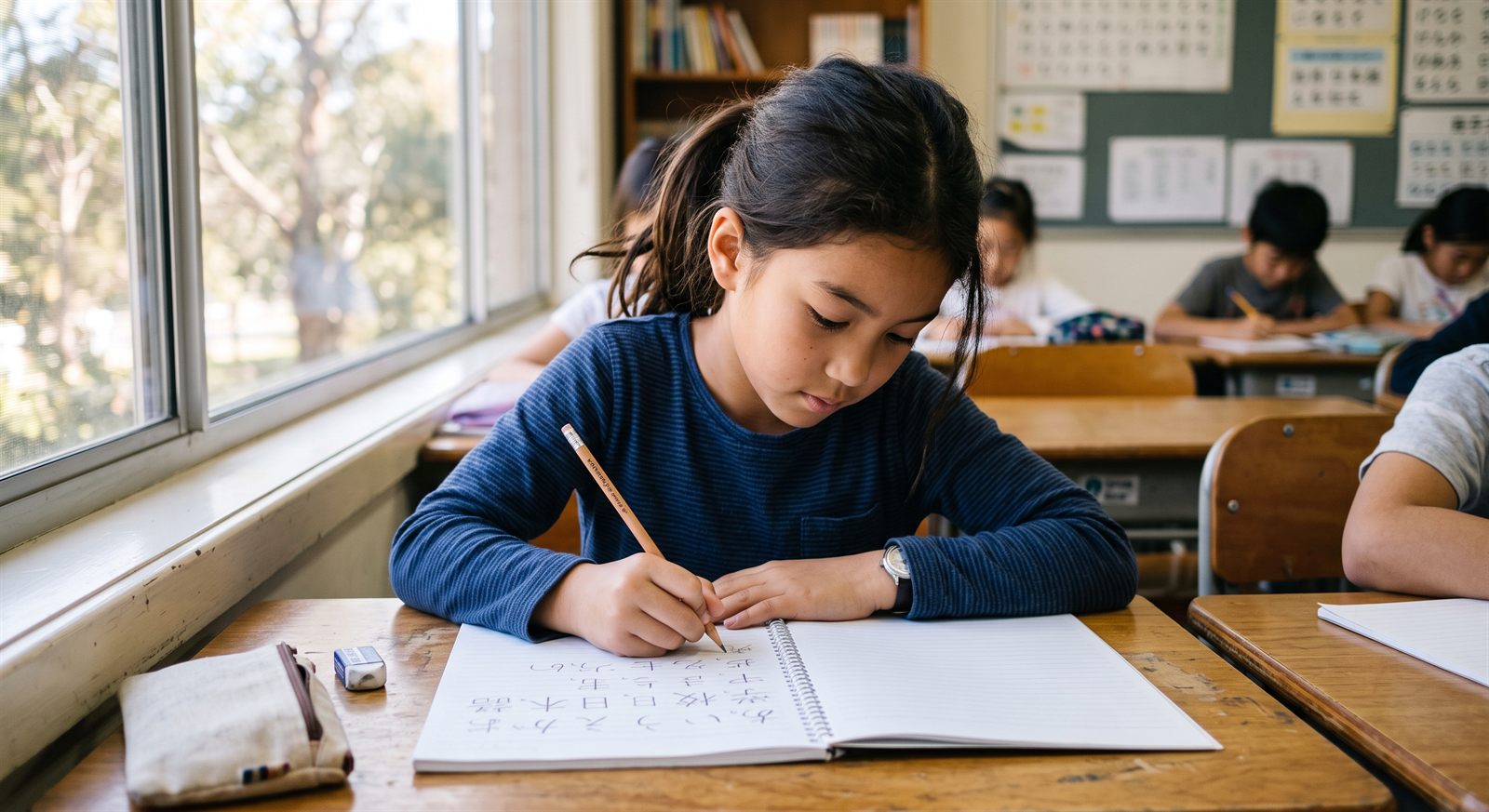
Put a Japanese-Australian child whose stronger language is English straight into grade-level kokugo, and Saturday can quickly turn into a weekly battle. That’s where the gentler options come in. Aozora Shokudo runs a Sunday, project-based Japanese learning community for children from Prep to high school, based at CERES in Brunswick East — less about textbooks, more about using Japanese to do and make things. On the private side, centres like JAPANEASY (CBD) and JIC teach conversational Japanese through songs, games and small groups, and one-to-one tutors run from around A$10–25 an hour on marketplaces. These keep a child engaged and speaking, but — and this matters — they generally won’t hold a heritage child at Japanese literacy level (kanji, reading, composition) the way a hoshuko or VSL First Language stream will. Aozora Shokudo / JAPANEASY
A note on the full-time option
Don’t confuse the Saturday MISJ with The Japanese School of Melbourne (JSM) in Caulfield South — a full-time, weekday day school where 90%+ of the coursework is in Japanese, built for temporary Japanese-resident families who’ll return to Japan in a few years. It’s a different category in both purpose and budget, so we just note it here for clarity. About JSM
Three Melbourne-specific things to plan around
- VCE eligibility is decided early — and it’s strict. A student generally sits VCE Japanese Second Language only if they’ve had no more than seven years of education in a Japanese-medium school; eligibility for Units 3–4 must be confirmed with VCAA through the child’s home school. Either way, the exam still demands real kanji, reading and written composition — spoken-only heritage Japanese won’t carry it. Keeping literacy going through the middle-school years is what protects the VCE options later.
- The schools are scattered. MISJ sits in the south-east (Oakleigh South), the community options cluster in the inner north, and VSL campuses are spread across the state. Depending on where you live, “Saturday Japanese school” can mean a real weekly drive.
- One session a week is the ceiling. Every weekend school runs a single roughly three-hour session, about 36 weeks a year. That alone doesn’t supply enough Japanese “volume” — every school assumes families top it up at home during the week.
The online option: turning once-a-week into every day
Saturday school is genuinely valuable — for community, culture and, through VSL, the VCE result. But as most Melbourne families discover, one lesson a week won’t make a child a confident Japanese speaker. That’s the gap we built TOMODACHI JAPAN to fill: an online Japanese school opening in December 2026, designed to be the “weekday Japanese time” that pairs with a weekend school. (If you’re weighing this against hoshuko more broadly, see our guide to the online alternative to Japanese hoshuko.)
- The time difference is just 1 hour (2 hours during Melbourne daylight saving). Japan’s late-afternoon classes land in the Melbourne evening — after school, from your own living room, no Saturday-morning commute.
- The other kids live in Japan. Your child talks in small groups with children from our sister school, NIJIN Academy, which has over 800 students across Japan. Real friends in Japan — the one thing a classroom in Oakleigh can’t manufacture.
- Unlimited attendance solves the “volume” problem. For one flat monthly fee, your child can join every day if they like — grouped by conversation level, not grade, so heritage-language kids fit right in. Lessons are led by qualified, currently-practising Japanese teachers.
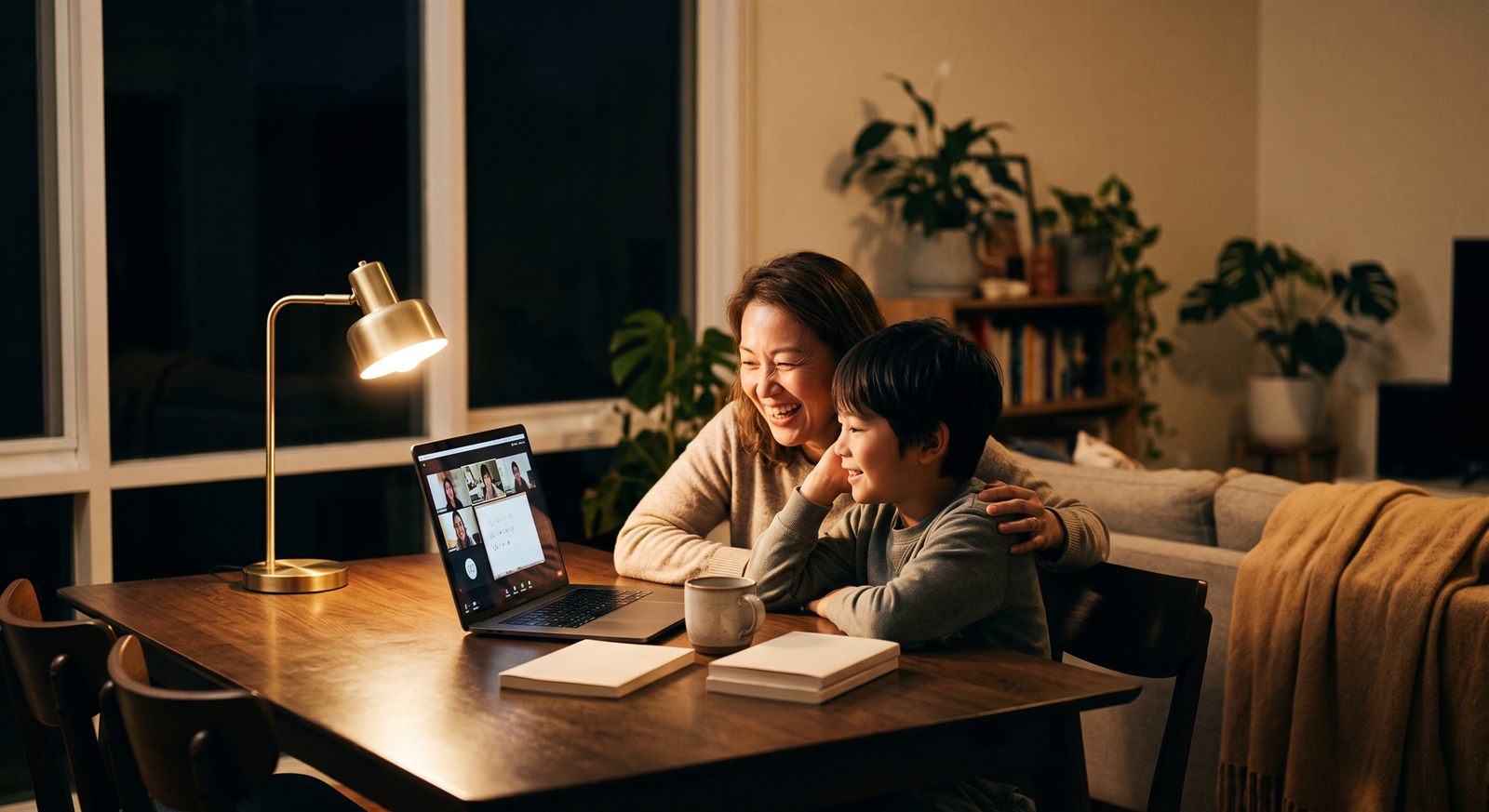
“VSL on Saturday for the VCE credential, weekday evenings online for conversation with friends in Japan” — for a Melbourne kid, that’s the combination that actually moves the needle.
FAQ from Melbourne families
MISJ hoshuko or VSL — which one for a heritage child?
It depends on how much Japanese happens at home and what you’re aiming for. If daily conversation is genuinely Japanese and you want grade-level schooling, MISJ is the fuller option. If your main goal is a strong VCE Japanese result at a very low cost, VSL is hard to beat. Many families actually use VSL for the credential and add something else for speaking volume. The fastest way to the right answer is an honest chat about your child’s level at the enrolment interview.
My child speaks Japanese but can’t really read or write it. Is that a problem for VCE?
Yes — and it’s the most common trap for heritage kids. VCE Japanese is heavily literacy-based (kanji, reading, composition), so a child who is fluent in speech but weak on the page can struggle badly. The fix is to keep reading and writing ticking over through the middle-school years rather than trying to cram it back in Year 11. Weekly Saturday classes plus regular weekday practice is what keeps that door open.
Can we combine an online school with Saturday school?
Yes — that’s the intended use. TOMODACHI JAPAN is unlimited-attendance, so kids join on the days that suit them and scale back in weeks when Saturday-school homework piles up. The roles don’t overlap: reading, writing and the VCE track at the weekend school; speaking volume and friendships online.
Isn’t joining classes in Japan awkward, timing-wise, from Melbourne?
Not at all — this is where Oceania wins. The time difference with Japan is only 1 hour (2 hours during daylight saving), so Japan’s late-afternoon classes are early evening in Melbourne — right after school and dinner. Unlike Europe or North America, Australia is one of the most compatible regions in the world for a Japan-based online school.
▼ Looking at Sydney rather than Melbourne? → Japanese school for kids in Sydney: fees and how to choose