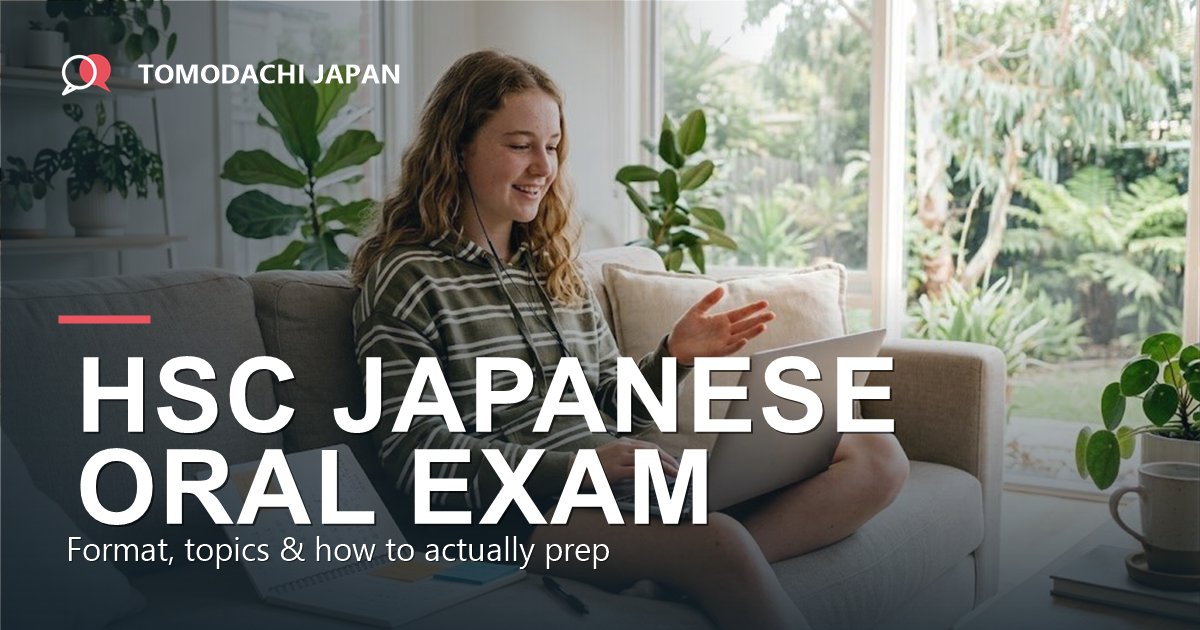
For NSW students taking HSC Japanese Continuers, the oral examination is the part that can’t be crammed and can’t be faked. It’s a roughly ten-minute conversation with an examiner you’ve never met, entirely in Japanese, and it’s worth 20 of the 100 marks in the HSC exam. This 2026 guide walks through exactly how the oral works, what markers are trained to reward, and the one form of preparation that actually moves a band: real, unscripted conversation with a Japanese person — not more flashcards.
How the HSC Japanese Continuers oral exam works (2026)
The HSC Japanese Continuers examination has two components: a written paper worth 80 marks and an oral examination worth 20 marks. The oral is an interview-style conversation of about 10 minutes in which you respond to an examiner’s questions on the prescribed course topics, all framed through your personal world — your life, family, school, interests, and experiences.
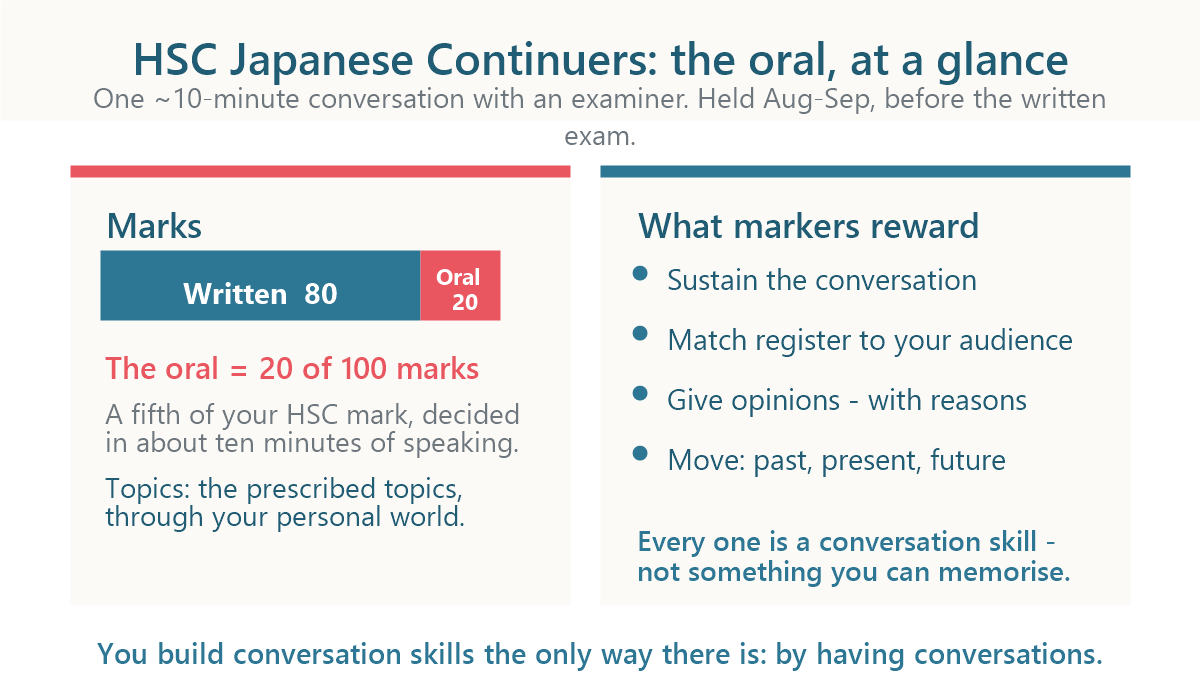
Two logistics catch families out every year, so plan for them early:
- It’s held before the written exams. HSC languages oral examinations run in August–September, at a dedicated examination centre — not at your own school. Scheduling is typically arranged in June, so confirm your date and venue with your school well ahead of time.
- The examiner is a stranger. You won’t be talking to your classroom teacher. That’s precisely why practising only with familiar voices leaves a gap on the day.
Looking for a way to keep Japanese going from abroad?
TOMODACHI JAPAN is an online Japanese school for children growing up outside Japan. They talk with peers their own age in Japan every day, taught by teachers working at Japanese schools, in small classes of 8.
🎁 Register and we’ll email you our School Guide (PDF, in English) straight away. You’ll also be first to hear about tuition, scholarships and opening dates.
Free · takes about 30 seconds
What HSC markers are trained to reward
The marking guidelines for the Continuers oral aren’t a secret — and they describe conversational skill, not memorisation. Markers look for a student who can:
- Sustain the conversation using communication strategies — asking for repetition naturally, rephrasing, keeping things flowing rather than stalling.
- Convey information appropriate to context, purpose and audience — pitching your register and politeness correctly, not just producing correct grammar.
- Exchange and justify opinions and ideas — giving a view and a reason, and responding to a follow-up.
- Reflect across past, present and future — moving comfortably between “I used to…”, “I now…”, and “I’d like to…”.
Read that list again and notice what it isn’t: it isn’t “recite 300 words” or “recall the perfect verb ending.” Every one of those descriptors is a conversation skill — and conversation skills are built by having conversations.

Why studying alone doesn’t fix the oral
Here’s the trap. Motivated HSC students pour hours into vocabulary apps, past papers, and grammar drills — all of which help the written paper. Then they walk into the oral and freeze, because none of that practice ever asked them to respond, live, to an unfamiliar person’s unexpected question. That’s a distinct skill. You build it by doing it, repeatedly, with someone who speaks Japanese naturally — ideally starting well before Term 3 of Year 12.
School does its best, but a Continuers class shares its teacher among many students, so each teen gets only minutes of real speaking a week — and always with the same voice, accent, and question style. The examiner in August won’t sound like that. The closer your practice gets to talking with unfamiliar Japanese people about your real life, the smaller the surprise on exam day.
Ways to prepare for the oral, honestly compared
Four routes NSW families take — with the trade-offs stated plainly.
| Option | Live speaking | Who you talk to | Best for | Watch-out |
|---|---|---|---|---|
| School class | A few min/week | Your teacher & class | Syllabus, assessments | Little 1-to-1 time; only familiar voices |
| Apps (Duolingo etc.) | None — no dialogue | A machine | Vocab & kanji upkeep | Builds zero conversation skill |
| 1-on-1 tutor (italki / Preply) | What you pay for | One adult tutor | Targeted fixes, flexible times | Per-lesson cost; single accent; can feel like a chore |
| TOMODACHI JAPAN | Unlimited — daily if you like | Real Japanese teachers and same-age peers in Japan | Natural speaking + mock orals | Runs on Japan time (excellent for Sydney — see below) |
“A real Japanese teacher” beats “a Japanese tutor” for the oral
TOMODACHI JAPAN isn’t a tutor marketplace — it’s an online school staffed by currently practising Japanese teachers who teach children inside Japan. For the Continuers oral, that shows up in two ways money can’t buy on a per-lesson site:
- A proper mock oral. A trained teacher can run a ten-minute interview against the actual marking descriptors — sustaining communication, opinions with reasons, past/present/future — and tell your teen exactly where a band slips and how to lift it. That’s diagnosis, not a chat.
- Real peers, real Japanese. Alongside teacher practice, students talk with Japanese kids their own age. That’s where natural intonation and quick, unrehearsed replies come from — and it’s why students keep showing up: it stops feeling like exam prep and starts feeling like friendship. (We wrote separately about the VCE Japanese oral exam — the same principle applies across states.)
The time-zone advantage for Sydney & NSW students
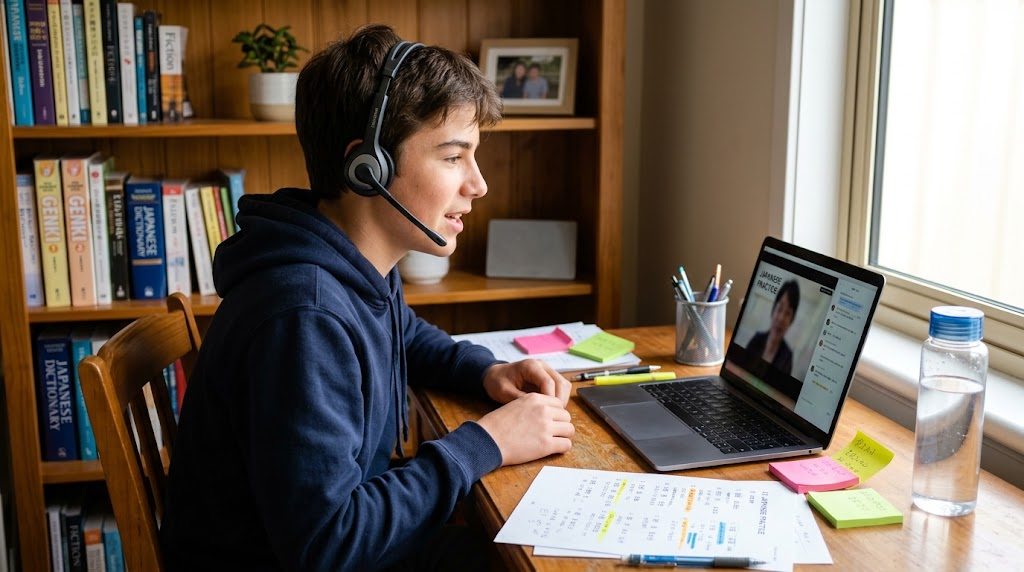
Sydney is only one hour ahead of Japan (two during daylight saving), so Japan’s weekday-evening sessions fall right in your teen’s after-school and evening — the natural time to practise. Because attendance is unlimited on one flat fee, an HSC student can ramp practice up through winter as the August–September oral approaches, then ease off, without paying per session. We map Japan time to your city in our class-times guide, and collect local details on our Japanese classes for Australia & New Zealand page.
A simple winter run-up to the oral
- From Term 1–2: two or three unscripted Japanese conversations a week — about your actual life. Build comfort and speed, not perfection.
- June–July (as venues are set): add a fortnightly mock oral — a ten-minute interview, then feedback against the marking criteria.
- The fortnight before your date: keep talking daily but keep it light. This is the time for confidence, not new memorisation.
FAQ
How much is the HSC Japanese Continuers oral worth?
The oral examination is worth 20 marks, with the written paper worth 80, for a 100-mark HSC examination. So the oral is a fifth of your exam mark — enough to move an overall result meaningfully.
How long is the oral and what happens in it?
It’s an interview-style conversation of about 10 minutes. An examiner asks questions on the prescribed course topics as they relate to your personal world, and you respond and develop the conversation in Japanese.
When and where is it held?
HSC languages oral exams are held in August–September at a designated examination centre (not your own school). Scheduling is usually arranged around June — confirm your exact date and venue through your school, and check the current-year NESA timetable.
Should Year 11 students start now?
Yes — it’s the best time. Speaking confidence built in Year 11 compounds; a program rushed into Term 3 of Year 12 rarely catches up. With unlimited attendance, younger students simply speak more, sooner.
What does it cost?
One flat monthly fee for unlimited daily attendance (billed in Japanese yen; your local-currency amount is on the tuition page). Unlike per-lesson tutoring, ramping up before the oral costs nothing extra.
Beyond exam prep, an online Japanese school for kids taught by qualified Japanese teachers helps students keep speaking with peers in Japan.
▼ Thinking further back than the HSC? Here is what is actually available for younger children → Japanese school for kids in Sydney: fees and how to choose