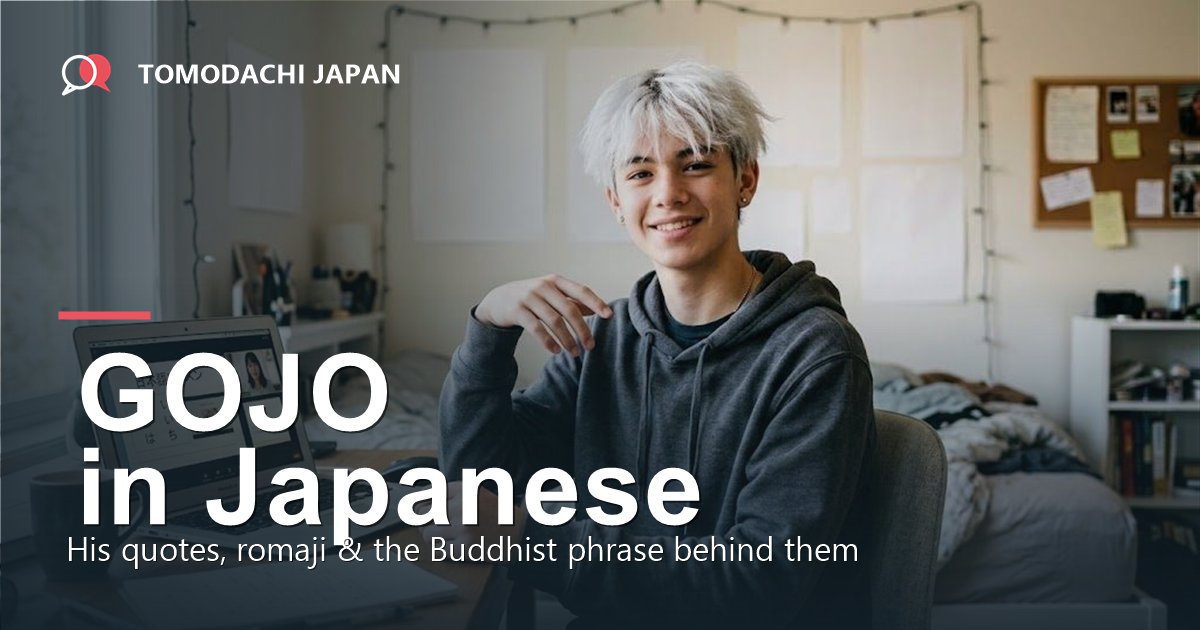
Gojo Satoru is the coolest, cockiest, and most quotable character in Jujutsu Kaisen — but his most famous line is actually a 2,500-year-old Buddhist phrase, and his catchphrase teaches you one of the most useful words in casual Japanese. I’m a Japanese teacher, and in this guide we’ll go through the most iconic Gojo quotes in Japanese with accurate originals, rōmaji and English, the grammar and culture behind each, and an honest ◎/△/✗ verdict on whether you can actually use it in real life.
Can-you-use-it legend: ◎ = natural everyday Japanese · △ = casual/dramatic, friends only · ✗ = anime/literary only.

“I’m the strongest”: Gojo’s signature line
| Japanese | Rōmaji | English | Use it? |
|---|---|---|---|
| 僕が最強だ。 | Boku ga saikyō da. | I’m the strongest. | △ Grammar is ◎, boast is Gojo |
| 大丈夫、僕、最強だから。 | Daijōbu, boku, saikyō dakara. | It’s fine — I’m the strongest. | ◎ 大丈夫 is everyday |
| なんてね。 | Nante ne. | …just kidding. | ◎ Genuinely useful |
Teacher’s note: Notice Gojo says 僕 (boku), the softer, cooler “I,” not the rough 俺 (ore) — it fits his relaxed confidence, and it’s a great, safe first-person pronoun for boys. 最強 (saikyō) is 最 (sai-, “most”) + 強い (tsuyoi, “strong”), the same 最 as in 最高 (saikō, “the best”). And the real gem here is なんてね (nante ne) — a super-common way to say “just kidding / never mind” after a bold or awkward line. Drop it in with friends and you’ll instantly sound more natural: 全部やったよ…なんてね (“I did it all… just kidding”).
Want to go from quoting anime to actually talking with friends in Japan?
TOMODACHI JAPAN is an online Japanese school for children growing up outside Japan. They talk with peers their own age in Japan every day, taught by teachers working at Japanese schools, in small classes of 8.
🎁 Register and we’ll email you our School Guide (PDF, in English) straight away. You’ll also be first to hear about tuition, scholarships and opening dates.
Free · takes about 30 seconds
“The honored one”: a 2,500-year-old phrase
| Japanese | Rōmaji | English | Use it? |
|---|---|---|---|
| 天上天下唯我独尊 | Tenjō tenge yuiga dokuson | Throughout heaven and earth, I alone am the honored one. | ✗ Ancient / ceremonial |
Teacher’s note — the coolest culture lesson in anime: Gojo’s most legendary line isn’t something the writers invented. 天上天下唯我独尊 (tenjō tenge yuiga dokuson) are, according to tradition, the words the Buddha spoke at his birth — “in all of heaven and earth, I alone am honored.” The last four characters, 唯我独尊 (yuiga dokuson), survive as a real four-character idiom (四字熟語) meaning “self-important / thinking only oneself is great.” So when Gojo says it, a Japanese audience hears both a god-tier flex and a wink at how arrogant that is. You’ll never say this in conversation — but knowing where it comes from is exactly the kind of depth that makes Japanese click.
Gojo’s heart: friendship and loss
| Japanese | Rōmaji | English | Use it? |
|---|---|---|---|
| 親友だよ。 | Shinyū da yo. | You’re my best friend. | ◎ 親友 is real & warm |
| 愛は呪いだよ。 | Ai wa noroi da yo. | Love is a curse. | △ Poetic; great vocab |
Teacher’s note: Under the swagger, Gojo’s warmest lines use everyday words. 親友 (shinyū) means “close/best friend” — deeper than 友達 (tomodachi), “friend,” and something you can absolutely use: 彼は私の親友です (“He’s my best friend”). His melancholy 愛は呪いだよ (ai wa noroi da yo) pairs 愛 (ai, “love”) with 呪い (noroi, “curse”) — poetic and dramatic, but both are useful vocabulary. The sentence-final だよ (da yo) adds a soft, confiding “you know” feeling — friendly, but casual, so switch to ですよ (desu yo) when you need to be polite.
Talking like Gojo vs. talking to real people

Gojo’s charm is the gap between his casual, boyish speech (僕, なんてね, だよ) and the enormous things he’s saying. That casual register is actually friendlier and safer than the rough ore-style speech of many anime heroes — but it’s still casual, meant for friends, not for teachers or first meetings. The reliable move, as always: keep the useful cores (大丈夫, 親友, なんてね, 最強), and add polite です / ます endings when the situation calls for it. Learn where that line sits and you get Gojo’s easy confidence without the accidental rudeness — which is exactly what a native teacher trains into you.
Frequently asked questions
What does Gojo say in Japanese (“Throughout Heaven and Earth”)?
天上天下唯我独尊 (Tenjō tenge yuiga dokuson) — “Throughout heaven and earth, I alone am the honored one.” It’s traditionally attributed to the Buddha’s words at birth, which is why it sounds so grand.
What is Gojo’s catchphrase in Japanese?
僕が最強だ (Boku ga saikyō da) / 大丈夫、僕、最強だから (Daijōbu, boku, saikyō dakara) — “I’m the strongest” / “It’s fine, I’m the strongest.” He often softens it with なんてね (nante ne), “just kidding.”
Which Gojo phrase can I actually use?
大丈夫 (daijōbu), なんてね (nante ne), and 親友 (shinyū, “best friend”) are all natural, friendly, everyday Japanese. Skip the “I’m the strongest” part unless you’re joking with friends!
Where can my child practise these with real Japanese kids?
At TOMODACHI JAPAN, kids join small-group classes with peers who live in Japan and real Japanese teachers, so the phrases they love from anime get used and gently corrected into natural Japanese. See our Jujutsu Kaisen quotes guide, our how to learn Japanese with anime hub, or our plans and pricing.
▼ If your child wants real lessons, not just famous lines → an honest comparison of online Japanese lessons for kids