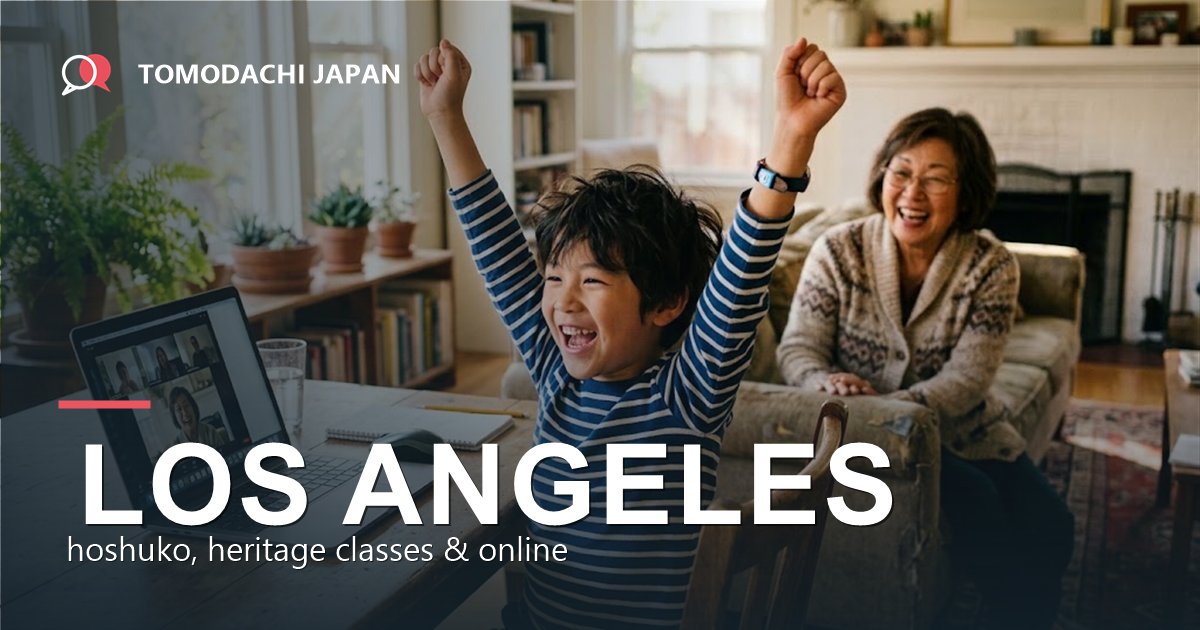
Los Angeles has the deepest Japanese-school scene of any city in the Americas — from Asahi Gakuen, the second-largest hoshuko (supplementary school) in the world, to century-old heritage-language schools founded in 1912. But the guides out there don’t help much: the most-shared listicle still quotes fees from 2015, the big directories list schools with no fees at all, and Yelp round-ups quietly mix in Kumon and private tutors. No one has lined up the current fees side by side, split hoshuko from heritage-language cleanly, or been honest about the Saturday-morning freeway commute. Here’s the short version first: a Saturday hoshuko runs around $270–290 a month plus fees; a heritage-language class can be as little as $100 a month; and the one full-time Japanese day school runs $1,000+ a month. Below we sort every major LA-area school into three types — hoshuko (“kokugo”), heritage-language, and full-time — with fees and sources as of July 2026, and we look squarely at what works for a Japanese-American child whose stronger language is English.
Japanese schools for kids in Los Angeles: fee comparison
| School | Type | Day | Ages | Tuition (per month) | Area |
|---|---|---|---|---|---|
| Asahi Gakuen | Hoshuko (kokugo / MEXT) | Saturday, full day | K–High School | $270–280 (+$20 env. fee) | Torrance / Santa Monica / San Gabriel / Orange |
| Nishiyamato Academy (weekday) | Full-time | Mon–Fri | Pre-K–G9 | $930–1,260 (+$101 facility) | Lomita |
| Nishiyamato Saturday Hoshuko | Hoshuko (kokugo) | Saturday, half day | K–G9 | $270 (+$20 facility) | Lomita / Rancho Palos Verdes / Irvine |
| Cosmos Gakuin | Heritage-language + supplementary | Saturday 9:00–12:30 | Kinder–High School | $250–260 (weekday kinder $240–480) | Sawtelle / West LA |
| GVJCI Japanese Language School | Heritage-language | Saturday 9:00–12:35 | 5–17 | $100 (1 child) / $190 (2+) | Gardena (South Bay) |
| Japanese Institute of Sawtelle (JIS) | Heritage + foreign-language tracks | Saturday (+ weekday preschool) | 3–18 | On inquiry | Sawtelle Japantown |
| Saniku Tozai Gakuen | Supplementary (Christian mission) | Saturday | Kinder–Middle School | On inquiry | South Bay / OC (3 campuses) |
| Kyodo System (Rafu Chuo / Pasadena) | Heritage-language | Saturday 8:45–12:15 | 5–High School | On inquiry | East LA / Pasadena |
| TOMODACHI JAPAN | Online, conversation & friendship | Any day (unlimited attendance) | 5–18 | One flat monthly fee — see the free guide | Your home |
Looking for a way to keep Japanese going from abroad?
TOMODACHI JAPAN is an online Japanese school for children growing up outside Japan. They talk with peers their own age in Japan every day, taught by teachers working at Japanese schools, in small classes of 8.
🎁 Register and we’ll email you our School Guide (PDF, in English) straight away. You’ll also be first to hear about tuition, scholarships and opening dates.
Free · takes about 30 seconds
Three types of school — and why the difference matters
LA’s Japanese schools can look interchangeable on a directory listing, but they split into three quite different types. Mixing them up is the number-one reason families end up saying “we enrolled, and it just wasn’t the right fit.”
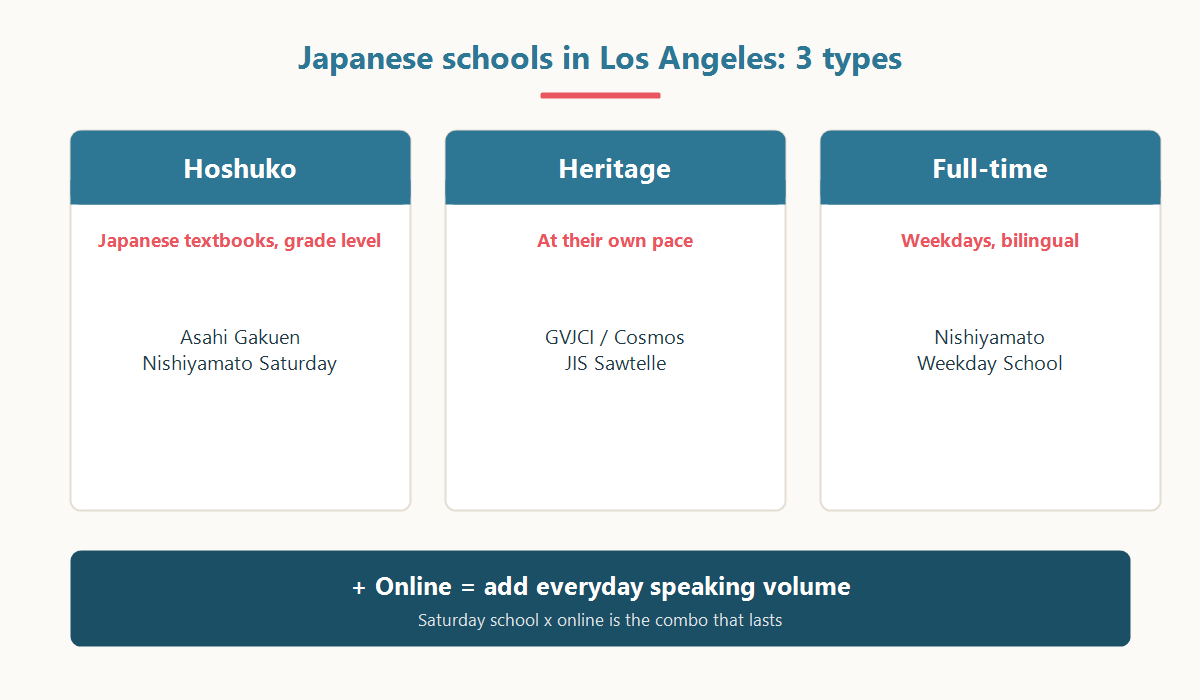
Hoshuko (“kokugo”) schools: keeping pace with grade level in Japan
Asahi Gakuen is the gold standard — a MEXT-recognized hoshuko, the second-largest in the world, running the full Japanese curriculum every Saturday, all day, from kindergarten through high school across four campuses (Torrance, Santa Monica/Marina del Rey, San Gabriel/South El Monte, and Orange/Westminster). Tuition is $270/month for elementary and junior high, $280/month for high school, plus a $20/month environment fee, with a $500 entrance fee and a $120 application fee. It has the strongest track record for kids heading back to Japan and sitting kikoku (returnee) entrance exams. The trade-off is real: a full day of Japanese-school rigor plus homework on top of US weekday school is heavy for an English-dominant heritage child. Nishiyamato Academy’s Saturday Hoshuko is the other kokugo option — a half-day program (K–G9) at $270/month plus a $20 facility fee, with three campuses including Irvine, which fills the Orange County gap, and a reputation for being supportive of kids who also do other weekend activities. Asahi Gakuen / Nishiyamato
Heritage-language schools: growing a mixed-family child’s “other mother tongue”
Put a Japanese-American child straight into grade-level kokugo and, more often than not, it turns into a weekly battle. That’s where heritage-language schools shine — they grow the “other mother tongue” at the child’s own pace. GVJCI Japanese Language School (Gardena Valley JCI, founded 1912) is the most affordable heritage option in the whole city at just $100/month for one child ($190 for two or more, or $900 for the ten-month year), meeting Saturdays 9:00–12:35 from September to June for ages 5–17. For an English-dominant nikkei kid, it’s close to ideal. Cosmos Gakuin (Sawtelle, West LA) blends heritage identity with academics and is refreshingly transparent about pricing: $250/month for Saturday elementary, $260 for junior high. Japanese Institute of Sawtelle (JIS), a 100-year-old nonprofit in Sawtelle Japantown, runs both heritage and Japanese-as-a-foreign-language tracks (ages 3–18; fees on inquiry). And the Kyodo System schools (Rafu Chuo Gakuen and Pasadena Gakuen) serve East LA and the San Gabriel Valley — a genuine geographic gap — on Saturday mornings. GVJCI / Cosmos Gakuin / Saniku Tozai Gakuen
Full-time: Nishiyamato Academy of California (weekday)
Nishiyamato’s weekday campus in Lomita is a full-time bilingual day school (roughly 70% Japanese, 30% English) running Monday to Friday from pre-K through grade 9 — the only full-time Japanese day school on the entire US West Coast. Tuition is $930/month for pre-K, $1,040 for grades 1–4, and $1,260 for grades 5–9, plus a $101/month facility fee and an $850–1,000 registration fee. It sits in a different category from the weekend schools in both purpose and budget — premium price, single Lomita location — so we’ll simply note it here. Official site
Three LA-specific things to watch out for
- Geography is destiny — and it’s mostly the South Bay. The schools cluster around Torrance, Gardena and Lomita. The Westside is served by Asahi Santa Monica, Cosmos and JIS Sawtelle; the San Gabriel Valley and East LA are thin (Kyodo, Asahi San Gabriel); Orange County uses Asahi Orange and Nishiyamato Irvine. Live on the wrong side of the metro and you’re looking at a 45–75 minute each-way Saturday drive.
- The cost stacks up fast. A hoshuko is ~$270–290/month before you add entrance and application fees — north of $3,000 a year. Full-time Nishiyamato is ~$1,000–1,360/month. Heritage GVJCI is ~$100/month. Which one is right depends entirely on whether your child is Japan-bound (kikoku exams) or an English-dominant heritage learner.
- Hoshuko intensity is the real thing. Asahi and Nishiyamato follow Japan’s April–March MEXT calendar with genuine homework, layered on top of your child’s US weekday school. Seats fill and classes cap — apply early and confirm the spot.
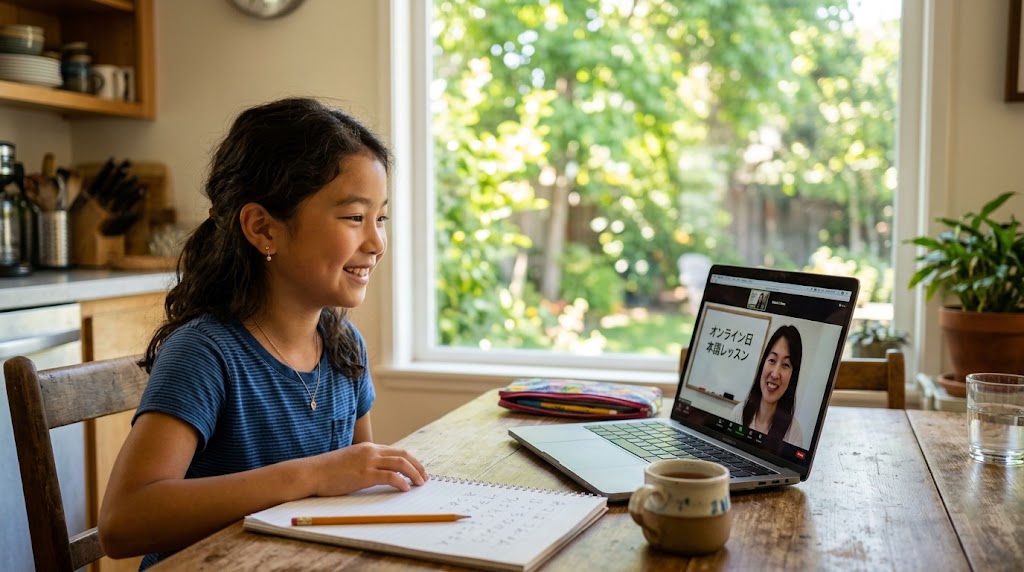
The online option: turning once-a-week into every day
Saturday school is genuinely valuable. But as most families discover, one session a week won’t make a child a Japanese speaker. That’s the gap we built TOMODACHI JAPAN to fill — an online Japanese school opening in December 2026, designed to be the “weekday Japanese time” that pairs with a Saturday hoshuko or heritage school rather than replacing it. (If your family is weighing this up against hoshuko more broadly, see our guide to the online alternative to Japanese hoshuko.)
Now the honest part about time zones, because LA is where it gets tricky. LA is 16 hours behind Japan (during PDT summer). The intuitive idea — join a Japanese weekday after-school class at 5 pm Japan time — lands at 1 am in Los Angeles. That’s the trap, and we won’t pretend otherwise. But there’s a workable sweet spot: Japan’s weekend mornings are your weekend evenings. A Japan Saturday 9 am class is Friday 5 pm in LA; a Japan Sunday morning is your Saturday evening. So for a family in North America’s West, the reliable window is a Japan weekend-morning class that lands on your Friday or Saturday evening — after school, from your own living room.
- The other kids live in Japan. Your child talks in small groups with children from our sister school, NIJIN Academy, which has over 800 students across Japan. Real friends in Japan — the one thing a classroom in LA can’t manufacture.
- It’s a connection to Japan, not just a lesson. For a heritage child, that link to identity and family roots is the long-term value — the reason the Japanese sticks when the worksheets are long forgotten.
- Kids-specialized, so heritage learners fit. For one flat monthly fee, your child can join every day if they like. Classes are grouped by conversation level rather than grade, so an English-dominant heritage kid isn’t stranded at a “5th-grade wall” of kanji — and unlimited attendance finally solves the “once a week isn’t enough volume” problem.
“Saturdays at GVJCI or Asahi for community and grade-level work, weekend evenings online for conversation with friends in Japan” — for an LA kid, that combination is the one that actually moves the needle.
FAQ from Los Angeles families
Our child is Japanese-American. Hoshuko or heritage school?
It comes down to how much Japanese happens at home and where your child is headed. If Japanese conversation is part of daily life and Japan (with its returnee exams) is a real possibility, a hoshuko like Asahi or Nishiyamato makes sense. If English is clearly the stronger language, a heritage school (GVJCI, Cosmos, JIS) is usually far better at keeping “Japanese = fun” alive rather than turning Saturday into a grind. The fastest route to the right answer is an honest conversation about your child’s level at the enrollment interview.
We’re on the wrong side of the metro for Saturday school. What now?
If you’re in the San Gabriel Valley, the far east, or a corner of OC without a nearby campus, a 45–75 minute each-way Saturday drive is a lot to sustain for years. Two realistic moves: check the closer-than-you-think options first (Asahi has four campuses, Nishiyamato three, and Kyodo covers East LA/Pasadena), and use online to cover the weekdays so a single manageable Saturday session is enough. Online has no commute at all — your child starts from the kitchen table.
Can we combine it with Saturday school?
Yes — that’s the intended use. TOMODACHI JAPAN is unlimited-attendance, so kids simply join on the evenings that suit them and scale back in weeks when hoshuko homework piles up. The roles don’t overlap: reading, writing and grade-level work at the Saturday school; speaking volume and real friendships online.
Isn’t the time difference from LA a problem?
It’s the one thing to plan around honestly. LA is 16 hours behind Japan, so a Japanese weekday after-school class (5 pm in Japan) would be 1 am here — that doesn’t work, and we won’t pretend it does. What does work is the weekend: Japan’s Saturday and Sunday mornings land on your Friday and Saturday evenings. So a West Coast family joins Japan’s weekend-morning classes at a comfortable evening hour. Plan around the weekend window and the distance stops being a barrier.