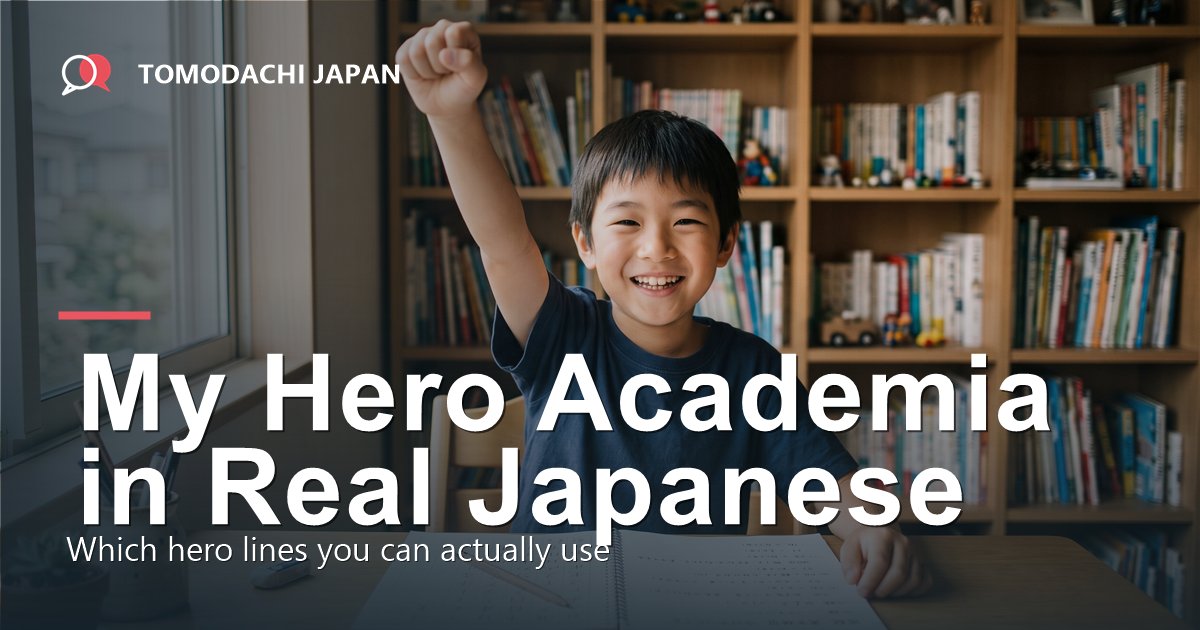
Almost every My Hero Academia fan can shout “Plus Ultra!” — but could you actually use All Might’s or Deku’s words with a real Japanese person, and would they sound heroic or just strange? I’m a Japanese teacher, and in this guide we’ll go through the most iconic My Hero Academia quotes in Japanese with accurate original text, rōmaji and English — plus what each line really teaches you about grammar, politeness, and which ones are safe to say out loud in real life.
Can-you-use-it legend: ◎ = natural everyday Japanese · △ = casual/dramatic, friends only · ✗ = anime only, rough or strange in real life.

All Might: the most famous My Hero Academia lines in Japanese
| Japanese | Rōmaji | English | Use it? |
|---|---|---|---|
| 私が来た! | Watashi ga kita! | I am (here) now! | △ Grammar is ◎, the line is a catchphrase |
| もう大丈夫だ。なぜって? 私が来た! | Mō daijōbu da. Nazette? Watashi ga kita! | It’s fine now. Why? Because I am here! | △ 大丈夫 itself is ◎ |
| 君はヒーローになれる。 | Kimi wa hīrō ni nareru. | You can become a hero. | ◎ ~になれる is very useful |
| 力の使い方を教えてやる。 | Chikara no tsukaikata o oshiete yaru. | I’ll teach you how to use your power. | △ ~てやる sounds tough |
Teacher’s note — the catchphrase: All Might’s 私が来た (watashi ga kita) literally means “I have come.” On its own it is grammatically clean and polite (私 = the neutral “I”), which is why it comforts people in the story — a hero arrived. The word to actually steal here is 大丈夫 (daijōbu), “it’s okay / I’m fine,” one of the most useful words in daily Japanese: 大丈夫ですか? (“Are you okay?”), 大丈夫です (“I’m fine”). Swap the blunt だ for です and it’s perfectly polite.
The line that changed Deku’s life: 君はヒーローになれる (kimi wa hīrō ni nareru) uses なれる (nareru), the potential form of なる (“to become”) → “can become.” This is gold: 上手になれる (“can get good at it”), 友達になれる (“can become friends”). Note 君 (kimi), “you,” is warm but slightly above-to-below — a teacher to a student, a senior to a junior. To a stranger or someone senior, use their name + さん instead.
Want to go from quoting anime to actually talking with friends in Japan?
TOMODACHI JAPAN is an online Japanese school for children growing up outside Japan. They talk with peers their own age in Japan every day, taught by teachers working at Japanese schools, in small classes of 8.
🎁 Register and we’ll email you our School Guide (PDF, in English) straight away. You’ll also be first to hear about tuition, scholarships and opening dates.
Free · takes about 30 seconds
Deku, Bakugo & the U.A. spirit
| Japanese | Rōmaji | English | Use it? |
|---|---|---|---|
| 助けたかったんだ。 | Tasuketakattan da. | I just wanted to save them. | ◎ ~たかった = “wanted to” |
| 今の僕にできること。 | Ima no boku ni dekiru koto. | What I can do right now. | ◎ できること is very useful |
| まだだ、まだ終わらんよ。 | Mada da, mada owaran yo. | Not yet — it’s not over yet. | △ 終わらん is rough/dialect |
| 勝つために全力を尽くす。 | Katsu tame ni zenryoku o tsukusu. | I’ll do everything to win. | ◎ ~ために = “in order to” |
| 死ぬ気で来い! | Shinu ki de koi! | Come at me with everything! | ✗ Rough command |
Teacher’s note — Deku’s heart: When Deku explains why he ran in to save Bakugo, he says 助けたかったんだ (tasuketakattan da). Break it down: 助ける (to help/save) → 助けたい (want to save) → 助けたかった (wanted to save). That ~たかった ending — “wanted to (do)” — is everyday Japanese: 行きたかった (“I wanted to go”), 食べたかった (“I wanted to eat”). Beautiful meaning and useful grammar.
The purposeful ones: ~ために (tame ni), “in order to,” is a pattern you’ll use forever: 日本語を話すために勉強する (“I study in order to speak Japanese”). But watch the register in 死ぬ気で来い (shinu ki de koi) — 来い is the barked command form of 来る (“come”). Thrilling in a fight, but as a command to a real person it’s aggressive. The friendly version is 来て (kite) or 来てください (kite kudasai).
Anime hero Japanese vs. real Japanese

Notice the pattern: the meaning of hero lines is often gentle — wanting to help, believing in someone, doing your best — while the delivery is loud and blunt (command forms like 来い, dropped endings like 終わらん, the tough ~てやる). That contrast is exactly what makes anime dialogue feel powerful. The good news for learners: the grammar underneath (なれる, ~たかった, ~ために, 大丈夫, できること) is 100% real and useful. You just re-dress it in polite ~です / ~ます forms for everyday life.
The fastest way to feel the difference? Say these lines to a real Japanese friend and watch the reaction. That’s how you learn — instantly and unforgettably — that 大丈夫です lands warmly while 死ぬ気で来い makes everyone laugh.
Frequently asked questions
What is All Might’s most famous quote in Japanese?
もう大丈夫だ。なぜって? 私が来た!(Mō daijōbu da. Nazette? Watashi ga kita!) — “It’s fine now. Why? Because I am here!” The heart of it, 大丈夫 (daijōbu), is genuinely everyday Japanese you can use to reassure anyone.
What does “Plus Ultra” mean in Japanese?
“Plus Ultra” (プルスウルトラ, Purusu Urutora) is actually Latin, not Japanese — U.A. High’s motto meaning “further beyond.” In the anime it’s shouted as a rallying cry, similar to “go beyond your limit!” It’s fun to yell with friends, but it isn’t a Japanese phrase you’d use in conversation.
Is My Hero Academia good for learning Japanese?
Yes — it’s full of motivational speeches built on genuinely useful grammar (potential forms, ~たい/~たかった, ~ために). Just remember hero speech is loud and blunt; learn the pattern, then practise it in polite form. See our guide to learning Japanese with anime for the full method.
Where can my child practise these with real Japanese friends?
At TOMODACHI JAPAN, kids join small-group classes with peers who live in Japan and real Japanese teachers — so the anime phrases they love get used, corrected and turned into real conversation. Read Attack on Titan quotes in Japanese next, or see our plans and pricing.