If you are starting Year 12 Japanese Beginners, the speaking exam is the one part of the HSC you can rehearse almost word for word in advance, because the examiner’s questions come from a small, predictable pool. The trap is that rehearsing word for word is exactly what loses marks. This page gives you 34 HSC Japanese Beginners speaking questions sorted by the six prescribed topics, each with a short model answer at Beginners level, plus the answer shape and the mistakes that cost students marks year after year.
The questions are drawn from the NSW Department of Education’s official Japanese Beginners practice speaking questions list (2025, published under CC BY 4.0). The model answers and teaching notes are ours, written by teachers who work in Japanese schools.
What the HSC Japanese Beginners speaking exam actually is
The oral examination is worth 20 of the 100 HSC marks and lasts about five minutes. It is held before the written paper, usually on a weekend in August or September, at an examination centre rather than your own classroom. In the words of the NSW Department of Education, it is an interview-style conversation in which you respond to the examiner’s questions on the prescribed topics as they relate to your personal world.
Two details from the official guidance shape everything below. First, the practice list is not a definitive list of the questions you will get. Second, the department warns that you may be interrupted if an answer sounds rote-learned. So the goal is not to memorise 34 paragraphs; it is to be able to talk comfortably about your own life in short, accurate sentences.
Looking for a way to keep Japanese going from abroad?
TOMODACHI JAPAN is an online Japanese school for children growing up outside Japan. They talk with peers their own age in Japan every day, taught by teachers working at Japanese schools, in small classes of 8.
🎁 Register and we’ll email you our School Guide (PDF, in English) straight away. You’ll also be first to hear about tuition, scholarships and opening dates.
Free · takes about 30 seconds
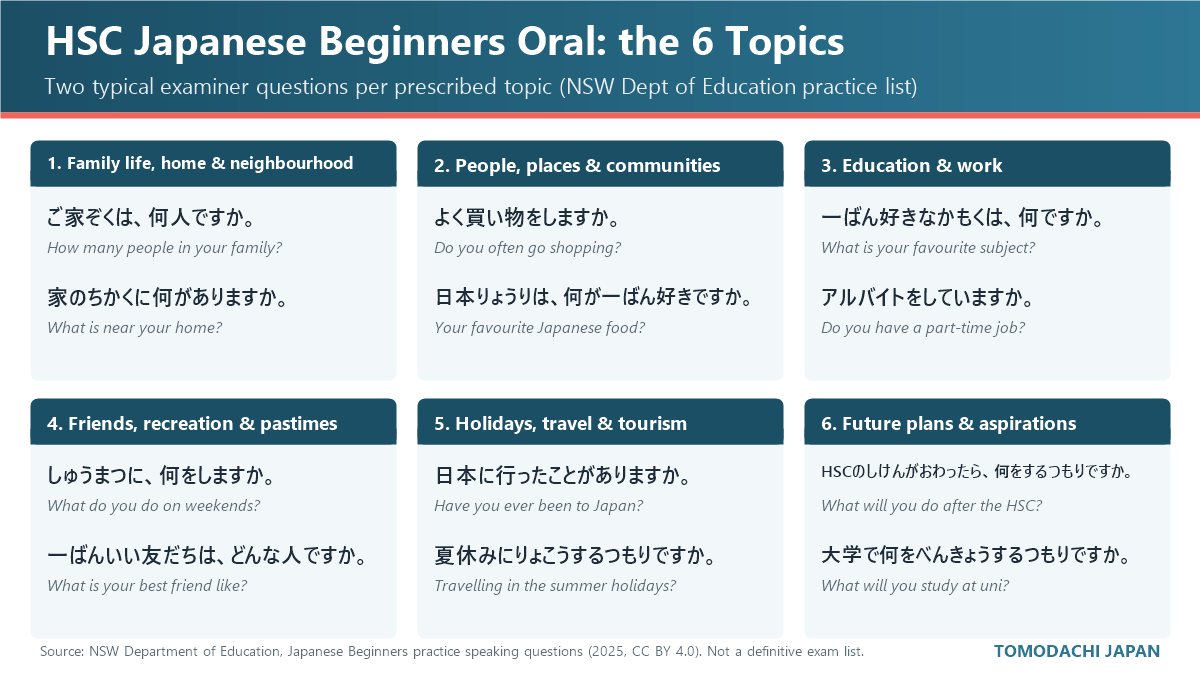
The six topics the examiner draws from
Every question comes from one of the six prescribed topics in the Japanese Beginners Stage 6 syllabus. If you can talk for a minute about each one, you are covered.
The answer shape: three short sentences, then stop
The official tips ask you to give reasons for your choices, use a variety of sentence structures and tenses, and answer with more than one sentence where possible. The simplest way to do all of that under pressure is a three-step answer: answer the question directly, give a reason with ~から, then add one more detail, ideally in a different tense.
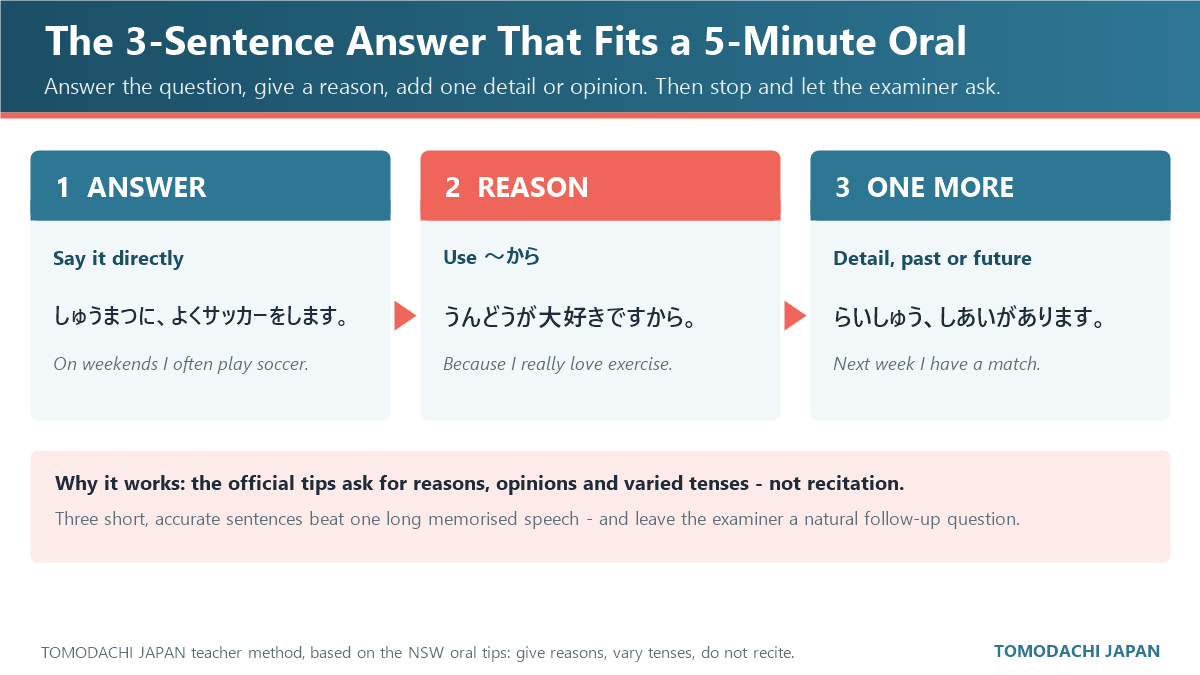
Then stop. A five-minute oral is short, and every answer you keep brief gives the examiner room to ask a follow-up, which is your chance to show you are genuinely conversing rather than reciting.
34 HSC Japanese Beginners speaking questions, with model answers
Read each model answer as a template, not a script. Swap in your own suburb, family and hobbies; the official tips say your information can be fictitious, as long as it stays consistent across the whole conversation.
1. Family life, home and neighbourhood
| Question | Meaning | Model answer |
|---|---|---|
| 何年生ですか。 | What year are you in? | 12年生です。 |
| ご家ぞくは、何人ですか。だれとだれですか。 | How many people are in your family? Who are they? | 四人です。父と母と弟とわたしです。 |
| お父さんは、どんな人ですか。 | What is your father like? | 父はとてもやさしくて、おもしろい人です。でも、ちょっときびしいです。 |
| どこに住んでいますか。 | Where do you live? | シドニーのチャッツウッドに住んでいます。 |
| あなたが住んでいる町は、どんな町ですか。 | What is the town you live in like? | にぎやかで、べんりな町です。みせがたくさんありますから、とても好きです。 |
| 学校からかえったあとで、何をしますか。 | What do you do after you get home from school? | まず、おやつを食べます。それから、しゅくだいをします。 |
| 家のしごとをしますか。 | Do you do chores at home? | はい、します。毎ばん、さらをあらいます。 |
Teacher’s note: the honorific trap. The examiner asks about ご家ぞく and お父さん because they are talking about your family, politely. When you answer about your own family, drop the politeness: say 家ぞく, 父 and 母, not お父さん and お母さん. Japanese speakers notice this instantly, and getting it right is one of the clearest signals that you understand how the language works rather than repeating phrases.
2. People, places and communities
| Question | Meaning | Model answer |
|---|---|---|
| よく買い物をしますか。 | Do you often go shopping? | はい、よくします。しゅうまつに、友だちとショッピングセンターに行きます。 |
| あなたの町で、一ばん好きなみせは、どんなみせですか。 | What is your favourite shop in your town? | 本やです。しずかで、マンガがたくさんありますから。 |
| 日本りょうりと、オーストラリアのりょうりでは、どちらのほうが好きですか。 | Which do you prefer, Japanese or Australian food? | 日本りょうりのほうが好きです。すしやラーメンがおいしいですから。 |
| さしみを食べたことがありますか。 | Have you ever eaten sashimi? | はい、あります。でも、あまり好きじゃありません。 |
| あなたの町にいいレストランがありますか。 | Is there a good restaurant in your town? | はい、あります。えきのちかくに、おいしいタイりょうりのレストランがあります。 |
3. Education and work
| Question | Meaning | Model answer |
|---|---|---|
| 一ばん好きなかもくは、何ですか。 | What is your favourite subject? | 日本語です。日本の友だちと話したいですから。 |
| あなたの学校は、どんな学校ですか。 | What is your school like? | 大きい学校です。学生は千二百人ぐらいいます。 |
| 学校は何時から何時までですか。 | What time does school start and finish? | 八時半から三時までです。 |
| ひる休みに何をしますか。 | What do you do at lunchtime? | 友だちとひるごはんを食べて、それからバスケットボールをします。 |
| アルバイトをしていますか。 | Do you have a part-time job? | はい、しています。土よう日にカフェではたらいています。 |
| しょうらい、どんなしごとをしたいと思いますか。 | What kind of job do you want in the future? | 先生になりたいと思います。子どもが好きですから。 |
4. Friends, recreation and pastimes
| Question | Meaning | Model answer |
|---|---|---|
| しゅうまつに、何をしますか。 | What do you do on weekends? | 土よう日はアルバイトをします。日よう日は家ぞくとビーチに行きます。 |
| 一ばん好きなスポーツは、何ですか。 | What is your favourite sport? | サッカーです。小学生のときから、ずっとしています。 |
| てん気のわるい日は、何をしますか。 | What do you do on days with bad weather? | 家でえいがを見たり、ゲームをしたりします。 |
| どんなおんがくが好きですか。 | What kind of music do you like? | Jポップが好きです。毎日聞いています。 |
| あなたの一ばんいい友だちは、どんな人ですか。 | What is your best friend like? | エマさんです。あかるくて、しんせつな人です。 |
| よくコンピュータをつかいますか。何につかいますか。 | Do you use a computer often? What for? | はい。しゅくだいや、日本語のべんきょうにつかいます。 |
Teacher’s note: stay in the ます form. Beginners students who have watched a lot of anime sometimes slide into casual forms mid-answer (好きだ, 行く). In an interview with an adult examiner, keep every sentence in です and ます. It is not about being stiff; it is the register any Japanese teenager would use with a teacher they have just met.
5. Holidays, travel and tourism
The official list branches here: if you say you have been to Japan, the follow-ups are about that trip; if not, they ask where you would like to go. Prepare both branches, because the examiner chooses the path from your first answer.
| Question | Meaning | Model answer |
|---|---|---|
| 日本に行ったことがありますか。 | Have you ever been to Japan? | はい、あります。去年の十二月に、家ぞくと行きました。 |
| 何が一ばんおもしろかったですか。 | What was the most interesting thing? | 京都が一ばんおもしろかったです。おてらがとてもきれいでした。 |
| しんかんせんにのりましたか。どうでしたか。 | Did you ride the shinkansen? How was it? | はい、のりました。とてもはやくて、びっくりしました。 |
| 日本に行きたいですか。(if no) | Do you want to go to Japan? | はい、とても行きたいです。東京でアニメのみせに行きたいです。 |
| 夏休みにりょこうするつもりですか。 | Do you plan to travel in the summer holidays? | はい。家ぞくとメルボルンに行くつもりです。 |
6. Future plans and aspirations
| Question | Meaning | Model answer |
|---|---|---|
| HSCのしけんがおわったら、何をするつもりですか。 | What will you do after the HSC exams? | 友だちとバイロンベイに行くつもりです。そして、たくさんねたいです。 |
| 大学に行くつもりですか。 | Do you plan to go to university? | はい。大学でかんごをべんきょうするつもりです。 |
| しょうらい何になりたいですか。どうしてですか。 | What do you want to be? Why? | エンジニアになりたいです。ものを作るのが好きですから。 |
| くるまのめんきょをもっていますか。 | Do you have a driver’s licence? | いいえ、まだです。でも、らいねん、とりたいです。 |
| しょうらい、がい国をりょこうしたいですか。 | Do you want to travel overseas in the future? | はい。日本とかんこくに行ってみたいです。 |
That makes 34 questions. The full official list has more variations on each, and you can download it from the NSW Department of Education’s Japanese Beginners practice speaking questions page.
Five mistakes that cost Beginners students marks
- Reciting a memorised paragraph. The official guidance is blunt that you may be interrupted. A memorised block also tends to answer a slightly different question from the one asked.
- One-word answers. はい or サッカーです alone gives the examiner nothing to assess. Use the three-sentence shape.
- Inconsistent details. If your brother is ten in the family question, he cannot be at university in the future-plans question. Fictitious is fine; contradictory is not.
- Only present tense. Build at least one past answer (~ました, ~かったです) and one future answer (~つもりです, ~たいです) into your preparation for each topic.
- Freezing on an unfamiliar question. It is fine to ask for help in Japanese: もういちど、おねがいします (once more, please) or すみません、ゆっくりおねがいします (sorry, slowly please). Our Japanese oral exam guide has more recovery phrases.
How to practise in the weeks before the oral

- Record and listen back. Pick five random questions a day, answer into your phone, and listen once. Fix pronunciation and long pauses, not grammar perfection.
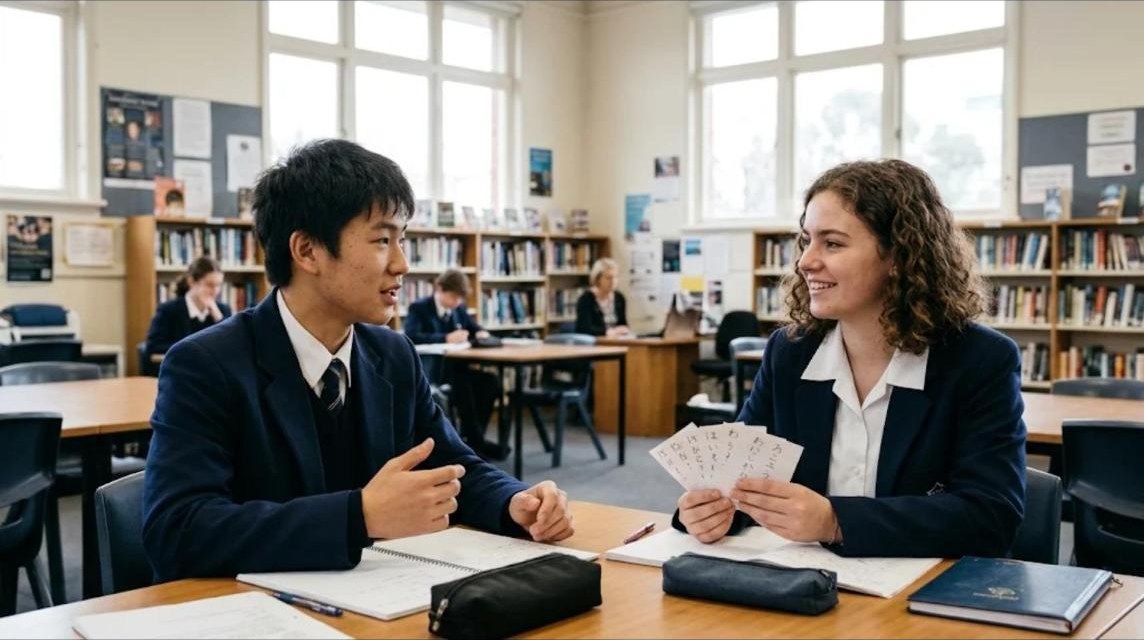
- Shuffle the order. Write the questions on cards and have a friend or parent read them at random. In the exam you will not get them in topic order.
- Get written feedback. The department suggests writing answers and submitting them to your teacher. Do this once per topic, early, so errors do not get rehearsed in.
- Talk to unfamiliar Japanese speakers. Your class teacher’s voice becomes easy to understand. The examiner’s will not be. The official tips end with a simple instruction: speak with any Japanese speakers you know, and be brave.
Beginners vs Continuers speaking: an honest comparison
| Japanese Beginners | Japanese Continuers | |
|---|---|---|
| Marks | 20 of 100 | 20 of 100 |
| Length | About 5 minutes | Roughly 10 minutes |
| Content | Six prescribed topics, your personal world | Mainly the personal world, with opinions and more complex follow-ups |
| What separates top answers | Accurate short sentences, reasons, varied tenses | Sustaining a natural conversation and justifying opinions |
If you are in Continuers, our HSC Japanese Continuers speaking guide and Continuers oral exam guide cover the longer format. For the written side of Beginners, see the HSC Japanese Beginners past papers and the Beginners syllabus and eligibility rules.
Where we fit, honestly: TOMODACHI JAPAN is an online Japanese school built for children growing up outside Japan, with small classes taught by teachers working in Japanese schools and regular conversation with peers in Japan. It is not an HSC tutoring service, and if all you need is exam drilling, a local HSC tutor who knows NESA marking may suit you better. What we offer is the thing the official tips keep pointing at: frequent, real conversation with Japanese speakers. Families in Australia and New Zealand can see how class times work on our Australia and New Zealand page, and fees are explained in the school guide via our tuition page.
Frequently asked questions
How long is the HSC Japanese Beginners speaking exam?
About five minutes of conversation with an examiner, worth 20 of the 100 HSC marks.
Will the exam use exactly these questions?
No. The NSW Department of Education states that its practice questions are suggestions only, not a definitive list. Expect the same topics and similar questions, phrased in different ways.
Can I make up details about my life?
Yes. The official tips say your information can be fictitious or not, as long as it is consistent and has relevant detail.
Should I use kanji or hiragana when preparing answers?
It does not matter for a spoken exam. Write your practice answers in whatever script helps you read them aloud smoothly, then practise without the paper.
What if I do not understand a question?
Ask in Japanese: もういちど、おねがいします. Asking calmly is part of holding a conversation; silence is what costs marks.