Most guides to the HSC Japanese Beginners syllabus start with the topics. That is the wrong end. The first question is not what will I study — it is whether you are allowed to study it at all, because Japanese Beginners is one of the HSC courses with strict eligibility rules, and eligibility is decided before you enrol, not after.
This guide covers both: who is eligible, and what the course and its examination actually contain, with the mark allocations.
Eligibility: the rule that catches families out
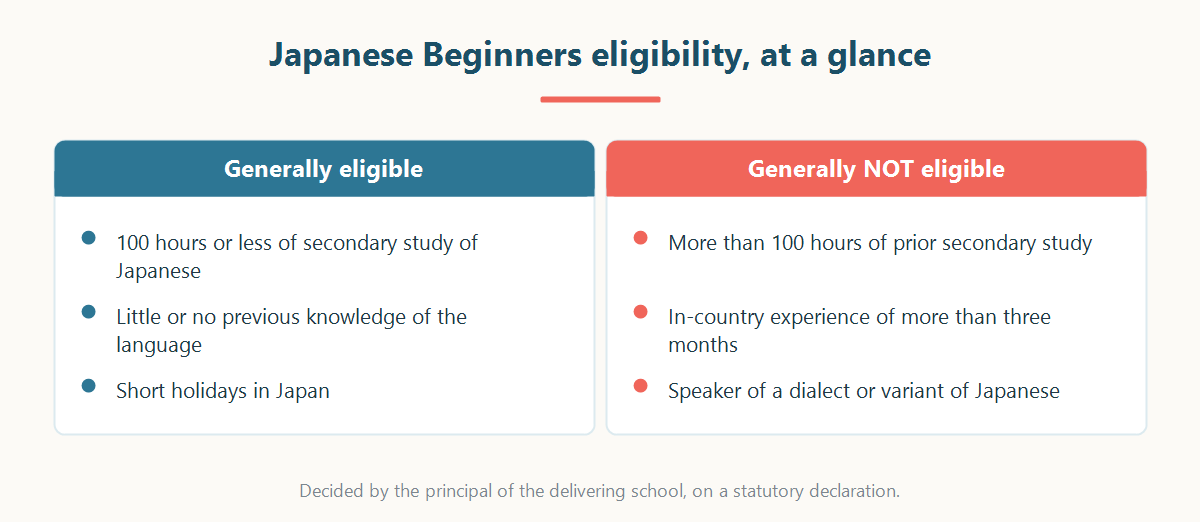
Beginners courses exist for genuine beginners, and NESA protects that with eligibility criteria. The core tests are:
- Prior study. A student must have had no more than 100 hours of study of the language at secondary level, or the equivalent, and little or no previous knowledge of the language.
- In-country experience. A significant in-country experience — homestay plus attendance at school, for example — of more than three months makes a student ineligible.
- Dialects count as the language. For eligibility purposes, a speaker of a dialect or variant is treated as a speaker of the standard language.
Two procedural points matter as much as the rules themselves. Eligibility is determined by the principal of the school delivering the course, not by NESA centrally and not by the family. And the application is not a tick-box: students seeking an eligibility determination complete a formal Beginners Language Course — Application for Eligibility Determination, which includes a statutory declaration, with supporting documentation where required.
This is the point at which families in our audience most often get a surprise. A child with a Japanese parent, or one who attended a Japanese Saturday school for a few years, or who spent a year of primary school in Japan, is usually heading for Continuers whether or not that feels fair. If you are weighing the courses, our guide to the HSC and VCE Japanese course levels sets them side by side.
Looking for a way to keep Japanese going from abroad?
TOMODACHI JAPAN is an online Japanese school for children growing up outside Japan. They talk with peers their own age in Japan every day, taught by teachers working at Japanese schools, in small classes of 8.
🎁 Register and we’ll email you our School Guide (PDF, in English) straight away. You’ll also be first to hear about tuition, scholarships and opening dates.
Free · takes about 30 seconds
The six prescribed topics
The Japanese Beginners Stage 6 (2009) syllabus prescribes six topics. Everything in the examination — including the oral conversation — is drawn from them:
- Family life, home and neighbourhood
- People, places and communities
- Education and work
- Friends, recreation and pastimes
- Holidays, travel and tourism
- Future plans and aspirations
The syllabus is a 2009 document that has not been superseded, which has a useful consequence: past papers going back to 2015 are all testing this same list. NESA also publishes a prescribed character list for the course — the kanji you are expected to handle are defined, not open-ended, which is the single biggest practical difference from Continuers.

How the marks are divided
There are two separate mark structures to keep straight: the external HSC examination (100 marks) and the school-based assessment that runs through the course.
The HSC examination — 100 marks
| Component | Marks | Detail |
|---|---|---|
| Oral examination | 20 | About 5 minutes, conversation with an examiner on the prescribed topics |
| Section I — Listening | 30 | About 10 questions in English, answered in English; no more than 13 items; at least one item worth 5 marks |
| Section II — Reading | 30 | About 5 questions in English, answered in English, across roughly 12 items; at least one item worth 5 marks |
| Section III — Writing in Japanese | 20 | Part A: two short answers (4 and 6 marks). Part B: one of two options (10 marks) |
The written paper is 2 hours 30 minutes plus 10 minutes reading time. Monolingual and bilingual dictionaries are permitted in it.
School-based assessment — by skill
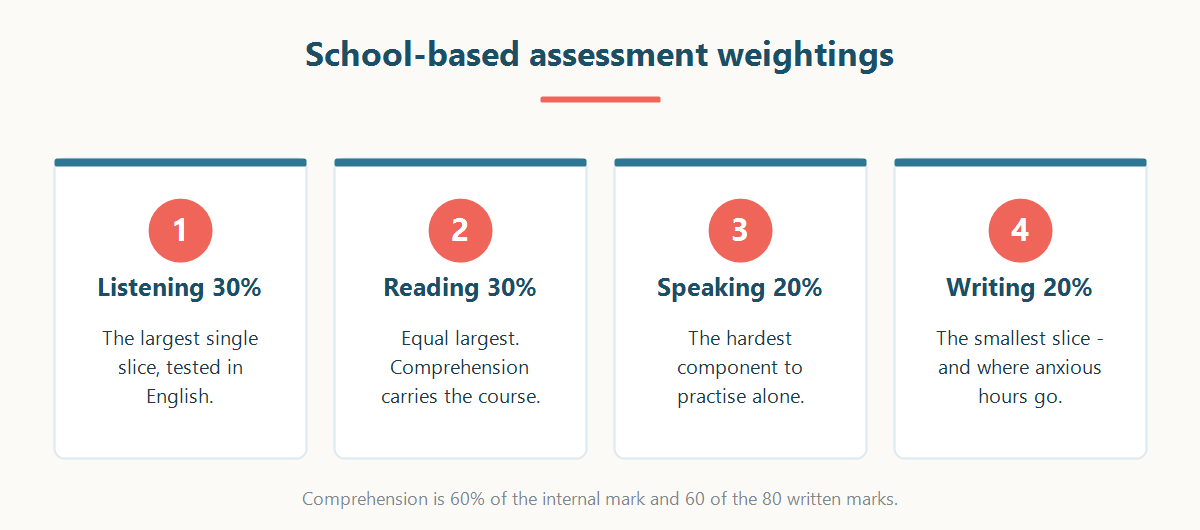
| Skill | Weighting |
|---|---|
| Listening | 30% |
| Reading | 30% |
| Speaking | 20% |
| Writing | 20% |
What the mark allocation is really telling you
Read the two tables together and a pattern appears that most study plans ignore.
- Comprehension carries the course. Listening and Reading are 60 of the 80 written marks, and 60% of the internal assessment. Both are answered in English. Understanding Japanese, not producing it, is where the marks live.
- Speaking is 20% internally and 20 marks externally, and it is the hardest to self-teach. You can drill listening with the audio files. You cannot drill an unscripted conversation on your own.
- Writing is the smallest slice. It is also the one students spend the most anxious hours on, because it feels like the hardest. Twenty marks out of a hundred is worth twenty marks of your time.
Our companion article on HSC Japanese past papers sets out how to work through NESA’s eleven published years section by section rather than paper by paper — which is the practical expression of the point above.
Beginners or Continuers?
If you are eligible for Beginners, the honest comparison looks like this:
| Japanese Beginners | Japanese Continuers | |
|---|---|---|
| Who it is for | Genuine beginners — 100 hours or less of prior secondary study | Students continuing from prior study |
| Eligibility check | Required, decided by the principal, statutory declaration | No Beginners-style eligibility test |
| Kanji | A defined prescribed character list | Substantially more, and a longer prescribed list |
| Answers in Listening and Reading | Questions and answers in English | More demanding, with Japanese-language response tasks |
| Oral | About 5 minutes | Longer and more demanding |
Scaling is the question families ask next, and it deserves a straight answer: choosing a course you are not eligible for is not an option, and choosing a course far below your level is not permitted either. Sit the course you qualify for and aim for the top band in it.
Frequently asked questions
Who is eligible for HSC Japanese Beginners?
Students with no more than 100 hours of secondary study of Japanese, or the equivalent, and little or no previous knowledge of the language. A significant in-country experience of more than three months makes a student ineligible. Eligibility is determined by the principal of the school delivering the course, on a formal application that includes a statutory declaration.
How many marks is the HSC Japanese Beginners oral exam?
Twenty marks out of 100. It is about five minutes of conversation with an examiner drawn from the six prescribed topics, and it is held earlier than the written paper — in August or September, usually on a Saturday.
How many kanji do you need for Japanese Beginners?
The course works from a prescribed character list published by NESA alongside the syllabus, so the set is defined rather than open-ended. Download the current list from the syllabus page rather than relying on a count quoted on a tutoring site — that is the version your exam is built on.
Is the Japanese Beginners syllabus still the 2009 one?
Yes. Japanese Beginners Stage 6 (2009) remains the current syllabus, which is why past papers from 2015 onward remain directly relevant.
What are the six topics in Japanese Beginners?
Family life, home and neighbourhood; people, places and communities; education and work; friends, recreation and pastimes; holidays, travel and tourism; and future plans and aspirations.
Sources
- NESA — Japanese Beginners Stage 6 Syllabus (2009), prescribed topics and prescribed character list
- NESA — Assessment and reporting in Japanese Beginners (examination structure and school-based assessment weightings)
- NESA — Eligibility criteria for Stage 6 Beginners language courses; ACE rules, course eligibility
- NSW Department of Education — Beginners Language Course, Application for Eligibility Determination
If you are still weighing Beginners against Continuers, the quickest reality check is to open the HSC Japanese Continuers past papers and see how much of one you can follow today.