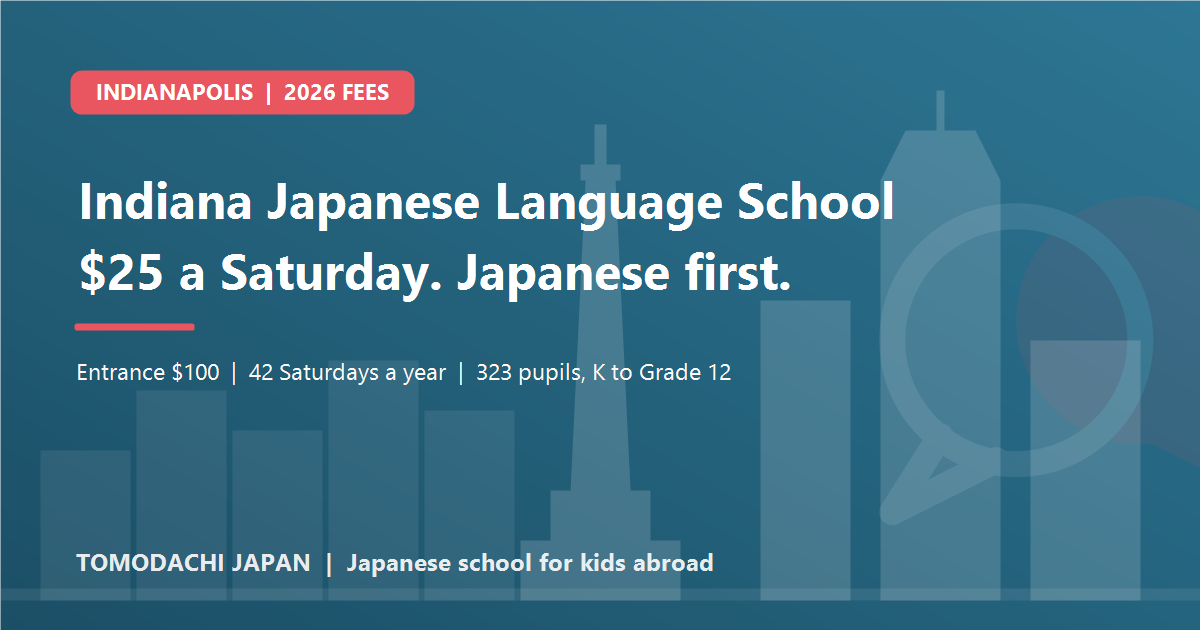
The Indiana Japanese Language School — インディアナ日本語学校, known in Japan as the Indiana Hoshu Jugyo Ko — charges $25 per Saturday in tuition for the 2026–27 school year ($30 in the high school), plus a one-time $100 entrance fee per child and $30 to $130 a year in workbooks. With 42 school Saturdays between April 2026 and March 2027, that comes to about $1,050 a year, or roughly $1,270 for a first-grader’s first year. Classes run from 9:05 to 2:00 in a borrowed private-school campus, The Orchard School at 615 West 64th Street, Indianapolis, for 323 children from kindergarten to Grade 12. The school is open to any family — no nationality rule is published — but it is built for children who already speak Japanese: kindergarteners must understand it, parents must deal with the school in Japanese, and there is no beginner or heritage class for children. The “levelled Japanese classes” some listings mention are an adults-only club.
This page is the single-school deep dive: what the Indiana Japanese Language School costs, who can enrol, how a Saturday there works, and what English-language listings get wrong. Everything comes from the school’s Japanese-only website, its 2026 school handbook (学校要覧) and fee page, read on 31 October 2026. Where something is not published, we say not published. Indiana falls under the Consulate-General of Japan in Chicago, and our guide to the Japanese language schools in Chicago covers the bigger schools three hours up I-65.
The short answer
| What it is | A Japanese Saturday school (hoshuko) teaching Japan’s curriculum in Japanese to children who attend American schools on weekdays. Founded 7 November 1981 with ten pupils; run by a management committee of Japanese companies in Indiana and approved as a school corporation by the State of Indiana in 1984 |
| Where | The Orchard School, 615 West 64th Street, Indianapolis, Indiana 46260, a private school whose campus it borrows on Saturdays. School buses come in from Lafayette, Fishers, Carmel, Avon, Greenwood and Columbus |
| Cost, 2026–27 | Tuition $25 a school day ($30 in the high school), paid by cheque at the start of each term. Entrance fee $100 per child. Workbooks $30 to $130 a year. About $1,050 a year if all 42 Saturdays are billed. No refunds once paid |
| Who it takes | Children from kindergarten (one year, age 5–6) to Grade 12 who can learn in Japanese. Admission is year-round after a short interview of the child. No nationality condition is published. Kindergarten is capped at 40 places, with a lottery if oversubscribed |
| Heritage or beginner class | None for children. The school’s “International Club” is for adults 18 and over only |
| Size | 323 pupils in 23 classes (projected for 1 April 2026), with 32 staff. About 370 in April 2019 |
| The real catch | Five lessons a week to cover what Japan teaches in five days, a lot of homework, compulsory parent volunteering, and a drive that can exceed an hour each way |
Looking for a way to keep Japanese going from abroad?
TOMODACHI JAPAN is an online Japanese school for children growing up outside Japan. They talk with peers their own age in Japan every day, taught by teachers working at Japanese schools, in small classes of 8.
🎁 Register and we’ll email you our School Guide (PDF, in English) straight away. You’ll also be first to hear about tuition, scholarships and opening dates.
Free · takes about 30 seconds
First, which school do you actually mean?
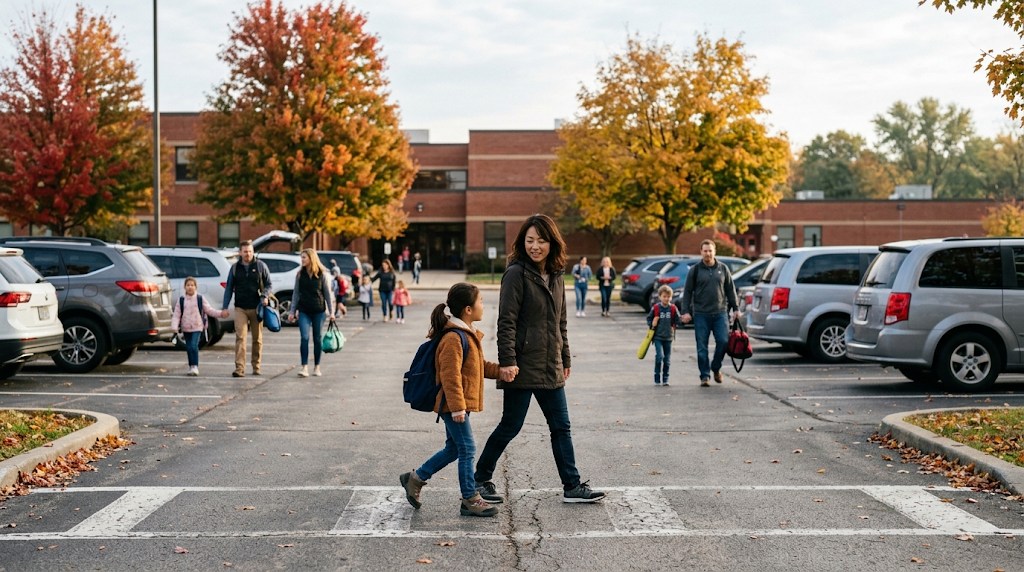
One school, three names, and a building that belongs to somebody else. On Saturdays the Indiana Japanese Language School fills the classrooms of The Orchard School; the rest of the week the building is an American private school with its own admissions office. Add an adult Japanese club with a similar name and a university outreach school two hundred miles south, and it is easy to call the wrong number.
| Name you will see | What it actually is | Who it is for | Where |
|---|---|---|---|
| Indiana Japanese Language School (IJLS), インディアナ日本語学校, also インディアナ補習授業校; indiana-j-school.net | The Saturday school this page is about. Japanese language, maths and social studies in Japanese, with Japanese textbooks | Japanese-speaking children, kindergarten to Grade 12 | The Orchard School, 615 W 64th St, Indianapolis |
| The Orchard School | The host, not the Japanese school. An independent day school that lends its campus on Saturdays. Applying there does not get you into IJLS | Its own weekday pupils | Same address |
| Japanese Language Club (国際クラブ, formerly 国際部) | An adult Japanese class run by parent volunteers on the same Saturdays, to raise funds and give back to the host school | Adults 18+ only, levelled groups of up to 10 | Same building |
| Southern Indiana Japanese School (SIJS) | A separate Saturday school run with the University of Southern Indiana, founded 1997 | K–12 with grade-level Japanese | Evansville, about 170 miles south-west |
Two practical consequences. If you are a non-Japanese-speaking family looking for Japanese lessons for a child, none of these is a beginner course; the club that sounds like one is for adults. And if you are a Japanese family arriving on assignment, the only address you need is 615 West 64th Street — but contact the Japanese school’s own office, which is open Tuesday to Saturday, not The Orchard School’s.
What it costs in 2026–27: $25 a Saturday, $100 to start
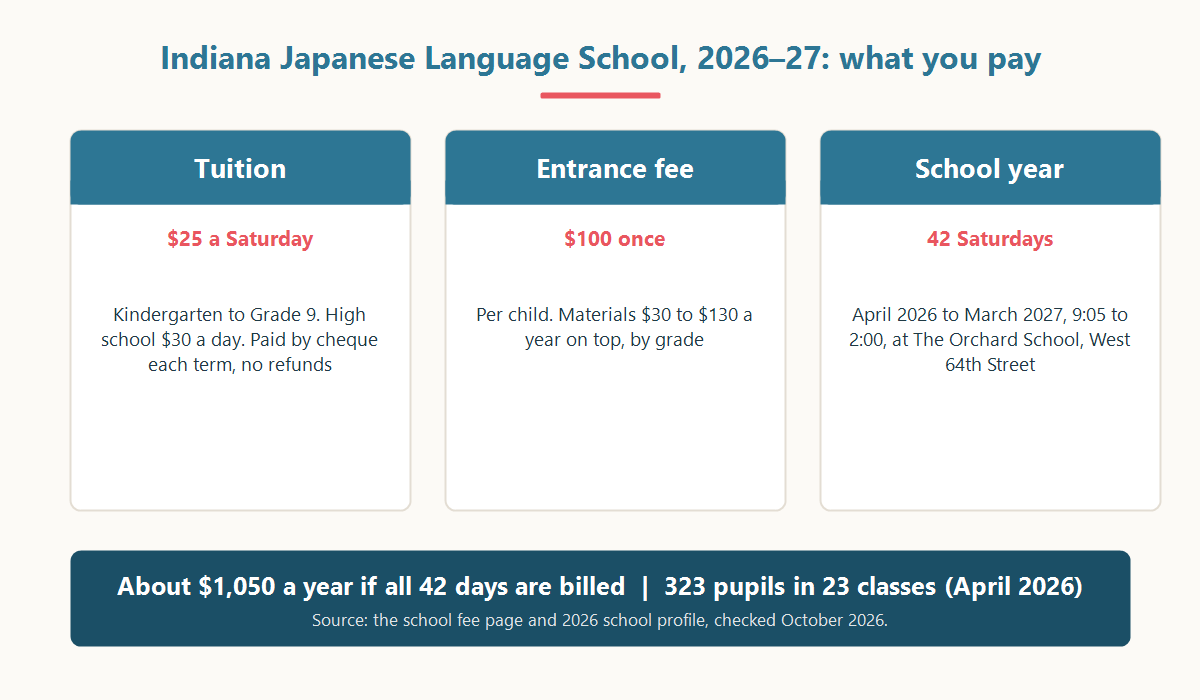
The fee schedule is one page of the school’s 2026 handbook, in Japanese. It follows the Japanese school year — April 2026 to March 2027, in three terms (April–June, July–December, January–March) — so “2026–27” here starts in April, not September. Tuition is set per school day, not per year, and collected by cheque at the start of each term. The school does not print an annual total; the yearly figures below are our arithmetic from its 2026–27 calendar of 42 Saturdays.
| Item | Kindergarten to Grade 9 | High school (Grades 10–12) |
|---|---|---|
| Entrance fee (once, per child) | $100 | $100 |
| Tuition, per school day | $25 | $30 |
| Term 1: 18 April – 20 June 2026 (10 days) | $250 | $300 |
| Term 2: 25 July – 19 December 2026 (21 days) | $525 | $630 |
| Term 3: 9 January – 20 March 2027 (11 days) | $275 | $330 |
| Tuition, full year (42 days) | about $1,050 | about $1,260 |
| Workbooks and materials, per year (approximate) | Kindergarten $30; Grade 1 $121; Grade 2 $112; Grade 3 $114; Grade 4 $115; Grades 5–6 $130; Grades 7, 8, 9 $63, $59, $58 | Depends on subjects |
| One-day trial | $25 | $30 |
| First year, Grade 1 | about $1,271 | — |
Put another way, a year of Saturdays costs about $87.50 a month, or under $7 per 45-minute lesson. A child who joins mid-year pays from the first day attended to the end of that term — a family starting on 7 November 2026, for example, would pay $150 for the six Saturdays left in term 2, plus the entrance fee and materials. Two children in Grades 1 and 4 would come to about $2,536 for a first year; no sibling discount is published.
Three things about these numbers that no English listing tells you:
- Cheques only, and nothing comes back. Fees are paid by cheque to “Indiana Japanese Language School” at the school office, using an envelope handed out each term. The handbook says, underlined, that tuition and materials once paid are not refunded. A family that is posted home in May has paid for June.
- Two costs are not on the sheet. Every family becomes a member of the parents’ association (保護者の会) on enrolment and signs a dues form, but the amount is not published. School buses run from six areas, but their fares are not published either.
- The price is low because parents and employers carry the rest. The school’s IRS filings, as summarised by CauseIQ, show revenue of about $530,000 and expenses of about $572,000 for the year to March 2026. The management committee is made up of managers from Aisin, Subaru, Honda, NTN, Nachi and other Japanese companies in Indiana, and the adult club exists partly to hold tuition down. Parents pay in time: safety-patrol and bell duties are compulsory.
Who can enrol: Japanese first, then an interview
Admission is open all year. The school states its purpose plainly: to give the children of families living in the United States a foundation in core subjects in Japanese, so that they can slot back into school when they move to Japan. Everything about entry follows from that.
- Before you move, collect your child’s Japanese textbooks from JOES, the Japan Overseas Educational Services foundation in Tokyo. The school keeps no textbooks for children arriving from Japan.
- After you arrive, phone 317-255-1631 or e-mail ijls@indiana-j-school.net to book an appointment, on a weekday between Tuesday and Friday, 9:00 to 4:00. Saturdays are teaching days and the office cannot handle admissions then.
- At the appointment, the school explains how it works and gives the child a simple interview.
- Hand in the forms: an application per child, a family questionnaire, an emergency-treatment consent, a general consent and the parents’ association dues form. Japanese school-leaving certificates are not needed.
- Pay the following Saturday, once the office has worked out tuition and materials.
The rules tighten at both ends of the age range. For the kindergarten (one year, 年長), the published conditions for the April 2026 intake were explicit: the child must be able to speak and understand simple Japanese, a condition marked “strictly applied”; children who do not understand Japanese may be refused; a child whose Japanese does not improve may be asked to leave during the year; and parents must communicate with the school in Japanese. Places are capped at 40 in two classes. If more apply on application day, a lottery decides who gets in and the order of the waiting list. For April 2027, the school calendar shows the notice going out on 21 November 2026, applications opening on 5 December, and an information session on 6 February 2027.
For the high school (高等部), moving up from Grade 9 is not automatic. Pupils need the school’s approval and an essay on their goals for high school, one and a half to two pages of Japanese manuscript paper. A pupil joining the high school from outside writes the same essay, sits a three-way interview with the principal and a parent, and signs a pledge to follow the school’s rules, with a parent countersigning.
What the pages do not contain is a nationality rule, a residence-status rule or a requirement to work for a Japanese company. The handbook says families already living in Indiana follow exactly the same procedure as new arrivals; a 2008 report by a former principal put the share of international-marriage families at about one in ten. The gate is language. With 20 children to a class and five lessons a week, teachers cannot slow down for a child who is reading two years behind.
How it works: five lessons, one Saturday, 42 times a year
The school is governed by its management committee — the 2026 chair is from Aisin World Corp of America — together with the principal and the parents’ association. The principal, Shin Fukuchi, arrived in April 2026 from a Tokyo public primary school as the sixteenth head seconded by Japan’s education ministry. Teachers are hired locally and must have US work authorisation.
| What | Kindergarten to Grade 9 | High school |
|---|---|---|
| Hours | Homeroom 8:55; lessons 9:05–1:55; dismissal 2:00. Five 45-minute periods with a 20-minute break and lunch | Four 60-minute periods, 9:05–1:55 |
| Subjects | Grades 1–4: Japanese 3, maths 2. Grades 5–9: Japanese 2, maths 2, social studies 1. Kindergarten: language, music and art | Japanese, maths, English, and essay writing or contemporary society |
| Year | 42 Saturdays: 40 teaching days plus sports day and graduation. Opening 18 April 2026; summer break only 21 June–24 July; closing 20 March 2027 | |
| Class size | About 20 per class; 23 classes in 2026 | |
| Getting there | Parents drive or use school buses from six areas. Drop-off in the lane without parking; pick-up from 1:55 at the main entrance. Parents do not go inside. A police officer has been stationed on school days since 2025 | |
| Communication | All school messages, closures and forms go through Canvas. A weekly newsletter is posted online in Japanese | |
| Extras | Kanji tests twice a year, a high-school speech contest, a library lending two books for two weeks | |
| Division | Pupils (1 April 2026, projected) | Classes |
|---|---|---|
| Kindergarten | 24 | 2 |
| Elementary, Grades 1–6 | 199 (20, 27, 39, 36, 44, 33) | 12 |
| Junior high, Grades 7–9 | 61 | 6 |
| High school, Grades 10–12 | 39 | 3 |
| Total | 323 | 23 |
Two features deserve a closer look. The first is the time squeeze. The principal’s welcome message makes the point itself: what Japanese schools cover in about 200 days, this school covers in forty-odd. A former principal counted 120 hours of Japanese a year for Grade 1, against 272 in Japan. The school’s answer is homework — the handbook warns that “a lot of homework” is set, and asks every child to study Japanese for at least an hour a day at home. In practice the Saturday school sets the work and the kitchen table does it.
The second is the parents. Membership of the parents’ association is automatic, and so are the duties: district representatives, library and copying rotas, bell duty, and a safety patrol of two-person teams — fathers, in principle — that each family takes about once a year. Absence from an assigned patrol is not allowed; you find your own substitute. For a family new to the United States, this is also how you meet everyone.
The honest review: what the English pages leave out
People search for “Indiana Japanese Language School reviews” and “photos” to find out what the school is like from the inside. We want to be straight: we found no verifiable parent reviews in English or Japanese, and the school’s own site is Japanese-only. The best photo of it is on the cover of its handbook — a wooden sign in Japanese calligraphy standing in front of The Orchard School’s entrance. We will not invent a consensus. What we can do is show where the pages that rank diverge from what the school publishes.
1. “Principal: Katsuyoshi Mori.” He left in March 2026
The English Wikipedia article, edited as recently as 18 October 2026, still names Katsuyoshi Mori as principal. The school’s list of principals shows Mori serving from April 2023 to March 2026 and Shin Fukuchi from April 2026. The same article’s enrolment figures stop at 1997 (308 pupils), and its subject list — maths, science and Japanese — comes from 1986. Today the subjects are Japanese, maths and social studies, plus English and essay writing in the high school, and enrolment is 323.
2. 63rd Street, 64th Street, ZIP 46220 vs 46260
Business directories cannot agree on the address. Yelp lists 615 W 63rd St and files the school under “Elementary Schools”; Yellow Pages uses ZIP code 46220. The school’s handbook, its map and its IRS registration all give 615 West 64th Street, Indianapolis, Indiana 46260, the address of The Orchard School. It teaches up to Grade 12, too, not only elementary pupils.
3. “Programmes for various ages and proficiency levels.” Not for children
The MapQuest listing says the school’s programmes cater to various age groups and proficiency levels. For children, there is one level: Japanese school, in Japanese. The levelled, small-group classes are the Japanese Language Club, which is for adults 18 and over. The club’s older FAQ says a beginner class for under-18s was discontinued for lack of staff and budget, and its $45-for-nine-sessions fee is sometimes read as the school’s. A parent of a non-Japanese-speaking child who drives to 64th Street expecting a beginner class will be turned away kindly.
4. Founded 1981, 1984, or maybe 1985? All three
GuideStar gives 1985 as the nonprofit’s ruling year; MapQuest and Wikipedia say 1981. Both are right. The handbook’s history table shows the school opening on 7 November 1981 in borrowed space at Indiana University–Purdue University Indianapolis, the State of Indiana approving it as a school corporation in 1984, the junior high opening in 1985, and the high school opening and the move to The Orchard School in 1987.
5. No English page prints a fee
Not Wikipedia, not the directories, not the school’s own English-language club page. The answer is in §5 of the Japanese handbook: $25 a day, $100 to enrol, cheques only, no refunds. A family budgeting for a full-time Japanese school, or for an American private school, can relax — this is about $1,050 a year. A family budgeting only that figure should add parents’ association dues and any bus fare, which are not published.
6. What to ask, since the reviews won’t tell you
- Is there a bus from our area, and what does it cost? Six areas are served; fares are not published, and a missed bus counts as an absence.
- What are the parents’ association dues, and which duties will we draw this year?
- How many children are in my child’s grade? Grade 5 had 44 in two classes; Grade 1 had 20.
- Is our child’s Japanese strong enough? Ask for the one-day trial ($25) before you commit.
- For kindergarten: when is application day, and how long is the waiting list? Over 40 applicants means a lottery.
- For high school: what did last year’s Grade 12 do next? The website does not say.
Other options in Indianapolis and Indiana
Indiana has no full-time Japanese school. Its Saturday schools have worked together since 2005 as a liaison council, which became “Indy 5” when Fort Wayne joined in 2007. Here is what we could verify.
| Option | Who it takes | What to know |
|---|---|---|
| Indiana Japanese Language School, Indianapolis | Japanese-speaking children, kindergarten to Grade 12 | The state’s largest; 323 pupils; buses from Lafayette, Fishers, Carmel, Avon, Greenwood and Columbus |
| Southern Indiana Japanese School, Evansville | K–12 “with Japanese language skills adequate for their grade level” | Run with the University of Southern Indiana since 1997; about 50 pupils (undated); most Saturdays. Evansville is on Central time |
| Greater Louisville Regional Japanese Saturday School, IU Southeast, New Albany | Children who speak Japanese | Japan’s ministry curriculum, at Indiana University Southeast across the river from Louisville since 1988 |
| Fort Wayne Japanese supplementary school | Japanese-speaking children | Part of the Indy 5 council; we could not verify its current details |
| Bloomington | — | No children’s Japanese school found. Families drive about 60 miles to 64th Street |
| Chicago Futabakai | Full-time Japanese school plus Saturday school | About three hours by road; see our Chicago Futabakai Japanese School guide |
| International School of Indiana, Indianapolis | Ages 3–18 | IB with French, Spanish or Mandarin immersion; no Japanese |
The pattern is the one we see across America’s car-industry belt, from Indiana to Middle Tennessee: Japanese manufacturers founded the schools for their employees’ children, the schools are good at what they were built for, and they were never built for the child who does not already speak Japanese. The American-Japanese child in Bloomington whose Japanese is fading, or the family in Lafayette for whom 64th Street is an hour each way, falls between them. Our guide to finding a Japanese Saturday school near you sets out what to check before you commit to the drive.
Two neighbouring Saturday schools follow the same Japanese-curriculum model: the Western Ohio Japanese Language School in Troy (an interview for every child, no kindergarten class) and the Central Kentucky Japanese School in Lexington (all lessons in Japanese, no published language test).
How to choose, in four questions
- Can your child follow a lesson taught entirely in Japanese? The school’s classes move at Japan’s pace in a fifth of the time. A child who chats at home but cannot read the grade’s textbook will struggle; the $25 trial day is the cheapest test there is.
- Are you going back to Japan? If so, IJLS is built for you: Japanese textbooks, Japan’s April year, essays and kanji tests that look like school in Japan. If your family is staying in Indiana, ask whether the homework load is sustainable alongside an American school.
- How far is 64th Street? From Carmel or Fishers, a short drive. From Lafayette, Columbus or Bloomington, an hour or more each way, 42 Saturdays a year, through Indiana winters.
- Can the family take on the duties? Japanese with the school, the patrol rota, the cheque each term. With an employer behind you, all of this is normal. As a locally hired or bilingual family, it is worth asking whether it fits.
Where TOMODACHI JAPAN fits
We are not a substitute for the Indiana Japanese Language School. If your child can follow a Japanese lesson and you are heading back to a school in Japan, we would point you to West 64th Street. We exist for the families the four questions above leave stuck — the child at an American school whose Japanese slips between Saturdays, the family in Bloomington or Lafayette for whom Indianapolis is too far every week, and the child who has never had Japanese friends of their own age.
- Japanese friends of the same age, every day. Classes with children the same age in Japan — not only other learners in Indiana. The reason children keep going is usually the other children.
- Teachers working at Japan’s current classroom standard — not a syllabus written abroad and not a tutoring marketplace.
- Small classes of eight children. Enough to be a class, few enough that every child speaks every lesson.
- Indianapolis is 14 hours behind Japan in winter, 13 in summer. That makes Indiana’s evenings Japan’s mornings. A class at 9 a.m. on a Saturday in Japan, for instance, would land at 7 p.m. on Friday in Indianapolis — after school and dinner, with no drive and no patrol rota.
- Unlimited classes for a flat monthly fee. Tuition, scholarships and opening dates are in our free school guide, which we email to everyone who registers, with no obligation.
If a Saturday school is what you are weighing us against, our guide to online alternatives to a Japanese hoshuko sets out what an online class can and cannot replace.
Frequently asked questions
How much does the Indiana Japanese Language School cost?
For 2026–27 (April 2026 to March 2027), tuition is $25 per school day, or $30 in the high school, paid by cheque at the start of each term. There is a one-time entrance fee of $100 per child and $30 to $130 a year for workbooks. Over 42 Saturdays that is about $1,050 a year in tuition, or around $1,270 for a first-grader’s first year. Fees are not refunded once paid; parents’ association dues and bus fares are not published.
Where is the Indiana Japanese Language School?
At The Orchard School, 615 West 64th Street, Indianapolis, Indiana 46260, a private school whose campus it borrows on Saturdays; it has been there since 1987. The Japanese school’s office is open Tuesday to Saturday on 317-255-1631.
Can my child join if they don’t speak Japanese?
Realistically, no. All lessons are taught in Japanese at a Japanese grade level, the kindergarten requires children to understand simple Japanese and parents to communicate in Japanese, and there is no beginner or heritage class for children. The school’s levelled Japanese Language Club is for adults 18 and over.
Does my child need a Japanese passport?
No nationality requirement is published. Families already living in Indiana apply exactly as new arrivals do: an appointment, a short interview of the child and a set of forms. The real requirement is that the child can learn in Japanese.
When can we start?
Any time in the year for Grades 1 to 9, after an interview booked on a weekday. Kindergarten has a fixed round: for April 2027, applications open on 5 December 2026, with a lottery if more than 40 apply. Entry to the high school from outside requires an essay and a three-way interview.
Is there a Japanese school in Bloomington?
We found none for children. Bloomington families use the Indiana Japanese Language School in Indianapolis, about 60 miles away, or study online.
Sources
- Indiana Japanese Language School (Japanese-language pages): Home, School profile, Principal’s message (about 320 pupils, 2026), Admissions procedure, Kindergarten admissions notice, School handbook 2026 (PDF), Tuition and materials (PDF), 2026 school calendar (PDF), Parents’ association, Staff recruitment (2019 enrolment), School newsletters, Japanese Language Club (adults)
- Other schools: Southern Indiana Japanese School, University of Southern Indiana; Japanese Saturday School, IU Southeast Japan Center
- Background: Former principal’s teaching report, Tokyo Gakugei University IERG (c. 2008); CauseIQ summary of IRS filings, FYE March 2026
- Third-party pages checked: Wikipedia (English); Wikipedia (Japanese); GuideStar profile; MapQuest listing; Yelp listing; Yellow Pages listing; Adult class FAQ (2022). The Consulate-General of Japan in Chicago’s school pages were blocked to our fetch. All checked 31 October 2026.
Many families pair weekend Japanese school with a little speaking practice during the week, or use it when the school is too far away or full. If you live in the US or Canada, our live online Japanese classes for kids in the US & Canada are small-group classes taught by qualified teachers in Japan, with class times set up around your time zone — see tuition.