Search Nishiyamato Academy of California in English and you will be quoted tuition of “$6,020–$9,080 kindergarten, $9,930–$11,890 elementary”. Wikipedia prints it. PrivateSchoolReview prints the identical ranges under a 2026–27 label with a green “verified” badge. Google’s own summary repeats it back as a current price.
Those numbers were read off the school’s website on 25 November 2014. That access date is still sitting in Wikipedia’s source code, and the page it points to no longer exists. The school’s actual 2026年度 fee table has been published, in plain text, the whole time — on a site that has no English version, which is why nobody has re-read it. Here it is, checked on 19 September 2026.
The short answer
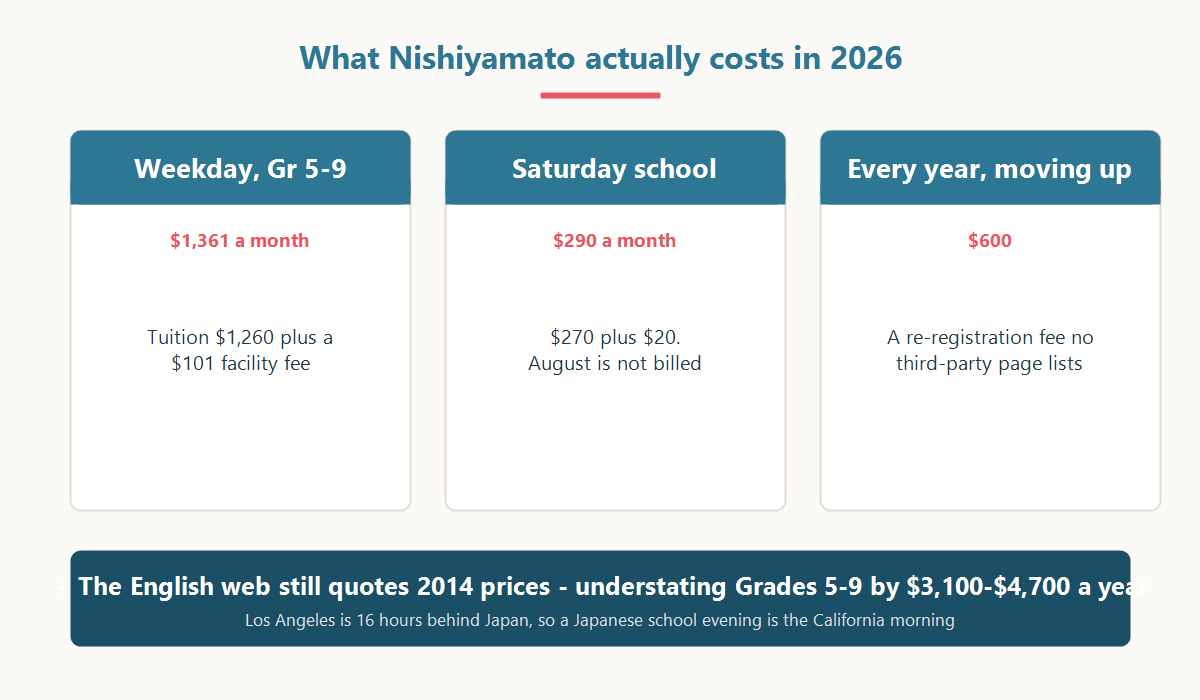
| Weekday school, preschool (年少–年長) | $930 a month tuition + $101 a month facility fee |
| Weekday school, Grades 1–4 | $1,040 a month + $101 a month |
| Weekday school, Grades 5–9 | $1,260 a month + $101 a month |
| Saturday school (three campuses) | $270 a month + $20 a month. August is not billed |
| Every year, on moving up a grade | $600 — a re-registration fee no third-party page lists |
Looking for a way to keep Japanese going from abroad?
TOMODACHI JAPAN is an online Japanese school for children growing up outside Japan. They talk with peers their own age in Japan every day, taught by teachers working at Japanese schools, in small classes of 8.
🎁 Register and we’ll email you our School Guide (PDF, in English) straight away. You’ll also be first to hear about tuition, scholarships and opening dates.
Free · takes about 30 seconds
What that comes to over a year
The school does not publish an annual total, and does not state how many months it bills. So the arithmetic below is ours, not theirs, and we show both an 11-month and a 12-month version. Do not treat either as a quote; confirm the billed months with the office.
| Weekday band | Tuition + facility, per month | × 11 months | × 12 months | What Wikipedia says |
|---|---|---|---|---|
| Preschool (年少–年長) | $1,031 | $11,341 | $12,372 | $6,020–$9,080 |
| Grades 1–4 | $1,141 | $12,551 | $13,692 | $9,930–$11,890 |
| Grades 5–9 | $1,361 | $14,971 | $16,332 | $11,610–$11,890 |
For a fifth-grader, the English internet is understating this school by roughly $3,100 to $4,700 a year. On top of tuition, year one adds a $120–$200 application fee and an $850–$1,000 registration fee, and every subsequent year adds the $600 promotion fee. Sibling discounts do exist on the weekday side and are unusually clear: 10% off the second child, 20% off the third, applied to tuition and the facility fee. They are not published for the Saturday school.
The Saturday school is three campuses, and your grade picks the campus
This is the operational fact that catches South Bay families out. The Saturday school charges the same $270 + $20 a month everywhere, but it runs in three places split by grade — and you do not choose.
| Saturday campus | Grades | Where |
|---|---|---|
| Lomita | Kindergarten 年長 to Grade 3 | The weekday school’s own building, Lomita |
| Palos Verdes | Grades 4–9 | A rented public-school site in Rancho Palos Verdes |
| Irvine | Kindergarten 年長 to Grade 9 — the only campus spanning the whole range, and the largest | A rented public-school site in Irvine, Orange County |
So a child who starts Saturday school at Lomita in kindergarten changes city at fourth grade, to Rancho Palos Verdes. That is a change in your Saturday, not the child’s — and it compounds the next fact, which is that the school runs no bus at all.
There is also an online branch, confusingly called the “online Saturday school”, which meets on Wednesdays at 3:45pm Pacific, for kindergarten 年長 and elementary. It matters more than it looks: the school offers it as the holding pattern for waitlisted families.
There is no bus. You drive, twice a day
We searched every weekday, Saturday, online and FAQ page for any mention of a school bus or transport service. There is none, and no bus line appears on either fee sheet. The FAQ answers it directly: at present, drop-off and collection are the parent’s job, or a nominated substitute’s. Preschool runs a car rotary so you do not have to get out.
Set against a weekday dismissal of just before 4pm — with an optional eighth period to 4:55pm and after-school classes running to 5pm — that is a real constraint on a working household, and it is the opposite of how most US-based Japanese full-day schools operate. Lunch is a bento from home; an optional paid bento delivery existed on Mondays, Wednesdays and Fridays but the site still describes it as suspended since 2020.
Getting in: a lottery decides whether you may sit the exam
PrivateSchoolReview lists the application deadline as “None / Rolling.” The real process, from the school’s own guidelines, is nothing like that.
- A ten-day window. For the September 2026 intake, applications opened 1 June and closed 10 June.
- A computer lottery, if oversubscribed — and it decides 受験資格, whether you are allowed to sit the entrance exam at all. Results by email within a week: pass to the exam, or waitlisted with a rank number.
- A fixed exam date. All bands, all campuses, at Lomita — 19 August 2026 for that intake.
- The exam itself. Kindergarten: a short written test plus an interview, assessing Japanese vocabulary, naming objects and numbers, fine motor work, and whether the child can hold a conversation with eye contact and sit still. Grade 1: reading hiragana in word units, writing hiragana and reading katakana, adding kanji from January entry. Grades 2–4: Japanese and maths papers. Grades 5 and above: Japanese, maths and English, plus an interview in which the child’s own motivation is assessed — though the English paper is not used for the decision at Grades 5–6.
- You can fail. Both FAQs say so plainly. The Saturday FAQ explains why: a child admitted below the bar cannot follow the lessons, and a 悪循環 — a vicious circle — begins.
The clearest signal of how full the school is comes from which grades were open for that intake. On the weekday side, Grade 9 was not recruiting. On the Saturday side: Lomita closed Grade 3; Palos Verdes took Grade 5 only and closed Grades 4 and 6 and the first two junior-high years; Irvine closed Grades 1, 4 and 5. Everything else was 若干名 — a small number.
And the waitlist is strict. When your number comes up you have five days to reply and one month to enrol, or the place moves on. Every autumn the school emails to ask whether you still want to be on the list; no reply by the deadline cancels you.
Applying is not an online portal either. You phone or email for a PDF form, type into it — handwriting is not accepted — and email it back with a photo of the child, proof of date of birth and, for school-age applicants, last term’s report card. The subject line has to be written in Japanese.
The honest review: what the English pages leave out
1. A parent has to read and write Japanese. It is a written admission condition
Not an expectation — a condition, on both programmes’ application guidelines. The weekday school requires a household that can support study at home and where 日本語の通信が読め, Japanese-language communications can be read. The Saturday school requires that school emails and notices in Japanese be understood, and that the family provide an environment of continuing Japanese communication at home.
For a mixed-nationality family in which the non-Japanese parent handles school admin, this is the single most decision-relevant sentence about the school. It appears in no English source anywhere. If no adult in your house reads Japanese, you are, on the school’s own terms, not eligible — and it is better to know that before the $120 application fee, which is non-refundable under any circumstances.
2. The link labelled “English” is a Japanese page about English lessons
The school’s navigation carries an item marked “English”. It resolves to a page titled 西大和学園の英語教育 — an account, in Japanese, of the school’s English curriculum. Every page on the site is served as lang="ja" with no English alternate. Wikipedia lists that same URL as the school’s website, which is exactly where English searchers are sent.
The consequence is worth stating plainly: every English-language claim about this school is second-hand, and the school has no way to correct any of it. That is how a 2014 price survives twelve years and picks up a “verified” badge on the way.
3. No parent duty — and that is a genuine advantage
The Saturday FAQ asks and answers it in three characters: 「保護者の当番はありますか。」「ありません。」 — is there a parent duty rota? No. Saturday-afternoon library opening and event help are advertised as opt-in volunteering.
Weigh that properly, but weigh it fairly. Compulsory duty rotas are still the norm at Japanese Saturday schools elsewhere in the United States — Chicago and Washington DC both run them — and they are one of the most common reasons an enrolment quietly ends. In Los Angeles, though, the old shorthand that “Asahi means parent duty” stopped being true in April 2025, when Asahi Gakuen abolished compulsory parent volunteering outright and made its parents’ association opt-in. Any comparison that still leans on that difference is a year and a half out of date. What remains, at both schools, is not rostered labour but weekly homework supervision in Japanese.
4. The school tells you your child will not become conversationally fluent in English there
Asked whether children come out speaking English fluently, the FAQ answers that accents are usually acquired cleanly, but on whether a child will converse fluently, 現地校とは違います — it is not like a local school — and advises families to join English-speaking clubs in the community. Teaching runs roughly seven parts Japanese to three parts English, with art, music and home economics taught in immersion and streamed ELD classes alongside. The stated targets are ambitious in their own direction: Eiken Grade 2 by sixth grade, Grade Pre-1 by the end of junior high. But the school is telling you to source conversational English elsewhere, and we have not seen another English page repeat it.
5. The refund policy is, essentially, unpublished
The only refund language we could find anywhere on the site concerns the application fee, and it is absolute: once paid, it is not returned for any reason. There is no published policy on refunding tuition, the $850–$1,000 registration fee or the $600 promotion fee if a family leaves mid-year. For an expat household that can be recalled to Japan at short notice, that is a live risk. Get it in writing before you pay.
Several other costs exist with no published number at all: materials, field trips and camp, Saturday textbooks, uniform, and the extended-care programme that a July 2026 poster announced in three- and five-day versions.
The school’s own site disagrees with itself in five places
| Point | One page says | Another says |
|---|---|---|
| Extended care | The preschool page still says daycare is suspended for infection control | An April 2026 post announces daycare has opened, and a July 2026 poster adds a three-day-a-week option to 4pm |
| Online-school fees | The live page shows an image file named tuition2026: $120 application, $375 registration, $210–$220 a month | A newer image headed “Fee Table, August 2026” sits in the media library, unlinked from any page: $135, $430, $240–$250 a month |
| …and inside that first table | It is named for 2026 | It prints, in its own footnote, that the supplementary-materials figures are a 2023 example |
| Dismissal time | The Grade 1–6 timetable ends at 15:55–16:05 | The school’s comparison page says dismissal is 15:15–18:10; the FAQ says after-school classes run to 17:00 |
| Street address | The application page and the cheque-payment line give 2458 Lomita Blvd. | The overview page and every footer give only “Lomita, CA 90717”, with no street number |
We are not asserting the August table is in force; it may be a draft. Treat the displayed figures as what the school currently shows, and confirm by email before budgeting.
How small is it? About five children per year group at the top
The school publishes no enrolment figure in any language, and the three English directory sites give 114, 124 and about 150 with no year attached and no breakdown. There is one government record, and it is the useful one: the US federal Private School Universe Survey for 2023–24 puts the weekday school at 139 pupils — 111 excluding the preschool — with 19.9 full-time-equivalent teachers.
The grade breakdown in that survey is the part worth stopping on. The three middle-school years held 6, 5 and 5 students. That is not a criticism — a 5:1 ratio is a luxury, and the ministry curriculum is delivered in full — but it is a very different social proposition from the school a parent pictures, and it is exactly the kind of thing to ask about at the open house. A child who arrives at Grade 7 will have four or five classmates, for three years.
What it is, and what happens at Grade 9
One category correction first, because two widely-read Japanese directories get it wrong. Nishiyamato is a 私立在外教育施設 — a private overseas educational facility recognised by Japan’s education ministry since March 1996 — and it is not a 日本人学校, which is a different ministry category. What the recognition buys you is the thing parents actually want: the Japanese course of study, ministry-issued textbooks, and a qualification that lets a child move back into Japanese schooling without a gap.
Two limits on that recognition, neither of which appears in English anywhere. First, the ministry’s recognition covers the elementary and middle divisions only — the preschool, at $930 a month, sits outside it. Second, and more likely to mislead: Nishiyamato’s Saturday school is not a ministry-registered supplementary school. In Los Angeles that designation belongs to Asahi Gakuen. Nishiyamato holds the ministry recognition for its weekday school; Asahi holds it for Saturday. A parent choosing between the two Saturday programmes is not choosing between official and unofficial, in either direction. The school also makes no WASC accreditation claim anywhere on its own site, which for a US private school is itself worth knowing.
There is no high school. The weekday school ends at Grade 9, and the FAQ says most graduates go on to high school in Japan, the rest locally. Three routes exist, and the first is the school’s real selling point:
- Sister-school recommendation to the Nishiyamato schools in Nara, without an entrance exam. The published conditions are Eiken Grade 2 equivalent for the junior high and Pre-1 for the high school; enrolment at the California school for at least the final year before returning to Japan; a principal’s recommendation; and a 専願 exclusive application, meaning you give up applying elsewhere. Two traps there: leave California early and the recommendation is gone, and the Nara school’s boarding houses are boys only — the school says so itself, noting that some families with daughters move to Nara to commute.
- Japanese high-school entrance exams, either the returnee route or the standard five-subject exam.
- A local American high school.
One caveat on the placement record. The school publishes a strong list — Keio, Waseda, ICU, Doshisha International and others — but it is labelled 2011–2021, a window that closed five years ago, and the Nara parent school’s university figures quoted alongside it are from the 2022 entrance cycle. Ask for something current.
How to choose, in four questions
- Is your child going back into Japanese schooling? If yes, the ministry recognition is the thing you are buying, and a Saturday school is not a substitute. If no, you are buying Japanese literacy, and the Saturday programme does that for about a fifth of the weekday price.
- Can an adult in your house read Japanese? Written admission condition, both programmes. Answer this before anything else.
- Can you drive it? No bus, a dismissal just before 4pm, and — on the Saturday side — a change of city at fourth grade.
- Can your child already follow grade-level lessons in Japanese? There is no beginner or second-language track at either programme. A child below the bar is failed at the exam, and the school explains that this is kinder than admitting them.
If the answer to the last one is no, the nearest alternative in the Los Angeles area is the Saturday-school network run by Asahi Gakuen; we set out its schedule, its term dates and what it asks of parents separately, and compared the wider LA options in our guide to Japanese Saturday schools in Los Angeles.
For a South Bay family the monthly Saturday fee at the two is much the same, so the real trade is the shape of the day. Nishiyamato’s Saturday runs roughly 8:20 to just after midday on Japanese and maths (plus 生活 in the early years); Asahi runs 8:40 to 15:30 and puts science and social studies on the timetable — about two and a half hours more of your Saturday — and carries on through a high-school division, which Nishiyamato does not have at all.
Where TOMODACHI JAPAN fits
We are not an accredited Japanese school and we would not pretend otherwise. If your child is returning to the Japanese system, Nishiyamato’s weekday school does something we cannot. We exist for the families the four questions above rule out — and around Los Angeles that is a great many families, because the gate here is unusually high.
- We teach children whose Japanese is still growing. No entrance exam, no lottery, no closed grades.
- Classes of eight, with children the same age in Japan. Friendships are what makes a child keep going, and they are the thing a weekly obligation rarely supplies on its own.
- Teachers working at Japan’s current classroom standard.
- No driving. Los Angeles is 16 hours behind Japan, so a Japanese school evening is the California morning and a Japanese Saturday morning is Friday evening here — which means a slot that does not cost you the weekend.
- Fees, scholarships and opening dates are in our school guide, emailed to everyone who registers. Free, and no obligation.
We have also written honestly about what an online school can and cannot replace about a Saturday school, including what it loses.
Frequently asked questions
How much is Nishiyamato Academy of California?
The weekday school publishes monthly rates for 2026年度: $930 preschool, $1,040 Grades 1–4, $1,260 Grades 5–9, plus a $101 monthly facility fee for every year group. The Saturday school is $270 a month plus $20, with August unbilled. Year one adds $120–$200 application and $560–$1,000 registration; every later year adds $600 on promotion. The school does not publish an annual total.
Why do Wikipedia and PrivateSchoolReview show lower fees?
Because they are showing 2014 figures. Wikipedia’s citation for those ranges carries an access date of 25 November 2014 and points at a page that no longer exists; PrivateSchoolReview reprints the identical ranges under a 2026–27 label. Google’s generated summaries then repeat them as current prices.
Is there a school bus?
No. There is no bus service and no bus fee anywhere on the site, and the FAQ states that parents or their nominated substitutes handle drop-off and collection. The preschool uses a car rotary so you can stay in the vehicle.
Does my child need to speak Japanese already?
Yes, at a level appropriate to the year group, and it is tested. There is no beginner track. Applicants are failed if they are below the bar, and both FAQs say so.
Is there a high school?
No. The weekday school ends at Grade 9 and the Saturday school at Grade 9 as well. Graduates go to high school in Japan — sometimes by sister-school recommendation to the Nishiyamato schools in Nara, which requires Eiken Grade 2 or Pre-1, enrolment through the final year before returning, and an exclusive application — or to a local American high school.
When can we apply for 2027?
Guidelines for the 2027 intake are not published yet. What is live is an open house for families hoping to enter in the third term of 2026 or the first term of 2027: 1 November 2026 for elementary and junior high, 12 November for the kindergarten, 13 November for the two-and-a-half-year-old preparatory class, by sign-up form. The school strongly recommends attending, and says that from Grade 5 upward the child’s own intention to enrol carries weight.
Is there a uniform, and is there lunch?
There is a uniform — introduced in April 2015 — and no cost is published for it. Lunch is a bento from home. The optional paid bento delivery on Mondays, Wednesdays and Fridays is still described on the site as suspended.
Sources
- Nishiyamato Academy of California: weekday fee table 2026年度, Saturday fee table, weekday application guidelines, Saturday application guidelines (Lomita), weekday FAQ, Saturday FAQ, placement record and sister-school recommendation, school history, online school
- Stale or contradicted third-party records checked 19 September 2026: English Wikipedia (tuition citation access-dated 25 November 2014), PrivateSchoolReview, GreatSchools (profile unclaimed, no data year). Niche, U.S. News, Yelp and doris.school could not be read: all returned access errors or timed out.
- Enrolment and grade breakdown: NCES Private School Universe Survey, 2023–24. Los Angeles supplementary-school designation and the April 2025 abolition of compulsory parent volunteering: Asahi Gakuen
- Ministry textbook distribution: JOES