Every English page about Chicago Futabakai Japanese School describes a small private K–9 school in Arlington Heights. That is not what is there. What is there is a three-programme, MEXT-accredited system whose Saturday side is nearly seven times larger than its weekday side, whose kindergarten costs more than its junior high, and which you cannot join at all unless a parent first takes out a membership of the Japanese Chamber of Commerce and Industry of Chicago. Not one English page says that last part.
Everything below comes from the schools’ own 2026 documents and the 2025 学校要覧 (school prospectus), all in Japanese, all checked on 19 September 2026. Where a figure is not published, this page says not published rather than guessing — which is the honest state of most of the Saturday School’s pricing.
The short answer
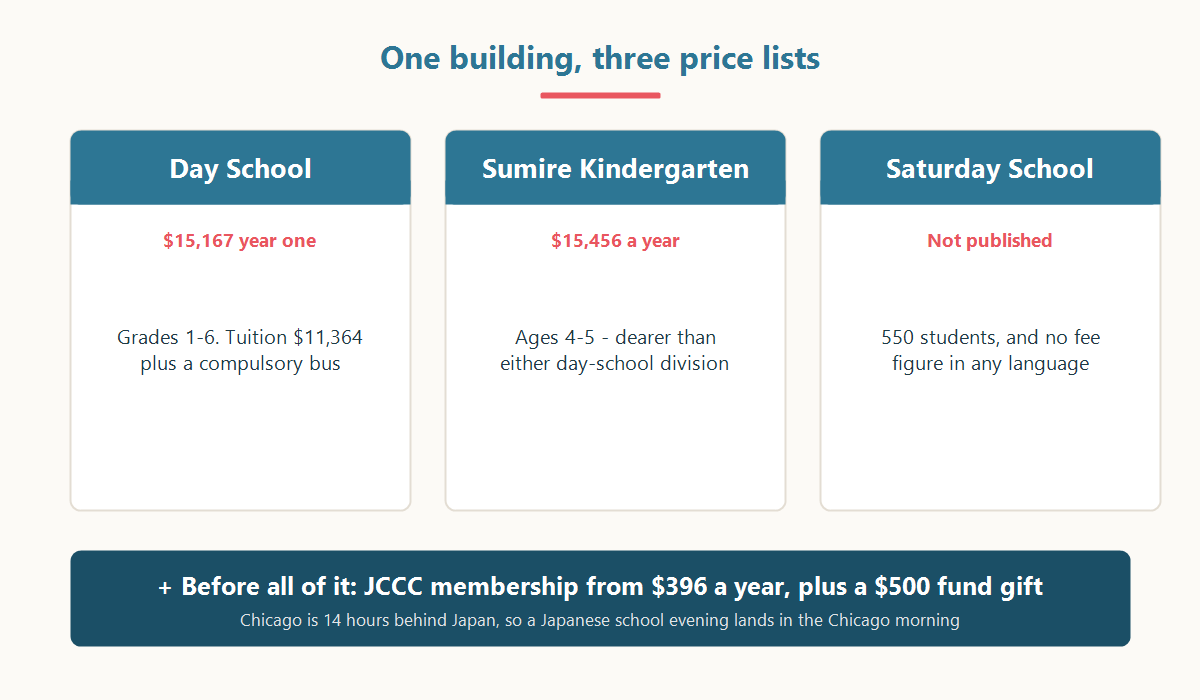
| Day School (weekdays, Grades 1–9) | Tuition $11,364 a year elementary, $12,159 junior high. Plus a compulsory $2,874 bus fee, $240 building levy, $189 ICT levy, and a one-off $500 joining fee |
| Sumire Kindergarten (weekdays, ages 4–5) | Tuition $15,456 a year — more than either division of the Day School |
| Saturday School (Saturdays, kindergarten to Grade 12) | Not published. No tuition figure exists on the public web in any language. You have to email the office |
| Before any of that: JCCC membership | A parent must be a member. Individual membership $396 a year; corporate bands run to $4,290. New members are also asked for a one-off Facility Fund gift from $500 |
Looking for a way to keep Japanese going from abroad?
TOMODACHI JAPAN is an online Japanese school for children growing up outside Japan. They talk with peers their own age in Japan every day, taught by teachers working at Japanese schools, in small classes of 8.
🎁 Register and we’ll email you our School Guide (PDF, in English) straight away. You’ll also be first to hear about tuition, scholarships and opening dates.
Free · takes about 30 seconds
Three schools, one building — not two
JCCC’s English page calls the arrangement the “Chicago method”: two schools, a Day School and a Saturday School, running simultaneously in one building at 2550 N. Arlington Heights Rd. That description is one school short. There is also Sumire Kindergarten (すみれ幼稚園), which has its own website, its own admissions guide and its own fee sheet, and which is formally the Day School’s kindergarten division.
| Programme | When | Ages / grades | Size |
|---|---|---|---|
| Day School (全日校) | Monday–Friday, 5 days, 6 periods a day | Grades 1–9 (Japanese 小1–中3) | 82 pupils, 97 including Sumire; 42 staff |
| Sumire Kindergarten | Weekdays | 年中組 and 年長組 (the Japanese 4- and 5-year-old years) | Included in the 97 above |
| Saturday School (補習校) | Saturdays only, once a week | Kindergarten, elementary, junior high and high school | 550 students in 30 classes; 45 staff |
The accreditation is real: an Illinois private school under state law, and a MEXT-approved 在外教育施設 — approved in 1978, given ministerial recognition in 1992 — which is what makes transfer back into a Japanese school straightforward. One catch for anyone checking: MEXT’s own register lists the weekday school as 「シカゴ日本人学校」, not under the Futabakai name, so searching the ministry list for “Futabakai” will not find it.
What the Day School costs in 2026–27
| Item | Elementary (G1–6) | Junior high (G7–9) |
|---|---|---|
| 入会金 joining fee, one-off | $500 | $500 |
| Tuition, per year | $11,364 | $12,159 |
| School bus, per year — compulsory | $2,874 | $2,874 |
| Building levy (校舎整備積立金) | $240 | $240 |
| ICT levy | $189 | $189 |
| Textbooks and workbooks | At cost, billed separately — amount not published | At cost — not published |
| PTA dues | Compulsory — amount not published | Compulsory — not published |
| Lunch | $0 — there is no lunch programme. Bento every day | $0 — bento every day |
| Sibling discount | Not published — no sibling provision appears on the fee sheet | Not published |
| First year, before textbooks and PTA | $15,167 | $15,962 |
Four things about that sheet that no directory site carries:
- You pay the bus fee whether or not your child uses the bus. The sheet says so in terms: “バスを利用しない方も、通学バスの安定的な運行のためバス代金をご負担していただきます” — and attendance by bus is the default for everyone.
- There are no refunds, for any reason. “お支払いいただいた納入金は理由のいかんを問わず返金はいたしません”. A leave of absence of up to 150 days is allowed — and the fees still run.
- One day inside a term bills the whole term. Enrol on 30 July and you owe the full April–July instalment.
- The bus fee can be re-set mid-year if the bus company raises its prices. It is the only line on the sheet with that warning.
Payment is three instalments a year, by cheque or online bill payment only. Cash is not accepted; on the Saturday side, the school states that Zelle and credit cards are not accepted either. Late invoices attract $20 a month, and six months of arrears is grounds for removal from the register.
The kindergarten is the most expensive part of the school
Sumire Kindergarten charges $15,456 a year for both year groups. That is $4,092 more than Day School elementary and $3,297 more than junior high. Bus ($1,212) and the building levy ($240) are charged to the older 年長組 year only; materials are at cost. The joining fee, the no-refund clause, the $20 late fee and the November withdrawal deadline are identical to the Day School’s.
It is worth pausing on that inversion, because it is the opposite of what parents expect and it is invisible in English. A family budgeting from a directory listing that says “PK–9” will assume the kindergarten year is the cheap one. It is the dearest year in the building.
The Saturday School is six times bigger — and publishes no prices
With 550 students against the Day School’s 82, the Saturday School is the programme most families actually mean when they say “Futabakai”. It runs kindergarten through high school on a two-term year (April–September, October–March), teaching Japanese language and maths, with social studies added from Grade 6.
| Division | Hours each Saturday |
|---|---|
| Kindergarten (幼稚部) | 6 hours |
| Elementary (小学部) | 4 hours Japanese + 2 hours maths (Grade 6 adds 1 hour social studies) |
| Junior high (中学部) | 3 hours Japanese + 2 hours maths + 1 hour social studies |
| High school (高等部) | 4 hours Japanese + 2 hours maths |
On price, the school’s public notices give only movement, never levels — a February 2025 notice said tuition would hold for the following year while the bus fee rose $15 and the transport contribution rose $6. Useful if you already have a bill. Useless if you are deciding. Any third-party page quoting “Futabakai tuition” is quoting Day School numbers and applying them to the whole institution.
Two further things a parent should know before writing to the office. The Saturday School sets an explicit Japanese-ability bar — “学習活動及び安全な学校生活に必要な日本語を身に付けていること” — and screens applicants with an interview and a written test. And its summer break runs mid-July to mid-August, which means your child is in Saturday classes through most of the American summer holiday.
The second bill: you have to join a chamber of commerce first
This is the single largest omission in the English record. The Day School’s fee sheet carries the line “シカゴ双葉会日本語学校の保護者は、シカゴ日本商工会議所の登録会員であることが条件となっております” — a parent must be a registered JCCC member. It is listed as the first of the three admission conditions, ahead of medical insurance and ahead of the requirement that the child not need individual support.
| JCCC membership | Annual dues | One-off Facility Fund gift on joining |
|---|---|---|
| Individual (個人会員) — the band that fits a family with no sponsoring company | $396 | from $500 |
| Supporting (贊助会員) | $1,056 for 1–5 registrants | from $500 (1 registrant) |
| Regular corporate (普通会員) | $1,716–$2,574 for 1–10 registrants | from $1,000 |
| Board member (理事会員) | $3,432–$4,290 for 1–10 registrants | from $1,000, rising to $9,000+ for 6 or more |
So the real cost of a first year in Day School elementary is not $11,364, and it is not the $14,667 a directory site prints. It is roughly $15,167 of school fees plus $396 of chamber dues plus a $500 gift, before textbooks and PTA dues that are not published at all.
The honest review: what the English pages leave out
1. English says “member employees”. Japanese says permanent residents and international families are welcome
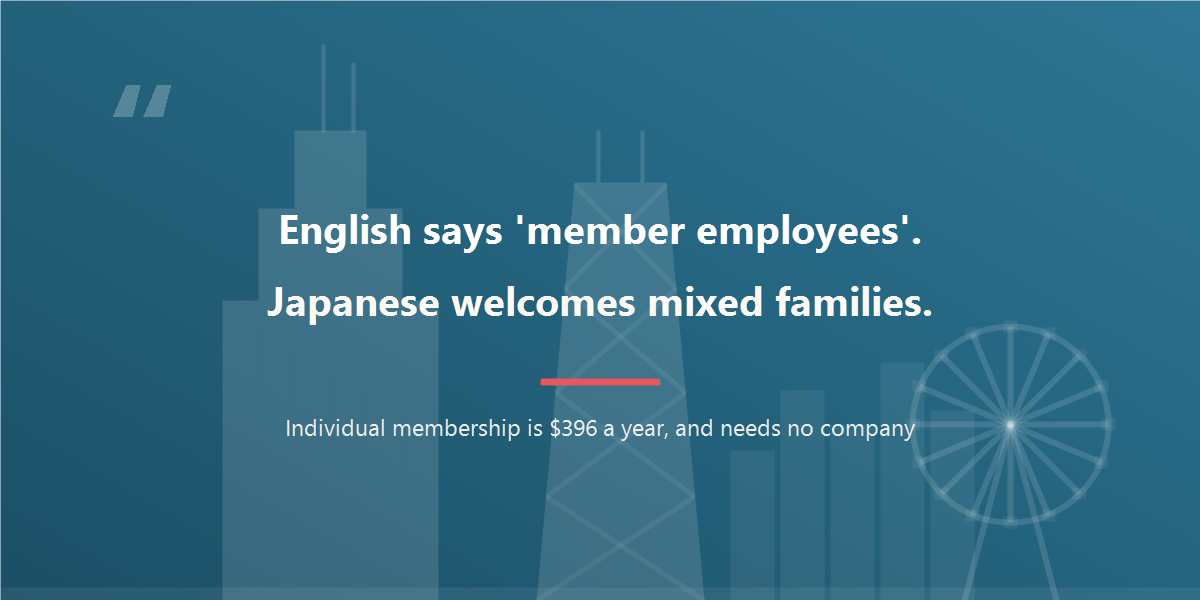
JCCC’s English page describes the schools as existing to educate “children of JCCC member employees”. Read as a family with no corporate posting behind you, that sentence closes the door. The Saturday School’s Japanese page does the opposite: it names 永住者や国際結婚のゴ家庭のお子様 — children of permanent residents and of international marriages — as students it expects to teach. And individual JCCC membership exists at $396 a year, open to people with no company at all. The English framing turns away precisely the families the Japanese pages say they want. If you are a mixed or permanent-resident family, the door you were told was shut is $396 wide.
2. Parents run the buses, and the school says so plainly
The transport committee that sets catchment areas, routes and stops is a parent body. The prospectus states twice that it is 学校ではありません — not the school — and that 学校の責任の範囲は通学時にはありません, the school’s liability does not extend to the commute. It also warns candidly that few of the buses have air conditioning or seat belts, and that the air conditioning is often broken. You may admire the honesty and still want to know it before you sign.
3. No school nurse, and no special-needs provision
Both are stated only in Japanese: 養護教變はいません (there is no school nurse — only a licensed nurse on limited hours) and 特別支援学級や専門の支援体制を設けていません. The third admission condition — that the child must not require individual support — follows from this and is not softened. The school also asks that inhalers and EpiPens be discussed before enrolment, and does not administer oral medication.
4. Parent duty is a rota with a lottery at the end of it
On the Saturday side, PTA participation is stated as compulsory. The published rota is library duty once or twice a year in 3.5-hour shifts, kindergarten classroom duty about twice a year in 1.75-hour shifts, and bus-stop duty rotating by stop. Executive posts are filled by volunteers first — and by lottery if nobody volunteers. Home study is framed the same way: the school writes that weekday study in Japanese matters as much as the Saturday lesson, and attributes children who last to their parents’ 強い意志. That is the same bargain the Washington Japanese Language School’s six duty shifts a year ask of DC families, and it is the part of Saturday school that most often ends an enrolment.
The Day School is a third of the size the English record implies
| Source | Day School size | Age of the figure |
|---|---|---|
| The school’s own 学校要覧2025 | 82 (97 with Sumire) | 2025 |
| English Wikipedia | 230, and a peak near 300 | 1998; most recent citation in the article is 2014 |
| NCES private school survey | 137, PK–9, merging Sumire in | 2023–24 |
| GreatSchools | 104, profile marked “Unclaimed” | No year given |
| PrivateSchoolReview | 123 — plus “5 AP courses” and a motto the school has never used | Labelled 2026–27 |
This is not a pedantic correction. At 82 pupils across nine grades, the weekday school is single-stream with very few same-age classmates — a different proposition from the 230–300-pupil school the English record describes, and one worth asking about directly at interview. The Saturday School’s own numbers tell a second story: at the March 2023 ceremony, 50 elementary, 34 junior-high and 6 high-school graduates. The drop from 34 to 6 is the retention figure nobody publishes in English, and it is the number we would want most if we were choosing.
A related warning for anyone Googling: the school’s own handbook still prints a homepage address that no longer resolves, and the Japanese Consulate in Chicago still lists a dead URL on a page whose footer is copyright-dated 2014. Jonathan Burr Elementary’s partnership page gives Futabakai’s address as its own Chicago address and phone number, and ranks on page one. The live sites are the Day School’s and Sumire’s edumap.jp pages and the Saturday School’s chicagohoshuko.com.
What else exists in the Chicago metro
Less than you would think. Within the metro there is exactly one MEXT-accredited Japanese school system — Futabakai’s three programmes — and essentially one community alternative.
| Option | What it is | Fees published? |
|---|---|---|
| JASC Donguri Kai | Japanese-language programme, K–12, levelled beginner to advanced, online Monday–Thursday and in person on Saturdays, 12-week terms. Accepts beginners, which Futabakai does not, and needs no chamber membership | No |
| JASC Tampopo Kai | Japanese cultural programme for ages 0–5 with a parent — the only published pre-K option outside Sumire | No |
| Japanese Culture Center | Says it runs children’s and teens’ courses; no ages, schedule or prices published | No |
| Bloomington/Normal Japanese Saturday School | The only other MEXT-listed Saturday school in Illinois — about 2h15 from Chicago | No |
If that list looks thin, it is the same shape as the one families face in the wider Chicago Japanese-class landscape, and the same shape as in Los Angeles, where Asahi Gakuen runs the only Saturday-school network of any size. One accredited school, one community programme, and a long drive to anything else.
How to choose, in four questions
- Is your child returning to Japanese schooling? If yes, the Day School’s MEXT accreditation is the thing you are buying, and nothing else on this page substitutes for it. If no, you are buying Japanese literacy, and the Saturday School or JASC do that for a fraction of the money.
- Can your child already work in Japanese? Both Futabakai programmes screen for it — interview on the weekday side, interview plus a written test on the Saturday side. JASC takes beginners. This is the single hardest gate for a mixed family.
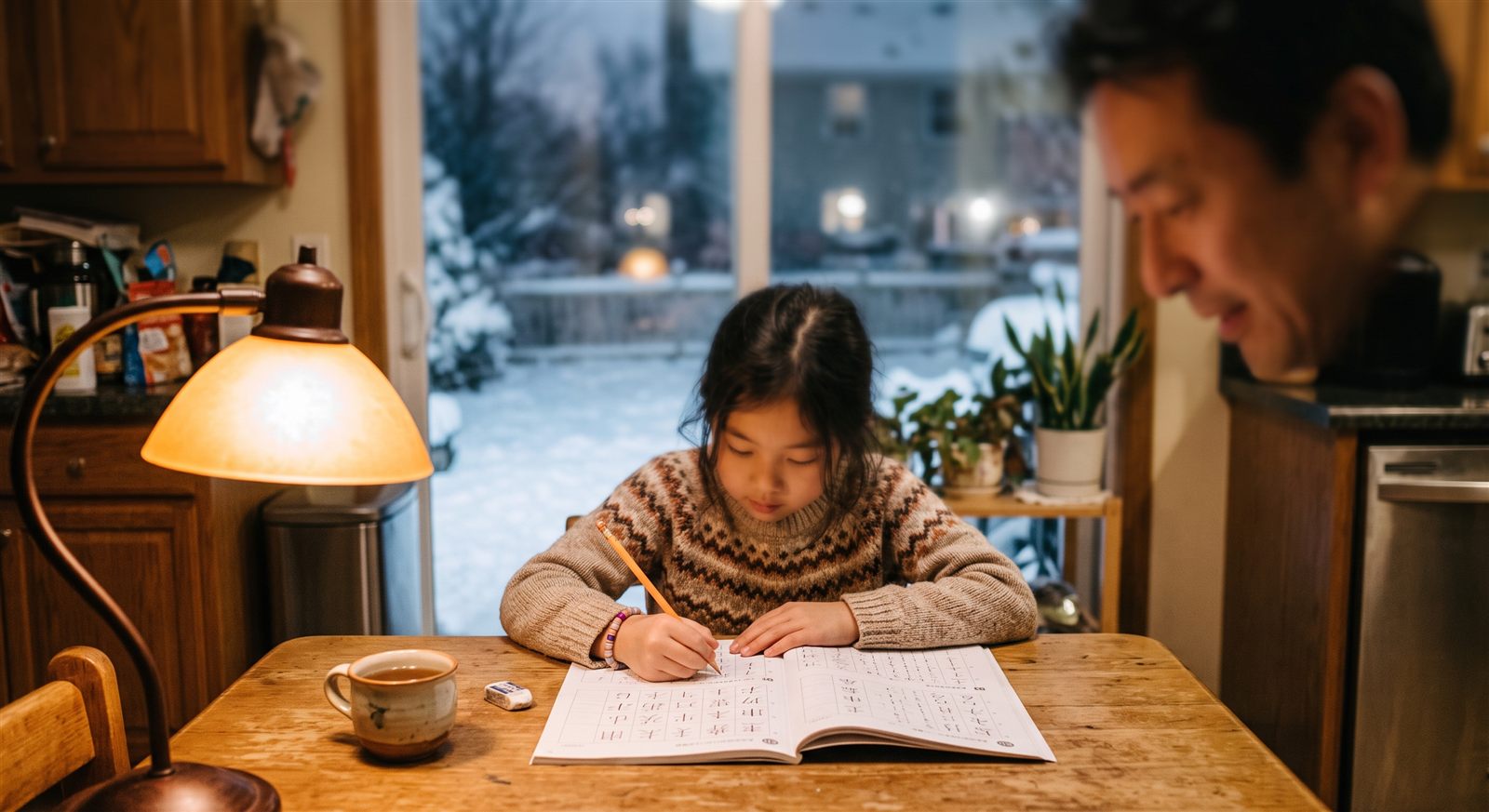
- Can a parent read Japanese? Every admission document, the fee sheet, the handbook, the calendar and the PTA papers are Japanese-only. There is no English enrolment pack on either site. Be honest about this before you apply, not after.
- Do you have a Saturday to give, every week, for years? Six hours of class plus duty rotas plus weekday homework, against an American school week. The 34-to-6 drop between junior high and high school is what happens when the answer turns out to be no.
Where TOMODACHI JAPAN fits
We are not a substitute for an accredited school, and if your child is going back into the Japanese system we would send you to Futabakai’s Day School ourselves. We exist for the families the four questions above rule out — and in Chicago that is a lot of families.
- Friends, not just lessons. Classes of eight, with children of the same age in Japan. The reason children stay is usually the other children, and a single-stream school of 82 cannot always offer that.
- Teachers working at Japan’s current classroom standard — not a syllabus written abroad and not a tutoring agency.
- Chicago is 14 hours behind Japan (13 in winter). A Japanese school evening lands in the Chicago morning, and a Japanese Saturday morning is Friday evening in Chicago — so a weekday-evening or Friday-evening slot works without giving up the whole Saturday. No bus, no catchment, no chamber membership, no entrance test.
- Fees, scholarships and opening dates are in our school guide, which we email to everyone who registers. There is no charge and no obligation.
If you are weighing the online route generally rather than Chicago specifically, we wrote up what an online school can and cannot replace about a Saturday school, including the parts we are honest about losing.
Frequently asked questions
How much is Chicago Futabakai Japanese School?
Day School tuition is $11,364 a year for elementary and $12,159 for junior high in 2026–27. With the compulsory bus, building and ICT levies and the one-off joining fee, a first year is $15,167 and $15,962 respectively, before textbooks and PTA dues, which are not published. Sumire Kindergarten is $15,456. Saturday School tuition is not published anywhere — you have to email hoshuko@chicagojs.com.
Do I have to join the Japanese Chamber of Commerce?
Yes. A parent being a registered JCCC member is the first of the school’s three admission conditions. Individual membership is $396 a year and does not require a company; new members are also asked for a one-off Facility Fund gift from $500. No English page states this.
Can my child join if their Japanese is weak?
Probably not at Futabakai. The Day School teaches the Japanese national curriculum in Japanese as a first language and admits by principal’s interview, with outright refusal or provisional admission both possible. The Saturday School requires “the Japanese needed for study and safe school life” and tests it in writing. JASC’s Donguri Kai is levelled and takes beginners.
Is there a uniform, and is there lunch?
No to both. The Day School states there is no uniform, and no name tag, indoor shoes or gym shoes are needed; the school bag is the family’s choice, randoseru or not. There is no lunch programme — bento every day.
When does the school year start, and how long is the summer?
April, on the Japanese calendar, in three terms. The Day School’s summer break sits between the end of the first term in July and the start of the second in August — about a month, against roughly eleven weeks for an American public school. The Saturday School breaks mid-July to mid-August, so it runs through most of the US summer.
When can we apply?
The Day School takes transfers on a rolling basis, except Grade 9, where a mid-year transfer may be refused because of Japanese high-school entrance exams; interviews can be held online. The Saturday School publishes fixed 2026 interview dates: 22 April, 13 May, 6–7 August, 23 September, 11 November, 16 December, then 23 January for kindergarten, 6 February for Grade 1 and 24–25 March. April-entry recruitment is announced the previous December, and waiting lists apply once classes fill.
Does the weekday school still exist?
Yes. It posts dated classroom updates through the current term and published a 2026–27 fee schedule. The confusion in English is about size, not existence — 82 pupils today against the 230–300 the older English sources imply.
Sources
- Chicago Futabakai Japanese School Day School: site, 2026年度 fee schedule, 学校要覧2025, transfer guidance, 2026 PTA enrolment notice
- Saturday School: chicagohoshuko.com (学校概要, 入学案内, 行事予定, よくある質問); Saturday School PTA
- Sumire Kindergarten: site and 2026年度 fee schedule
- JCCC: Futabakai page (English), membership dues, Futabakai Schools Facility Fund
- MEXT: list of recognised overseas educational facilities; Consulate-General of Japan in Chicago, school list
- Alternatives: JASC Donguri Kai, JASC Tampopo Kai, Bloomington/Normal Japanese Saturday School
- Third-party records checked and found stale or wrong: English Wikipedia, NCES private school survey, GreatSchools, PrivateSchoolReview, U.S. News, doris.school, Jonathan Burr Elementary partnerships page. All checked 19 September 2026.