HSC Japanese Extension is one of the smallest courses in the NSW HSC — 134 students were enrolled in 2025 — and one of the most rewarding. Its students also scale very well. But because the cohort is small, good preparation material is thin, and much of what circulates online was written for a different prescribed text.
This guide sets out what HSC Japanese Extension actually examines in 2026, the prescribed film you must know, where the past papers are and what they can and cannot teach you now, the scaling figures, and a four-week plan for the run into the written exam on Friday 16 October 2026.
What the course is
Japanese Extension is a 1-unit course taken alongside HSC Japanese Continuers. Under the NESA syllabus you must have completed the Continuers Year 11 course, and you study Continuers HSC at the same time. It is not a separate language level; it is Continuers students going deeper into ideas, argument and a text.
The course prescriptions for 2025–2030 set the theme as the individual and contemporary society, with three prescribed issues: Connectedness, Journeys and Diversity of values. The prescribed text is Hirokazu Koreeda’s film Like Father, Like Son (そして父になる). NESA sets ten extracts for close study, but you are expected to know the whole film.
Because the prescriptions run to 2030, the same film applies to the 2026 and 2027 HSC. That matters for past papers, as we will see.
Want unscripted Japanese discussion practice before the HSC?
TOMODACHI JAPAN is an online Japanese school for children growing up outside Japan. They talk with peers their own age in Japan every day, taught by teachers working at Japanese schools, in small classes of 8.
🎁 Register and we’ll email you our School Guide (PDF, in English) straight away. You’ll also be first to hear about tuition, scholarships and opening dates.
Free · takes about 30 seconds
The HSC Japanese Extension exam, section by section
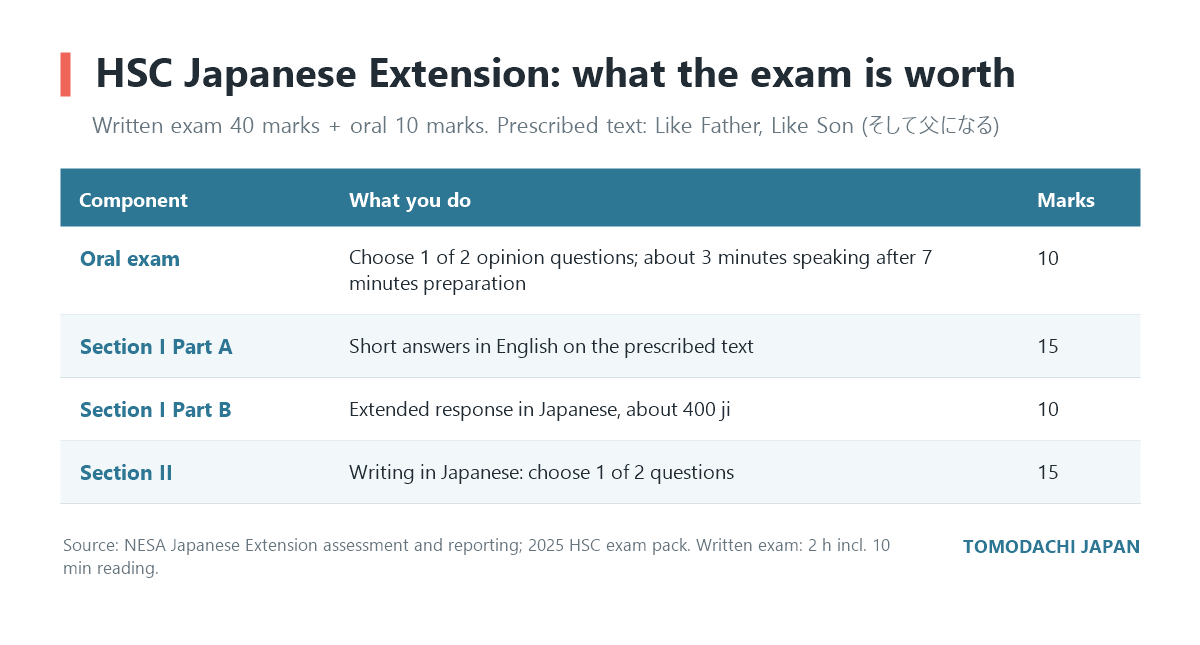
The examination has two parts.
- Oral examination (10 marks). You choose one of two questions asking for your opinion and speak for about three minutes after seven minutes of preparation. The 2025 oral paper states that dictionaries may not be used. Oral exams for 2026 ran from August to 12 September.
- Written examination (40 marks), 2 hours including 10 minutes reading time. Print dictionaries, monolingual or bilingual, are allowed.
- Section I — Response to prescribed text (25 marks). Part A: around five short-answer questions in English (15 marks). Part B: an extended response in Japanese of about 400 ji (10 marks).
- Section II — Writing in Japanese (15 marks). One question from a choice of two.
Notice where the weight is: 25 of the 40 written marks are about one film. A student who knows Like Father, Like Son in depth, scene by scene and issue by issue, has most of the written exam covered before walking in.
HSC Japanese Extension past papers: use them the right way
NESA publishes exam packs for Japanese Extension from 2020 to 2025, each with the question paper, marking guidelines and marking feedback, and an archive for 2015–2019. The 2025 pack also includes the oral paper. Find them on the NESA Japanese Extension exam papers page.
The catch: papers before 2025 were set under the previous course prescriptions. Their text questions are not about your film, and their issues may differ from the three you study. That does not make them useless. It changes what you use them for:
| Section | Older papers (2020–2024) | 2025 paper |
|---|---|---|
| Section I Part A (text, English) | Use for question types only: how NESA asks about a scene, a character or an issue | Full practice on your film |
| Section I Part B (400 ji) | Rewrite each question so it applies to Like Father, Like Son, then answer it | Full practice |
| Section II (writing) | Largely usable: the writing tasks do not require the prescribed text, though older questions may lean on earlier issues | Full practice |
| Marking guidelines & feedback | Read all of them. What separates a band is the same across texts | Read first |
Rewriting an old Part B question for your film is the single best exercise available. It forces you to connect the prescribed issues to specific scenes, which is precisely what the real question will ask.
Scaling: what the numbers say
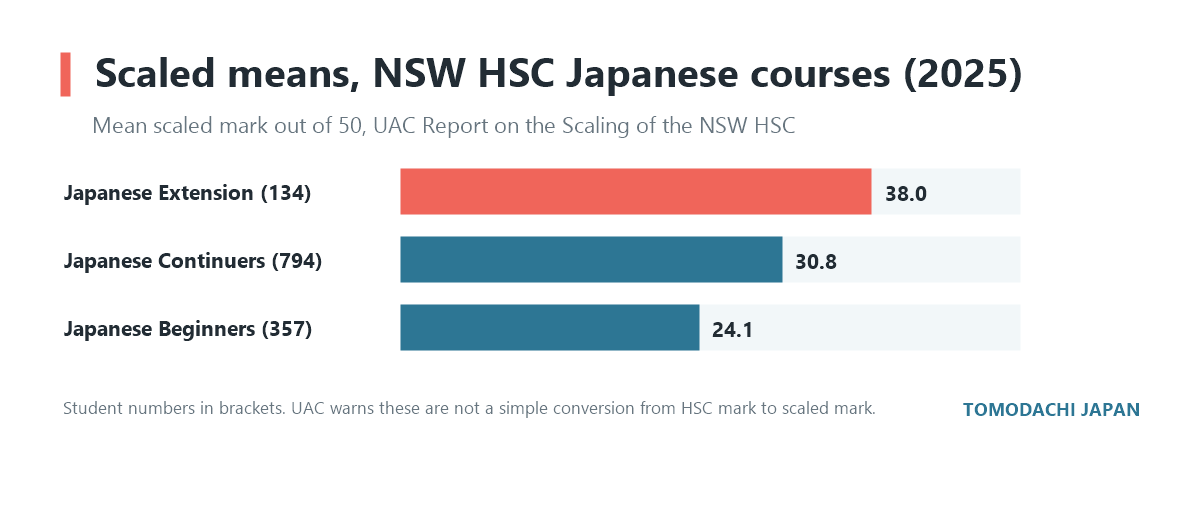
In UAC’s Report on the Scaling of the 2025 NSW HSC, Japanese Extension’s 134 students had a mean HSC mark of 43.6 and a mean scaled mark of 38.0 out of 50. For comparison, Japanese Continuers’ scaled mean was 30.8 and Beginners’ 24.1. In NESA’s 2025 results, 51% of Extension students reached the top band, E4.
Two cautions. First, a strong scaled mean mostly reflects a strong cohort — students who choose Extension are usually the best Continuers students in their schools. It does not mean the course is easy marks. Second, UAC itself warns that these tables should not be used as a simple conversion from an HSC mark to a scaled mark.
A four-week plan to 16 October
| Week | Focus | What you produce |
|---|---|---|
| 1 | Rewatch the whole film with Japanese audio; list scenes under each prescribed issue | A one-page scene map: Connectedness / Journeys / Diversity of values |
| 2 | The ten prescribed extracts in depth | For each: who, what changes, which issue, two quotable lines in Japanese |
| 3 | Section I Part B: two 400-ji responses using rewritten older questions, plus one timed Section II task | Responses marked against the guidelines, and a personal list of connectives you actually use |
| 4 | 2025 paper under exam conditions, then targeted repair | A mark, and a list of the three things to fix before the exam |

A note from a Japanese classroom teacher
In a 400-ji response, the students who do best are rarely the ones with the most advanced vocabulary. They are the ones whose argument is easy to follow. Japanese essay writing leans heavily on clear signposting: まず, 次に, 一方で, つまり, このように. A reader should know within the first two sentences what you think and how you are going to show it. If your opening line is a plot summary, the marker has to work to find your point, and that costs you.
For the film itself, pay attention to how the two fathers speak, not just what they say. Koreeda gives the two families noticeably different speech styles and levels of politeness, and the distance between them is part of the film’s argument about what makes someone a parent. Noticing a shift from polite to plain speech in a scene, and saying what it shows, is exactly the kind of insight a Japanese Extension marker is looking for — and it is something only reading the Japanese, not the English subtitles, will give you.
Frequently asked questions
Is HSC Japanese Extension worth taking?
If you are already strong in Continuers and enjoy discussing ideas, usually yes: it is one unit, it deepens the same skills your Continuers exam rewards, and the cohort scales well. If Continuers is already a struggle, the extra unit may be better spent elsewhere. Talk to your teacher.
Can I use a dictionary?
In the written exam, yes — print dictionaries, monolingual or bilingual. In the oral, the 2025 paper states dictionaries may not be used.
Will the prescribed text change for 2027?
Not under the current prescriptions, which cover 2025 to 2030. Check NESA’s course prescriptions page at the start of Year 12 in case of any change.
Where are the 2015–2019 papers, and are they useful?
They are on NESA’s Japanese Extension archive page. Use them the same way as the 2020–2024 papers: Section II for full practice, and older text questions for question types only.
How do I practice for the oral when it is only three minutes?
Three minutes of opinion with seven minutes to prepare is a skill you can drill: pick a question, set a timer for seven minutes, plan four points, then speak and record. The harder part is sounding like you are thinking rather than reciting, and that comes only from regular unscripted conversation with Japanese speakers.
Related: HSC and VCE Japanese course levels explained, HSC Japanese Continuers past papers: a six-paper plan, the HSC Continuers kanji list, and our Japanese oral exam guide.
The short version
HSC Japanese Extension in 2026 is about one film, Like Father, Like Son, through three issues, and 25 of the 40 written marks depend on it. Use older past papers for question types and Section II, and the 2025 paper for full rehearsal. The written exam is on 16 October. Know the film in Japanese, and make your argument easy to follow.