
Every Japanese learner who likes manga eventually buys a volume in Japanese, opens it with great hope, and closes it on page three. The problem is rarely the learner. It is almost always the choice of book — and the choice is easier than it looks once you know one rule about how Japanese manga are printed.
This guide explains that rule, gives you a ladder of manga for learning Japanese ranked by real difficulty ratings, shows where you can legally buy Japanese-language manga from outside Japan (several popular options quietly do not work abroad), and gives you a page-by-page method that gets you to the end of a volume.
The furigana rule that decides everything
Furigana are the small hiragana printed beside a kanji to show how it is read. For a learner they are the difference between a page you can look up and a page you cannot even type into a dictionary.
Whether a manga has them depends mostly on who it was published for. Manga for boys and girls — shōnen and shōjo magazines such as Weekly Shōnen Jump — generally print furigana on every kanji, because publishers cannot know which kanji a twelve-year-old has learned. Manga for adults, seinen and josei, mostly do not, because adult readers are assumed to read standard kanji. Full furigana has a name: 総ルビ (sō-rubi).
There are exceptions in both directions. Chi’s Sweet Home ran in an adult magazine and Shirokuma Cafe in a josei one, yet both have full furigana. So treat the magazine as a strong hint, and check a sample page before you buy.
Want to talk about manga in Japanese with kids in Japan?
TOMODACHI JAPAN is an online Japanese school for children growing up outside Japan. They talk with peers their own age in Japan every day, taught by teachers working at Japanese schools, in small classes of 8.
🎁 Register and we’ll email you our School Guide (PDF, in English) straight away. You’ll also be first to hear about tuition, scholarships and opening dates.
Free · takes about 30 seconds
Manga for learning Japanese, ranked by difficulty
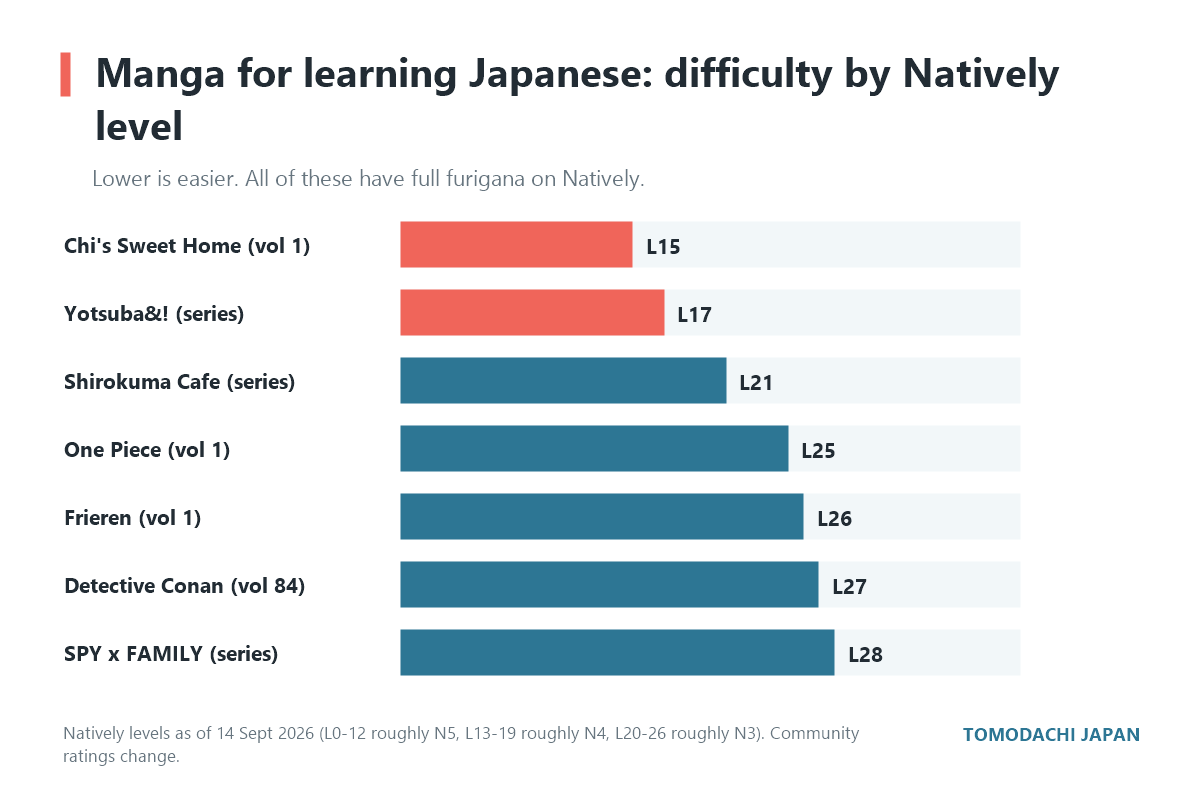
Rather than rank by our opinion, we used Natively, a community site where learners rate Japanese books by comparing them against each other. Its levels roughly map to the JLPT: L0–12 is around N5, L13–19 around N4, L20–26 around N3. Natively itself stresses the mapping is an estimate, and ratings shift as more people vote.
| Manga | Natively level (Sept 2026) | Why it works for learners | Watch out for |
|---|---|---|---|
| Chi’s Sweet Home (チーズスイートホーム) | L15 (vol. 1) | A kitten’s-eye view of family life. Short chapters, full color, everyday vocabulary | Chi talks in baby-talk; don’t copy her pronunciation |
| Yotsuba&! (よつばと!) | L17 (series) | A five-year-old discovering ordinary life. The most recommended first manga for a reason | Casual family speech throughout |
| Shirokuma Cafe (しろくまカフェ) | L21 (series) | Gentle humor built on everyday conversations and wordplay | Puns can be hard to catch |
| One Piece (ワンピース) | L25 (vol. 1) | Motivation: if you love it, you will keep reading | Pirate and villain speech styles |
| Frieren (葬送のフリーレン) | L26 (vol. 1) | Quiet pacing and calm dialogue for its level | Fantasy vocabulary |
| Detective Conan (名探偵コナン) | L27 (vol. 84) | Long-running, huge supply of volumes once you are ready | Explanations of tricks are dense |
| SPY×FAMILY | L28 (series) | Popular with teens; family comedy between the action | Spy jargon and politics |
If you are around N5, start with Chi or Yotsuba. If you are around N4, Shirokuma Cafe. Save the shōnen blockbusters for when you can read a page without stopping every line. A book slightly too easy, finished, teaches far more than a favorite abandoned on page three.

Where to buy Japanese-language manga outside Japan
This is where most guides are out of date. Several services that are brilliant in Japan either do not sell Japanese editions abroad or are officially for Japan only.
| Option | Japanese-language manga from abroad? | What to know |
|---|---|---|
| Kinokuniya (stores and webstore) | Yes, print | About 17 stores in the US, 6 in Singapore and 1 in Sydney, plus online ordering |
| Amazon Japan (print books) | Yes, print | Ships many physical books internationally; postage adds up |
| Amazon Japan Kindle | Generally no | Amazon states digital content on amazon.co.jp is for customers living in Japan |
| BookWalker | Only via its separate Japan store | Japanese ebooks are sold on the Japanese-language Japan Store, with its own account, not the Global store |
| MANGA Plus (Shueisha) | No | Offers several languages, but not Japanese |
| Shōnen Jump+ / honto | No | Both describe their services or ebooks as for use in Japan |
For most learners abroad, print from Kinokuniya is simply the easiest path. Paper has another advantage: you cannot tap your way out of a hard page.
Tools that make reading manga easier
- Yomitan — a free pop-up dictionary for Chrome, Firefox and Edge, the successor to the discontinued Yomichan. Hover over Japanese text on a web page and see the reading and meaning. It can also create Anki cards.
- Mokuro — open-source software that runs text recognition on manga page images so the text becomes selectable in a browser, which lets Yomitan work on it. It needs Python and some setup, and you must supply files you have the rights to.
- Natively — beyond levels, it runs book clubs on its forums, which is the easiest way to get through a first volume with other learners.
- Learn Japanese with Manga, Volume One (Tuttle) — a textbook by Marc Bernabé that teaches kana and 160 kanji through manga art. Note that Tuttle recommends it for ages 16 and up because of mature language.
How to read a page without burning out
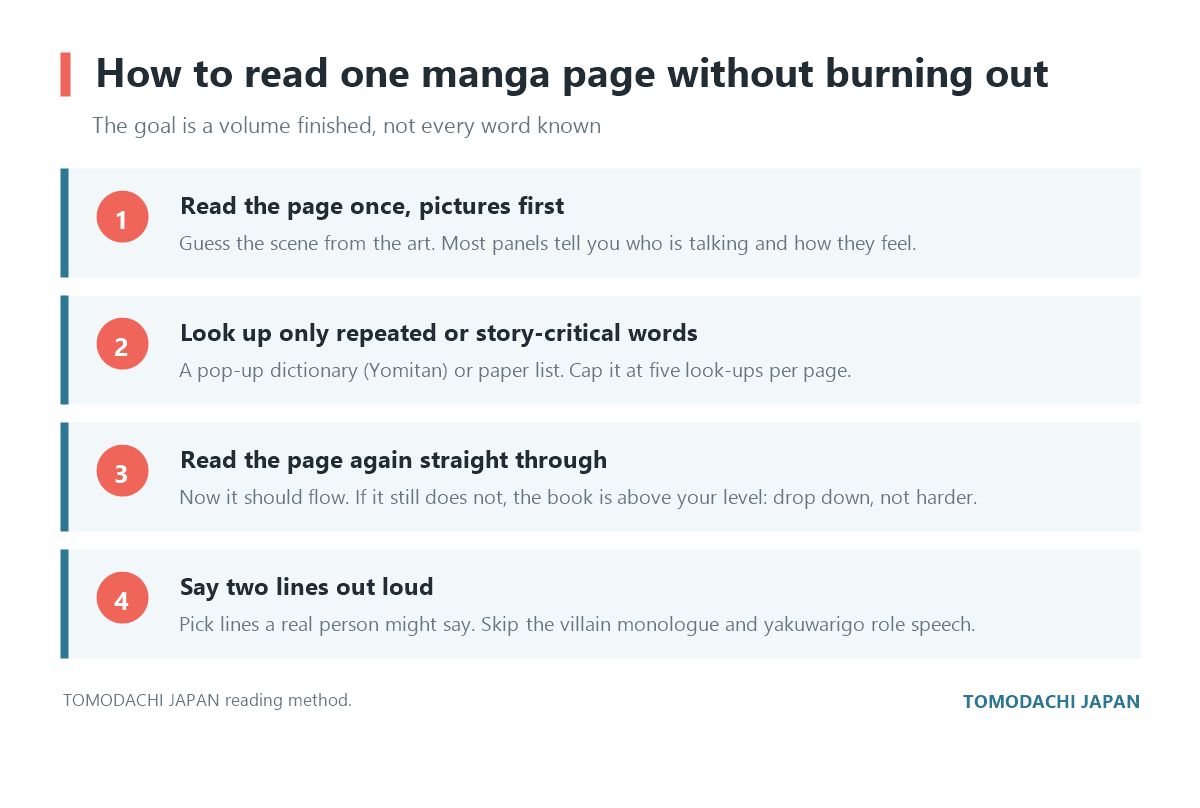
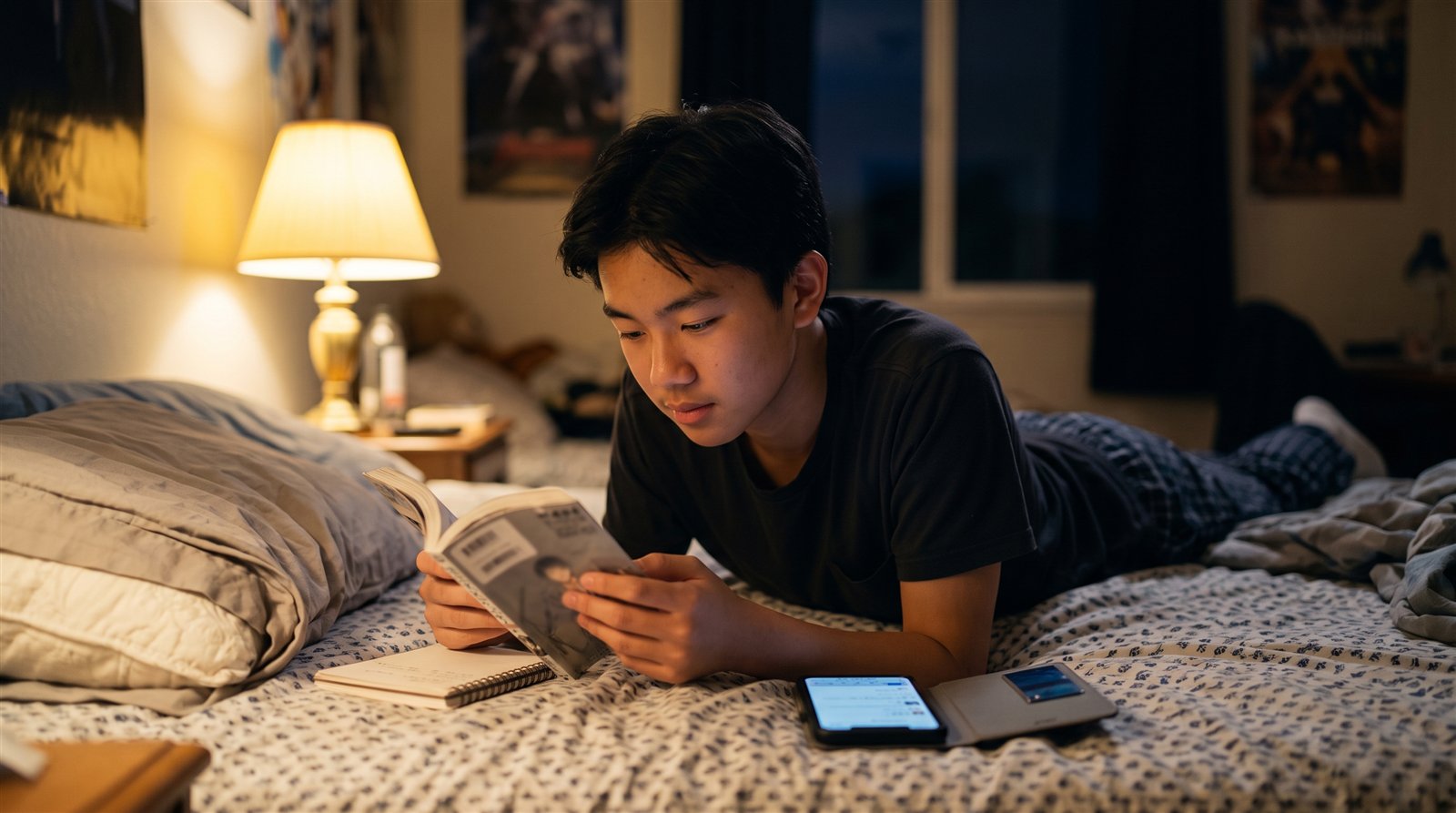
Read the page once using the pictures, and guess. Then look up only the words that repeat or that the story depends on — five at most per page. Read it again straight through. If it still does not flow, the book is above your level, and the fix is an easier book, not more look-ups. Finish by saying two lines out loud.
The five-word cap is the whole trick. Learners who look up every unknown word read one page a night, lose the story, and quit. Learners who accept 80% understanding finish volume one and find volume two noticeably easier, because the same characters say the same kinds of things.
A note from a Japanese classroom teacher
Manga dialogue is written for characters, and Japanese has a whole system for that. Linguist Satoshi Kinsui named it yakuwarigo, role language: an old professor says じゃ and わし, a noble young lady says ですわ, a tough boy says おれ and だぜ. Real people almost never talk like this. Readers recognize the type instantly, which is why manga use it, but a learner who copies it sounds like a costume.
So I tell students to read everything and borrow carefully. The lines worth saying out loud are the ones Yotsuba’s father or a classmate in a school comedy might say: asking what someone is doing, saying you’re hungry, apologizing for being late. If you are unsure whether a line is role language, ask someone who speaks Japanese every day. Our guide to ore, boku and watashi is a good place to start with the most common trap.
Frequently asked questions
What is the best manga for a complete beginner?
Once you can read hiragana and katakana, Chi’s Sweet Home or Yotsuba&!. Both have full furigana and everyday language. Before you can read kana, a manga will be pictures only — learn kana first.
Can I learn Japanese just by reading manga?
You can build a large reading vocabulary and a feel for grammar. You will not learn to speak, and you will pick up role language unless someone points it out. Manga works best alongside conversation.
Is it better to read a manga I already know in English?
For a first volume, yes. Knowing the plot lets you focus on the language. After that, read something new so you are genuinely reading, not remembering.
Are manga good for kids learning Japanese?
Very, if you choose for age. Check content ratings, since some popular shōnen series are violent, and remember that a manga’s reading level and its age suitability are separate questions.
Related: the best anime to learn Japanese, Frieren’s best lines in Japanese, SPY×FAMILY quotes explained, and anime Japanese vs real Japanese.
The short version
Pick manga with full furigana, usually shōnen or shōjo titles. Start lower than your pride wants: Chi or Yotsuba around N5, Shirokuma Cafe around N4. Buy print from Kinokuniya rather than fighting region-locked apps. Cap look-ups at five a page. Read everything, and borrow only the lines real people say.